Report ID: 1451 |
Published Date: 28 Sep 2026 |
Report Format: |
Delivery Timeline: 48-72 Business Hours
Zero Trust Network Access Market Outlook:
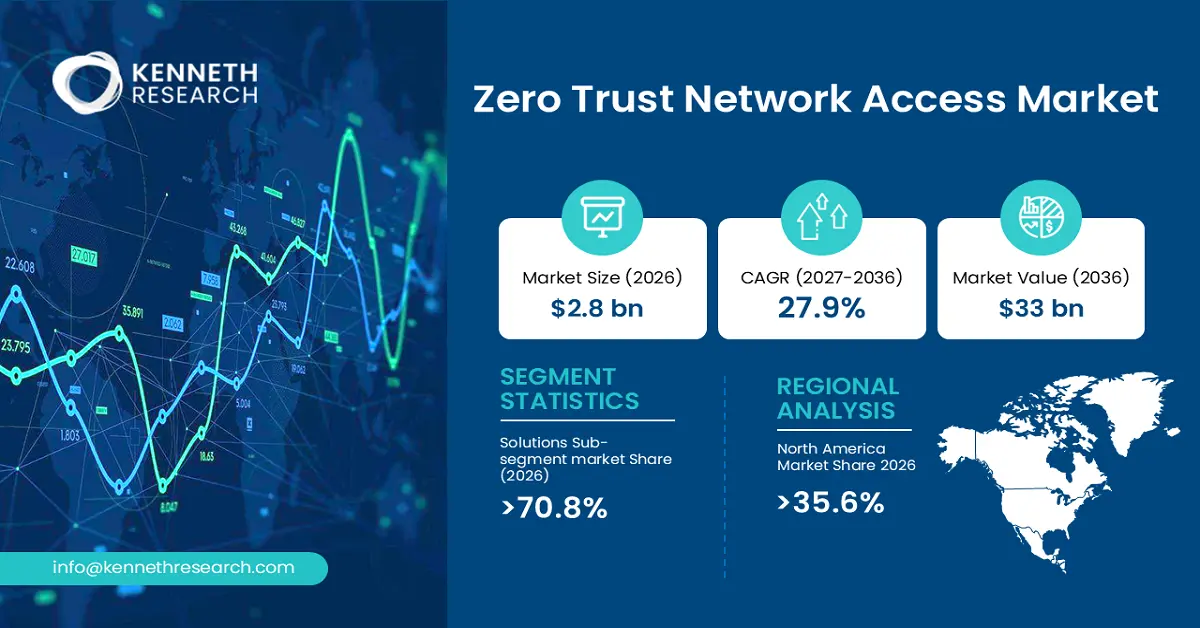
Zero Trust Network Access Market size was valued at USD 2.8 billion in 2026 and is projected to reach USD 33.0 billion by the end of 2036, rising at a CAGR of 27.9% during the forecast period, i.e., 2027–2036. In 2027, the industry size of the zero trust network access market is estimated at USD 3.6 billion.
The primary growth driver for the zero trust network access market is the rapid expansion of hybrid work, cloud computing, and distributed enterprise infrastructure.
The zero trust network access market encompasses technologies, software, platforms, and services that provide secure, identity-centric access to private applications and enterprise resources without implicitly trusting users or devices based solely on their network location. Unlike conventional perimeter-based security models, zero trust network access continuously evaluates access requests using contextual factors such as user identity, device posture, authentication status, application requirements, and security policies.
Key characteristics include least-privilege access, continuous verification, granular application-level connectivity, identity-based policy enforcement, and reduced exposure of internal resources. These capabilities enable organizations to replace broad network access with controlled access to specifically authorized applications and services.
Key Zero Trust Network Access Market Insights Summary:
Key Takeaways: Market Trends & Insights
- Zero Trust Network Access Market is projected to grow from USD 2.8 billion in 2026 to USD 33.0 billion by 2036 at a 27.9% CAGR.
- North America accounted for the largest regional share at 35.6% in 2026, supported by advanced cybersecurity infrastructure, cloud adoption, and strong government-led zero trust initiatives.
- Large Enterprises will remain the leading By enterprise segment, accounting for 70.8% in 2026, driven by extensive distributed IT environments and increasing requirements for granular application access controls.
- Solutions will continue to witness strong demand as enterprises seek integrated zero trust capabilities covering identity verification, application access, endpoint assessment, and policy enforcement across hybrid and cloud environments.
Market Drivers
- Government-led cybersecurity modernization and zero trust implementation.
- Increasing adoption of cloud, hybrid, and distributed IT environments.
- Rising requirements for identity-based and least-privilege application access.
- Growing integration of zero trust capabilities with endpoint, identity, and security-management platforms.
Challenges
- Legacy Infrastructure and Integration Complexity
- Policy Management and Operational Complexity
Zero Trust Network Access Market: Market Overview & Supply Chain
Adoption of zero trust network access is increasing globally as organizations migrate workloads to cloud environments, support distributed workforces, and manage increasingly complex digital infrastructures. The technology is particularly relevant to cybersecurity modernization because it replaces implicit network trust with continuous authentication, authorization, and contextual access controls. Government modernization programs are also reinforcing demand.
The industry value chain begins with technology inputs, including identity-management frameworks, authentication technologies, endpoint-security capabilities, cloud infrastructure, networking protocols, policy engines, and security analytics. Software developers and cybersecurity vendors integrate these technologies into zero trust network access platforms that enforce identity- and policy-based application access. Specialized security providers may add implementation, integration, monitoring, and managed-security services.
Zero Trust Network Access Market: Growth Drivers & Challenges
Growth Drivers
- Expansion of Government-Led Zero Trust Modernization: Government cybersecurity modernization is accelerating demand for zero trust network access as public-sector organizations transition from perimeter-based security toward identity-, device-, and application-centric controls. Zero trust frameworks require access requests to be continuously evaluated rather than automatically trusted because a user or device is operating within an organizational network. This approach creates demand for solutions that integrate authentication, policy enforcement, endpoint assessment, network segmentation, and application-level access. Government implementation is also creating practical reference points for commercial organizations evaluating similar architectures.
- Increasing Adoption of Cloud and Distributed IT Environments: The migration of enterprise applications and workloads across public clouds, private clouds, data centers, branch locations, and remote endpoints is increasing the limitations of traditional network-perimeter security. Zero trust network access addresses this shift by establishing application-specific connections based on verified identities and security policies rather than granting broad access to an internal network. This enables enterprises to support hybrid workforces while reducing unnecessary exposure of applications and infrastructure.
Challenges
- Legacy Infrastructure and Integration Complexity: A major restraint is the complexity of integrating zero trust network access with legacy infrastructure, applications, identity systems, and existing security controls. Enterprises frequently operate heterogeneous technology environments in which older applications were designed around network-based trust rather than granular identity and application-level authorization. Implementing zero trust principles can therefore require extensive policy redesign, application modernization, identity integration, endpoint visibility, and network reconfiguration.
- Policy Management and Operational Complexity: Zero trust network access requires organizations to maintain detailed access policies covering users, devices, applications, services, and contextual security conditions. As enterprise environments expand, managing these policies can become operationally demanding, particularly when organizations have numerous applications, third-party users, distributed endpoints, and changing business requirements. Incorrectly configured policies can create either excessive access or unnecessary restrictions that disrupt legitimate workflows.
Zero Trust Network Access Market Size and Forecast:
| Report Attribute | Details |
|---|---|
| Base Year |
2026 |
| Forecast Year |
2027-2036 |
| CAGR |
27.9% |
| Base Year Market Size (2026) |
USD 2.8 billion |
| Forecast Year Market Size (2036) |
USD 33.0 billion |
| Regional Scope |
|
Zero Trust Network Access Market: Segmentation Analysis
Enterprise Type Segment Analysis
In the enterprise size segment, the large enterprises sub-segment is anticipated to capture the largest market share of 70.8% in 2026.
Large enterprises represent the leading segment of the zero trust network access market by enterprise, supported by their extensive digital infrastructure, geographically distributed operations, large user populations, and higher requirements for granular access control. These organizations commonly operate combinations of cloud platforms, data centers, branch networks, remote endpoints, and business-critical applications, increasing the need to authenticate and authorize access at the individual resource level.
On the supply side, vendors are expanding platforms that integrate identity and access management, endpoint assessment, policy enforcement, secure application connectivity, and security analytics, allowing large organizations to consolidate access controls across heterogeneous environments.
Component Type Segment Analysis
as enterprises seek integrated technologies that can enforce identity-aware access policies across applications, users, devices, and distributed infrastructure. Demand is being supported by increasing cloud adoption, application modernization, and the need to replace broad network-level permissions with more granular controls.
From the supply side, solution providers are increasingly integrating identity verification, policy engines, endpoint assessment, application discovery, secure connectivity, and centralized administration into unified platforms. This integration can simplify deployment and improve visibility across hybrid environments, making solutions attractive to enterprises seeking to consolidate security controls.
Our in-depth analysis of the global zero trust network access market includes the following segments:
|
Segment |
Sub-segment |
|
By Component |
|
|
By Deployment |
|
|
Enterprise Size |
|
|
Application |
|
|
End Use |
|
Zero Trust Network Access Market Regional Insights:
North America Market Trends & Insights:
North America is the dominant region in the zero trust network access market, accounting for 35.6% in 2026. Regional leadership is supported by mature enterprise cybersecurity infrastructure, substantial cloud adoption, extensive digital transformation, and strong government emphasis on zero trust architectures. The U.S. has established federal requirements encouraging agencies to transition toward zero trust, creating a structured policy environment that also influences commercial cybersecurity practices.
In the U.S., demand is supported by federal cybersecurity modernization, large-scale enterprise IT infrastructure, cloud migration, and the presence of major cybersecurity technology providers.
Canada is also strengthening its zero trust environment as government organizations modernize cybersecurity architectures around continuous verification and secure digital identities.
Asia-Pacific Market Trends & Insights:
Asia-Pacific is emerging as an important demand center for zero trust network access as organizations accelerate cloud adoption, digital transformation, data-intensive services, and cybersecurity modernization. Government initiatives across the region are increasingly emphasizing identity controls, secure data exchange, application security, and continuous risk management. This policy direction supports the development of security architectures aligned with zero trust principles, particularly as enterprises expand distributed digital infrastructure.
In Japan, government agencies are advancing zero trust adoption alongside broader cybersecurity modernization. The Digital Agency has issued specific zero trust architecture application policies for government information systems, addressing the security implications of cloud services and remote working.
China is strengthening the supporting ecosystem through national cybersecurity standards, data-security policies, and initiatives promoting secure digital infrastructure.
Leading Companies Operating in the Zero Trust Network Access Market:
Here is a list of upstream, downstream, and key players operating in the global zero trust network access market competitive ecosystem:
- Zscaler (U.S.)
- Company Overview
- Business Strategy
- Key Product Offerings
- Financial Performance
- Key Performance Indicators
- Risk Analysis
- Recent Development
- Regional Presence
- SWOT Analysis
- Palo Alto Networks (U.S.)
- Netskope (U.S.)
- Cloudflare (U.S.)
- Fortinet (U.S.)
- Check Point Software Technologies (Israel)
Recent Developments
- June 2025 — Zscaler announced a new suite of Zero Trust Everywhere solutions on June 3, 2025, extending its Zero Trust Exchange across branches, multi-cloud environments, users, applications, and devices. The announcement included Zero Trust Branch, microsegmentation, workload protection, and Zero Trust Exchange for B2B use cases.
- August 2025 — Cloudflare announced new Zero Trust capabilities within Cloudflare One designed to help organizations monitor and control generative AI usage, protect against Shadow AI, and safeguard sensitive information.
Frequently Asked Question
In 2026, the zero trust network access market exceeded USD 2.8 billion.
The zero trust network access market is projected to reach USD 33.0 billion by the end of 2036, expanding at a CAGR of 27.9% over the forecast period (2027-2036).
The major players in the market are Zscaler, Palo Alto Networks, Netskope, Cloudflare, Fortinet, and Check Point Software Technologies.
In the by enterprise segment, the large enterprises sub-segment is anticipated to capture the largest market share of 70.8% in the future and exhibit lucrative growth opportunities during 2027-2036.
North America is projected to hold the largest market share of 35.6% by the end of 2026 and provide more business opportunities in the future.
Why Choose Kenneth Research ?
-
Insight with Impact : We don’t just gather data — we uncover stories, trends, and opportunities that fuel business growth.
-
Experts Who Get It : Our team speaks your industry’s language and knows what really matters to your customers and market.
-
Custom-Built for You : Forget one-size-fits-all. We craft research and consulting solutions as unique as your business vision.
-
Partners, Not Just Providers : We work with you, not for you — collaborating closely to turn insights into smart, strategic moves.
-
Results That Speak : Our work powers brands, startups, and industry leaders alike — with a track record of ideas that work in the real world.
Report ID: 1451 |
Published Date: 28 Sep 2026 |
Report Format: |
Delivery Timeline: 48-72 Business Hours

Copyright © 2025 Kenneth Research. All rights reserved. Terms of Use | Privacy Policy
