Report ID: 1298 |
Published Date: 14 Sep 2026 |
Report Format: |
Delivery Timeline: 48-72 Business Hours
Wood Foam Market Outlook:
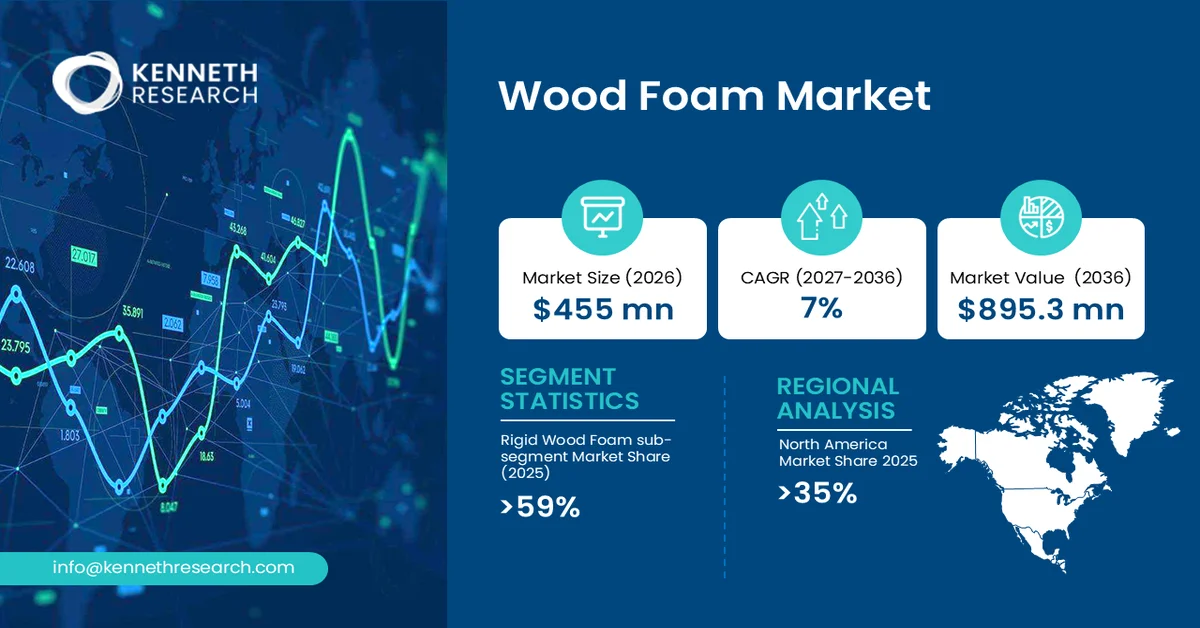
Wood Foam Market size was valued at USD 455 million in 2025 and is projected to reach USD 895.3 million by the end of 2035, rising at a CAGR of 7% during the forecast period, i.e., 2026–2035. In 2026, the industry size of the wood foam is estimated at USD 487 million.
The primary growth driver for the wood foam market is rising demand for lightweight, renewable, and sustainable insulation materials. Increasing emphasis on energy-efficient buildings and reduced reliance on fossil-based materials is encouraging construction companies and manufacturers to adopt wood-based foam solutions offering thermal
The wood foam market comprises lightweight foam materials manufactured from wood-derived cellulose and other lignocellulosic resources. These materials are engineered into porous structures that provide insulation, cushioning, lightweight structural performance, and material efficiency. Wood foam is gaining attention as a bio-based alternative to conventional petroleum-derived foam products because it can utilize renewable feedstocks and potentially reduce dependence on fossil-based raw materials.
Key characteristics include low density, thermal insulation capability, lightweight construction, and compatibility with sustainable material systems. Depending on formulation and processing technology, wood foams can be produced in rigid or flexible forms for applications requiring insulation, packaging, acoustic management, and lightweight components.
Key Wood Foam Market Insights Summary:
Key Takeaways: Market Trends & Insights
- Wood foam market projected to grow from USD 455 million in 2025 to USD 895.3 million by 2035 at a 7% CAGR.
- North America accounted for the largest regional share at 35% in 2025, supported by energy-efficient construction, insulation demand, and growing adoption of renewable building materials across the U.S. and Canada.
- Rigid Wood Foam represented the leading Product segment with a 59% market share in 2025, driven by its lightweight structure, thermal insulation capabilities, and suitability for sustainable building applications.
- Thermal Insulation is expected to remain a key application area as builders increasingly seek renewable materials that improve building-envelope energy performance while reducing dependence on fossil-based insulation products.
- The market is benefiting from growing demand for bio-based materials, sustainable construction practices, lightweight insulation solutions, and continued development of wood-derived foam technologies for building and industrial applications.
Market Drivers
- Rising demand for energy-efficient buildings.
- Growing preference for renewable bio-based materials.
- Increasing adoption of sustainable insulation solutions.
- Development of lightweight, high-performance wood-based materials.
Challenges
- Manufacturing scale-up and cost competitiveness.
- Performance and building-code requirements.
Wood Foam Market: Market Overview & Supply Chain
Global adoption of wood foam is increasing as construction and manufacturing industries seek renewable, lightweight, and energy-efficient material solutions. Its thermal insulation capability and bio-based feedstock make it relevant to sustainable building envelopes and low-impact material development. The U.S. Department of Energy states that residential and commercial buildings accounted for 38% of total U.S. energy consumption in 2022, reinforcing the importance of efficient building materials and insulation technologies.
The wood foam market value chain begins with sustainably sourced wood, cellulose, lignocellulosic residues, and other bio-based feedstocks. These inputs undergo fiber preparation, chemical or mechanical treatment, foaming, molding, drying, and finishing to produce rigid or flexible wood foam products. Manufacturers then supply finished materials through direct industrial sales, building-material distributors, specialty suppliers, and project-based procurement channels. Key end users include construction companies, insulation manufacturers, packaging producers, furniture manufacturers, and industrial fabricators. Major stakeholders include forestry and biomass suppliers, wood-processing companies, foam manufacturers, chemical and equipment providers, building-material producers, architects, contractors, and sustainability-focused developers.
Wood Foam Market: Growth Drivers & Challenges
Growth Drivers
- Rising Demand for Energy-Efficient Buildings: Increasing emphasis on building energy efficiency is creating opportunities for wood foam as a renewable insulation material. Its low density and thermal insulation properties make it suitable for walls, roofs, floors, and other building-envelope applications where reducing heat transfer is important. Governments are strengthening building-efficiency policies, while developers increasingly prioritize materials that support lower operational energy consumption and sustainability objectives. The U.S. Department of Energy's Building Technologies Office continues to support research and deployment of advanced building materials and technologies aimed at improving building energy performance. This policy and technology environment encourages manufacturers to develop bio-based insulation solutions with improved thermal performance, moisture resistance, durability, and manufacturability. As construction increasingly incorporates low-carbon materials, wood foam can gain opportunities in both new buildings and renovation projects, particularly where renewable feedstocks and insulation performance are important procurement criteria.
- Growing Preference for Renewable Bio-Based Materials: The shift toward renewable and bio-based materials is supporting interest in wood foam across construction and industrial applications. Wood-derived cellulose provides a renewable feedstock that can reduce reliance on petroleum-based foam materials while supporting greater use of forestry residues and other biomass resources. Manufacturers and material developers are therefore focusing on improving foam strength, moisture resistance, fire performance, processing efficiency, and product consistency. Increasing corporate sustainability commitments and circular-economy strategies are also encouraging material substitution where technically feasible. This trend can broaden wood foam adoption beyond insulation into packaging, furniture, acoustic products, and lightweight components. Future growth will depend on successful scale-up, competitive production economics, reliable feedstock sourcing, and continued development of formulations capable of meeting demanding commercial and building-performance requirements.
Challenges
- Manufacturing Scale-Up and Cost Competitiveness: Wood foam production can involve specialized processing, drying, foaming, and structural-control steps that are more complex than established conventional foam manufacturing. Achieving consistent density, pore structure, moisture resistance, and mechanical performance at commercial scale can increase production complexity and capital requirements. These factors can make wood foam less competitive where buyers prioritize established materials with mature manufacturing networks and predictable costs. Manufacturers must therefore improve process efficiency, equipment utilization, feedstock preparation, and product standardization. Future competitiveness will depend on scaling production while maintaining the sustainability and performance advantages that differentiate wood foam from conventional insulation and foam materials.
- Performance and Building-Code Requirements: Wood foam must satisfy demanding requirements for thermal performance, moisture management, fire resistance, durability, and structural stability before gaining broad adoption in building applications. Variations in wood feedstock and processing conditions can affect final product properties, creating additional testing and certification requirements. Construction companies and architects may also hesitate to specify emerging bio-based materials without extensive performance records and established building-code recognition. These factors can lengthen qualification cycles and increase commercialization costs. Manufacturers are consequently focusing on formulation improvements, protective treatments, standardized production, and testing programs. Wider regulatory acceptance and demonstrated long-term performance will be important for expanding wood foam adoption across mainstream construction projects.
Wood Foam Market Size and Forecast:
| Report Attribute | Details |
|---|---|
| Base Year |
2025 |
| Forecast Year |
2026-2035 |
| CAGR |
7% |
| Base Year Market Size (2025) |
USD 455 million |
| Forecast Year Market Size (2035) |
USD 895.3 million |
| Regional Scope |
|
Wood Foam Market: Segment Analysis
Product Segment Analysis
In the Product segment, the Rigid Wood Foam sub-segment is anticipated to capture the largest market share of 59% by the end of 2025.
Rigid wood foam benefits from its structural stability, low weight, and thermal insulation properties, making it particularly relevant to building-envelope applications. Demand is supported by increasing interest in renewable insulation materials for walls, roofs, floors, and prefabricated construction systems. Manufacturers are focusing on improving moisture resistance, fire performance, dimensional stability, and manufacturing consistency to meet construction requirements. The U.S. Department of Energy reported that buildings accounted for 76% of U.S. electricity consumption in 2022, highlighting the importance of energy-efficient building materials and insulation solutions. As sustainable construction practices expand, rigid wood foam is positioned to benefit from greater demand for bio-based insulation products. Future development will focus on commercial-scale production, improved performance, and broader integration into energy-efficient building systems.
Application Type Segment Analysis
The Thermal Insulation segment is projected to grow as builders increasingly prioritize energy-efficient envelopes and renewable insulation materials. Wood foam offers low weight, renewable feedstock, and thermal resistance, making it suitable for walls, roofs, floors, and prefabricated building systems. Adoption is supported by tighter energy-efficiency requirements and renovation activity, while manufacturers are improving moisture resistance, fire performance, dimensional stability, and scalable processing. The U.S. Department of Energy identifies building-envelope technologies, including advanced insulation materials, as an important pathway for reducing building energy consumption and improving efficiency. As demand for lower-impact building materials expands, wood foam can gain opportunities in new construction and retrofit applications. Future growth will depend on achieving competitive production costs, consistent performance, and wider acceptance within building codes and construction specifications.
Our in-depth analysis of the global wood foam market includes the following segments:
|
Segment |
Sub-segment |
|
Product |
|
|
Application |
|
|
End User |
|
Wood Foam Market – Regional Analysis
North America Market Trends & Insights:
North America accounted for 35% of the wood foam market in 2025, maintaining regional leadership due to strong construction activity, established insulation industries, energy-efficiency initiatives, and growing interest in renewable building materials.
The U.S. and Canada benefit from mature building-material supply chains and increasing demand for insulation solutions that improve building performance while supporting sustainability objectives. Government programs promoting energy-efficient buildings and building-envelope improvements are also creating opportunities for bio-based insulation technologies. Continued renovation activity, green construction, and adoption of low-impact materials are expected to support regional demand for wood foam.
In the U.S., demand is supported by extensive residential and commercial construction, building-efficiency programs, and ongoing modernization of existing structures. The country's established insulation manufacturing ecosystem also provides channels for introducing innovative bio-based materials.
Canada offers additional opportunities through residential construction, commercial development, and increasing emphasis on energy-efficient buildings. Statistics Canada reported that investment in Canadian building construction increased 12.2% year over year in December 2025, indicating continued construction activity across the country.
Europe Market Trends & Insights:
Asia Pacific represents a significant growth opportunity for wood foam, supported by expanding construction activity, urban development, manufacturing growth, and increasing interest in energy-efficient and sustainable building materials. Governments and developers across the region are placing greater emphasis on building efficiency, resource conservation, and lower-impact construction practices. Japan's mature construction sector and focus on advanced building technologies create opportunities for bio-based insulation solutions, while China's extensive construction industry provides a broader demand base for lightweight and energy-efficient materials. Future opportunities are expected to arise from green buildings, building renovation, prefabricated construction, and development of renewable material supply chains.
Japan is positioned for adoption through its advanced building-material industry, sophisticated manufacturing capabilities, and emphasis on energy-efficient construction. Demand can expand through renovation projects and high-performance building envelopes.
China offers substantial long-term potential because of its large construction sector, expanding urban infrastructure, and growing focus on energy-efficient buildings. Manufacturers in both countries can benefit from developing locally sourced wood-based feedstocks and scalable processing technologies. Greater standardization, improved fire and moisture performance, and stronger integration with established insulation distribution channels will be important for accelerating commercial adoption across the region.
Wood Foam Market – Competitive Landscape
Here is a list of upstream, downstream, and key players operating in the global wood foam competitive ecosystem:
- Stora Enso(Finland)
- Company Overview
- Business Strategy
- Key Product Offerings
- Financial Performance
- Key Performance Indicators
- Risk Analysis
- Recent Development
- Regional Presence
- SWOT Analysis
- Fibu AB(Sweden)
- Woamy(Finland)
- Nature-Pack(United States)
Recent Developments
- December 2025: Stora Enso Collaborated with Krekelberg Flock Products and Flocktechniek–C&B Innovations to develop a flocked version of Papira® wood foam, adding a customizable soft surface to the material.
- May 2025: Stora Enso Promoted Fibrease® and Papira® as wood-foam alternatives to fossil-based polymer foams, highlighting applications in protective and thermal packaging.
Frequently Asked Question
In 2025, the wood foam market exceeded USD 455 million.
The wood foam market is projected to reach USD 895.3 million by the end of 2035, expanding at a CAGR of 7% over the forecast period (2026–2035).
The major players in the market are Stora Enso, Fibu AB, Woamy, Nature-Pack, and others.
In the Product segment, the Rigid Wood Foam sub-segment is anticipated to capture the largest market share of 59% in the future and exhibit lucrative growth opportunities during 2026–2035. This growth trajectory is largely attributed to increasing demand for lightweight, renewable, and energy-efficient insulation materials.
North America is projected to hold the largest market share of 35% by the end of 2025 and provide more business opportunities in the future. Growing adoption of energy-efficient construction, sustainable building materials, and advanced insulation solutions across the U.S. and Canada is fostering the region's dominance.
Why Choose Kenneth Research ?
-
Insight with Impact : We don’t just gather data — we uncover stories, trends, and opportunities that fuel business growth.
-
Experts Who Get It : Our team speaks your industry’s language and knows what really matters to your customers and market.
-
Custom-Built for You : Forget one-size-fits-all. We craft research and consulting solutions as unique as your business vision.
-
Partners, Not Just Providers : We work with you, not for you — collaborating closely to turn insights into smart, strategic moves.
-
Results That Speak : Our work powers brands, startups, and industry leaders alike — with a track record of ideas that work in the real world.
Report ID: 1298 |
Published Date: 14 Sep 2026 |
Report Format: |
Delivery Timeline: 48-72 Business Hours

Copyright © 2025 Kenneth Research. All rights reserved. Terms of Use | Privacy Policy
