Report ID: 1159 |
Published Date: 25 Aug 2026 |
Report Format: |
Delivery Timeline: 48-72 Business Hours
Wood Coating Resin Market Outlook:
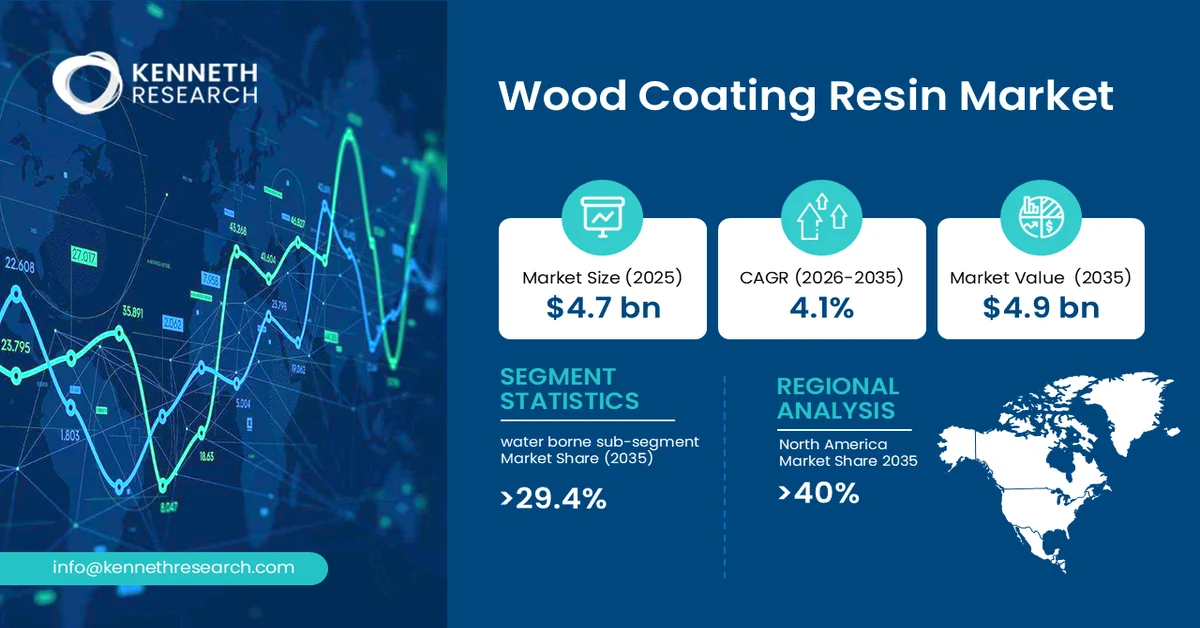
Wood Coating Resin Market size was valued at USD 4.7 billion in 2025 and is projected to reach USD 7.3 billion by the end of 2035, rising at a CAGR of 4.1% during the forecast period, i.e., 2026-2035. In 2026, the industry size of the wood coating resin is estimated at USD 4.9 billion.
The primary growth driver for the wood coating resin market is the rising demand for durable, low-emission, and high-performance wood finishes across residential, commercial, and industrial applications. Increasing adoption of environmentally compliant coating technologies, expanding furniture manufacturing, and continuous investments in sustainable construction are accelerating the use of advanced wood coating resins worldwide.
The wood coating resin market comprises polymer-based binding materials used in coatings formulated to protect, preserve, and enhance the appearance of wooden substrates. These resins serve as the primary film-forming component in wood coatings, providing essential properties such as adhesion, hardness, flexibility, chemical resistance, abrasion resistance, moisture protection, and long-term durability. Depending on application requirements, manufacturers utilize different resin chemistries to achieve desired performance characteristics for furniture, flooring, cabinetry, doors, windows, decorative panels, and engineered wood products.
Wood coating resins play a critical role across the value chain by enabling coatings to withstand mechanical wear, environmental exposure, ultraviolet radiation, and household chemicals while maintaining aesthetic appeal. The market supports multiple end-use industries, including furniture manufacturing, building and construction, interior finishing, and industrial wood processing, where protective coatings contribute to product longevity and compliance with evolving environmental standards. Growing emphasis on sustainable coating technologies, reduced volatile organic compound (VOC) emissions, and improved processing efficiency continues to encourage innovation in resin formulations, making wood coating resins an essential material within the global coatings and advanced materials industry.
Key Wood Coating Resin Market Insights Summary:
Key Takeaways: Market Trends & Insights
- Wood Coating Resin Market projected to grow from USD 4.7 billion in 2025 to USD 7.3 billion by 2035 at a 4.1% CAGR
- North America is projected to hold the largest regional share at 40% by 2035, supported by its mature wood products manufacturing industry, advanced coatings technologies, and stringent environmental regulations
- Water Borne is expected to remain the leading Product Type segment with a 29.4% market share, driven by increasing adoption of low-VOC and environmentally compliant coating technologies
- Polyurethane is projected to witness significant growth in the Resin Type segment due to its superior durability, abrasion resistance, chemical resistance, and growing use in premium furniture and flooring applications
- The market is benefiting from rising demand for sustainable wood finishing solutions, increasing automation in industrial wood coating processes, and continuous innovation in high-performance resin technologies
Market Drivers
- Increasing investments in green building materials and sustainable construction practices.
- Technological advancements in UV-curable and radiation-cured wood coating resin systems.
- Rising demand for premium interior furniture and decorative wood products.
- Expansion of automated industrial wood finishing and high-efficiency coating processes.
Challenges
- Volatility in petrochemical feedstock availability and raw material costs
- Increasing complexity of regulatory compliance across global markets
Wood Coating Resin Market Overview & Supply Chain
The adoption of wood coating resins is increasing globally as manufacturers prioritize durable surface protection, enhanced aesthetics, and compliance with increasingly stringent environmental regulations governing coating formulations. Demand from furniture production, interior construction, engineered wood products, and renovation activities is encouraging the transition toward advanced resin technologies that deliver improved scratch resistance, weatherability, and lower emissions. Regulatory frameworks are also accelerating innovation in water-based and low-emission coating systems. The U.S. Environmental Protection Agency (EPA) notes that its national architectural coatings standards are estimated to reduce volatile organic compound (VOC) emissions by 103,000 megagrams per year through VOC-content limitations for coating products. This regulatory emphasis has encouraged coating and resin producers to develop environmentally compliant formulations, strengthening the industrial relevance of wood coating resins across global manufacturing and construction value chains.
The wood coating resin industry operates through a multi-stage value chain involving chemical feedstock suppliers, resin manufacturers, coating formulators, distributors, applicators, and end-use industries. Upstream activities begin with the procurement of petrochemical and specialty chemical inputs, including polyols, isocyanates, acrylic intermediates, alkyd components, additives, pigments, and performance modifiers. Resin producers convert these raw materials into specialized coating resins designed to meet performance and regulatory requirements.
Midstream participants include coating manufacturers that formulate finished wood coatings by combining resins with solvents, water systems, curing agents, and functional additives. These products are distributed through industrial suppliers, coatings distributors, direct sales networks, and specialized channels serving furniture and construction industries. Downstream demand originates from furniture manufacturers, flooring producers, cabinetry manufacturers, architectural wood product companies, and woodworking contractors. Key stakeholders include chemical companies, resin producers, coating formulators, regulatory agencies, certification bodies, distributors, industrial applicators, and end-use manufacturers that collectively influence product development, compliance standards, and commercial adoption across the wood finishing ecosystem.
Wood Coating Resin Market: Growth Drivers & Challenges
Growth Drivers:
- Rising demand for low-VOC and sustainable coating technologies: Environmental regulations and corporate sustainability initiatives are accelerating the adoption of advanced wood coating resins with lower volatile organic compound (VOC) emissions and improved environmental performance. Manufacturers are increasingly investing in water-borne, bio-based, and high-solids resin technologies that enable compliance with evolving environmental standards without compromising coating durability, appearance, or processing efficiency. This transition is encouraging resin producers to develop innovative formulations that meet the performance expectations of furniture, cabinetry, flooring, and architectural wood manufacturers while reducing environmental impact. The industry is also benefiting from continuous product innovation. In October 2023, BASF introduced Joncryl® 953X portfolio water-based acrylic dispersions designed for industrial wood coatings, expanding sustainable coating solutions for wood applications. The launch reflects the industry's shift toward environmentally responsible resin technologies that are expected to support long-term product innovation and wider commercial adoption.
- Expansion of furniture manufacturing and engineered wood applications: The continued growth of furniture manufacturing, modular interiors, engineered wood products, and residential renovation activities is creating sustained demand for high-performance wood coating resins. Modern furniture producers increasingly require coatings capable of delivering superior scratch resistance, stain protection, chemical resistance, rapid curing, and consistent aesthetic finishes while supporting automated production lines. At the same time, engineered wood materials such as MDF, particleboard, plywood, and laminated products require specialized resin systems that provide reliable adhesion and long-term durability across varying environmental conditions. These evolving performance requirements are encouraging coating manufacturers to invest in advanced resin chemistries tailored for industrial-scale production. Looking ahead, increasing automation in woodworking facilities, greater emphasis on premium interior finishes, and the adoption of environmentally compliant coating systems are expected to strengthen demand for technologically advanced wood coating resins across both mature and emerging manufacturing markets.
Challenges
- Volatility in petrochemical feedstock availability and raw material costs: Wood coating resin manufacturers remain highly dependent on petrochemical-derived intermediates used in the production of acrylic, alkyd, epoxy, polyester, and polyurethane resin systems. Fluctuations in feedstock availability caused by refinery maintenance, geopolitical disruptions, transportation bottlenecks, and energy price instability create uncertainty across procurement and production planning. As raw material costs become more unpredictable, resin manufacturers face increasing pressure to balance profitability with long-term supply commitments to coating formulators. Commercially, frequent input cost fluctuations complicate pricing strategies, reduce contract stability, and may delay product development initiatives. Smaller manufacturers are particularly vulnerable because they often possess limited purchasing leverage and lower inventory flexibility. Looking ahead, companies are expected to strengthen supplier diversification, regional sourcing strategies, and alternative raw material development to improve supply chain resilience while maintaining product consistency and regulatory compliance.
- Increasing complexity of regulatory compliance across global markets: The regulatory landscape governing coating materials continues to become more complex as countries adopt stricter environmental, chemical safety, labeling, and product stewardship requirements. Wood coating resin manufacturers serving multiple geographic markets must often reformulate products to satisfy differing regional regulations related to chemical composition, emissions, hazardous substances, and sustainability reporting. This increases research and development workloads, extends product qualification timelines, and raises compliance costs throughout the value chain. Commercially, frequent regulatory changes can slow market entry for new formulations, increase certification expenses, and require continuous investment in testing and documentation. Companies with broad international operations must also manage multiple product portfolios tailored to regional requirements. In the coming years, regulatory harmonization efforts may reduce some complexity, but manufacturers will continue investing in compliant, sustainable resin technologies to remain competitive in global markets.
Wood Coating resin Market Size and Forecast:
| Report Attribute | Details |
|---|---|
| Base Year |
2025 |
| Forecast Year |
2026-2035 |
| CAGR |
4.1% |
| Base Year Market Size (2025) |
USD 4.7 billion |
| Forecast Year Market Size (2035) |
USD 4.9 billion |
| Regional Scope |
|
Wood Coating Resin Market: Segment Analysis
Product Type Segment Analysis
In the product type segment, the water borne sub-segment is anticipated to capture the largest market share of 29.4% by the end of 2035.
The water borne sub-segment dominates the wood coating resin market due to its ability to combine high-performance surface protection with reduced environmental impact, making it the preferred choice for furniture manufacturers, cabinetry producers, flooring manufacturers, and architectural wood finishers. Growing regulatory emphasis on lowering volatile organic compound (VOC) emissions has accelerated the transition from conventional solvent-based systems to water-borne resin technologies. These coatings offer excellent adhesion, durability, color retention, rapid drying, and improved workplace safety while helping manufacturers meet environmental compliance requirements. Supply-side growth is supported by continuous investments in advanced acrylic and polyurethane dispersion technologies, enabling resin producers to deliver improved chemical resistance, scratch resistance, and application efficiency for industrial-scale wood finishing.
Demand is further reinforced by regulatory requirements governing wood building product coating operations. The U.S. Environmental Protection Agency (EPA) states that the National Emission Standards for Hazardous Air Pollutants (NESHAP) for surface coating of wood building products establish emission limitations and work practice requirements for all major coating facilities applying surface coatings to wood products. These regulatory requirements continue to encourage adoption of lower-emission coating technologies, strengthening demand for water-borne resin systems across industrial wood finishing applications. Looking ahead, continued innovation in high-performance water-based formulations and stricter sustainability expectations are expected to reinforce the segment's leadership.
Resin Type Segment Analysis
The polyurethane sub-segment is projected to witness robust growth due to its superior balance of durability, abrasion resistance, flexibility, and chemical resistance, making it well suited for premium wood finishing applications. Polyurethane resins are increasingly specified for furniture, hardwood flooring, cabinetry, doors, and architectural wood products where long service life and high-quality surface aesthetics are essential. Growing demand for premium interior products and factory-applied coatings has encouraged manufacturers to adopt polyurethane-based formulations that provide excellent gloss retention, fast curing, and resistance to moisture and household chemicals. On the supply side, resin producers continue to develop low-emission and water-dispersible polyurethane technologies that comply with evolving environmental requirements while maintaining high performance.
Demand is also supported by the expansion of furniture manufacturing. According to Innovation, Science and Economic Development Canada, manufacturing revenues in Canada's furniture and related product manufacturing industry reached USD 16.1 billion (CAD) in 2023, reflecting continued industrial activity that supports demand for advanced wood coating technologies, including polyurethane resins used in furniture finishing. Looking ahead, ongoing investments in automated wood finishing, premium furniture production, and sustainable coating formulations are expected to further strengthen the growth of polyurethane resin adoption across industrial wood applications.
Our in-depth analysis of the global wood coating resin market includes the following segments:
|
Segment |
Sub-segment |
|
Product Type |
|
|
Resin Type |
|
|
Application |
|
|
Technology |
|
|
End user |
|
Wood Coating Resin Market Regional Insights:
North America Market Trends & Insights:
North America is projected to account for 40% of the global wood coating resin market by 2035, maintaining its leadership through a well-established wood products manufacturing base, advanced coatings industry, and stringent environmental regulations that encourage the adoption of high-performance resin technologies.
The region benefits from continuous investments in sustainable coating solutions, automated wood finishing systems, and research focused on reducing emissions while improving coating durability. Demand is reinforced by strong furniture manufacturing, residential renovation, commercial construction, and engineered wood product industries. The presence of leading resin manufacturers, coating formulators, and chemical suppliers further strengthens regional competitiveness by supporting product innovation, supply chain reliability, and regulatory compliance. North America's mature industrial ecosystem and ongoing investment in environmentally compliant coating technologies are expected to sustain its dominant position throughout the forecast period.
The United States remains the primary contributor to regional demand owing to its extensive furniture, cabinetry, flooring, and engineered wood manufacturing industries, supported by continuous investments in industrial production and sustainable coating technologies.
Canada complements regional growth through its strong forestry sector, value-added wood processing industry, and expanding production of furniture and architectural wood products. According to the U.S. Census Bureau's 2023 Annual Survey of Manufactures, the Furniture and Related Product Manufacturing industry recorded approximately USD 75.7 billion in the value of shipments, highlighting the scale of downstream industries that rely on high-performance wood coating systems. This large manufacturing base continues to generate sustained demand for advanced wood coating resins across the region while encouraging continued innovation in environmentally compliant formulations.
Europe Market Trends & Insights:
Asia Pacific is expected to remain one of the fastest-growing regions for the Wood Coating Resin Market due to rapid industrialization, expanding furniture manufacturing, increasing urban development, and rising investments in residential and commercial infrastructure. The region has evolved into a major production hub for wood products, supported by extensive manufacturing capabilities and integrated supply chains serving both domestic and export markets. Government policies promoting sustainable manufacturing, cleaner industrial processes, and advanced materials are encouraging the adoption of environmentally compliant coating technologies, particularly water-based and high-performance resin systems. Increasing consumer demand for premium furniture, modular interiors, engineered wood products, and decorative finishes is also driving the need for coatings that offer enhanced durability and aesthetic performance. As manufacturers continue to modernize production facilities and automate finishing processes, opportunities are expected to expand for resin suppliers offering innovative, low-emission, and application-specific formulations tailored to evolving regulatory and customer requirements.
Japan continues to represent a technologically advanced market where demand is driven by high-quality furniture production, precision wood processing, and stringent quality standards for architectural and interior wood applications. Manufacturers in the country emphasize premium coating performance, long-term durability, and environmentally responsible formulations, fostering the adoption of advanced resin technologies.
China remains the region's largest manufacturing base for furniture and engineered wood products, supported by extensive production capacity, export-oriented industries, and continuous investment in industrial modernization. The country's focus on sustainable manufacturing, efficient production systems, and higher-value wood products is encouraging broader use of advanced wood coating resins across furniture, flooring, cabinetry, and construction-related applications. Together, Japan's technological expertise and China's manufacturing scale are expected to reinforce Asia Pacific's long-term growth trajectory in the wood coating resin industry.
Leading Companies Operating in the Global Wood Coating Resin Market:
Here is a list of upstream, downstream, and key players operating in the global wood coating resin market competitive ecosystem:
- BASF SE(Germany)
- Company Overview
- Business Strategy
- Key Product Offerings
- Financial Performance
- Key Performance Indicators
- Risk Analysis
- Recent Development
- Regional Presence
- SWOT Analysis
- Arkema S.A(France)
- Synthomer plc(United Kingdom)
- Sirca S.p.A.(Italy)
Recent Developments
- May 2025: BASF Coatings expanded its biomass-balanced coatings portfolio into North America, introducing products manufactured using certified biomass-balanced raw materials.
- April 2025: BASF introduced Acronal® 6335, a universal dispersion binder for wood coatings suitable for primers, midcoats, and topcoats across multiple joinery applications.
Frequently Asked Question
In 2025, the wood coating resin market exceeded USD 4.7 billion.
The wood coating resin market is projected to reach USD 7.3 billion by the end of 2035, expanding at a CAGR of 4.1% over the forecast period (2026-2035).
The major players in the market are BASF SE, Covestro AG, Allnex, Arkema S.A., Synthomer plc, DIC Corporation, Wacker Chemie AG, Sirca S.p.A., and others.
In the product type segment, the water borne sub-segment is anticipated to capture the largest market share of 29.4% in the future and exhibit lucrative growth opportunities during 2026–2035. This growth trajectory is largely attributed to the increasing adoption of low-VOC and environmentally compliant coating technologies across furniture, cabinetry, flooring, and architectural wood applications.
North America is projected to hold the largest market share of 40% by the end of 2035 and provide more business opportunities in the future. Continuous investments in sustainable coating technologies, advanced wood manufacturing, and strong industrial demand across the U.S. and Canada are fostering the region's dominance.
Why Choose Kenneth Research ?
-
Insight with Impact : We don’t just gather data — we uncover stories, trends, and opportunities that fuel business growth.
-
Experts Who Get It : Our team speaks your industry’s language and knows what really matters to your customers and market.
-
Custom-Built for You : Forget one-size-fits-all. We craft research and consulting solutions as unique as your business vision.
-
Partners, Not Just Providers : We work with you, not for you — collaborating closely to turn insights into smart, strategic moves.
-
Results That Speak : Our work powers brands, startups, and industry leaders alike — with a track record of ideas that work in the real world.
Report ID: 1159 |
Published Date: 25 Aug 2026 |
Report Format: |
Delivery Timeline: 48-72 Business Hours

Copyright © 2025 Kenneth Research. All rights reserved. Terms of Use | Privacy Policy
