Report ID: 1347 |
Published Date: 10 Sep 2026 |
Report Format: |
Delivery Timeline: 48-72 Business Hours
Wind Turbine Market Outlook:
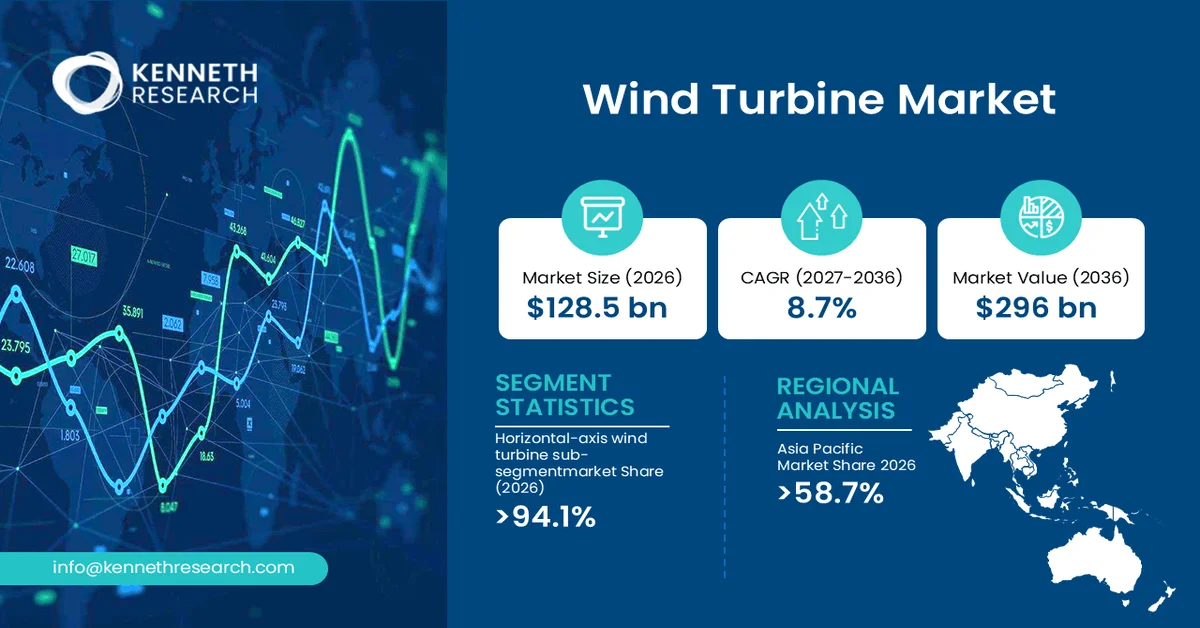
Wind Turbine Market size was valued at USD 128.5 billion in 2026 and is projected to reach USD 296 billion by the end of 2036, rising at a CAGR of 8.7% during the forecast period, i.e., 2027-2036. In 2027, the industry size of the wind turbine is estimated at USD 139.7 billion.
Rapid expansion of renewable electricity capacity is driving demand for wind turbines as governments and utilities accelerate decarbonization, strengthen energy security, and diversify power generation.
The wind turbine market encompasses the equipment and systems used to convert the kinetic energy of moving air into electrical power. Wind turbines consist primarily of rotor blades, hubs, nacelles, generators, towers, control systems, and associated electrical and mechanical components that enable electricity generation and grid integration. The industry includes turbines designed for onshore and offshore installations, with configurations differentiated by rotor architecture, rated capacity, tower design, drivetrain technology, and site requirements.
A key characteristic of wind turbines is their ability to generate renewable electricity without direct fuel consumption during operation. Modern systems incorporate advanced aerodynamics, digital monitoring, automated controls, condition-monitoring technologies, and increasingly sophisticated power-electronics systems to improve performance and operational reliability.
Key Wind Turbine Market Insights Summary:
Key Takeaways: Market Trends & Insights
- Wind turbine market is projected to grow from USD 128.5 billion in 2026 to USD 296 billion by 2036, expanding at a 8.7% CAGR during the forecast period.
- Asia-Pacific accounted for the largest regional share at 58.7% in 2026, supported by extensive renewable-energy deployment, strong manufacturing capabilities, and continued wind-power investments in Japan and China.
- Horizontal-axis wind turbines remained the leading axis type, accounting for 94.1% in 2026, supported by their established technology, high efficiency, scalability, and suitability for utility-scale wind-power generation.
- Onshore installations are expected to maintain strong growth as developers benefit from established infrastructure, comparatively accessible project development, mature supply chains, and scalable deployment opportunities.
Market Drivers
- Increasing turbine efficiency and technological advancement
- Expansion of renewable power infrastructure
- Government incentives and supportive wind-energy policies
- Growing demand for low-carbon and energy-secure electricity generation
Challenges
- High capital requirements and financing pressure
- Supply chain and manufacturing constraints
Wind Turbine Market Overview & Supply Chain
Global adoption of wind turbines is increasing as governments, utilities, and project developers expand renewable-power capacity to reduce emissions, improve energy security, and diversify electricity generation. Technological progress in turbine aerodynamics, larger rotor designs, digital monitoring, power electronics, and grid integration is improving project performance and expanding viable deployment locations. The International Energy Agency reported that wind expanded global electricity generation by about 180 TWh in 2024, reflecting continued additions of wind projects worldwide. This expansion reinforces demand for turbine manufacturing, installation, grid-connection infrastructure, and long-term maintenance services.
The wind turbine value chain begins with raw materials and industrial inputs, including steel, composites, copper, rare-earth materials, electronic components, bearings, and specialized electrical equipment. Component manufacturers produce blades, generators, gearboxes, towers, converters, control systems, and other assemblies, which are integrated by turbine manufacturers into complete wind-generation systems. Project developers and engineering, procurement, and construction contractors then select suitable sites, manage permitting, arrange financing, and coordinate transportation and installation.
Wind Turbine Market: Growth Drivers & Challenges
Growth Drivers:
- Increasing turbine efficiency and scale: Advances in turbine engineering are strengthening the economics of wind projects and encouraging developers to adopt larger, more productive machines. Manufacturers are increasing rotor diameters, hub heights, and rated capacity to capture more energy from available wind resources and improve generation from sites with comparatively moderate wind speeds. The U.S. Department of Energy reported that the average rotor diameter of newly installed U.S. wind turbines exceeded 133.8 meters in 2023, demonstrating the continued shift toward larger turbine architectures. Larger rotors increase swept area and allow turbines to capture more wind, while higher-capacity machines can reduce the number of turbines required for a given project output.
- Expansion of renewable power infrastructure: The expansion of renewable electricity infrastructure is creating sustained demand for wind turbines across utility-scale projects. Governments and utilities are increasing renewable procurement, strengthening transmission networks, and developing policies that support wind deployment as part of broader energy-transition strategies. Wind projects also provide opportunities to diversify electricity supplies and reduce dependence on fossil-fuel generation.
Challenges:
- High capital requirements and financing pressure: Wind projects require substantial upfront investment in turbines, civil works, electrical infrastructure, grid connections, transportation, and installation. Financing conditions can significantly affect project economics because developers must commit capital well before electricity generation begins. Higher interest rates, equipment costs, and supply-chain expenses can weaken project returns and make previously agreed power prices less attractive.
- Supply chain and manufacturing constraints: Wind turbine manufacturing depends on complex global supply chains covering steel, composites, electrical equipment, bearings, generators, gearboxes, and specialized materials. Disruptions in component availability, transportation, manufacturing capacity, or raw-material supply can delay project schedules and increase procurement costs. The International Energy Agency has warned that the wind turbine manufacturing sector requires additional investment to prevent supply-chain bottlenecks, particularly as deployment expands.
Wind Turbine Market Size and Forecast:
| Report Attribute | Details |
|---|---|
| Base Year |
2026 |
| Forecast Period |
2027-2036 |
| CAGR |
8.7% |
| Base Year Market Size (2026) |
USD 128.5 billion |
| Forecast Year Market Size (2036) |
USD 296 billion |
| Regional Scope |
|
Wind Turbine Market Segmentation Analysis:
Axis Type Segment Analysis
In the axis type segment, the Horizontal-axis wind turbine sub-segment is anticipated to capture the largest market share of 94.1% by the end of 2036.
Horizontal-axis designs dominate because their propeller-style configuration is well established for utility-scale electricity generation and can efficiently convert wind energy into power. The U.S. Department of Energy identifies horizontal-axis turbines as the most commonly used turbine type in the current market and notes that rotor diameter determines the swept area available for capturing wind energy.
The segment benefits from extensive manufacturing capabilities, established supply chains, mature installation practices, and continued improvements in rotor dimensions, blade materials, generators, and control systems. Larger and more efficient turbine designs are also enabling developers to improve energy yields from suitable sites while supporting greater project productivity.
Installation Type Segment Analysis
In the installation segment, the Onshore sub-segment is positioned for continued growth because land-based wind projects generally benefit from established construction practices, accessible infrastructure, and comparatively straightforward installation logistics. Demand is supported by utilities and independent power producers seeking scalable renewable generation while governments encourage domestic clean-energy deployment. Onshore projects also benefit from a mature ecosystem covering turbine manufacturing, transportation, civil engineering, grid connection, and operations and maintenance. Improvements in turbine design are allowing developers to extract more electricity from suitable land-based sites, strengthening project economics and supporting replacement and repowering opportunities.
Our in-depth analysis of the global wind turbine market includes the following segments:
|
Segment |
Sub-segment |
|
Axis Type |
|
|
Installation |
|
|
Component |
|
Wind Turbine Market Regional Insights:
Asia-Pacific Market Trends & Insights:
Asia-Pacific holds the dominant regional position in the wind turbine market, accounting for 58.7% in 2026.
The region benefits from large-scale renewable-energy deployment, strong manufacturing capabilities, extensive project pipelines, and supportive government policies. China is a particularly important contributor to regional demand.
Japan represents an important market because of its strong focus on renewable-energy diversification and its need to expand clean electricity generation within geographically constrained land resources.
China remains the region’s principal growth engine, supported by extensive wind resources, large-scale renewable-energy development, and a mature domestic industrial ecosystem. Government policy continues to prioritize renewable-energy expansion and improved power-system integration.
North America Market Trends & Insights:
North America represents an important market for wind turbine deployment, supported by established renewable-power infrastructure, mature turbine manufacturing capabilities, and continued investment in both land-based and offshore wind projects. The U.S. remains the region’s principal market, while Canada is expanding its wind-generation base through new projects and renewable-energy initiatives.
U.S. demand is supported by utility-scale renewable deployment, federal incentives, state-level clean-energy policies, and ongoing grid modernization. The country also has an established domestic manufacturing and services ecosystem spanning turbine production, engineering, construction, transportation, and operations and maintenance.
Canada is developing its wind sector as part of broader renewable-electricity expansion. Natural Resources Canada states that wind generated 36 TWh of electricity in 2022, while the country continued expanding installed wind capacity through new projects and government initiatives.
Leading Companies Operating in the Global Wind Turbine Market:
Here is a list of upstream, downstream, and key players operating in the global wind turbine market competitive ecosystem:
- Vestas (Denmark)
- Company Overview
- Business Strategy
- Key Product Offerings
- Financial Performance
- Key Performance Indicators
- Risk Analysis
- Recent Development
- Regional Presence
- SWOT Analysis
- Siemens Gamesa (Spain)
- GE Vernova (United States)
Recent Developments
- August 2026: Vestas announced a new order with Statkraft Peru for a wind project, adding another onshore turbine supply contract to its 2026 order intake.
- August 2026: GE Vernova announced an agreement with Enfinity Global to supply its 3.8 MW–154m onshore wind turbines for the Fatehgarh Wind Farm in Rajasthan, India. The project strengthens GE Vernova’s position in India’s onshore wind market.
Frequently Asked Question
In 2026, the wind turbine market exceeded USD 128.5 billion.
The wind turbine market is projected to reach USD 296 billion by the end of 2036, expanding at a CAGR of 8.7% over the forecast period (2027-2036).
The major players in the market are Vestas, Siemens Gamesa, GE Vernova, Goldwind, Enercon, and others.
In the axis type segment, the horizontal-axis wind turbine sub-segment is anticipated to capture the largest market share of 94.1% in the future and exhibit lucrative growth opportunities during 2027-2036.
Asia-Pacific is projected to hold the largest market share of 58.7% by the end of 2026 and provide more business opportunities in the future.
Why Choose Kenneth Research ?
-
Insight with Impact : We don’t just gather data — we uncover stories, trends, and opportunities that fuel business growth.
-
Experts Who Get It : Our team speaks your industry’s language and knows what really matters to your customers and market.
-
Custom-Built for You : Forget one-size-fits-all. We craft research and consulting solutions as unique as your business vision.
-
Partners, Not Just Providers : We work with you, not for you — collaborating closely to turn insights into smart, strategic moves.
-
Results That Speak : Our work powers brands, startups, and industry leaders alike — with a track record of ideas that work in the real world.
Report ID: 1347 |
Published Date: 10 Sep 2026 |
Report Format: |
Delivery Timeline: 48-72 Business Hours

Copyright © 2025 Kenneth Research. All rights reserved. Terms of Use | Privacy Policy
