Report ID: 1082 |
Published Date: 14 Aug 2026 |
Report Format: |
Delivery Timeline: 48-72 Business Hours
Wearable Medical Device Market Outlook:
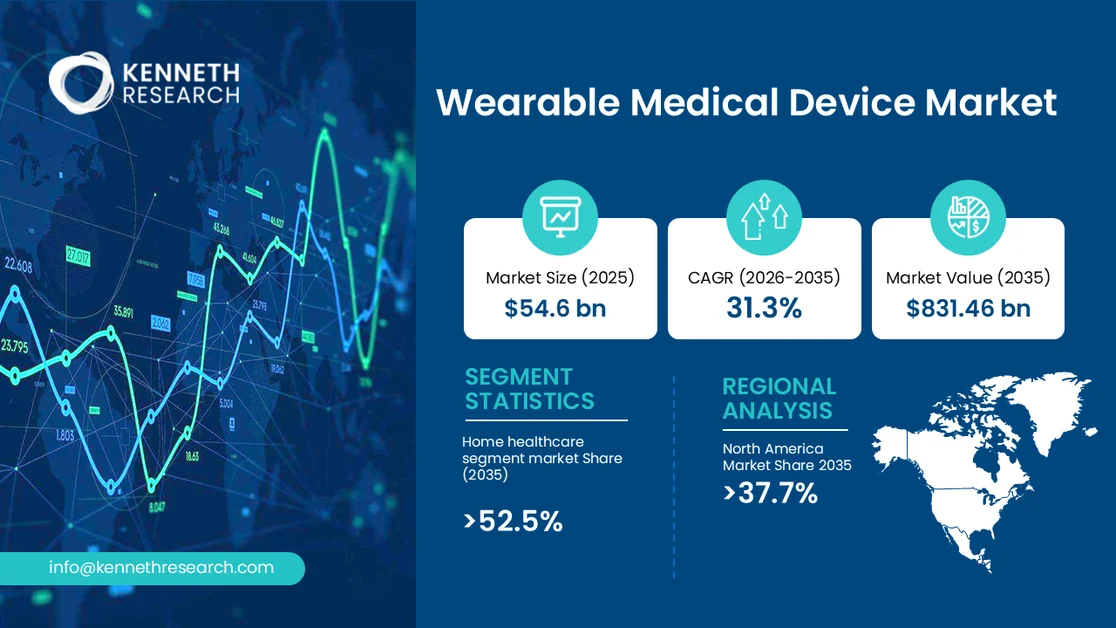
Wearable Medical Device Market size was valued at USD 54.6 billion in 2025 and is projected to reach USD 831.46 billion by the end of 2035, rising at a CAGR of 31.3% during the forecast period, i.e., 2026-2035. In 2026, the industry size of wearable medical device is estimated at USD 71.69 billion.
The increasing prevalence of chronic diseases, growing adoption of remote patient monitoring, expanding digital healthcare infrastructure, and rising consumer demand for continuous health tracking are accelerating the adoption of wearable medical devices.
The wearable medical device market comprises medical-grade wearable technologies designed to monitor, diagnose, manage, or support the treatment of various health conditions through continuous or periodic physiological data collection. These devices are worn on the body and include products such as wearable monitors, diagnostic devices, therapeutic wearables, and connected health sensors that enable real-time health assessment and data transmission to healthcare professionals or digital health platforms. Key characteristics of wearable medical devices include portability, wireless connectivity, continuous monitoring capabilities, user-friendly operation, and integration with healthcare information systems.
Key Wearable Medical Device Market Insights Summary:
Key Takeaways: Market Trends & Insights
- In the application, the home healthcare sub-segment is anticipated to capture the revenue share of 52.5% during 2026-2035
- North America wearable medical device market is projected to hold the largest revenue share of 37.7% by the end of 2035
- The consumer grade sub-segment of grade type segment led the global market with largest share of 76.4% in 2025.
Market Drivers
- Expansion of remote patient monitoring and digital healthcare programs
- Increasing adoption of AI-enabled personalized healthcare solutions
- Rising prevalence of chronic diseases requiring continuous physiological monitoring
- Technological advancements in connected biosensors, wireless communication, and cloud-integrated wearable medical devices
Challenges
- Data privacy, cybersecurity, and regulatory compliance complexity
- Clinical validation and reimbursement barriers
Wearable Medical Device Market Overview & Supply Chain
Global adoption of wearable medical devices is accelerating as healthcare systems increasingly emphasize preventive care, remote patient monitoring, and digital health integration. Advances in biosensors, wireless connectivity, artificial intelligence, and cloud-based analytics have improved the accuracy and usability of wearable technologies, enabling continuous monitoring of physiological parameters outside traditional clinical settings. The growing burden of chronic diseases is further strengthening demand for wearable medical devices that facilitate early intervention and long-term disease management.
The wearable medical device industry value chain begins with suppliers of semiconductor components, biosensors, microprocessors, batteries, medical-grade polymers, display technologies, and wireless communication modules. Device manufacturers integrate these components with embedded software, connectivity solutions, and clinical-grade algorithms to develop wearable medical products that comply with healthcare quality and regulatory standards. Following production, products undergo validation, quality assurance, and certification before reaching healthcare providers through direct sales channels, medical device distributors, digital health platforms, and hospital procurement networks.
Wearable Medical Device Market: Growth Drivers & Challenges
Growth Drivers:
- Expansion of remote patient monitoring and digital healthcare programs: The rapid adoption of remote patient monitoring (RPM) is a key growth driver for the wearable medical device market. Healthcare providers are increasingly integrating wearable technologies into chronic disease management, post-acute care, and preventive health programs to enable continuous monitoring outside conventional clinical settings. The widespread use of connected biosensors and cloud-enabled health platforms improves clinical decision-making by providing real-time physiological data while reducing unnecessary hospital visits. According to the U.S. Centers for Disease Control and Prevention (CDC), the Community Preventive Services Task Force recommends telehealth interventions, including remote patient monitoring, for managing conditions such as cardiovascular disease, diabetes, asthma, obesity, and hypertension because they improve medication adherence and clinical outcomes.
- Increasing adoption of AI-enabled personalized healthcare solutions: Advancements in artificial intelligence, advanced biosensors, and digital analytics are transforming wearable medical devices from basic monitoring tools into intelligent clinical support systems. Modern wearable devices can continuously analyze physiological parameters, generate predictive health insights, and facilitate early detection of medical conditions, supporting personalized treatment strategies. Healthcare providers are increasingly utilizing these technologies to improve patient engagement, optimize chronic disease management, and enhance preventive care. Device manufacturers are simultaneously developing interoperable solutions capable of integrating with electronic health records and digital health ecosystems, improving workflow efficiency across healthcare settings.
Challenges:
- Data privacy, cybersecurity, and regulatory compliance complexity: The increasing connectivity of wearable medical devices exposes manufacturers and healthcare providers to growing cybersecurity and data privacy challenges. These devices continuously collect, transmit, and store sensitive patient information, requiring compliance with diverse healthcare data protection regulations across multiple jurisdictions. The need to implement robust encryption, secure cloud infrastructure, software validation, and post-market cybersecurity monitoring increases product development complexity and operational costs. Delays in regulatory approvals and evolving cybersecurity requirements may also extend commercialization timelines for new products. Commercially, companies must invest heavily in secure digital ecosystems to maintain customer confidence and healthcare provider adoption.
- Clinical validation and reimbursement barriers: Although wearable medical technologies continue to evolve rapidly, achieving widespread clinical adoption requires strong evidence demonstrating accuracy, reliability, and measurable healthcare benefits. Manufacturers must conduct extensive clinical validation and generate robust real-world evidence to satisfy regulatory authorities, healthcare providers, and reimbursement agencies. This process can significantly increase development costs and extend product launch timelines. In addition, reimbursement policies for wearable medical devices remain inconsistent across healthcare systems, limiting adoption in certain clinical settings despite technological advancements. Commercial success therefore depends not only on product innovation but also on the ability to demonstrate clinical value and economic benefits.
Wearable Medical Device Market Size and Forecast:
| Report Attribute | Details |
|---|---|
| Base Year |
2025 |
| Forecast Year |
2026-2035 |
| CAGR |
31.3% |
| Base Year Market Size (2025) |
USD 54.6 billion |
| Forecast Year Market Size (2035) |
USD 831.46 billion |
| Regional Scope |
|
Wearable Medical Device Market Segmentation Analysis:
Application Segment Analysis
The home healthcare sub-segment is anticipated to hold the largest share of 52.5% in the global market by the end of 2035.
The home healthcare segment is projected to remain the dominant application in the wearable medical device market as healthcare systems increasingly shift toward decentralized care models that enable continuous patient monitoring outside traditional clinical environments. Rising demand for chronic disease management, post-discharge monitoring, elderly care, and preventive healthcare is driving the adoption of wearable medical devices in home settings. Patients and healthcare providers are increasingly utilizing connected wearable technologies to support real-time physiological monitoring, improve treatment adherence, and facilitate timely clinical intervention. The continued digital health investments, broader telehealth adoption, and advances in connected medical technologies are expected to sustain the segment's leadership throughout the forecast period.
Product Segment Analysis
The Diagnostic Devices segment is projected to experience robust growth as healthcare providers increasingly prioritize early disease detection, continuous physiological monitoring, and data-driven clinical decision-making. Advances in sensor technology, artificial intelligence, and wireless connectivity have enabled wearable diagnostic devices to monitor vital signs, cardiac rhythms, blood oxygen levels, sleep patterns, and other health parameters in real time. Adoption is expanding across hospitals, ambulatory care settings, and home healthcare as clinicians seek to improve patient outcomes through timely diagnosis and intervention. According to the World Health Organization (WHO), approximately 1.4 billion adults aged 30–79 years worldwide are living with hypertension in 2024, with most residing in low- and middle-income countries. continued innovation in digital diagnostics, remote monitoring, and personalized healthcare is expected to accelerate adoption of wearable diagnostic devices across global healthcare systems.
Our in-depth analysis of the global wearable medical device market includes the following segments:
|
Segment |
Sub-segment |
|---|---|
|
Application |
|
|
Product |
|
|
Grade Type |
|
|
Site |
|
|
Distribution Channel |
|
Wearable Medical Device Market Regional Insights:
North America Market Trends & Insights:
North America is projected to lead the wearable medical device market, accounting for 37.7% of the global market by 2035, according to the provided market inputs. The region's leadership is driven by its advanced healthcare infrastructure, widespread adoption of digital health technologies, favorable reimbursement frameworks, and strong investment in medical device innovation. Healthcare providers are increasingly integrating wearable medical devices into remote patient monitoring, chronic disease management, and preventive care programs to improve clinical outcomes and operational efficiency. Regulatory support for digital health technologies, coupled with a mature ecosystem of medical device manufacturers, software developers, and healthcare institutions, continues to accelerate commercialization and adoption of wearable medical solutions across multiple care settings.
The United States remains the principal growth engine owing to its extensive digital health ecosystem, strong clinical research capabilities, and high adoption of connected healthcare technologies. The rapid pace of medical device innovation and regulatory activity that supports broader adoption of advanced wearable medical technologies across the country.
Canada complements regional growth through continued investment in virtual care, healthcare modernization, and digital health implementation across provincial healthcare systems.
Asia Pacific Market Trends & Insights:
Asia Pacific is emerging as a fastest-growing region for the wearable medical device market, supported by expanding healthcare infrastructure, rapid digital transformation, and increasing demand for remote healthcare services. Rising awareness of preventive healthcare, growing incidence of chronic diseases, and broader adoption of connected health technologies are encouraging healthcare providers and consumers to embrace wearable medical devices. Governments across the region are promoting digital health through healthcare modernization initiatives, telemedicine expansion, and investments in health information systems, creating a favorable environment for wearable medical technology adoption.
China plays a pivotal role in regional growth through its large-scale medical device manufacturing capabilities, expanding digital healthcare ecosystem, and continued investment in smart healthcare technologies. Government support for healthcare digitization and innovation is accelerating the deployment of connected medical solutions across hospitals and community healthcare settings.
Japan strengthens the regional market with its advanced medical technology industry, aging population, and strong emphasis on preventive healthcare and remote patient management. The country's focus on healthcare innovation, precision medicine, and high-quality medical device development continues to support the adoption of sophisticated wearable medical devices for clinical and home healthcare applications.
Leading Companies Operating in the Global Wearable Medical Device Market:
Here is a list of upstream, downstream, and key players operating in the global wearable medical device market competitive ecosystem:
- Medtronic (Ireland)
- Company Overview
- Business Strategy
- Key Product Offerings
- Financial Performance
- Key Performance Indicators
- Risk Analysis
- Recent Development
- Regional Presence
- SWOT Analysis
- Omron Healthcare (Japan)
- Biobeat (Israel)
Recent Developments
- In August 2024, Medtronic announced U.S. FDA approval of its Simplera™ continuous glucose monitor (CGM) and simultaneously entered a global partnership with Abbott to integrate Abbott's CGM technology with Medtronic's automated insulin delivery and smart insulin pen systems. Strengthens Medtronic's wearable diabetes portfolio and expands interoperability, supporting broader adoption of connected wearable medical devices.
- In March 2024, The U.S. FDA cleared the Dexcom G7 15-Day Continuous Glucose Monitoring System, extending sensor wear duration while supporting continuous glucose monitoring. Reinforces innovation in wearable diagnostic devices and improves patient convenience through longer sensor life.
Frequently Asked Question
In 2025, the wearable medical device market exceeded USD 54.6 billion.
The wearable medical device market is projected to reach USD 831.46 billion by the end of 2035, expanding at a CAGR of 31.3% over the forecast period (2026-2035).
The major players in the market are Abbott, Dexcom, Medtronic, Philips, iRhythm Technologies, and others.
In the application segment, the home healthcare sub-segment is anticipated to capture the largest market share of 52.5% in the future and exhibit lucrative growth opportunities during 2026-2035. This growth trajectory is largely attributed to increasing adoption of remote patient monitoring and digital healthcare solutions.
North America is projected to hold the largest market share of 37.7% by the end of 2035 and provide more business opportunities in the future. Continuous investments in digital healthcare infrastructure, remote patient monitoring, and advanced medical device innovation in the U.S. and Canada are fostering the region's dominance.
Why Choose Kenneth Research ?
-
Insight with Impact : We don’t just gather data — we uncover stories, trends, and opportunities that fuel business growth.
-
Experts Who Get It : Our team speaks your industry’s language and knows what really matters to your customers and market.
-
Custom-Built for You : Forget one-size-fits-all. We craft research and consulting solutions as unique as your business vision.
-
Partners, Not Just Providers : We work with you, not for you — collaborating closely to turn insights into smart, strategic moves.
-
Results That Speak : Our work powers brands, startups, and industry leaders alike — with a track record of ideas that work in the real world.
Report ID: 1082 |
Published Date: 14 Aug 2026 |
Report Format: |
Delivery Timeline: 48-72 Business Hours

Copyright © 2025 Kenneth Research. All rights reserved. Terms of Use | Privacy Policy
