Report ID: 1291 |
Published Date: 01 Sep 2026 |
Report Format: |
Delivery Timeline: 48-72 Business Hours
Wearable Cameras Market Outlook:
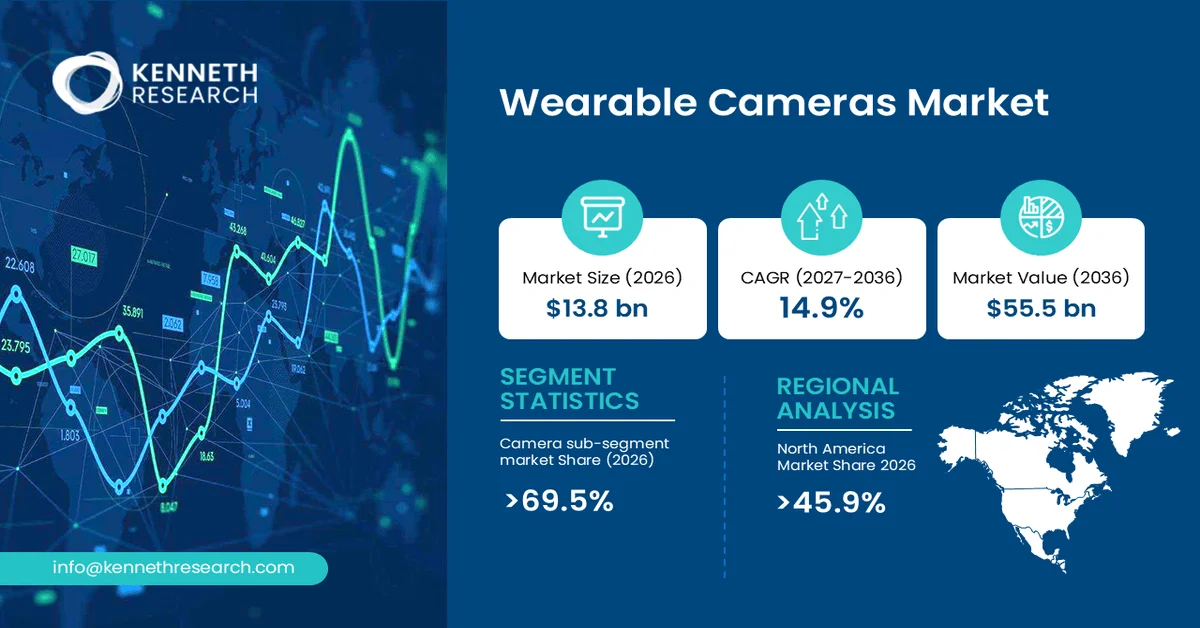
Wearable Cameras Market size was valued at USD 13.8 billion in 2026 and is projected to reach USD 55.5 billion by 2036, expanding at a CAGR of 14.9% during the forecast period, i.e., 2027-2036. In 2027, the industry size of the wearable cameras is estimated at USD 15.9 billion.
The primary growth driver for the wearable cameras market is increasing adoption of compact, hands-free cameras for documentation, safety, evidence collection, and real-time monitoring. Law enforcement agencies are expanding body-worn camera programs to improve accountability, evidence collection, and officer safety.
The wearable cameras market comprises compact imaging devices designed to be worn on the body, head, clothing, helmets, or other equipment to capture photographs and video from the user's perspective. Products include body-worn cameras, head-mounted cameras, action-oriented wearable cameras, and specialized recording devices.
These cameras are increasingly integrated with wireless connectivity, GPS, cloud storage, image stabilization, sensors, and artificial-intelligence capabilities. Applications span law enforcement, public safety, industrial operations, sports and recreation, healthcare, defense, and field services.
Key Wearable Cameras Market Insights Summary:
Key Takeaways: Market Trends & Insights
- Wearable Cameras Market projected to grow from USD 13.8 Billion in 2026 to USD 55.5 Billion by 2036, registering a 14.9% CAGR.
- North America accounted for the largest regional share at 45.9% in 2026, supported by established public-safety, law-enforcement, and enterprise adoption.
- Camera remains the leading Product segment, accounting for 69.5% in 2026, supported by demand for hands-free recording, evidence collection, safety monitoring, and field documentation.
- Head Mount is an important Type segment, benefiting from first-person recording capabilities while keeping users' hands available for operational tasks.
- Market development is increasingly shifting toward connected wearable cameras, with cloud evidence management, AI-enabled video analytics, wireless connectivity, and real-time streaming becoming important differentiators.
Market Drivers
- Expansion of government-backed body-worn camera programs
- Rising demand for digital evidence and accountability
- Increasing adoption of hands-free recording in field operations
- Integration of cameras with cloud-based evidence management and analytics systems
Challenges
- Privacy and Data Protection Concerns
- Data Storage and Infrastructure Requirements
Wearable Cameras Market Overview & Supply Chain
The wearable cameras market is expanding as body-worn and hands-free imaging devices gain adoption across law enforcement, public safety, industrial operations, transportation, and field services. Government initiatives are supporting this trend.
The value chain begins with suppliers of image sensors, lenses, processors, batteries, memory, wireless modules, and protective housings. Camera manufacturers integrate these components into wearable devices and add features such as stabilization, GPS, wireless connectivity, audio capture, and cloud integration. Finished cameras are distributed through OEM channels, technology integrators, public-sector procurement programs, industrial equipment suppliers, and specialist distributors.
Downstream demand comes from law enforcement, emergency services, industrial companies, transportation operators, healthcare organizations, defense agencies, and sports users.
Wearable Cameras Market: Growth Drivers & Challenges
Growth Drivers
- Expansion of body-worn camera programs: Government-led deployment of body-worn cameras is creating sustained demand for wearable imaging equipment. Canada's RCMP, for example, began its national rollout in late 2024, with the program targeting approximately 10,000 cameras for frontline officers. The initiative combines cameras with a digital evidence-management system, increasing demand not only for hardware but also for storage, data management, and supporting technologies.
- Increasing demand for digital evidence and accountability: Growing emphasis on transparency, evidence collection, and accountable interactions is encouraging public-safety organizations to adopt wearable cameras. The RCMP reported that its 2024–25 rollout had equipped approximately 3,750 frontline officers with body-worn cameras across more than 300 detachments by the end of the fiscal year. This demonstrates how wearable cameras are becoming integrated into broader digital-evidence workflows rather than functioning solely as standalone recording devices.
Challenges
- Privacy and data protection concerns: Privacy remains a significant challenge for wearable-camera adoption because continuous recording can capture sensitive information involving employees, customers, bystanders, children, and crime victims. Government guidance emphasizes the need for clear policies governing when cameras record, how footage is accessed, how long it is retained, and when it can be shared or deleted. The U.S. Bureau of Justice Assistance highlights privacy, redaction, evidence access, and data-handling requirements as important considerations for body-worn-camera programs. For manufacturers and technology providers, this creates demand for privacy-by-design capabilities such as encryption, access controls, automated redaction, audit trails, and configurable recording policies.
- Data storage and infrastructure requirements: The increasing volume of high-resolution video creates substantial requirements for storage, data transfer, processing, and evidence management. The Bureau of Justice Assistance identifies video storage as one of the most expensive aspects of body-worn-camera programs, while agencies may also need infrastructure for retrieval, sharing, chain-of-custody management, and secure archiving.
Wearable Cameras Market Size and Forecast:
| Report Attribute | Details |
|---|---|
| Base Year |
2026 |
| Forecast Year |
2027-2036 |
| CAGR |
14.9% |
| Base Year Market Size (2026) |
USD 13.8 billion |
| Forecast Year Market Size (2036) |
USD 55.5 billion |
| Regional Scope |
|
Wearable Cameras Market Segmentation Analysis:
Product Type Segment Analysis
In the Product segment, the Camera sub-segment is expected to maintain its leading position, accounting for 69.5% in 2026.
Demand is supported by the expanding use of wearable imaging devices for evidence collection, situational awareness, safety monitoring, field documentation, and hands-free video capture. Government agencies are increasingly establishing technical requirements for body-worn camera systems, while the U.S. Department of Homeland Security notes that automatic-activation cameras can begin recording based on external events or sensors, expanding their operational functionality.
Camera manufacturers are also incorporating higher-resolution imaging, improved battery performance, wireless connectivity, automatic activation, GPS, and secure data-transfer capabilities. The U.S. Bureau of Justice Assistance identifies wearable-camera systems as tools supporting officer safety, situational awareness, accountability, and evidence collection.
Type Segment Analysis
In the Type segment, the Head Mount sub-segment is expected to witness strong demand as hands-free recording becomes increasingly relevant for field operations, public safety, industrial inspection, emergency response, and sports applications. Head-mounted cameras provide a first-person perspective while allowing users to keep both hands available for operational tasks, making them suitable for environments where conventional handheld recording is impractical.
Government procurement activity also demonstrates institutional demand for wearable-camera systems. Japan's Ministry of Land, Infrastructure, Transport and Tourism issued procurement notices for wearable cameras in 2023, including equipment intended for regional infrastructure operations. In 2024, Japan's Ministry of Justice also issued a procurement notice covering the installation of a complete wearable-camera system, indicating continued adoption of wearable imaging technologies across government operations.
Our in-depth analysis of the global wearable cameras market includes the following segments:
|
Segment |
Sub-segment |
|
By Product |
|
|
By Type |
|
|
By Connectivity |
|
|
Application |
|
Wearable Cameras Market Regional Insights:
North America Market Trends & Insights:
North America accounted for 45.9% of the wearable cameras market in 2026, supported by established adoption of body-worn and hands-free camera systems across law enforcement, public safety, industrial, and field-service applications. The U.S. Department of Homeland Security has specifically evaluated body-worn video cameras with automatic-activation capabilities, reflecting continued government interest in advanced wearable imaging technologies.
The U.S. represents the leading market in the region, supported by established body-worn-camera programs, public-safety procurement, and digital-evidence infrastructure. Government funding through the Bureau of Justice Assistance continues to support body-worn-camera acquisition and evidence-management capabilities.
Canada is also expanding institutional adoption, with the Royal Canadian Mounted Police implementing a national body-worn-camera program alongside a digital evidence-management system.
Asia-Pacific Market Trends & Insights:
Asia-Pacific represents a significant growth market for wearable cameras, supported by increasing adoption across public safety, government operations, infrastructure management, and industrial applications. Japan and China are particularly important markets as government organizations increasingly evaluate wearable imaging for operational monitoring and evidence collection.
Japan is demonstrating growing institutional adoption. Japan’s National Police Agency launched model projects to evaluate wearable cameras for community policing, traffic enforcement, and crowd-security activities. The initiative is designed to assess the effectiveness and operational challenges of wearable-camera deployment.
China is supported by its large electronics manufacturing ecosystem and expanding use of connected imaging technologies across industrial and public-sector applications. The country's established capabilities in cameras, semiconductors, wireless connectivity, and consumer electronics provide a strong foundation for wearable-camera development and deployment.
Leading Companies Operating in the Global Wearable Cameras Market:
Here is a list of upstream, downstream, and key players operating in the global wearable cameras market competitive ecosystem:
- Axon Enterprise (United States)
- Company Overview
- Business Strategy
- Key Product Offerings
- Financial Performance
- Key Performance Indicators
- Risk Analysis
- Recent Development
- Regional Presence
- SWOT Analysis
- Motorola Solutions (United States)
- GoPro (United States)
Recent Developments
- 2026 —Axon continues to expand its Axon Body 4 platform, which combines an upgraded 5MP camera sensor, full-shift battery, optional POV camera, LTE connectivity, live streaming, location tracking, and two-way communication.
- April 2026 —GoPro launched its MISSION 1 Series of compact professional cameras, including 8K and 4K Open Gate models powered by its GP3 processor and a 50MP 1-inch sensor.
Frequently Asked Question
In 2027, the wearable cameras market is valued at USD 15.9 billion.
The market is projected to reach USD 55.5 billion by 2036, expanding at a CAGR of 14.9% during 2027-2036.
Major participants include Axon Enterprise, Motorola Solutions, Panasonic i-PRO Sensing Solutions, GoPro, and Garmin. (Fortune Business Insights).
In the Product segment, Camera is anticipated to maintain the leading position, accounting for 69.5% in 2026. Demand is supported by increasing requirements for hands-free recording, public-safety documentation, field operations, and wearable video applications.
North America is projected to remain the leading regional market, accounting for 45.9% in 2026, supported by established adoption of body-worn cameras, public-safety programs, and digital evidence-management infrastructure.
Why Choose Kenneth Research ?
-
Insight with Impact : We don’t just gather data — we uncover stories, trends, and opportunities that fuel business growth.
-
Experts Who Get It : Our team speaks your industry’s language and knows what really matters to your customers and market.
-
Custom-Built for You : Forget one-size-fits-all. We craft research and consulting solutions as unique as your business vision.
-
Partners, Not Just Providers : We work with you, not for you — collaborating closely to turn insights into smart, strategic moves.
-
Results That Speak : Our work powers brands, startups, and industry leaders alike — with a track record of ideas that work in the real world.
Report ID: 1291 |
Published Date: 01 Sep 2026 |
Report Format: |
Delivery Timeline: 48-72 Business Hours

Copyright © 2025 Kenneth Research. All rights reserved. Terms of Use | Privacy Policy
