Report ID: 1296 |
Published Date: 01 Sep 2026 |
Report Format: |
Delivery Timeline: 48-72 Business Hours
Waterborne Epoxy Resin Market Outlook:
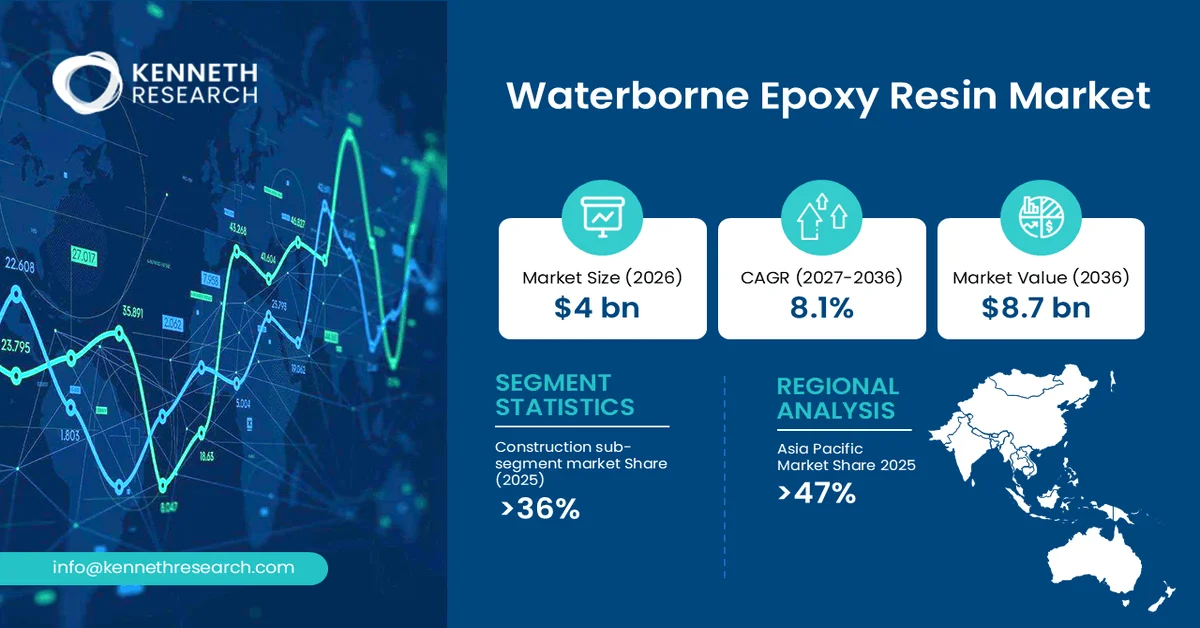
Waterborne Epoxy Resin Market size was valued at USD 4 billion in 2025 and is projected to reach USD 8.7 billion by the end of 2035, rising at a CAGR of 8.1% during the forecast period, i.e., 2026-2035. In 2026, the industry size of the waterborne epoxy resin is estimated at USD 4.3 billion.
The primary growth driver for the waterborne epoxy resin market is increasing demand for low-VOC, environmentally preferable coating and adhesive systems. Waterborne epoxy resins provide strong adhesion, chemical resistance, and durability while reducing reliance on solvent-based formulations, supporting adoption across construction, infrastructure, automotive, industrial flooring, and protective coating applications.
The waterborne epoxy resin market comprises epoxy resin systems formulated or dispersed in water for use in coatings, adhesives, flooring, composites, and other industrial applications. Unlike conventional solvent-borne epoxy systems, waterborne formulations use water as the primary dispersion medium, helping reduce solvent emissions while retaining important epoxy performance characteristics.
Key characteristics include strong adhesion, chemical and abrasion resistance, durability, corrosion protection, and relatively low volatile organic compound emissions. Formulations can be engineered for different substrates and operating environments, allowing manufacturers to tailor curing behavior, hardness, flexibility, and surface performance according to application requirements.
Key Waterborne epoxy resin Market Insights Summary:
Key Takeaways: Market Trends & Insights
- Waterborne Epoxy Resin Market projected to grow from USD 4 billion in 2025 to USD 8.7 billion by 2035 at an 8.1% CAGR.
- Asia Pacific accounted for the largest regional share at 47% in 2025, supported by expanding construction, infrastructure, automotive manufacturing, and industrial activity across Japan and China.
- Construction remained the leading End Use segment with a 36% market share in 2025, driven by demand for durable, low-emission coatings for buildings, flooring, and infrastructure.
- Automotive is expected to witness increasing adoption as manufacturers seek waterborne coating technologies offering corrosion protection, strong adhesion, and reduced solvent emissions.
- The market is benefiting from stricter environmental requirements, growing demand for sustainable coatings, infrastructure development, and continued formulation advances that improve curing, durability, and application performance.
Market Drivers
- Increasing demand for low-emission coating technologies.
- Expansion of construction and infrastructure applications.
- Growing adoption of sustainable industrial coatings.
- Rising demand for durable protective flooring systems.
Challenges
- Performance limitations under demanding conditions.
- Raw material and formulation complexity.
Waterborne Epoxy Resin Market Overview & Supply Chain
Global adoption is increasing as construction and industrial coating users seek durable formulations with lower solvent emissions. Waterborne epoxy systems combine epoxy performance with water-based formulation, making them relevant to architectural, industrial, flooring, and protective coatings. The U.S. Environmental Protection Agency identifies waterborne coatings among low- or no-VOC/HAP coating technologies, reflecting their relevance to pollution-prevention strategies and regulatory compliance.
The value chain begins with epoxy intermediates, curing agents, modifiers, additives, pigments, and other chemical inputs. Resin manufacturers synthesize and modify epoxy materials before dispersing or formulating them into waterborne systems with appropriate curing chemistry and performance characteristics. Finished products move through direct industrial sales, coatings formulators, specialty distributors, and construction-material channels. End users include construction contractors, infrastructure operators, automotive manufacturers, industrial facilities, flooring companies, and protective-coating applicators. Major stakeholders include chemical producers, resin formulators, coating manufacturers, equipment suppliers, distributors, contractors, architects, industrial asset owners, and regulatory bodies.
Waterborne Epoxy Resin Market: Growth Drivers & Challenges
Growth Drivers
- Increasing demand for low-emission coatings: Growing regulatory and customer emphasis on reducing volatile organic compound emissions is supporting waterborne epoxy resin adoption. These systems provide epoxy's adhesion, durability, and chemical resistance while using water as the principal dispersion medium, making them attractive for construction, flooring, infrastructure, and industrial coating applications. Manufacturers are investing in improved dispersion technology, curing systems, and formulation design to deliver stronger performance without reverting to solvent-heavy formulations. The U.S. Environmental Protection Agency continues to identify waterborne technologies as an approach for reducing emissions from coating applications, supporting the industry's transition toward lower-emission products.
- Expansion of construction and infrastructure applications: Construction and infrastructure projects require durable coatings for concrete, steel, floors, walls, and other substrates exposed to moisture, chemicals, abrasion, and mechanical wear. Waterborne epoxy systems can provide strong adhesion and protective performance while supporting lower-emission application requirements. Growing renovation, industrial flooring, infrastructure maintenance, and commercial building activity is therefore creating opportunities for these formulations. Coating manufacturers are developing faster-curing systems and application-specific grades to improve productivity and broaden usability. Future growth will be supported by increasing specification of sustainable coating technologies, particularly where contractors and asset owners seek durable protection alongside environmental performance. Expansion into maintenance and refurbishment projects should provide additional opportunities beyond new construction.
Challenges
- Performance limitations under demanding conditions: Waterborne epoxy systems can face formulation challenges involving curing speed, moisture sensitivity, substrate compatibility, and performance consistency compared with established solvent-borne systems. High humidity and low temperatures can particularly affect curing and final coating properties. These limitations may restrict adoption in demanding industrial environments where rapid return-to-service and predictable performance are critical. Manufacturers must therefore improve curing chemistry, formulation stability, and application tolerance while maintaining low-emission characteristics. Continued formulation development can reduce these limitations, but qualification requirements may increase commercialization time and development costs.
- Raw material and formulation complexity: Waterborne epoxy formulations require careful balancing of epoxy resins, curing agents, surfactants, additives, pigments, and other components. Changes in raw-material quality or formulation compatibility can affect stability, shelf life, application behavior, and finished-coating performance. This complexity can increase manufacturing controls and technical-support requirements. Price fluctuations for chemical inputs can also pressure margins, particularly where customers expect competitive pricing against conventional coating systems. Future competitiveness will depend on efficient formulation design, reliable raw-material sourcing, process optimization, and development of products that provide consistent performance across different application environments.
Waterborne Epoxy Resin Market Size and Forecast:
| Report Attribute | Details |
|---|---|
| Base Year |
2025 |
| Forecast Period |
2026-2035 |
| CAGR |
8.1% |
| Base Year Market Size (2025) |
USD 4 billion |
| Forecast Year Market Size (2035) |
USD 8.7 billion |
| Regional Scope |
|
Waterborne Epoxy Resin Market Segmentation Analysis:
End Use Segment Analysis
In the End Use segment, the Construction sub-segment is anticipated to capture the largest market share of 36% by the end of 2025.
Demand is supported by waterborne epoxy resins' strong adhesion, durability, chemical resistance, and suitability for concrete floors, protective coatings, infrastructure, and building surfaces. Contractors increasingly favor lower-emission coating systems that combine performance with environmental compliance. The U.S. Census Bureau reported that U.S. construction spending reached USD 2,154.4 billion in 2024, highlighting the substantial construction activity supporting demand for advanced coating materials. Continued renovation, infrastructure development, industrial flooring, and commercial construction should sustain demand. Manufacturers are also improving curing performance, moisture tolerance, and application efficiency, helping waterborne epoxy systems compete in demanding construction environments.
Automotive Segment Analysis
The Automotive segment is expected to grow as manufacturers seek durable, lower-emission coatings for vehicle bodies, components, and metal protection. Waterborne epoxy systems provide adhesion, corrosion resistance, and chemical durability while supporting reduced-solvent coating processes. Automotive manufacturers are also investing in electric-vehicle production, creating opportunities for specialized protective coatings across evolving vehicle platforms. Statistics Canada reported that Canada recorded 1,958,582 new motor vehicle sales in 2025, demonstrating continued automotive activity in a major North American manufacturing market. Growing vehicle production, component manufacturing, and demand for environmentally preferable coating technologies should support adoption. Future opportunities will center on faster curing, improved corrosion protection, compatibility with lightweight materials, and formulations suited to electric-vehicle components.
Our in-depth analysis of the global waterborne epoxy resin market includes the following segments:
|
Segment |
Sub-segment |
|
End use |
|
|
Application |
|
|
Resin Type |
|
|
Formulation |
|
Waterborne Epoxy Resin Market Regional Insights:
Asia Pacific Market Trends & Insights:
Asia Pacific accounted for 47% of the waterborne epoxy resin market in 2025, supported by extensive construction, infrastructure development, automotive manufacturing, and industrial production.
Japan and China provide strong downstream demand and established chemical manufacturing capabilities, while regional sustainability initiatives are encouraging lower-emission coating technologies. Expanding commercial construction, industrial flooring, infrastructure maintenance, and automotive production create broad application opportunities for waterborne epoxy systems. Continued investment in manufacturing capacity and environmentally preferable coating technologies should strengthen regional demand.
Japan benefits from advanced automotive, electronics, construction, and specialty-chemical industries. Its mature manufacturing ecosystem supports adoption of high-performance coatings where durability and environmental performance are important.
China represents a major regional opportunity because of its extensive construction industry, manufacturing base, and growing automotive sector. China's National Bureau of Statistics reported that industrial output increased 5.8% in 2024, reflecting continued manufacturing activity that supports demand for industrial coatings and protective materials.
North America Market Trends & Insights:
North America represents an important growth market for waterborne epoxy resins, supported by construction, infrastructure maintenance, automotive production, industrial manufacturing, and protective-coating applications. Demand is increasingly influenced by the shift toward lower-emission coating technologies and durable materials for demanding environments. Government-backed energy-efficiency programs, infrastructure modernization, and environmental requirements are encouraging users to evaluate waterborne alternatives to conventional solvent-based systems. Future opportunities are expected across commercial buildings, industrial flooring, transportation infrastructure, automotive components, and refurbishment projects. The region's established coatings industry and strong technical capabilities also support formulation development and commercialization of higher-performance waterborne epoxy systems.
The U.S. offers substantial opportunities through its large construction and industrial base, extensive infrastructure network, and automotive manufacturing sector. Demand is supported by protective coatings for buildings, equipment, floors, and infrastructure assets.
Canada provides additional opportunities through construction, infrastructure renewal, manufacturing, and growing interest in environmentally preferable coating technologies. Both countries offer established distribution networks and technical-service capabilities that can facilitate adoption. Future regional growth will depend on improved curing performance, moisture tolerance, application efficiency, and competitive formulation costs, allowing waterborne epoxy resins to expand across both new-build and maintenance applications.
Leading Companies Operating in the Global Waterborne Epoxy Resin Market:
Here is a list of upstream, downstream, and key players operating in the global waterborne epoxy resin market competitive ecosystem:
- Allnex(Germany)
- Company Overview
- Business Strategy
- Key Product Offerings
- Financial Performance
- Key Performance Indicators
- Risk Analysis
- Recent Development
- Regional Presence
- SWOT Analysis
- Evonik Industries(Germany)
- Ark Golden India(India)
- Lintec(China)
Recent Developments
- April 2026: Evonik Expanded its Americas epoxy-curing portfolio with Ancamine® 2868 and Ancamine® 2844, targeting rapid curing under low-temperature and high-humidity conditions.
Frequently Asked Question
In 2025, the waterborne epoxy resin market exceeded USD 4 billion.
The waterborne epoxy resin market is projected to reach USD 8.7 billion by the end of 2035, expanding at a CAGR of 8.1% over the forecast period (2026–2035).
The major players in the market are allnex, Evonik Industries, Ark Golden India, Shenzhen Boree Technology, Lintec, and others.
In the End Use segment, the Construction sub-segment is anticipated to capture the largest market share of 36% in the future and exhibit lucrative growth opportunities during 2026–2035. This growth trajectory is largely attributed to increasing demand for durable, low-emission coating systems in construction and infrastructure applications.
Asia Pacific is projected to hold the largest market share of 47% by the end of 2035 and provide more business opportunities in the future. Expanding construction, infrastructure, automotive manufacturing, and industrial activity across Japan and China are fostering the region's dominance.
Why Choose Kenneth Research ?
-
Insight with Impact : We don’t just gather data — we uncover stories, trends, and opportunities that fuel business growth.
-
Experts Who Get It : Our team speaks your industry’s language and knows what really matters to your customers and market.
-
Custom-Built for You : Forget one-size-fits-all. We craft research and consulting solutions as unique as your business vision.
-
Partners, Not Just Providers : We work with you, not for you — collaborating closely to turn insights into smart, strategic moves.
-
Results That Speak : Our work powers brands, startups, and industry leaders alike — with a track record of ideas that work in the real world.
Report ID: 1296 |
Published Date: 01 Sep 2026 |
Report Format: |
Delivery Timeline: 48-72 Business Hours

Copyright © 2025 Kenneth Research. All rights reserved. Terms of Use | Privacy Policy
