Report ID: 1354 |
Published Date: 10 Sep 2026 |
Report Format: |
Delivery Timeline: 48-72 Business Hours
Vibration Sensor Market Outlook:
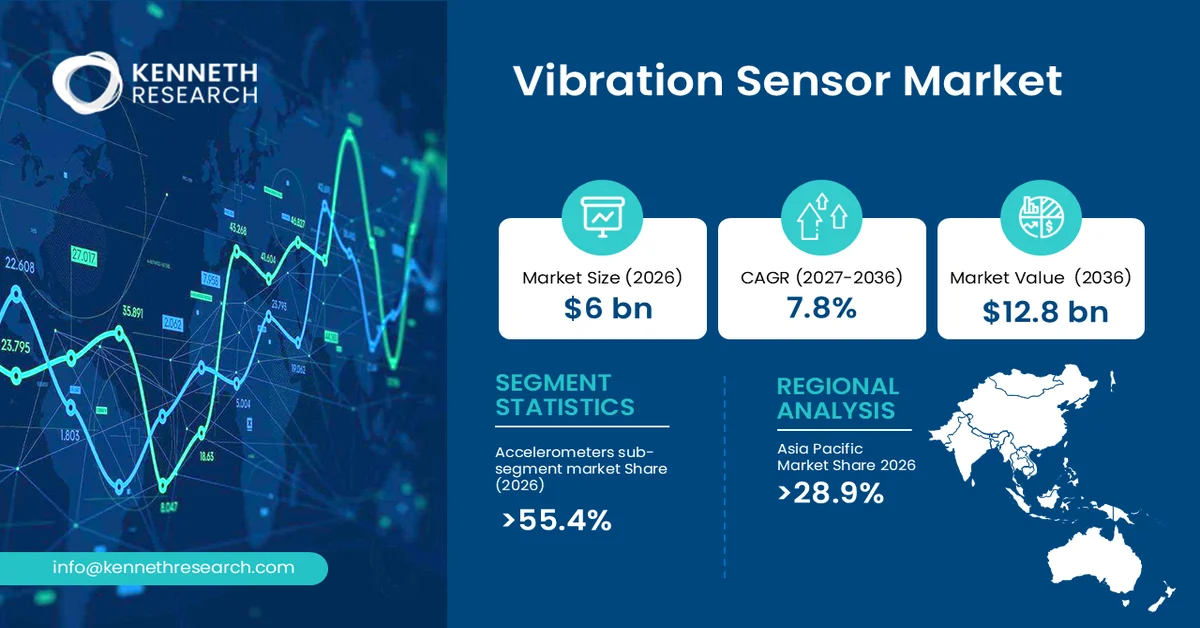
Vibration Sensor Market size was valued at USD 6 billion in 2026 and is projected to reach USD 12.8 billion by the end of 2036, rising at a CAGR of 7.8% during the forecast period, i.e., 2027–2036. In 2027, the industry size of the vibration sensor is estimated at USD 6.5 billion.
The primary growth driver for the vibration sensor market is the increasing adoption of predictive maintenance across industrial operations. Vibration sensing enables continuous equipment-condition assessment, helping operators identify mechanical abnormalities before failures occur.
The vibration sensor market comprises sensing devices and associated technologies designed to detect, measure, and monitor mechanical vibration in equipment, machinery, structures, and industrial systems. These sensors convert mechanical motion or vibration into measurable electrical or digital signals that can be analyzed to assess operating conditions, identify abnormalities, and support equipment diagnostics.
Key characteristics include sensitivity to changes in vibration, frequency-response capability, measurement accuracy, durability, and compatibility with monitoring and data-processing systems.
Key Vibration Sensor Market Insights Summary:
Key Takeaways: Market Trends & Insights
- Vibration Sensor Market is projected to grow from USD 6 billion in 2026 to USD 12.8 billion by 2036 at a 7.8% CAGR.
- Asia-Pacific accounted for the largest regional share at 28.9% in 2026, supported by strong industrial activity, manufacturing capabilities, and technology adoption across Japan and China.
- Accelerometers remained the leading Product Type segment with a 55.4% market share in 2026, driven by increasing adoption of predictive and condition-based maintenance across industrial operations.
- Doped Silicon is projected to witness increasing demand within the Material segment, supported by the growing integration of MEMS-based sensing technologies into compact and connected vibration-monitoring systems.
Market Drivers
- Expansion of predictive and condition-based maintenance
- Integration with smart manufacturing, industrial IoT, and analytics
- Increasing deployment of vibration monitoring in energy and critical infrastructure
- Growing adoption of compact MEMS and advanced sensor technologies
Challenges
- Sensor Accuracy and Calibration Complexity
- Integration Complexity Across Heterogeneous Industrial Systems
Vibration Sensor Market Overview & Supply Chain
Adoption of vibration sensors is increasing globally as manufacturers, energy operators, and industrial asset owners prioritize continuous equipment monitoring, predictive maintenance, and operational reliability. Vibration data helps identify abnormal mechanical conditions in motors, pumps, rotating machinery, and other critical assets, supporting earlier intervention and reducing maintenance inefficiencies.
The vibration sensor market value chain begins with raw-material and component suppliers providing sensing materials, semiconductor substrates, piezoelectric elements, doped silicon, electronic components, housings, connectors, and packaging materials. Sensor manufacturers then integrate these inputs into accelerometers and other vibration-sensing devices, incorporating signal-conditioning electronics and, where applicable, communication capabilities. Calibration, testing, and quality assurance follow manufacturing to ensure measurement reliability and application suitability.
Vibration Sensor Market: Growth Drivers & Challenges
Growth Drivers
- Expansion of predictive and condition-based maintenance: The increasing shift from reactive maintenance toward predictive and condition-based maintenance is accelerating demand for vibration sensors across manufacturing, energy, transportation, and heavy industrial applications. Vibration signals provide continuous information about machinery health, enabling operators to identify abnormal operating patterns and intervene before equipment degradation develops into major failures. NIST research published in 2022 demonstrated an inertial-sensor approach for online monitoring of ball-screw degradation during normal production operations, showing how vibration-based sensing can support non-intrusive industrial health monitoring.
- Integration of sensors with smart manufacturing and industrial analytics: The integration of vibration sensors with smart manufacturing platforms, industrial IoT architectures, and advanced analytics is creating new applications for real-time equipment monitoring. Modern production environments generate continuous machine data that can be processed to identify deviations, improve diagnostics, and support operational decisions. Vibration measurements are particularly valuable because mechanical abnormalities can be detected through changes in frequency, amplitude, and signal patterns.
Challenges
- Sensor accuracy and calibration complexity: A major restraint for the vibration sensor market is the technical difficulty of maintaining measurement accuracy across varying operating environments. Vibration sensors can experience sensitivity changes, signal distortion, drift, and noise when exposed to temperature fluctuations, electromagnetic interference, mechanical stresses, or unsuitable mounting conditions. These issues become particularly consequential when sensors are deployed for condition monitoring, where inaccurate measurements can generate false alarms or obscure early-stage equipment faults.
- Integration complexity across heterogeneous industrial systems: Integration with existing industrial infrastructure remains another significant restraint because vibration sensors must operate within diverse equipment architectures, communication protocols, control systems, and data environments. Older machinery may lack standardized interfaces or digital connectivity, requiring additional gateways, wiring, signal-conditioning equipment, or retrofit engineering before sensor data can be incorporated into plant monitoring systems.
Vibration Sensor Market Size and Forecast:
| Report Attribute | Details |
|---|---|
| Base Year |
2026 |
| Forecast Period |
2027-2036 |
| CAGR |
7.8% |
| Base Year Market Size (2026) |
USD 6 billion |
| Forecast Year Market Size (2036) |
USD 12.8 billion |
| Regional Scope |
|
Vibration Sensor Market Segmentation Analysis:
Product Type Segment Analysis
In the Product Type segment, the Accelerometers sub-segment is anticipated to capture the largest market share of 55.4% by the end of 2026.
Accelerometers dominate the vibration sensor market because they provide versatile, non-contact-independent measurement of mechanical vibration and can capture a broad range of machinery conditions. Their established use in rotating equipment, manufacturing machinery, motors, turbines, and industrial automation supports strong adoption for condition monitoring and predictive maintenance. Accelerometers also benefit from mature MEMS and piezoelectric manufacturing ecosystems, enabling suppliers to offer compact, rugged, and application-specific devices. On the demand side, manufacturers increasingly combine accelerometer outputs with edge computing, wireless connectivity, and machine-learning-based diagnostics, strengthening their role in connected maintenance architectures.
Material Type Segment Analysis
Doped silicon is projected to grow within the vibration sensor market as manufacturers increasingly seek semiconductor materials that enable sensitive, compact, and reliable MEMS-based sensing architectures. Doping allows the electrical properties of silicon to be engineered for specific sensor functions, supporting piezoresistive and other microfabricated sensing mechanisms. Demand is reinforced by the broader adoption of MEMS across automotive, aerospace, industrial, medical, and connected-device applications. NIST notes that MEMS have critical applications in sensing and are increasingly important across automobiles, aerospace systems, medical devices, and wireless communications.
Supply-side advances in silicon microfabrication and semiconductor processing are also improving manufacturers’ ability to produce miniaturized sensing structures with consistent characteristics.
Our in-depth analysis of the global vibration sensor market includes the following segments:
|
Segment |
Sub-segment |
|
Product Type |
|
|
Technology |
|
|
Material |
|
|
End User |
|
Vibration Sensor Market Regional Insights:
Asia-Pacific Market Trends & Insights:
Asia-Pacific is the dominant region in the vibration sensor market, accounting for 28.9% in 2026.
Regional leadership is supported by a large manufacturing base, expanding industrial automation, electronics production, and investment in machinery-intensive industries.
Japan represents an important technology and manufacturing hub, supported by sophisticated machinery, automotive, electronics, and industrial-equipment industries. The country’s established precision-manufacturing ecosystem supports demand for reliable vibration measurement across production and equipment-monitoring applications.
China offers a larger industrial deployment environment, with growth in machinery, automotive, electrical equipment, and electronics manufacturing creating broad opportunities for vibration-sensing solutions.
Together, Japan and China strengthen the region’s production capabilities, technology adoption, and downstream demand, while continued industrial digitization should sustain Asia-Pacific’s leadership in vibration-monitoring applications.
North America Market Trends & Insights:
North America represents a significant regional opportunity for the vibration sensor market, supported by advanced manufacturing, industrial automation, energy infrastructure, aerospace, and transportation applications. Demand is increasingly linked to the modernization of production assets and the integration of sensors with connected monitoring and industrial analytics platforms.
The U.S. is the principal North American demand center, with extensive manufacturing, energy, aerospace, and industrial-equipment activity. NIST specifically identifies vibration measurements as important process information for developing smart machine tools capable of monitoring equipment health and production performance in real time.
Canada offers opportunities through its advanced-manufacturing ecosystem, particularly in automotive, aerospace, machinery, and technology-intensive production. Government-backed initiatives are supporting automation and AI-enabled manufacturing, including projects integrating robotics and AI into production processes.
Leading Companies Operating in the Global Vibration Sensor Market:
Here is a list of upstream, downstream, and key players operating in the global vibration sensor market competitive ecosystem:
- Honeywell (U.S)
- Company Overview
- Business Strategy
- Key Product Offerings
- Financial Performance
- Key Performance Indicators
- Risk Analysis
- Recent Development
- Regional Presence
- SWOT Analysis
- Kistler (Switzerland)
- SKF (Sweden)
Recent Developments
- June 2025 — Honeywell introduced the HG3900 MEMS Inertial Measurement Unit (IMU) in June 2025, expanding its navigation and sensor portfolio with an all-silicon MEMS device incorporating accelerometers and gyroscopes.
- July 2025 — Kistler launched its KiVibe Miniature triaxial IEPE accelerometer in July 2025. The company describes the sensor as a compact solution for high-precision vibration measurement and applications involving limited installation space, including aerospace, automotive, semiconductor research, and structural-dynamics testing.
Frequently Asked Question
In 2026, the vibration sensor market exceeded USD 6 billion.
The vibration sensor market is projected to reach USD 12.8 billion by the end of 2036, expanding at a CAGR of 7.8% over the forecast period (2027-2036).
The major players in the market are Honeywell, TE Connectivity, SKF, Kistler, PCB Piezotronics, and others.
In the Product Type segment, the Accelerometers sub-segment is anticipated to capture the largest market share of 55.4% in the future and exhibit lucrative growth opportunities during 2027-2036.
Asia-Pacific is projected to hold the largest market share of 28.9% by the end of 2036 and provide more business opportunities in the future.
Why Choose Kenneth Research ?
-
Insight with Impact : We don’t just gather data — we uncover stories, trends, and opportunities that fuel business growth.
-
Experts Who Get It : Our team speaks your industry’s language and knows what really matters to your customers and market.
-
Custom-Built for You : Forget one-size-fits-all. We craft research and consulting solutions as unique as your business vision.
-
Partners, Not Just Providers : We work with you, not for you — collaborating closely to turn insights into smart, strategic moves.
-
Results That Speak : Our work powers brands, startups, and industry leaders alike — with a track record of ideas that work in the real world.
Report ID: 1354 |
Published Date: 10 Sep 2026 |
Report Format: |
Delivery Timeline: 48-72 Business Hours

Copyright © 2025 Kenneth Research. All rights reserved. Terms of Use | Privacy Policy
