Report ID: 1316 |
Published Date: 10 Sep 2026 |
Report Format: |
Delivery Timeline: 48-72 Business Hours
Vessel Energy Storage System Market Outlook:
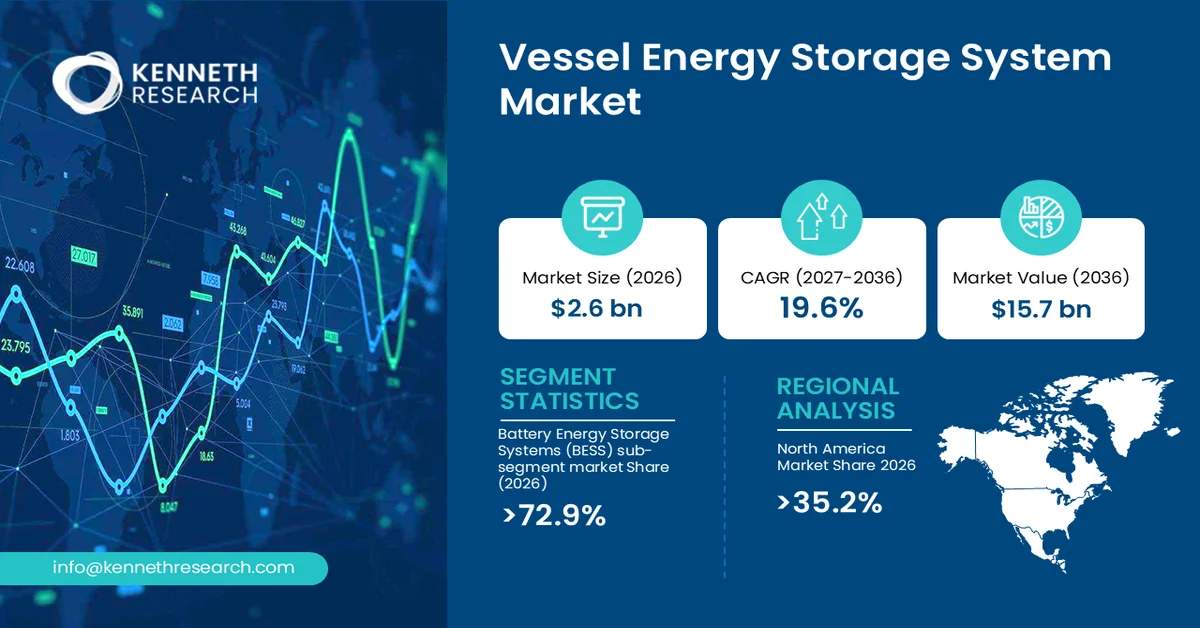
Vessel Energy Storage System Market size was valued at USD 2.6 billion in 2026 and is projected to reach USD 15.7 billion by the end of 2036, rising at a CAGR of 19.6% during the forecast period, i.e., 2027–2036. In 2027, the industry size of the Global vessel energy storage system market is estimated at USD 3.1 billion .
The primary growth driver is maritime decarbonization regulation, which is accelerating vessel adoption of battery and hybrid energy-storage technologies. IMO requirements are increasing pressure on shipowners to improve energy efficiency and reduce carbon intensity, while its decarbonization strategy explicitly recognizes electric and hybrid power among the technological pathways available to shipping.
The vessel energy storage system market comprises technologies, equipment, and integrated solutions that store electrical energy for use aboard marine vessels. These systems primarily include rechargeable battery-based storage and associated power-conversion, battery-management, monitoring, safety, and thermal-management components. They can operate as standalone energy sources or alongside conventional engines and other onboard power-generation technologies.
Vessel energy storage systems are designed to support propulsion, auxiliary loads, peak-power management, energy recovery, load balancing, and reduced engine operation. Depending on vessel configuration and operating requirements, storage can enable fully electric operation or provide hybrid functionality in combination with internal-combustion propulsion.
Key Vessel Energy Storage System Market Insights Summary:
Key Takeaways: Market Trends & Insights
- Global market value rises from USD 2.6 Billion in 2026 to USD 15.7 Billion by 2036
- The market expands at a CAGR of 19.6% during 2027–2036
- Battery Energy Storage Systems lead the Type segment with a 72.9% market share in 2026
- North America dominates the regional landscape with a 35.2% market share in 2026
- Hybrid Systems represent the fastest-growing Energy Source segment, supported by increasing vessel electrification and demand for flexible propulsion architectures
Market Drivers
- Regulatory push for maritime decarbonization
- Increasing demand for hybrid and electrified vessel architectures
- Advances in battery energy density, power electronics, and onboard energy management
- Expansion of shore-side charging and marine electrification infrastructure
Challenges
- Maritime safety and thermal-runaway risk
- Regulatory and design-approval complexity
Vessel Energy Storage System Market Overview & Supply Chain
Global adoption of vessel energy storage systems is increasing as shipowners and vessel operators seek practical technologies for decarbonization, energy efficiency, and flexible onboard power management. Battery and hybrid architectures can reduce reliance on conventional propulsion during selected operating conditions, support peak-load management, and facilitate integration with alternative power sources. Regulatory pressure is reinforcing this transition as maritime stakeholders respond to increasingly stringent environmental-performance requirements. UN Trade and Development reports that shipping accounts for 3% of global greenhouse gas emissions, highlighting the sector’s material environmental footprint and the industrial relevance of technologies capable of improving vessel energy performance.
The vessel energy storage system value chain begins with raw-material and component suppliers providing battery-active materials, metals, electronic components, thermal-management equipment, enclosures, cabling, and power-conversion hardware. Cell and module manufacturers convert these inputs into storage units, while system integrators combine cells, battery-management systems, power electronics, cooling, monitoring, protection, and marine-certified enclosures into complete solutions. Specialized engineering firms and ship-equipment manufacturers then adapt systems to vessel-specific electrical architectures and safety requirements. Distribution occurs through marine-equipment suppliers, shipyards, system integrators, and direct procurement channels. End users include commercial shipping operators, ferry companies, offshore-service operators, passenger-vessel owners, naval and government fleets, and other marine transport providers.
Vessel Energy Storage System Market: Growth Drivers & Challenges
Growth Drivers
- Regulatory push for maritime decarbonization: The tightening global decarbonization framework is accelerating investment in onboard energy-storage technologies because vessel operators increasingly need solutions that reduce fuel consumption and support lower-emission operating profiles. Battery systems can provide propulsion assistance, capture regenerative energy, manage transient loads, and enable zero-emission operation in suitable vessel segments. The regulatory mechanism is particularly important because compliance requirements influence fleet-renewal decisions and encourage shipowners to evaluate hybrid and electric architectures during newbuild and retrofit projects.
- Increasing demand for hybrid and electrified vessel architectures: The expansion of hybrid and electrified vessel designs is creating a broader role for onboard energy storage across commercial and specialized marine applications. Storage systems allow engines and generators to operate more efficiently by supplying supplemental power during peak-demand periods and absorbing excess generation when available. This architecture can also improve maneuvering performance, reduce engine cycling, and provide quieter operation in environmentally sensitive areas. Hybridization is particularly relevant for vessels with variable duty cycles, frequent port calls, or predictable routes, where batteries can be integrated into operational energy-management strategies.
Challenges
- Maritime safety and thermal-runaway risk: The principal technical restraint is the elevated safety burden associated with high-energy battery systems installed in confined marine environments. Lithium-ion cells can experience thermal runaway, potentially producing fire, toxic gases, and propagation between adjacent battery units. Unlike land-based installations, vessels have constrained evacuation routes, limited firefighting resources, and demanding requirements for system isolation and ventilation. These risks increase engineering complexity because operators require battery-management systems, thermal controls, gas detection, fire suppression, protective enclosures, and carefully designed installation procedures.
- Regulatory and design-approval complexity: A second restraint is the evolving regulatory environment surrounding battery-powered and hybrid vessels. Marine energy-storage installations must satisfy safety, electrical, fire-protection, classification, and vessel-specific design requirements, but international rules are still being developed for some emerging configurations. This creates uncertainty for shipowners and shipbuilders when selecting technologies whose technical specifications may need to accommodate future regulatory changes. The impact extends across the value chain: manufacturers must maintain flexible designs, engineering teams must interpret evolving requirements, and shipyards may need additional validation before commissioning.
Vessel Energy Storage System Market Size and Forecast:
| Report Attribute | Details |
|---|---|
| Base Year |
2026 |
| Forecast Period |
2027-2036 |
| CAGR |
19.6% |
| Base Year Market Size (2026) |
USD 2.6 Billion |
| Forecast Year Market Size (2036) |
USD 15.7 Billion |
| Regional Scope |
|
Vessel Energy Storage System Market Segmentation Analysis:
Type Segment Analysis
In the type segment, Battery Energy Storage Systems (BESS) sub-segment is anticipated to capture the largest market share of 72.9% the end of 2026.
Battery Energy Storage Systems (BESS) represent the leading application segment because they provide the core electrical-storage capability required for propulsion support, peak-load management, auxiliary power, and hybrid vessel operation. Demand is being reinforced by shipowners seeking flexible energy-management solutions that can reduce engine loading and improve operational efficiency without requiring a fully electric vessel architecture. The broader battery ecosystem is also strengthening supply availability and technology maturity. According to the International Energy Agency, more than 40 GW of battery storage capacity was added in the power sector in 2023, demonstrating accelerating deployment of battery-based storage technologies across energy systems.
Energy Source Segment Analysis
The Hybrid Systems is projected to grow as the second-largest segment in the Vessel Energy Storage System market due to four converging demand drivers.
Hybrid systems are projected to be the fastest-growing energy-source segment because they offer vessel operators a practical transition between conventional propulsion and full electrification. By combining engines with battery energy storage, hybrid architectures can supply peak power, support low-speed maneuvering, reduce generator loading, and enable quieter operation in ports or environmentally sensitive areas. Government-backed procurement is reinforcing adoption: Canada’s federal government is developing replacement ferries with diesel-electric hybrid propulsion and onboard energy storage, while the United States has also funded electric and hybrid ferry projects. The Canadian program illustrates supply-side momentum as shipyards, propulsion suppliers, and battery integrators develop marine-specific hybrid configurations. Hybrid systems are particularly attractive where full battery propulsion remains constrained by route length, charging availability, or vessel power requirements.
Our in-depth analysis of the vessel energy storage system market includes the following segments:
|
Segment |
Sub-segment |
|
Type |
|
|
Energy Sources |
|
|
Vessel Type |
|
Vessel Energy Storage System Market Regional Insights:
North America Market Trends & Insights:
North America Vessel Energy Storage System market is projected to hold the largest revenue share of 35.2% by the end of 2026.
It is supported by strong vessel electrification activity, established marine engineering capabilities, and policy-led investment in cleaner transportation technologies. The region benefits from a mature shipbuilding and maritime-services ecosystem, while U.S. and Canadian authorities are supporting battery, hybrid, and alternative-propulsion demonstrations.
The United States represents a major demand center because federal and state initiatives are supporting maritime decarbonization, vessel electrification, and advanced energy-storage development. Public-sector programs are also encouraging collaboration between technology developers and vessel operators. Canada is strengthening regional adoption through fleet modernization, with Transport Canada pursuing diesel-electric hybrid ferries incorporating onboard battery energy storage. The Canadian Coast Guard is likewise incorporating hybrid-electric technology into fleet renewal, supporting domestic marine engineering and integration capabilities. Together, these developments position North America for continued investment in vessel energy storage, particularly across ferries, government fleets, commercial vessels, and specialized marine applications.
Asia Pacific Market Trends & Insights:
Asia Pacific presents strong opportunities for vessel energy storage systems as maritime manufacturing capacity, coastal trade, port activity, and government-led green-shipping programs converge. China is strengthening the supply ecosystem through policies supporting high-energy-density, high-safety marine batteries, electric vessels, and associated charging or swapping infrastructure.
China is positioned as a major regional technology and manufacturing center. Government policy explicitly promotes green intelligent ship development and battery-powered marine applications, while domestic shipbuilders are progressing with large electric-container-vessel programs.
India is developing demand through green-waterway initiatives and domestic shipbuilding incentives. Government-backed projects include hybrid-electric passenger vessels using fast-charging batteries, while policy support extends financial assistance to vessels equipped with fully electric or hybrid propulsion.
Leading Companies Operating in the Global Vessel Energy Storage System Market:
Here is a list of upstream, downstream, and key players operating in the vessel energy storage system competitive ecosystem:
- Corvus Energy (Norway)
- Company Overview
- Business Strategy
- Key Product Offerings
- Financial Performance
- Key Performance Indicators
- Risk Analysis
- Recent Development
- Regional Presence
- SWOT Analysis
- Wärtsilä Corporation (Finland)
- ABB Ltd (Switzerland)
- Siemens Energy AG (Germany)
- Leclanché SA (Switzerland)
- SAFT (TotalEnergies) (France)
Recent Developments
- In January 2026, Siemens Energy and ABS launched a joint development project to improve lithium-ion battery safety for marine and offshore applications. The partnership uses advanced modeling and simulation to better understand thermal runaway behavior under extreme conditions, supporting safer design, verification, and operation of energy storage systems.
- In May 2026, Corvus Energy and BYD Energy Storage signed a Strategic Cooperation Agreement to co-develop next-generation lithium iron phosphate (LFP) marine battery systems. The partnership combines Corvus's marine integration expertise with BYD's advanced cell technology to reduce system costs while maintaining safety and performance standards for demanding maritime environments.
Frequently Asked Question
In 2026, the vessel energy storage system market reached USD 2.6 Billion.
The vessel energy storage system market is projected to reach USD 15.7 Billion by the end of 2036, expanding at a CAGR of 19.6% over the forecast period (2027-2036).
The major players in the market are Corvus Energy, Wärtsilä Corporation, ABB Ltd, Siemens Energy AG, Leclanché SA, SAFT (TotalEnergies), and others.
In the Type segment, the Battery Energy Storage Systems (BESS) sub-segment is anticipated to capture the largest market share of 72.9% in 2026 and exhibit lucrative growth opportunities during 2027-2036. This growth trajectory is largely attributed to increasing demand for flexible onboard energy management and hybrid vessel operation.
North America is projected to hold the largest market share of 35.2% in 2026 and provide more business opportunities in the future. Continuous investments in vessel electrification, maritime decarbonization, and advanced energy-storage technologies in the United States and Canada are fostering the region's dominance.
Why Choose Kenneth Research ?
-
Insight with Impact : We don’t just gather data — we uncover stories, trends, and opportunities that fuel business growth.
-
Experts Who Get It : Our team speaks your industry’s language and knows what really matters to your customers and market.
-
Custom-Built for You : Forget one-size-fits-all. We craft research and consulting solutions as unique as your business vision.
-
Partners, Not Just Providers : We work with you, not for you — collaborating closely to turn insights into smart, strategic moves.
-
Results That Speak : Our work powers brands, startups, and industry leaders alike — with a track record of ideas that work in the real world.
Report ID: 1316 |
Published Date: 10 Sep 2026 |
Report Format: |
Delivery Timeline: 48-72 Business Hours

Copyright © 2025 Kenneth Research. All rights reserved. Terms of Use | Privacy Policy
