Report ID: 1308 |
Published Date: 11 Sep 2026 |
Report Format: |
Delivery Timeline: 48-72 Business Hours
UV LED Market Outlook:
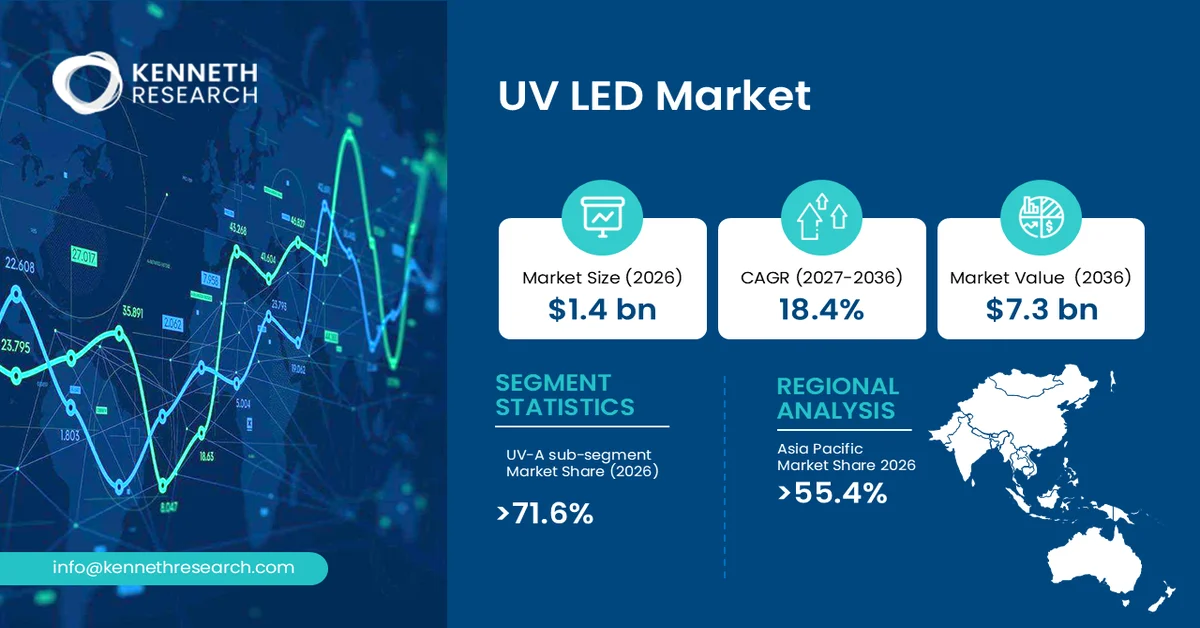
UV LED Market size was valued at USD 1.4 billion in 2026 and is projected to reach USD 7.3 billion by the end of 2036, rising at a CAGR of 18.4% during the forecast period, i.e., 2027–2036. In 2027, the industry size of the - UV LED market is estimated at USD 1.6 billion.
The primary growth driver for the - UV LED market is the expanding replacement of conventional ultraviolet lamps across curing, disinfection, and industrial applications.
The UV LED market comprises semiconductor-based light-emitting diode technologies designed to generate ultraviolet radiation for commercial, industrial, medical, and specialized applications. UV LEDs are generally categorized into UV-A, UV-B, and UV-C technologies, with different wavelength ranges supporting distinct application requirements.
Key characteristics include compact form factors, directional light emission, rapid electronic control, long operating potential, and compatibility with mercury-free system architectures. UV-A LEDs are particularly relevant to curing processes involving inks, coatings, adhesives, and polymers, while UV-B technologies support selected phototherapy applications and UV-C devices are increasingly evaluated for disinfection and water-treatment systems.
Key UV LED Market Insights Summary:
UV LED Market - Key Takeaways & Market Trends
- UV LED market is projected to grow from USD 1.4 billion in 2026 to USD 7.3 billion by 2036, expanding at a 18.4% CAGR.
- Asia-Pacific accounted for the largest regional share at 55.4% in 2026, supported by advanced semiconductor manufacturing, electronics production, and expanding industrial applications across Japan and China.
- UV-A remains the leading Technology segment with a 71.6% share in 2026, supported by extensive use in industrial curing, printing, coatings, adhesives, and polymer-processing applications.
- Curing (Inks, Coatings, and Adhesives) is positioned as a key Application segment, benefiting from demand for rapid, precise, mercury-free curing solutions across printing, packaging, electronics, and industrial manufacturing.
Market Drivers
- Rising adoption of UV LEDs for industrial curing
- Expansion of UV-based disinfection and water treatment
- Increasing demand for mercury-free ultraviolet technologies
- Growing integration of UV LEDs into automated and compact treatment systems
Challenges
- High manufacturing and system costs
- Thermal management and performance limitations
UV LED Market: Market Overview & Supply Chain
Adoption of the UV LED market is increasing as manufacturers and infrastructure operators seek compact, controllable, mercury-free ultraviolet sources for curing, disinfection, water treatment, and specialized industrial processes. UV-based technologies are already used across healthcare, water treatment, manufacturing, and consumer applications. In 2024, the U.S. National Institute of Standards and Technology (NIST) highlighted applications ranging from hospital sanitization and water disinfection to UV curing, while also upgrading its ultraviolet calibration capabilities to support industry and ensure accurate UV-source performance.
The industry value chain begins with semiconductor materials, substrates, epitaxial layers, electrode materials, packaging materials, phosphor or optical components where applicable, thermal-management materials, and electronic drivers. LED manufacturers convert these inputs into UV LED chips, packages, arrays, and modules through epitaxial growth, wafer processing, die fabrication, packaging, testing, and binning. System manufacturers then integrate UV LED modules with optics, heat sinks, power electronics, sensors, controls, and application-specific housings. Distribution occurs through direct OEM relationships, specialized equipment manufacturers, industrial suppliers, technology integrators, and application-focused distributors.
UV LED Market: Growth Drivers & Challenges
Growth Drivers
- Rising Adoption of UV LEDs for Industrial Curing: The expanding use of UV LEDs in curing inks, coatings, adhesives, and polymers is a major growth driver for the UV LED market. UV LED curing enables manufacturers to achieve rapid, localized curing while supporting compact equipment designs and digitally controlled production lines. The technology is increasingly relevant to printing, packaging, electronics, automotive components, and specialty coatings, where production flexibility and process consistency are important. The U.S. Department of Energy identifies UV curing of inks and polymers as an important application for UV LED technology, particularly because LEDs can provide controllable ultraviolet output without relying on conventional mercury-vapor sources.
- Expansion of UV-Based Disinfection and Water Treatment: Growing demand for efficient ultraviolet disinfection is creating additional opportunities for UV LED technologies across water, air, and surface-treatment applications. UV LEDs can provide compact ultraviolet sources that can be incorporated into decentralized treatment equipment and application-specific systems. The U.S. Environmental Protection Agency conducted research with Washington University and AquiSense Technologies to develop and test small-scale UV-C LED water-treatment devices, demonstrating government-supported development of UV LED systems for water treatment.
Challenges
- High Manufacturing and System Costs: UV LED systems can require sophisticated semiconductor manufacturing, thermal management, optical design, and power electronics. High-performance UV LEDs are more technically demanding than conventional visible-light LEDs because ultraviolet wavelengths require specialized materials and careful device engineering. These requirements can increase component and system costs, particularly for high-output applications.
- Thermal Management and Performance Limitations: UV LEDs can generate substantial heat within compact packages, making thermal management critical to maintaining optical output, reliability, and operating life. Performance can also vary significantly across wavelengths and operating conditions. In applications such as water disinfection, achieving uniform UV exposure requires careful optical and reactor design. EPA-supported research into UV-C LED water-treatment systems highlights the importance of developing application-specific configurations rather than treating the LED source as a standalone component.
UV LED Market Size and Forecast:
| Report Attribute | Details |
|---|---|
| Base Year |
2026 |
| Forecast Year |
2027-2036 |
| CAGR |
18.4% |
| Base Year Market Size (2026) |
USD 1.4 billion |
| Forecast Year Market Size (2036) |
USD 7.3 billion |
| Regional Scope |
|
UV LED Market: Segment Analysis
Technology Segment Analysis
In the technology segment, the UV-A sub-segment is anticipated to maintain its leading position, accounting for 71.6% in 2026.
UV-A LEDs have broad applicability in industrial curing, particularly for inks, coatings, adhesives, and polymer-based materials, making them highly relevant to printing, packaging, electronics, automotive, and manufacturing processes. The U.S. Department of Energy identifies UV curing as a major commercial application of UV radiation and notes that it mainly involves UV-A sources.
The technology also benefits from the advantages of solid-state light sources, including compact designs, controllable output, and compatibility with automated equipment. DOE research identifies UV-A applications as having the broadest commercial use among industrial UV applications, supporting continued demand for this wavelength category.
Application Segment Analysis
In the application segment, the Curing (Inks, Coatings, and Adhesives) sub-segment is projected to grow as manufacturers increasingly adopt UV LED curing systems for faster, more controlled, and energy-efficient production processes. UV LED curing is particularly relevant to industrial manufacturing, printing, packaging, electronics assembly, wood coatings, and specialty adhesives, where precise curing conditions can improve process consistency and support automated production.
The U.S. Department of Energy identifies UV curing of inks and polymers as one of the most commercially established industrial applications for ultraviolet technology, particularly within the UV-A wavelength range. On the supply side, equipment manufacturers are expanding UV LED curing systems with higher optical output, improved cooling, modular configurations, and automated process controls.
Our in-depth analysis of the global UV LED market includes the following segments:
|
Segment |
Sub-segment |
|
Technology |
|
|
Product Form |
|
|
Power Output |
|
|
Application |
|
|
End Use |
|
UV LED Market: Regional Analysis
Asia-Pacific Market Trends & Insights:
Asia-Pacific is the dominant region in the UV LED market, accounting for 55.4% in 2026.
Regional leadership is supported by extensive electronics and semiconductor manufacturing, strong industrial production, established UV LED manufacturing capabilities, and expanding applications in curing, sterilization, water treatment, and sensing. Japan and China are particularly important because of their advanced optoelectronics ecosystems and large manufacturing bases.
Japan represents a technology-intensive market supported by advanced semiconductor research, precision manufacturing, and established optical and lighting industries. Its industrial base provides opportunities for UV-A curing and other specialized UV LED applications.
China provides substantial production and consumption opportunities because of its large electronics, semiconductor, printing, packaging, and manufacturing industries. Government emphasis on industrial modernization and environmental technologies further supports adoption of energy-efficient ultraviolet solutions.
North America Market Trends & Insights:
North America is a significant market for the UV LED market, supported by advanced manufacturing, healthcare infrastructure, water-treatment systems, and growing demand for mercury-free ultraviolet technologies. The region's strong R&D ecosystem and adoption of automated industrial processes are creating opportunities for UV LEDs in curing, disinfection, sensing, and phototherapy. Government-supported research and technology development are also encouraging improvements in UV LED efficiency and application performance.
In the U.S., demand is supported by established printing, electronics, healthcare, water treatment, and industrial manufacturing sectors. The country also has a strong ecosystem of semiconductor developers, technology companies, and research institutions supporting UV LED innovation.
Canada offers opportunities through water treatment, environmental applications, healthcare, and advanced manufacturing. Increasing emphasis on clean technologies and efficient treatment systems is supporting the use of compact, controllable UV sources.
UV LED Market: Competitive Landscape
Here is a list of upstream, downstream, and key players operating in the UV LED market competitive ecosystem:
- Nichia Corporation (Japan)
- Company Overview
- Business Strategy
- Key Product Offerings
- Financial Performance
- Key Performance Indicators
- Risk Analysis
- Recent Development
- Regional Presence
- SWOT Analysis
- Seoul Viosys (South Korea)
- ams OSRAM (Germany)
Recent Developments
- January 2026 — Nichia launched its Mercury-Free Project, replacing UV mercury lamps with LED-based light sources on its own production lines.
- May 2025-- Seoul Viosys announced that it had achieved the No. 1 position in UV LEDs for the sixth consecutive year, based on TrendForce's 2024 assessment.
Frequently Asked Question
In 2026, the UV LED Market exceeded USD 1.4 billion.
The UV LED Market is projected to reach USD 7.3 billion by the end of 2036, expanding at a CAGR of 18.4% over the forecast period (2027-2036).
The major players in the market are Nichia Corporation, Seoul Viosys, ams OSRAM, Luminus Devices, Crystal IS, and others.
In the Technology segment, the UV-A sub-segment is anticipated to capture the largest market share of 71.6% in the future and exhibit lucrative growth opportunities during 2027-2036.
Asia-Pacific is projected to hold the largest market share of 55.4% by the end of 2026 and provide more business opportunities in the future.
Why Choose Kenneth Research ?
-
Insight with Impact : We don’t just gather data — we uncover stories, trends, and opportunities that fuel business growth.
-
Experts Who Get It : Our team speaks your industry’s language and knows what really matters to your customers and market.
-
Custom-Built for You : Forget one-size-fits-all. We craft research and consulting solutions as unique as your business vision.
-
Partners, Not Just Providers : We work with you, not for you — collaborating closely to turn insights into smart, strategic moves.
-
Results That Speak : Our work powers brands, startups, and industry leaders alike — with a track record of ideas that work in the real world.
Report ID: 1308 |
Published Date: 11 Sep 2026 |
Report Format: |
Delivery Timeline: 48-72 Business Hours

Copyright © 2025 Kenneth Research. All rights reserved. Terms of Use | Privacy Policy
