Report ID: 1172 |
Published Date: 25 Aug 2026 |
Report Format: |
Delivery Timeline: 48-72 Business Hours
UV Coatings Market Outlook:
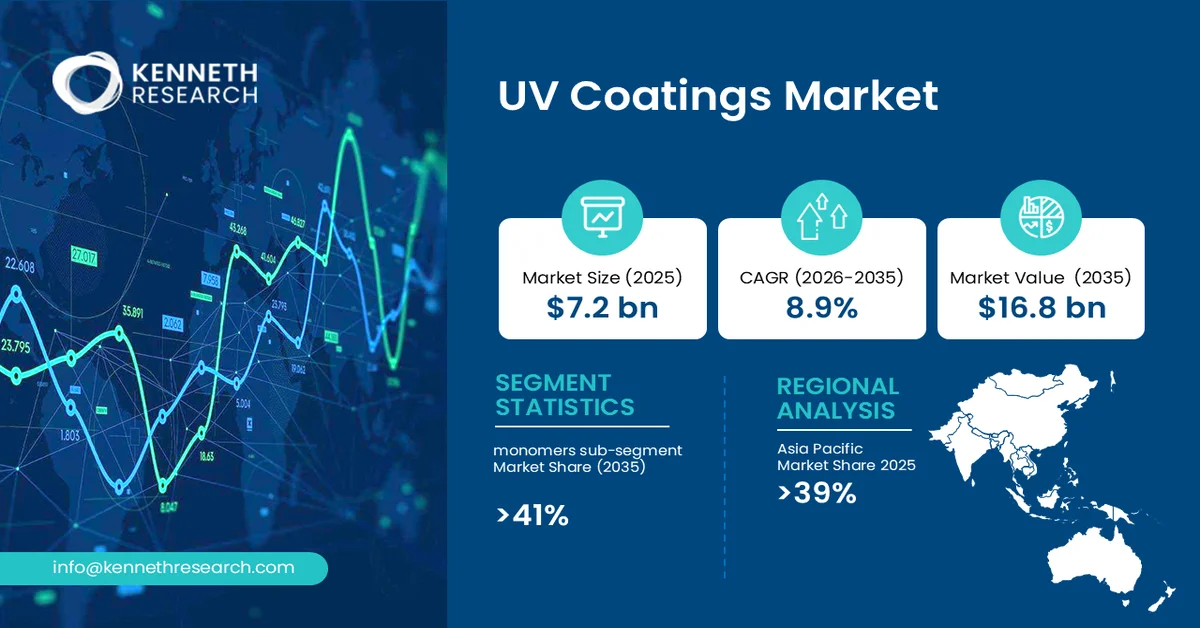
UV Coatings Market size was valued at USD 7.2 billion in 2025 and is projected to reach USD 16.8 billion by the end of 2035, rising at a CAGR of 8.9% during the forecast period, i.e., 2026-2035. In 2026, the industry size of the UV Coatings is estimated at USD 7.8 billion.
Growing demand for fast-curing, low-emission coating technologies is a key growth driver for the UV Coatings Market. UV coatings cure rapidly under ultraviolet radiation, enabling high production throughput, reduced processing time, and lower solvent emissions.
The UV coatings market comprises coatings formulated to cure rapidly when exposed to ultraviolet radiation, creating durable protective or decorative films on substrates. These systems typically contain reactive components such as monomers, oligomers, photoinitiators, pigments, additives, and other formulation ingredients. Unlike conventional solvent-based coatings that depend on evaporation, UV coatings undergo photochemical polymerization, enabling rapid curing and efficient production processes.
Key characteristics include fast cure speeds, strong adhesion, abrasion resistance, chemical resistance, high surface quality, and the ability to achieve desired functional or decorative properties with relatively efficient material utilization. UV coatings can be formulated for different substrates and application processes, including wood, plastics, metals, paper, electronics, and printed materials.
Key UV Coatings Market Insights Summary:
Key Takeaways: Market Trends & Insights
- UV Coatings Market projected to grow from USD 7.2 billion in 2025 to USD 16.8 billion by 2035 at a 8.9% CAGR.
- Asia Pacific accounted for the largest regional share at 39% in 2025, supported by strong manufacturing activity across Japan and China, particularly in electronics, automotive, packaging, and industrial production.
- Monomers are expected to remain the leading Composition segment with a 41% market share, supported by their essential role in controlling curing behavior, viscosity, adhesion, flexibility, and final coating performance.
- Water-based coatings are projected to gain traction within the Formulation segment as manufacturers seek lower-emission coating technologies while maintaining UV-curing performance and high-quality surface finishes.
- The market is benefiting from increasing demand for rapid-curing technologies, low-emission formulations, UV-LED curing systems, advanced monomer chemistries, and high-performance coatings across industrial manufacturing, electronics, packaging, wood finishing, and other applications.
Market Drivers
- Increasing demand for low-emission and environmentally compliant coating technologies
- Growing adoption of rapid-curing coatings across industrial manufacturing
- Expansion of electronics, packaging, printing, and wood-finishing applications
- Increasing use of UV-LED curing systems and advanced coating formulations
Challenges
- High initial investment and process integration requirements for UV curing systems
- Formulation complexity and substrate-specific curing limitations
UV Coatings Market: Market Overview & Supply Chain
Global adoption of UV coatings is increasing as manufacturers seek faster curing, improved production efficiency, durable surface performance, and lower-emission coating technologies. UV-curable systems are particularly relevant to industrial finishing, wood products, printing, electronics, and other applications where rapid processing can improve manufacturing productivity. The shift toward more efficient production and lower-emission technologies is also strengthening the relevance of advanced curing systems. The International Energy Agency (IEA) reports that global energy efficiency investment reached about USD 660 billion in 2024, reflecting continued investment in technologies and processes that improve energy performance across buildings, industry, and other end-use sectors.
The UV coatings market value chain begins with chemical and specialty-material suppliers providing monomers, oligomers, photoinitiators, pigments, additives, resins, and other formulation inputs. Coating manufacturers combine these materials through formulation, blending, dispersion, quality testing, and application-specific product development to produce UV-curable systems. Manufacturing capabilities focus on achieving controlled viscosity, curing response, adhesion, surface finish, and substrate compatibility. Finished coatings reach customers through direct manufacturer sales, specialty chemical distributors, industrial coating suppliers, and application partners.
UV Coatings Market: Growth Drivers & Challenges
Growth Drivers
- Increasing demand for low-emission and environmentally compliant coatings: Increasing regulatory attention toward volatile organic compound emissions is encouraging manufacturers to evaluate coating technologies that can reduce reliance on conventional solvent-intensive systems. UV coatings are well positioned because they cure through photochemical polymerization rather than relying primarily on solvent evaporation, making them attractive for applications where emission control and production efficiency are important. The regulatory environment is becoming more consequential for coating manufacturers and users. In 2025, the U.S. Environmental Protection Agency (EPA) finalized amendments to national VOC emission standards for aerosol coatings, updating emission limits, reactivity factors, and regulated VOC thresholds.
- Growing adoption of rapid-curing coatings across industrial manufacturing: Manufacturers are increasingly adopting UV coatings where rapid curing can improve production-line efficiency, reduce handling time, and support high-throughput finishing operations. Unlike conventional coatings that may require extended drying or thermal curing, UV systems can achieve rapid polymerization when exposed to appropriate radiation, allowing coated components to move quickly through subsequent manufacturing stages. This characteristic is particularly valuable in automated production environments such as furniture finishing, electronics, printing, packaging, and specialty industrial components. The ability to reduce curing-space requirements and integrate coating processes into continuous production lines can also improve manufacturing flexibility.
Challenges:
- High initial investment and process integration requirements: Adoption of UV coatings can be constrained by the capital expenditure required to install or upgrade UV curing equipment, particularly when manufacturers transition from conventional thermal or air-drying coating lines. Industrial users may need specialized lamps or UV-LED systems, shielding, ventilation, conveyors, controls, and process modifications to integrate curing into existing production lines. These requirements can be particularly challenging for smaller manufacturers operating with limited investment budgets or legacy equipment. The commercial impact extends beyond equipment acquisition because operators may also require technical training and process optimization to achieve consistent curing performance.
- Formulation complexity and substrate-specific curing limitations: UV coatings require carefully engineered formulations and controlled curing conditions, creating technical challenges when manufacturers serve diverse substrates and demanding applications. UV radiation must reach the reactive coating sufficiently to achieve complete polymerization, which can become difficult with highly pigmented, opaque, thick, or geometrically complex coatings. Adhesion and curing behavior can also vary across plastics, metals, wood, and other substrates, requiring application-specific formulation adjustments and process optimization. These technical requirements increase research, testing, and quality-control demands for coating producers and industrial users.
UV Coatings Market Size and Forecast:
| Report Attribute | Details |
|---|---|
| Base Year |
2025 |
| Forecast Year |
2026-2035 |
| CAGR |
8.9% |
| Base Year Market Size (2025) |
USD 7.2 billion |
| Forecast Year Market Size (2035) |
USD 16.8 billion |
| Regional Scope |
|
UV Coatings Market Segmentation Analysis:
Composition Segment Analysis
In the composition segment, the monomers sub-segment is anticipated to capture the largest market share of 41% by the end of 2035.
In the composition segment, monomers are anticipated to remain the leading sub-segment, supported by their essential role in UV-curable formulations and their influence on coating viscosity, reactivity, adhesion, flexibility, hardness, and final film performance. Demand is strengthened by the expanding use of UV coatings across wood finishing, printing, electronics, plastics, and industrial applications, where formulators require precise control over curing behavior and surface characteristics. Industry adoption is also supported by continued development of reactive monomers with improved functionality and application-specific performance.
Formulation Segment Analysis
The Water-based Coatings formulation segment is projected to grow as manufacturers increasingly seek coating systems that combine UV-curing performance with lower-emission formulation characteristics. Demand is supported by applications across wood, paper, plastics, metals, and glass, where producers require improved surface performance while addressing environmental requirements. Industry adoption is also benefiting from advances in waterborne UV-curable polyurethane and related formulations, which are being developed to combine rapid photochemical curing with desirable physicochemical and optical properties. On the supply side, formulation developers are expanding resin, dispersion, and additive technologies to improve stability, adhesion, curing response, and substrate compatibility.
Our in-depth analysis of the global UV coatings market includes the following segments:
|
Segment |
Sub-segment |
|
Composition |
|
|
Formulation |
|
|
Application |
|
|
End User |
|
UV Coatings Market Regional Insights:
Asia- Pacific Market Trends & Insights:
Asia Pacific accounted for 39% of the UV coatings market in 2025, making it the leading regional market.
Its dominance is supported by extensive manufacturing activity, expanding electronics and automotive production, growing packaging and printing industries, and increasing adoption of advanced industrial finishing technologies. Japan and China provide particularly strong demand bases because of their established manufacturing ecosystems and continued investment in higher-productivity production processes. Government policy supporting industrial modernization and manufacturing competitiveness further strengthens the regional environment for UV-curable coating technologies. Japan's Ministry of Economy, Trade and Industry (METI) maintains comprehensive production statistics covering manufactured chemical products, plastics, paper, machinery, electronics, and other industries that represent important end-use sectors for UV coatings.
Japan represents a mature market supported by sophisticated electronics, automotive, precision manufacturing, furniture, and industrial production sectors. Demand for high-performance finishes and efficient curing technologies supports continued UV coating adoption.
China provides substantial expansion opportunities through its large manufacturing base, packaging industry, electronics production, and industrial modernization. The country's broad manufacturing ecosystem creates opportunities for UV coatings across multiple substrates and applications.
North America Market Trends & Insights:
North America represents a significant opportunity for the UV Coatings Market, supported by established manufacturing industries, advanced coating technologies, and growing demand for efficient and lower-emission finishing solutions. The region's industrial base spans automotive components, electronics, packaging, furniture, printing, and specialty manufacturing, creating diverse applications for UV-curable coatings
The U.S. represents the principal market in North America, supported by its extensive manufacturing base, sophisticated coating industry, and strong demand for advanced surface-protection technologies. Applications across electronics, automotive, packaging, wood products, and industrial components provide multiple avenues for UV coating adoption.
Canada offers additional opportunities through its manufacturing, wood-product, packaging, and industrial sectors, where durable and efficient coating solutions are increasingly relevant. Together, the U.S. and Canada provide a mature customer base and established technical infrastructure for UV coating manufacturers, while continued investment in production efficiency and environmentally preferable coating technologies should create further opportunities across the region.
Leading Companies Operating in the Global UV Coatings Market:
Here is a list of upstream, downstream, and key players operating in the global UV coatings market competitive ecosystem:
- BASF(United States)
- Company Overview
- Business Strategy
- Key Product Offerings
- Financial Performance
- Key Performance Indicators
- Risk Analysis
- Recent Development
- Regional Presence
- SWOT Analysis
- Allnex(Belgium)
- DIC Corporation(Japan)
- Sherwin-Williams(United States)
- Eternal Materials Co., Ltd.(Taiwan)
Recent Developments
- October 2025: BASF introduced Tinuvin® NOR® 600, a next-generation NOR-HALS light stabilizer designed to improve UV and heat resistance in PVC and polyolefin applications.
Frequently Asked Question
In 2025, the UV coatings market exceeded USD 7.2 billion.
The UV coatings market is projected to reach USD 16.8 billion by the end of 2035, expanding at a CAGR of 8.9% over the forecast period (2026-2035).
The major players in the market are allnex, DIC Corporation, Sherwin-Williams, Eternal Materials Co., Ltd., Dymax Corporation, and others.
In the composition segment, the Monomers sub-segment is anticipated to capture the largest market share of 41% in the future and exhibit lucrative growth opportunities during 2026-2035. This growth trajectory is largely attributed to the essential role of monomers in controlling curing behavior and coating performance.
Asia Pacific is projected to hold the largest market share of 39% by the end of 2025 and provide more business opportunities in the future. Strong manufacturing activity in Japan and China, particularly across electronics, automotive, packaging, and industrial production, is fostering the region's dominance.
Why Choose Kenneth Research ?
-
Insight with Impact : We don’t just gather data — we uncover stories, trends, and opportunities that fuel business growth.
-
Experts Who Get It : Our team speaks your industry’s language and knows what really matters to your customers and market.
-
Custom-Built for You : Forget one-size-fits-all. We craft research and consulting solutions as unique as your business vision.
-
Partners, Not Just Providers : We work with you, not for you — collaborating closely to turn insights into smart, strategic moves.
-
Results That Speak : Our work powers brands, startups, and industry leaders alike — with a track record of ideas that work in the real world.
Report ID: 1172 |
Published Date: 25 Aug 2026 |
Report Format: |
Delivery Timeline: 48-72 Business Hours

Copyright © 2025 Kenneth Research. All rights reserved. Terms of Use | Privacy Policy
