Report ID: 1400 |
Published Date: 25 Sep 2026 |
Report Format: |
Delivery Timeline: 48-72 Business Hours
Utility and Energy Analytics Market Outlook:
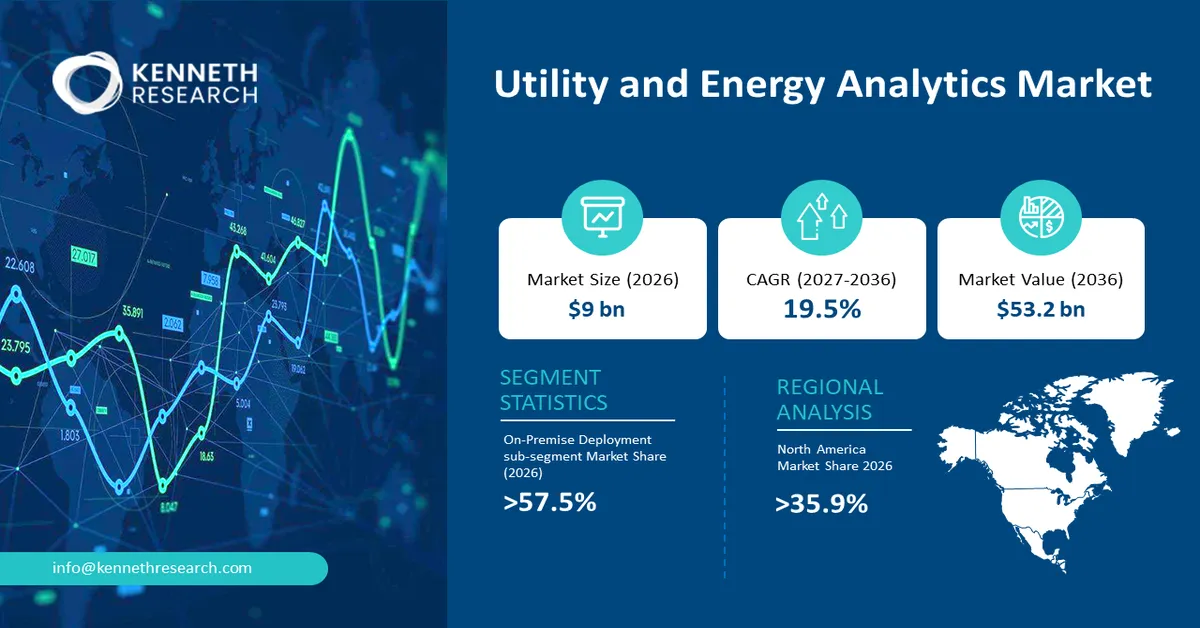
Utility and Energy Analytics Market size was valued at USD 9 billion in 2026 and is projected to reach USD 53.2 billion by the end of 2036, rising at a CAGR of 19.5% during the forecast period, i.e., 2027-2036. In 2027, the industry size of the utility and energy analytics is estimated at USD 10.7 billion.
The primary growth driver for the utility and energy analytics market is the increasing adoption of data-driven technologies to modernize electricity infrastructure and improve operational efficiency.
The utility and energy analytics market comprises software, platforms, solutions, and analytical services used by utilities and energy organizations to collect, process, analyze, visualize, and interpret data generated across energy operations. These solutions support applications including energy demand forecasting, asset management, grid monitoring, predictive maintenance, outage management, customer analytics, energy consumption analysis, renewable energy integration, and operational optimization.
The market covers analytics deployed across electricity generation, transmission, distribution, and energy consumption environments. Deployment models include on-premise and cloud-based solutions, while end users include electric utilities and other organizations operating across the energy value chain.
Key Utility and Energy Analytics Market Insights Summary:
Key Takeaways: Market Trends & Insights
- The utility and energy analytics market is projected to grow from USD 9 billion in 2026 to USD 53.2 billion by 2036, registering a CAGR of 19.5% during 2027-2036.
- Growing grid modernization, digitalization, and deployment of connected energy infrastructure are driving demand for advanced analytics across utility operations.
- On-premise deployment is the leading Deployment Type segment, accounting for 57.5% in 2026, supported by utilities’ need for data control, security, system integration, and operational continuity.
- Electric utilities represent the key Product Type segment, supported by increasing requirements for demand forecasting, asset monitoring, predictive maintenance, grid optimization, and renewable-energy integration.
- North America dominates the market with a 35.9% share in 2026, supported by advanced utility infrastructure and continued digital transformation across the U.S. and Canada.
Market Drivers
- Accelerating grid modernization and data-driven utility operations
- Increasing adoption of artificial intelligence and predictive analytics
- Growing deployment of smart meters, sensors, and connected energy infrastructure
- Rising need for predictive maintenance, demand forecasting, and renewable-energy integration
Challenges
- Data Integration and Legacy-System Compatibility
- Cybersecurity, Data Governance, and Reliability Risks
Utility and Energy Analytics Market Overview & Supply Chain
The utility and energy analytics market is expanding as utilities and energy organizations increasingly use data-driven technologies to improve operational visibility, asset performance, energy management, and decision-making. The growing deployment of smart meters, connected grid infrastructure, distributed energy resources, renewable generation assets, and digital utility platforms is generating substantial volumes of operational data. Analytics solutions help organizations transform this data into actionable insights for demand forecasting, asset monitoring, predictive maintenance, grid optimization, outage management, and customer engagement.
The supply chain begins with data-generation infrastructure, including smart meters, sensors, grid equipment, renewable energy assets, and other connected devices. Hardware and technology providers supply these systems, while data-management and analytics software providers develop platforms for data collection, integration, processing, visualization, and analysis. System integrators and technology service providers subsequently configure and deploy analytics solutions within utility environments.
Utility and Energy Analytics Market: Growth Drivers & Challenges
Growth Drivers:
- Accelerating grid modernization and data-driven utility operations: The modernization of electricity grids is increasing demand for analytics solutions that can process large volumes of operational data and convert them into actionable intelligence. Utilities are deploying sensors, smart meters, connected equipment, and digital control systems, creating greater requirements for data collection, visualization, forecasting, and real-time analysis. As utilities increasingly integrate distributed generation, storage, and electrified loads, analytics can improve asset monitoring, demand forecasting, outage response, and operational planning. This will encourage utilities to invest in advanced analytics platforms and support continued market expansion as digital grid infrastructure becomes more sophisticated.
- Increasing adoption of artificial intelligence and predictive analytics: The growing adoption of artificial intelligence, machine learning, and predictive analytics is creating new opportunities for utility and energy organizations to improve operational efficiency and decision-making. Advanced analytics can identify patterns across historical and real-time data, enabling utilities to forecast electricity demand, predict equipment failures, optimize energy flows, detect anomalies, and improve outage management. The integration of AI with utility data also allows organizations to move from reactive operations toward predictive and proactive management. This shift can reduce operational inefficiencies while improving asset utilization and supporting more informed investment decisions.
Challenges:
- Data integration and legacy-system compatibility: A major restraint is the difficulty of integrating modern analytics platforms with fragmented and aging utility information technology and operational technology systems. Utilities often operate multiple generations of infrastructure, databases, control systems, smart-meter platforms, and asset-management applications that were developed independently and use different data structures and communication protocols. This fragmentation can make it difficult to establish consistent data flows and create unified analytical environments. Integration projects can therefore require extensive system upgrades, data cleansing, interoperability work, and specialized technical expertise.
- Cybersecurity, data governance, and reliability risks: The increasing connectivity of utility infrastructure creates significant cybersecurity and data-governance challenges for analytics deployments. Analytics platforms may process operational, customer, asset, and grid-performance information, while their integration with operational systems can expand the potential consequences of unauthorized access, data manipulation, or system compromise. The challenge becomes more significant as utilities introduce AI and automated decision-support tools into critical grid operations. These requirements can increase implementation complexity and slow adoption, particularly where organizations have limited digital-security expertise.
Utility and Energy Analytics Market Size and Forecast:
| Report Attribute | Details |
|---|---|
| Base Year |
2026 |
| Forecast Period |
2027-2036 |
| CAGR |
19.5% |
| Base Year Market Size (2026) |
USD 9 billion |
| Forecast Year Market Size (2036) |
USD 53.2 billion |
| Regional Scope |
|
Utility and Energy Analytics Market Segmentation Analysis:
Deployment Type Segment Analysis
In the deployment type segment, the On-Premise Deployment sub-segment is anticipated to capture the largest market share of 57.5% in 2026.
On-premise deployment remains attractive to utilities because it provides organizations with greater control over sensitive operational data, infrastructure configuration, system access, and integration with existing utility information technology and operational technology environments. Utilities managing critical electricity infrastructure often require analytics systems that can be closely aligned with internal security, governance, compliance, and reliability requirements. On-premise platforms can also support integration with legacy systems and specialized applications that may not be readily compatible with external environments. From a commercial perspective, this deployment model creates opportunities for software vendors and system integrators to provide customized analytics infrastructure, implementation, maintenance, and technical-support services.
Product Type Segment Analysis
In the product type segment, the electric utilities sub-segment is anticipated to maintain strong demand as electricity providers increasingly require analytics capabilities to manage complex and increasingly digital power systems. Electric utilities generate and receive extensive operational data from generation assets, transmission networks, distribution infrastructure, smart meters, substations, and customer-management systems. Analytics platforms enable these organizations to analyze this information for demand forecasting, asset performance monitoring, predictive maintenance, outage management, load optimization, and grid planning. The increasing integration of renewable generation, distributed energy resources, battery storage, and electric vehicles is further increasing operational complexity and strengthening the need for advanced analytical capabilities.
Our in-depth analysis of the global utility and energy analytics market includes the following segments:
|
Segment |
Sub-segment |
|
By Deployment |
|
|
By Component |
|
|
By Application |
|
|
Utility Type |
|
|
End-user |
|
Utility and Energy Analytics Market Regional Insights:
North America Market Trends & Insights:
North America is anticipated to dominate the utility and energy analytics market, accounting for 35.9% of the market in 2026. The region’s leadership is supported by the advanced digitalization of utility operations, established electricity infrastructure, increasing deployment of smart-grid technologies, and strong adoption of data analytics across energy organizations.
The U.S. represents a leading country within North America because of its large and technologically advanced electricity sector, extensive utility infrastructure, and ongoing investment in grid modernization.
Canada provides significant opportunities for utility and energy analytics providers through its extensive electricity infrastructure and increasing emphasis on grid modernization, renewable-energy integration, and operational efficiency.
Asia-Pacific Market Trends & Insights:
Asia-Pacific represents a significant growth region for the utility and energy analytics market, supported by expanding electricity infrastructure, rapid digitalization of utilities, increasing renewable-energy deployment, and the modernization of transmission and distribution networks.
Japan offers substantial opportunities for utility and energy analytics providers because of its technologically advanced electricity infrastructure, sophisticated energy-management ecosystem, and emphasis on improving grid efficiency and resilience.
China represents an important growth market due to its large electricity system, continued power-sector modernization, and extensive deployment of digital and smart-grid technologies.
Leading Companies Operating in the Utility and Energy Analytics Market:
Here is a list of upstream, downstream, and key players operating in the global utility and energy analytics market competitive ecosystem:
- Oracle (U.S.)
- Company Overview
- Business Strategy
- Key Product Offerings
- Financial Performance
- Key Performance Indicators
- Risk Analysis
- Recent Development
- Regional Presence
- SWOT Analysis
- GE Vernova (U.S.)
- Itron (U.S.)
- Siemens (Germany)
- SAS (U.S.)
Recent Developments
- April 2026 - Oracle announced new and enhanced AI capabilities across its Utilities Industry Suite, including the Utilities AI Data Platform, AI-powered asset intelligence, meter-data analytics, and data visualization capabilities. The company stated that the enhanced platform is designed to help utilities connect customer, grid, and asset operations.
- January 2026 - Itron announced a collaboration with Snowflake to advance grid planning and utility analytics through an AI-powered data cloud. The combined solution integrates Itron's grid-edge intelligence with Snowflake's data platform to support advanced grid modeling, forecasting, DER integration, and grid modernization.
Frequently Asked Question
In 2026, the utility and energy analytics market exceeded USD 9 billion.
The utility and energy analytics market is projected to reach USD 53.2 billion by the end of 2036, expanding at a CAGR of 19.5% over the forecast period (2027-2036).
The major players in the market are Oracle, GE Vernova, Itron, Siemens, SAS, and others.
In the deployment type segment, the on-premise deployment sub-segment is anticipated to capture the largest market share of 57.5% in the future and exhibit lucrative growth opportunities during 2027-2036.
North America is projected to hold the largest market share of 35.9% by the end of 2026 and provide more business opportunities in the future.
Why Choose Kenneth Research ?
-
Insight with Impact : We don’t just gather data — we uncover stories, trends, and opportunities that fuel business growth.
-
Experts Who Get It : Our team speaks your industry’s language and knows what really matters to your customers and market.
-
Custom-Built for You : Forget one-size-fits-all. We craft research and consulting solutions as unique as your business vision.
-
Partners, Not Just Providers : We work with you, not for you — collaborating closely to turn insights into smart, strategic moves.
-
Results That Speak : Our work powers brands, startups, and industry leaders alike — with a track record of ideas that work in the real world.
Report ID: 1400 |
Published Date: 25 Sep 2026 |
Report Format: |
Delivery Timeline: 48-72 Business Hours

Copyright © 2025 Kenneth Research. All rights reserved. Terms of Use | Privacy Policy
