Report ID: 1004 |
Published Date: 05 Nov 2025 |
Report Format: |
Delivery Timeline: 48-72 Business Hours
U.S. Loyalty Management Market Outlook:
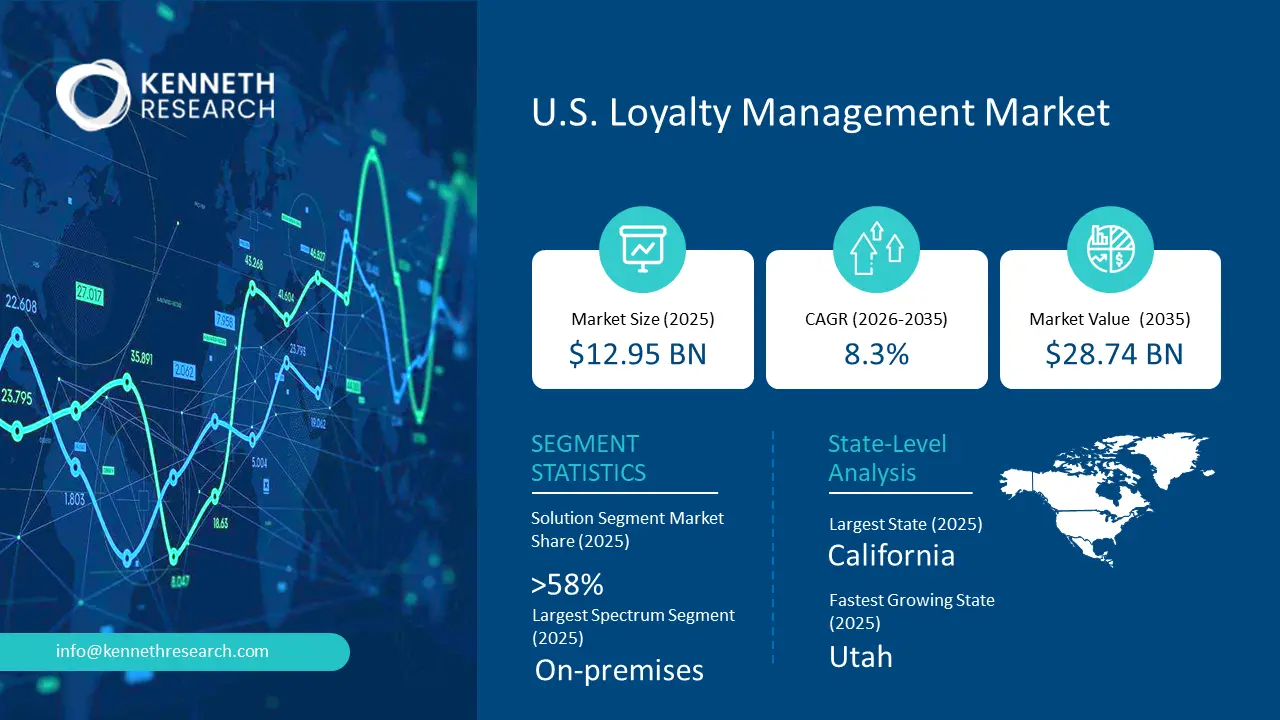
U.S. Loyalty Management Market size was valued at over USD 12.95 billion in 2025 and is projected to cross USD 28.74 billion by 2035, expanding at 8.3% CAGR during 2026-2035. In 2026, the industry size is estimated at USD 13.96 billion.
U.S. Loyalty Management Market Opportunities:
AI-Powered Personalization and Predictive Insights
Artificial intelligence is transforming how loyalty programs anticipate customer behavior and deliver tailored rewards. U.S. companies are leveraging AI-driven analytics to personalize offers, predict churn, and optimize engagement strategies in real time. For instance, Starbucks and Sephora utilize machine learning to track purchase histories and adapt loyalty incentives based on individual preferences, fostering stronger emotional connections with consumers. This data-driven personalization not only enhances retention but also improves cross-selling and upselling efficiency. Businesses can capitalize on this opportunity by integrating AI-based recommendation engines and dynamic segmentation tools to deliver contextually relevant, omnichannel loyalty experiences.
Integration with Digital Wallets and Super Apps
The growing adoption of digital payment ecosystems presents an opportunity for loyalty integration directly within mobile wallets and super apps. Brands are embedding loyalty points, coupons, and membership credentials into Apple Pay, Google Wallet, and other fintech ecosystems to simplify redemption and increase program visibility. For example, American Airlines’ AAdvantage program and Walgreens’ Balance Rewards seamlessly integrate with digital wallets to ensure convenient point accrual and instant reward redemption. This convergence between payments and loyalty programs enhances engagement frequency and strengthens brand stickiness. To seize this opportunity, companies should focus on API-based interoperability, frictionless redemption mechanisms, and secure digital ID authentication within partner ecosystems.
Sustainability-Linked Loyalty Initiatives
As U.S. consumers increasingly prioritize ethical consumption, sustainability-driven loyalty programs are emerging as a competitive differentiator. Brands are offering rewards for eco-friendly actions—such as recycling, carbon offset purchases, or choosing green delivery options. Patagonia and IKEA have introduced reward frameworks that encourage circular economy behaviors, positioning sustainability as part of their loyalty value proposition. Such initiatives deepen trust and resonate with younger, values-driven demographics. Companies can effectively leverage this opportunity by partnering with sustainability platforms, gamifying responsible behaviors, and transparently communicating impact metrics to reinforce brand integrity and purpose-driven loyalty.
U.S. Loyalty Management Market: Growth Drivers & Challenges
Growth Drivers -
- Digital Transformation and Data-Driven Personalization: The rapid digitization of consumer engagement is redefining the U.S. loyalty management market. Brands are increasingly relying on advanced analytics, artificial intelligence (AI), and real-time data integration to personalize customer experiences across channels. This shift enables businesses to move from traditional, points-based rewards toward predictive, behavior-driven programs that enhance retention and brand affinity. For instance, Starbucks’ AI-powered Rewards platform uses machine learning to tailor offers based on purchase history, while American Express leverages data analytics to refine its Membership Rewards program. Companies that integrate omnichannel data and predictive insights are building deeper, more emotionally connected relationships with their customers. To capitalize on this trend, businesses should invest in unified data ecosystems and automation tools that enable real-time personalization and seamless customer journeys.
- Expansion of Omnichannel and Mobile Engagement: The convergence of mobile, online, and in-store channels is fueling innovation in loyalty program design. Consumers now expect consistent recognition and rewards, whether they engage via an app, e-commerce site, or physical store. Mobile-first loyalty programs, in particular, have become pivotal to brand engagement strategies. Retailers like Target and Sephora are leading this evolution — Target Circle combines mobile engagement with in-store experiences, while Sephora’s Beauty Insider app connects loyalty benefits with social and digital channels. The emphasis on mobile accessibility not only drives participation but also generates valuable behavioral data. To remain competitive, companies must ensure loyalty platforms are mobile-responsive, frictionless, and integrated with digital payment and CRM systems to enhance the end-to-end user experience.
- Sustainability and Purpose-Driven Loyalty Models: Consumer preferences are increasingly shaped by social and environmental awareness, driving brands to embed purpose into their loyalty programs. Modern customers favor brands that align rewards with ethical values, such as sustainability, community support, and inclusivity. For example, Marriott’s Bonvoy program allows members to donate points to environmental and humanitarian causes, while outdoor retailer REI’s Co-op Membership ties loyalty directly to sustainability initiatives. This evolution reflects a broader shift from transactional loyalty to emotional and values-based engagement. Companies that design programs emphasizing ethical impact can strengthen brand reputation and customer trust. Businesses should consider integrating green rewards, social impact incentives, or community-driven partnerships to appeal to the growing segment of conscious consumers.
Challenges -
- Data Privacy and Customer Trust Concerns: The U.S. loyalty management market faces a major challenge in maintaining data privacy and customer trust amid evolving regulations and heightened consumer awareness. As loyalty programs rely on extensive customer data to deliver personalization, the risk of misuse or breaches directly threatens brand credibility. The introduction of state-level privacy laws like the California Consumer Privacy Act (CCPA) has compelled companies to adopt stricter data governance measures, increasing operational complexity and compliance costs. Leading players such as Salesforce and Oracle have strengthened their platforms with enhanced consent management tools, encrypted storage, and transparent data-handling practices to assure customers of ethical data use. To navigate this challenge, companies should prioritize privacy-by-design frameworks, integrate real-time compliance monitoring, and emphasize transparent communication that fosters long-term trust while enabling personalized engagement.
- Fragmented Omnichannel Customer Engagement: A second major constraint on market growth is the difficulty of creating a unified, seamless loyalty experience across multiple digital and physical channels. Consumers expect consistent rewards and recognition whether they shop in-store, via mobile apps, or through online platforms—yet many businesses struggle with siloed systems and fragmented data streams. Legacy point-based programs often fail to integrate with newer channels such as mobile wallets, social commerce, or brand communities. In response, companies like Mastercard and Bond Brand Loyalty are investing in API-driven architectures and AI-powered analytics to synchronize data across touchpoints and enhance personalization accuracy. To overcome this barrier, businesses should adopt cloud-native loyalty ecosystems, unify customer identifiers, and leverage predictive analytics to ensure continuity and context across every interaction. This omnichannel cohesion will ultimately deepen engagement and drive sustainable brand loyalty.
U.S. Loyalty Management Market Size and Forecast:
| Report Attribute | Details |
|---|---|
| Base Year |
2025 |
| Forecast Year |
2026-2035 |
| CAGR |
8.3% |
| Base Year Market Size (2025) |
USD 12.95 billion |
| Forecast Year Market Size (2035) |
USD 28.74 billion |
U.S. Loyalty Management Market Segmentation:
The solution segment holds the largest share of the U.S. loyalty management market, accounting for around 58%, due to its critical role in enabling businesses to design, execute, and monitor customer engagement programs effectively. Companies are prioritizing integrated software solutions that combine analytics, omnichannel campaign management, and rewards automation to improve customer retention and brand advocacy. The increasing use of AI and machine learning in these platforms allows firms to personalize incentives and measure behavioral outcomes in real time, strengthening customer relationships. Major players like Salesforce, Oracle, and Adobe are driving growth in this segment by offering cloud-based loyalty platforms that align with data privacy regulations and provide actionable customer insights for marketing teams.
The on-premises segment maintains the largest share in the U.S. loyalty management market, driven by organizations’ emphasis on data control, compliance, and system customization. Many enterprises, particularly in finance, telecom, and retail, prefer on-premises deployments to safeguard sensitive consumer data and maintain internal oversight of reward systems. This approach ensures tighter integration with legacy systems and allows more tailored security configurations. Firms like Oracle, IBM, and SAP continue to provide hybrid and on-premises loyalty solutions that comply with stringent data governance standards while allowing flexible program management. As regulatory scrutiny around data privacy intensifies, on-premises models remain the preferred choice for industries handling high volumes of confidential customer information.
The retail and consumer goods segment holds the largest share of 22.00% in the U.S. loyalty management market due to its deep integration of customer engagement and data-driven personalization strategies. Retailers and consumer brands rely heavily on loyalty programs to retain customers, enhance lifetime value, and differentiate in a highly competitive marketplace. The segment’s dominance stems from the sector’s early adoption of digital loyalty platforms, omnichannel engagement tools, and AI-powered analytics that tailor rewards to individual purchasing behavior. Companies such as Starbucks, Walmart, and Amazon have set benchmarks with sophisticated loyalty ecosystems that merge mobile apps, payment systems, and exclusive perks, fostering strong emotional and transactional connections with consumers. Additionally, the rising emphasis on experience-based loyalty and sustainable reward models has further strengthened the segment’s leadership within the U.S. market.
Large enterprises dominate the loyalty management market with approximately 62% share, primarily because of their extensive customer bases and the strategic importance of maintaining long-term engagement. These organizations invest heavily in customized loyalty ecosystems integrated with CRM and analytics tools to drive brand differentiation. The complexity of managing multi-tier programs across diverse geographies also favors advanced enterprise-level platforms. Companies such as IBM, SAP, and Microsoft cater to this demand by delivering scalable, AI-enhanced loyalty systems that support predictive modeling and customer journey optimization. The need for measurable ROI on customer experience initiatives further reinforces large enterprises’ preference for robust, data-driven loyalty management frameworks.
Our in-depth analysis of the global market includes the following segments:
|
Segment |
Subsegment |
|
Component |
|
|
Deployment |
|
|
Organization Size |
|
|
Vertical |
|
State-Level Analysis for U.S. Loyalty Management Market:
California stands as the largest state in the U.S. loyalty management market. California’s leadership is supported by its deep technology ecosystem (especially in the Bay Area and Silicon Valley) and a high concentration of enterprise software firms that supply loyalty-management, CRM and customer-engagement platforms. For example, major players in the loyalty-management space such as Oracle Corporation and Salesforce, Inc. both base significant operations in California (Silicon Valley, San Francisco area) as part of their broader customer‐engagement portfolios. Add to that the large retail, hospitality and digital-commerce markets in California that adopt advanced loyalty-management solutions, and the state becomes a primary concentration area for this industry.
Utah is emerging as the fastest-growing state in the U.S. loyalty management market. Although the overall loyalty-management market is national, Utah shows one of the highest growth rates in the technology and software publishing sector (with a location quotient of 4.41 for software publishing in 2022) among U.S. states. This strong software and services growth, combined with increasingly favourable business climate, suggests Utah is an expanding base for loyalty-management technology deployment, SaaS startups, and innovation in customer-engagement platforms.
U.S. Loyalty Management Market: Competitive Landscape
- Oracle Corporation: A dominant player offering its “Loyalty” and “CrowdTwist Loyalty & Engagement” cloud solutions, Oracle enables enterprises to design and manage loyalty programmes across omni-channel touchpoints. It emphasises integration with CRM, marketing and commerce stacks, supporting real-time analytics and scalable architectures.
- Salesforce, Inc.: Known for its cloud CRM leadership, Salesforce has extended into loyalty management via a cloud-native, modular loyalty and customer engagement platform. Its strength lies in real-time personalization, ecosystem integration, and leveraging the broader Marketing/Commerce Cloud.
- Adobe Inc.: With its focus on digital-experience platforms, Adobe is applying its analytics and AI capabilities to loyalty management—linking loyalty data with social, web and in-store interactions to support seamless customer journeys.
- SAP SE: SAP brings deep ERP/commerce integration to loyalty programmes, offering capabilities in personalised campaigns, coalition loyalty, and global compliance—making it notable for large enterprises with complex loyalty needs.
- Comarch SA: While based in Poland, Comarch is active in the U.S. loyalty-management space. Its modular, vertical-specific loyalty platform supports B2C, B2B, coalition programmes and benefits from recent partnerships in AI/ML to enhance segmentation and promotion optimisation.
- Epsilon Data Management, LLC: A U.S. data-driven marketing and loyalty firm, Epsilon leverages consumer data platforms and loyalty solutions (e.g., PeopleCloud Loyalty) to help brands create personalised reward experiences, omnichannel activation and deterministic insight.
Market Structure & Strategic Indicators
These companies illustrate a market structure characterised by a blend of enterprise software stalwarts (Oracle, Salesforce, Adobe, SAP) and specialist loyalty/data firms (Comarch, Epsilon).
- Technology leadership: The enterprise software giants are extending their platforms to encompass loyalty as part of broader CRM/commerce stacks, benefitting from existing data and user base.
- Distribution and integration strength: These firms can leverage global sales channels, existing enterprise relationships, and integration into marketing/commerce ecosystems, making their loyalty solutions compelling for large-scale brands.
- Customer engagement & personalization: A key competitive dimension is the ability to deliver true personalization, real-time analytics and AI-driven reward optimisation—differentiating loyalty programmes from mere points/discount mechanics.
- Regulatory and data capabilities: As loyalty programmes collect large volumes of behavioural data, companies emphasise compliance, data security and integration with consumer-data platforms—especially relevant in U.S. retail and financial services markets.
- Competitive interplay: The specialist firms (e.g., Comarch, Epsilon) often pitch depth in loyalty programme design, flexible architecture, or vertical-specialised expertise, challenging the large enterprise vendors on agility and niche markets.
Why Choose Kenneth Research ?
-
Insight with Impact : We don’t just gather data — we uncover stories, trends, and opportunities that fuel business growth.
-
Experts Who Get It : Our team speaks your industry’s language and knows what really matters to your customers and market.
-
Custom-Built for You : Forget one-size-fits-all. We craft research and consulting solutions as unique as your business vision.
-
Partners, Not Just Providers : We work with you, not for you — collaborating closely to turn insights into smart, strategic moves.
-
Results That Speak : Our work powers brands, startups, and industry leaders alike — with a track record of ideas that work in the real world.
Report ID: 1004 |
Published Date: 05 Nov 2025 |
Report Format: |
Delivery Timeline: 48-72 Business Hours

Copyright © 2025 Kenneth Research. All rights reserved. Terms of Use | Privacy Policy
