Report ID: 1340 |
Published Date: 28 Sep 2026 |
Report Format: |
Delivery Timeline: 48-72 Business Hours
Ultracapacitor Market Outlook:
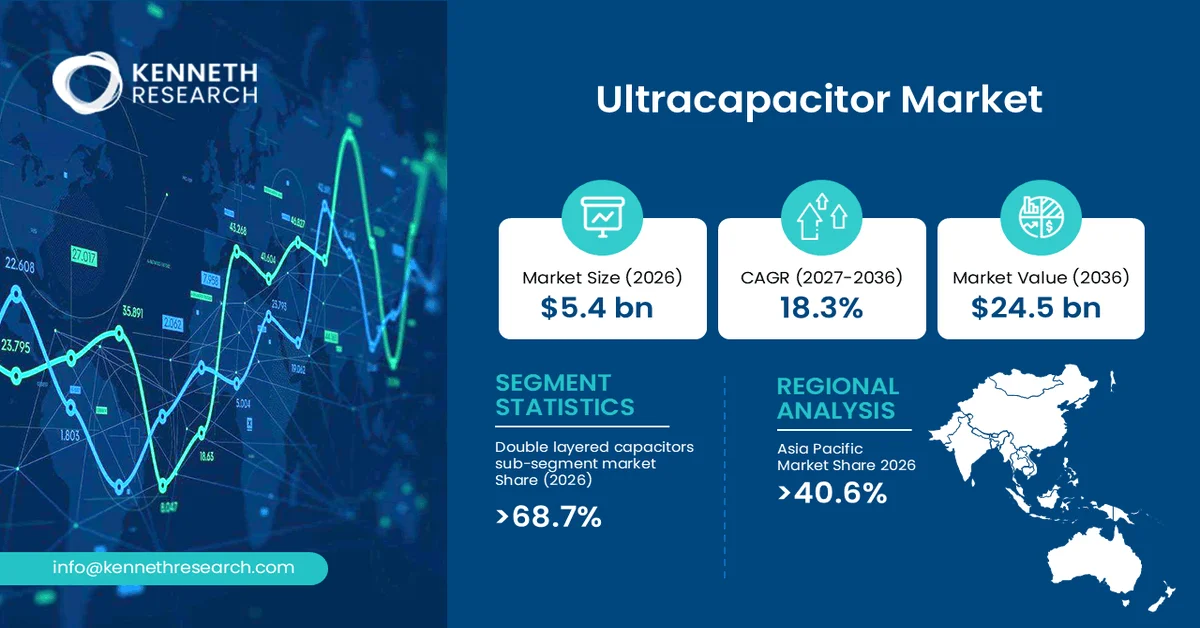
Ultracapacitor Market size was valued at USD 4.6 billion in 2026 and is projected to reach USD 24.5 billion by the end of 2036, rising at a CAGR of 18.3% during the forecast period, i.e., 2027-2036. In 2027, the industry size of the ultracapacitor is estimated at USD 5.4 billion.
The primary growth driver for the global ultracapacitor market is increasing demand for energy-storage technologies capable of delivering rapid power, frequent charge-discharge cycles, and high efficiency.
The global ultracapacitor market comprises electrochemical energy-storage devices that store electrical energy through electrostatic and electrochemical mechanisms and are designed for rapid charging and discharging. Ultracapacitors, also known as supercapacitors or electrochemical capacitors, are characterized by high power density, rapid response, long cycle capability, and the ability to deliver repeated bursts of power.
Industrial relevance stems from their ability to complement batteries by handling peak-power requirements, regenerative-energy capture, voltage stabilization, and rapid load fluctuations. Hybrid energy-storage architectures can combine ultracapacitors with batteries to balance power and energy requirements.
Key Ultracapacitor Market Insights Summary:
Key Takeaways & Market Trends
- Ultracapacitor market is projected to grow from USD 4.6 billion in 2026 to USD 24.5 billion by 2036, expanding at a 18.3% CAGR.
- Asia-Pacific accounted for the largest regional share at 40.6% in 2026, supported by advanced automotive manufacturing, electronics production, energy-storage development, and strong technology capabilities in Japan and China.
- Double Layered Capacitors are expected to remain the leading Type segment, accounting for 68.7% in 2026, supported by their established technology, rapid charge-discharge capability, and suitability for high-power applications.
- Multi-Cell Modules are positioned as a key Module Type, benefiting from growing demand for integrated, higher-voltage ultracapacitor configurations across transportation, industrial equipment, and energy-storage applications.
Market Drivers
- Increasing demand for high-power energy storage in transportation
- Growing integration with hybrid energy-storage systems
- Rising deployment of regenerative-braking and peak-power applications
- Increasing use of ultracapacitors for grid support, power quality, and industrial equipment
Challenges
- Lower energy density compared with batteries
- High system cost and integration requirements
Ultracapacitor Market Overview & Supply Chain
Adoption of the ultracapacitor market is increasing as industries seek energy-storage technologies capable of rapid power delivery, frequent cycling, and efficient handling of short-duration power requirements. Ultracapacitors are particularly relevant where batteries may face limitations from intensive charge-discharge cycles or sudden power demands. The U.S. Department of Energy's 2024 assessment identifies supercapacitors as high-specific-power storage devices with rapid charging and discharging, long operational life, and strong cycle performance.
The industry value chain begins with electrode materials, activated carbon, electrolytes, separators, current collectors, conductive materials, casings, terminals, and electronic control components. Manufacturers process and assemble these inputs into individual ultracapacitor cells, followed by cell matching, electrical testing, balancing, packaging, and module integration. Multi-cell configurations require additional busbars, monitoring electronics, thermal-management elements, and protective systems. Distribution typically occurs through direct manufacturer relationships, electrical-equipment suppliers, automotive and industrial OEM channels, specialized energy-storage integrators, and technology distributors.
Ultracapacitor Market: Growth Drivers & Challenges
Growth Drivers:
- Increasing demand for high-power energy storage in transportation: The growing electrification of transportation is strengthening demand for energy-storage technologies capable of delivering rapid bursts of power and recovering energy efficiently. Ultracapacitors are well suited to applications such as regenerative braking, acceleration assistance, start-stop systems, and hybrid energy-storage architectures because they can absorb and release power rapidly while tolerating frequent cycling. The U.S. Department of Energy identifies ultracapacitors as technologies that can provide a battery power boost for hybrid and electric vehicles, highlighting their complementary role alongside conventional batteries.
- Growing integration with hybrid energy-storage systems: The second growth driver is increasing integration of ultracapacitors with batteries and other energy-storage technologies to combine high energy density with rapid power response. Hybrid architectures allow ultracapacitors to handle short-duration power peaks, sudden load changes, and frequent charge-discharge events while batteries provide sustained energy delivery. This complementary operating model is particularly relevant to industrial equipment, transportation, renewable-energy systems, and grid-support applications. The U.S. Department of Energy's supercapacitor assessment identifies standalone and hybrid energy-storage configurations as important commercial applications and notes their suitability for frequent short-duration charging and discharging.
Challenges:
- Lower energy density compared with batteries: The relatively low energy density of ultracapacitors limits their suitability for applications requiring long-duration energy delivery. Although they provide rapid power output and excellent cycling characteristics, they generally cannot replace batteries where large amounts of energy must be stored for extended periods. This limits their standalone use in applications such as long-range electric mobility and long-duration stationary storage.
- High system cost and integration requirements: Ultracapacitor systems can face comparatively high costs when evaluated on an energy-storage basis, particularly when large amounts of stored energy are required. Integration with batteries or electrical systems also requires power-management electronics, balancing systems, control software, thermal considerations, and specialized system engineering. These requirements can increase upfront investment and complicate procurement decisions. Future competitiveness will depend on advances in electrode materials, manufacturing efficiency, module design, and hybrid-system integration that improve overall economics without compromising the technology's high-power characteristics.
Ultracapacitor Market Size and Forecast:
| Report Attribute | Details |
|---|---|
| Base Year |
2026 |
| Forecast Period |
2027-2036 |
| CAGR |
18.3% |
| Base Year Market Size (2026) |
USD 5.4 billion |
| Forecast Year Market Size (2036) |
USD 24.5 billion |
| Regional Scope |
|
Ultracapacitor Market Segmentation Analysis:
Type Segment Analysis
In the type segment, the double layered capacitors sub-segment is anticipated to maintain its leading position, accounting for 68.7% in 2026.
Their dominance is supported by established manufacturing processes, mature activated-carbon electrode technology, fast charge-discharge characteristics, and suitability for applications requiring repeated short-duration power exchanges. The U.S. Department of Energy identifies electrochemical double-layer capacitors (EDLCs) as the most mature supercapacitor technology, with charge stored through physical processes at the electrode-electrolyte interface.
Demand is particularly relevant in transportation, industrial equipment, microgrids, and power-quality applications where rapid power delivery and energy recovery are more important than long-duration storage. DOE research also identifies EDLCs as a key technology pathway for advancing supercapacitor performance through improvements in cell packaging, hybrid components, and automated manufacturing.
Module Type Segment Analysis
In the module type segment, the multi-cell modules sub-segment is projected to grow as end users increasingly require higher-voltage, application-ready ultracapacitor configurations rather than individual cells. Multi-cell modules combine multiple cells with electrical connections, balancing, protection, and monitoring elements, enabling manufacturers to integrate ultracapacitor storage more efficiently into transportation, industrial equipment, renewable-energy systems, and power-management applications. Demand is supported by the broader shift toward modular energy-storage architectures that can be configured according to specific power and voltage requirements.
The U.S. Department of Energy identifies module development as an important innovation pathway for EDLC technology and notes that industry is examining module innovations for applications including wind-turbine pitch control. This supports the transition from individual components toward integrated, application-specific storage solutions.
Our in-depth analysis of the global ultracapacitor market includes the following segments:
|
Segment |
Sub-segment |
|
Type |
|
|
Power Rating |
|
|
Module Type |
|
|
Application |
|
Ultracapacitor Market Regional Insights:
Asia-Pacific Market Trends & Insights:
Asia-Pacific is the dominant region in the ultracapacitor market, accounting for 40.6% in 2026.
Regional leadership is supported by strong electronics and automotive manufacturing ecosystems, expanding electrification, established energy-storage supply chains, and increasing investment in advanced energy technologies. Japan and China are particularly important because of their capabilities in electric mobility, industrial automation, power electronics, and advanced materials. Government-backed energy-storage programs are also strengthening the regional environment.
Japan has a mature technology and automotive base, creating demand for ultracapacitors in regenerative braking, hybrid power systems, industrial equipment, and advanced electronics. Its emphasis on energy efficiency and high-performance manufacturing supports continued technology development.
China benefits from extensive battery and power-electronics manufacturing capabilities, a large electric-vehicle ecosystem, and expanding renewable-energy infrastructure. These conditions create opportunities for ultracapacitor manufacturers to integrate high-power storage into transportation and stationary applications.
North America Market Trends & Insights:
North America represents a significant opportunity for the ultracapacitor market, supported by advanced automotive and industrial sectors, grid modernization, and increasing investment in energy-storage technologies. Demand is particularly relevant for applications requiring rapid power response, regenerative braking, power-quality support, and hybrid storage.
In the U.S., the established automotive, electronics, industrial automation, and power infrastructure provides a broad customer base for ultracapacitor manufacturers. Research and commercialization efforts are supporting applications ranging from transportation to grid services and critical infrastructure.
In Canada, expanding energy-storage deployment and grid modernization are creating additional opportunities for high-power storage technologies. The Canada Energy Regulator identifies continued growth in grid-connected energy storage as an important development for the country's electricity system.
Leading Companies Operating in the Global Ultracapacitor Market:
Here is a list of upstream, downstream, and key players operating in the global ultracapacitor market competitive ecosystem:
- Maxwell Technologies (U.S)
- Company Overview
- Business Strategy
- Key Product Offerings
- Financial Performance
- Key Performance Indicators
- Risk Analysis
- Recent Development
- Regional Presence
- SWOT Analysis
- Skeleton Technologies (Germany)
- Eaton (Ireland)
Recent Developments
- November 2025: Clarios announced the acquisition of Maxwell Technologies, strengthening its portfolio in supercapacitor-based energy-storage solutions for mobility, grid, and industrial applications.
- June 2026: Skeleton Technologies announced that its supercapacitor achieved UL 810A certification and demonstrated a peak-current capability in its latest product for high-demand power applications, including AI data-center infrastructure.
Frequently Asked Question
In 2026, the ultracapacitor market exceeded USD 4.6 billion.
The ultracapacitor market is projected to reach USD 24.5 billion by the end of 2036, expanding at a CAGR of 18.3% over the forecast period (2027-2036).
The major players in the market are Maxwell Technologies, Skeleton Technologies, Eaton, CAP-XX, Nippon Chemi-Con, LS Mtron, and others.
In the type segment, the double layered capacitors sub-segment is anticipated to capture the largest market share of 68.7% in the future and exhibit lucrative growth opportunities during 2027-2036.
Asia-Pacific is projected to hold the largest market share of 40.6% by the end of 2036 and provide more business opportunities in the future.
Why Choose Kenneth Research ?
-
Insight with Impact : We don’t just gather data — we uncover stories, trends, and opportunities that fuel business growth.
-
Experts Who Get It : Our team speaks your industry’s language and knows what really matters to your customers and market.
-
Custom-Built for You : Forget one-size-fits-all. We craft research and consulting solutions as unique as your business vision.
-
Partners, Not Just Providers : We work with you, not for you — collaborating closely to turn insights into smart, strategic moves.
-
Results That Speak : Our work powers brands, startups, and industry leaders alike — with a track record of ideas that work in the real world.
Report ID: 1340 |
Published Date: 28 Sep 2026 |
Report Format: |
Delivery Timeline: 48-72 Business Hours

Copyright © 2025 Kenneth Research. All rights reserved. Terms of Use | Privacy Policy
