Report ID: 1179 |
Published Date: 26 Aug 2026 |
Report Format: |
Delivery Timeline: 48-72 Business Hours
Time Sensitive Networking Market Outlook:
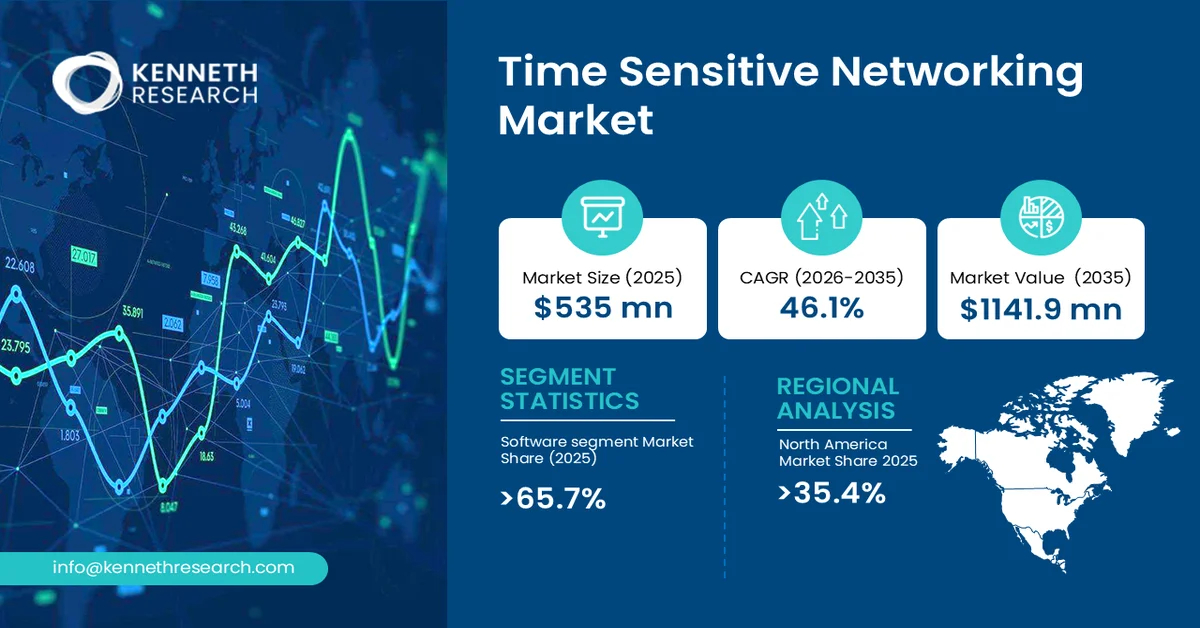
Time Sensitive Networking Market size was valued at USD 535 million in 2025 and is projected to reach USD 1,141.9 million by the end of 2035, rising at a CAGR of 46.1% during the forecast period, i.e., 2026-2035. In 2026, the industry size of the time sensitive networking is estimated at USD 781.6 million.
The primary growth driver for the Time Sensitive Networking Market is the increasing demand for deterministic, low-latency communication across industrial automation, automotive, aerospace, and other mission-critical applications.
The Time Sensitive Networking (TSN) Market comprises networking technologies, hardware, software, and related solutions based on IEEE 802.1 standards that provide deterministic communication with bounded latency, low packet-delay variation, precise synchronization, and high reliability.
Key capabilities include time synchronization, traffic scheduling, frame replication and elimination, congestion management, resource reservation, and centralized network configuration. These capabilities allow organizations to converge operational technology and information technology networks without compromising the timing requirements of industrial control and other mission-critical processes.
Key Time Sensitive Networking Market Insights Summary:
Key Takeaways: Market Trends & Insights
- The Time Sensitive Networking Market is projected to expand from USD 535 million in 2025 to USD 1,141.9 million by 2035, registering a 46.1% CAGR during 2026-2035.
- North America represented the leading regional market with a 35.4% share in 2025, supported by industrial automation, automotive applications, aerospace systems, and advanced networking research.
- Software was the dominant Component segment, accounting for 65.7% in 2025, reflecting increasing demand for traffic scheduling, network configuration, synchronization, monitoring, and deterministic network management.
- On-premises deployment is expected to maintain growth as industrial organizations prioritize direct control over critical networking infrastructure, data, security, and integration with existing operational-technology environments.
Market Drivers
- Growing adoption in industrial automation and smart manufacturing.
- Increasing demand for deterministic and low-latency networking.
- Rising deployment of connected machines, robotics, and cyber-physical systems.
- Increasing standardization and interoperability of TSN-based industrial networks.
Challenges
- Interoperability and integration with existing industrial networks.
- Complexity of synchronization and traffic scheduling.
Time Sensitive Networking (TSN) Market Overview & Supply Chain
The Time Sensitive Networking (TSN) Market is gaining momentum as manufacturers and infrastructure providers seek deterministic Ethernet connectivity for industrial automation, robotics, automotive systems, aerospace, and other time-critical applications. TSN enables time-sensitive and conventional traffic to share a common Ethernet infrastructure while maintaining predictable communication performance. NIST research has demonstrated TSN applications in industrial wireless environments, particularly for factory automation where reliability and deterministic latency are important. The publication of the IEC/IEEE 60802-2026 industrial automation profile further strengthens standardization and interoperability, providing a common framework for deploying TSN across industrial networks.
The TSN value chain begins with semiconductor manufacturers, Ethernet chipset providers, networking component suppliers, and software developers supplying processors, network interfaces, synchronization technologies, operating systems, and traffic-management capabilities. Networking equipment manufacturers integrate these technologies into TSN-enabled switches, routers, gateways, controllers, and industrial communication platforms. Software providers contribute configuration, monitoring, scheduling, network-management, and orchestration capabilities that allow organizations to manage deterministic traffic across converged Ethernet environments.
Time Sensitive Networking Market: Growth Drivers & Challenges
Growth Drivers
- Growing adoption in industrial automation: The increasing adoption of automation, robotics, and cyber-physical production systems is driving demand for TSN because these environments require deterministic communication, precise timing, and reliable data delivery. TSN enables time-critical and conventional traffic to operate over a shared Ethernet infrastructure while maintaining predictable transmission behavior. NIST research is specifically evaluating TSN for industrial wireless applications, including collaborative robotics and factory automation, with emphasis on reliability and deterministic latency.
- Demand for deterministic and low-latency networking: The growing need for predictable communication in mission-critical applications is encouraging organizations to move beyond conventional best-effort Ethernet. TSN provides bounded latency, synchronization, traffic prioritization, and deterministic transmission, making it suitable for applications where delays or packet variation can affect operational performance. NIST identifies industrial machine-to-machine communication and automotive applications among TSN use cases requiring synchronization, prioritization, determinism, and bounded latency.
Challenges
- Interoperability and integration with Existing Industrial Networks: A major challenge for the Time Sensitive Networking Market is integrating TSN with legacy industrial Ethernet systems, proprietary protocols, and equipment from multiple vendors. Industrial facilities often operate heterogeneous networking environments that were developed at different stages of automation modernization. This can make network configuration, synchronization, traffic scheduling, and interoperability more complex. NIST research identifies implementation challenges when adapting TSN to real-world equipment already in place, including the potential for additional cost and custom coding requirements.
- Complexity of synchronization and traffic scheduling: TSN deployments require highly coordinated time synchronization and traffic scheduling to deliver deterministic communication. As industrial networks become larger and incorporate wireless connectivity, robotics, sensors, and distributed control systems, maintaining precise timing across devices can become increasingly complex. NIST's industrial wireless TSN research highlights challenges involving deterministic latency, reliability, scheduling, and wireless-channel conditions.
Time Sensitive Networking Market Size and Forecast:
| Report Attribute | Details |
|---|---|
| Base Year |
2025 |
| Forecast Year |
2026-2035 |
| CAGR |
46.1% |
| Base Year Market Size (2025) |
USD 535 million |
| Forecast Year Market Size (2035) |
USD 1141.9 million |
| Regional Scope |
|
Time Sensitive Networking Market Segmentation Analysis:
Component Type Segment Analysis
In the Component segment, Software is anticipated to account for the largest market share of 65.7% in 2025.
Its dominance is supported by the growing need for flexible network configuration, traffic scheduling, synchronization, monitoring, and management across deterministic Ethernet environments. As manufacturers adopt connected machinery, robotics, and cyber-physical systems, software is increasingly required to coordinate time-critical traffic and simplify TSN deployment across complex networks. Industry adoption is also shifting toward software-defined management, enabling organizations to modify network policies and optimize traffic without replacing underlying infrastructure. On the supply side, vendors are expanding TSN platforms with centralized configuration, diagnostics, scheduling, and interoperability capabilities. Standardization is reinforcing this trend; the IEC/IEEE 60802-2026 profile establishes common TSN configurations and procedures for industrial automation, creating a more consistent environment for software deployment.
Deployment Type Segment Analysis
In the Deployment Mode segment, the On-Premises sub-segment is projected to grow as industrial organizations require direct control over deterministic networking infrastructure, data, security, and network configuration. On-premises TSN deployments are particularly relevant for factories and other mission-critical environments where predictable latency, precise synchronization, and uninterrupted communication are essential. NIST's 2024 research evaluated software-based TSN in industrial Wi-Fi networks, demonstrating efforts to extend deterministic communication capabilities across industrial environments while managing time-critical and best-effort traffic on shared infrastructure. This supports demand for locally managed networking architectures that can be closely integrated with existing operational technology systems.
Our in-depth analysis of the global Time Sensitive Networking Market includes the following segments:
|
Segment |
Sub-segment |
|
Component |
|
|
Deployment Mode |
|
|
Enterprise Size |
|
|
End User |
|
Time Sensitive Networking Market Regional Insights:
North America Market Trends & Insights:
North America accounted for 35.4% of the Time Sensitive Networking Market in 2025, supported by advanced industrial automation, automotive manufacturing, aerospace applications, and strong development of deterministic networking technologies.
The U.S. benefits from an established industrial technology ecosystem and continued research into TSN-enabled cyber-physical systems, real-time networking, and next-generation industrial communications. NIST research has also evaluated software-based TSN over industrial Wi-Fi, examining traffic scheduling and latency performance while assessing the use of existing wireless infrastructure for time-critical communication.
Canada complements the regional market through its advanced manufacturing, automotive, transportation, and industrial technology base. Increasing requirements for deterministic connectivity across automated production environments are creating opportunities for TSN-enabled networking equipment and software
Europe Market Trends & Insights:
Asia-Pacific is emerging as a significant growth region for the Time Sensitive Networking Market, supported by expanding industrial automation, smart manufacturing, automotive production, robotics, and Industry 4.0 initiatives. Japan and China represent important markets as manufacturers increasingly require deterministic and reliable communication for connected production systems
Japan has a highly automated manufacturing ecosystem and strong adoption of robotics and advanced production technologies, creating demand for networking architectures capable of supporting real-time machine coordination and control.
China is also expanding industrial digitalization and connected manufacturing, increasing the need for reliable communications between machines, controllers, sensors, and industrial systems.
Leading Companies Operating in the Global Time Sensitive Networking Market:
Here is a list of upstream, downstream, and key players operating in the global Time Sensitive Networking Market competitive ecosystem:
- NXP Semiconductors (Netherlands)
- Company Overview
- Business Strategy
- Key Product Offerings
- Financial Performance
- Key Performance Indicators
- Risk Analysis
- Recent Development
- Regional Presence
- SWOT Analysis
- Texas Instruments (U.S)
- Siemens (Germany)
- Cisco(U.S)
Recent Developments
- July 2026 –NXP released GenAVB/TSN Stack 3.5, expanding its real-time edge software support for TSN endpoints and bridges across NXP hardware platforms. The stack supports IEEE 802.1AS-2020 gPTP and runtime configuration capabilities.
- June 2026 – Texas Instruments published updated TSN and Ethernet design resources addressing deterministic networking for emerging robotic systems. Its latest reference material demonstrates TSN over 1000-Mbps Single Pair Ethernet, targeting reliable, low-latency communication between robotic controllers, sensors, and actuators.
Frequently Asked Question
In 2025, the time sensitive networking market was valued at USD 535 million.
The time sensitive networking market is projected to reach USD 1,141.9 million by the end of 2035, expanding at a CAGR of 46.1% during the forecast period (2026–2035).
Major players include Cisco, Siemens, Texas Instruments, NXP Semiconductors, among others.
In the Component segment, the Software sub-segment is anticipated to capture the largest market share of 65.7% in 2025, supported by increasing demand for network configuration, traffic scheduling, monitoring, synchronization, and deterministic communication management.
North America is projected to remain the leading region, accounting for 35.4% of the market in 2025, supported by advanced industrial automation, automotive applications, aerospace systems, and strong development of deterministic networking technologies.
Why Choose Kenneth Research ?
-
Insight with Impact : We don’t just gather data — we uncover stories, trends, and opportunities that fuel business growth.
-
Experts Who Get It : Our team speaks your industry’s language and knows what really matters to your customers and market.
-
Custom-Built for You : Forget one-size-fits-all. We craft research and consulting solutions as unique as your business vision.
-
Partners, Not Just Providers : We work with you, not for you — collaborating closely to turn insights into smart, strategic moves.
-
Results That Speak : Our work powers brands, startups, and industry leaders alike — with a track record of ideas that work in the real world.
Report ID: 1179 |
Published Date: 26 Aug 2026 |
Report Format: |
Delivery Timeline: 48-72 Business Hours

Copyright © 2025 Kenneth Research. All rights reserved. Terms of Use | Privacy Policy
