Report ID: 1319 |
Published Date: 10 Sep 2026 |
Report Format: |
Delivery Timeline: 48-72 Business Hours
Tidal Energy Market Outlook:
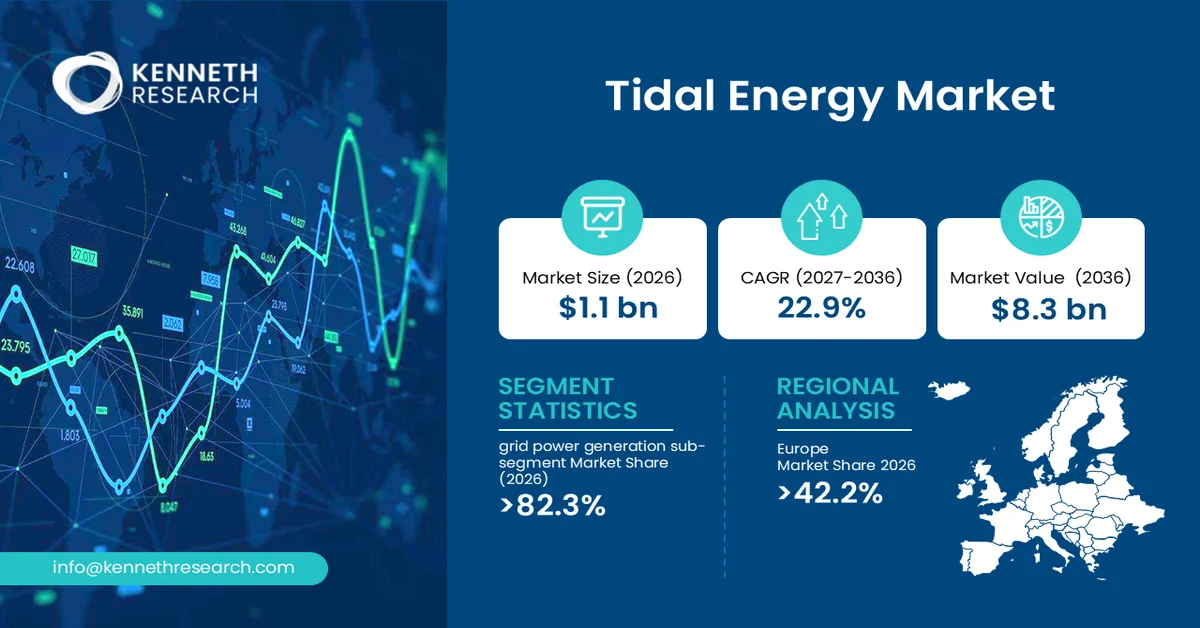
Tidal Energy Market size was valued at USD 1.1 billion in 2026 and is projected to reach USD 8.3 billion by the end of 2036, rising at a CAGR of 22.9% during the forecast period, i.e., 2027–2036. In 2027, the industry size of the tidal energy is estimated at USD 1.3 billion.
The primary growth driver of the tidal energy market is the increasing focus on predictable, low-carbon electricity generation from marine resources. Unlike variable renewable sources that depend heavily on weather conditions, tidal resources follow highly predictable natural cycles, allowing tidal power to complement solar and wind generation and support broader grid decarbonization.
The tidal energy market comprises technologies and services that harness the movement of tides and tidal currents to generate electricity. The market includes tidal-stream turbines, tidal-range systems, subsea generators, foundations, power-conversion equipment, electrical cables, monitoring systems, installation services, and maintenance solutions.
Tidal-stream systems generally use the kinetic energy of moving seawater to rotate turbines connected to electrical generators, while tidal-range systems use differences in water levels created by tidal movements. The U.S. Department of Energy defines tidal energy as energy derived from the movement of water created by the gravitational forces responsible for tides.
Key Tidal Energy Market Insights Summary:
Key Takeaways: Market Trends & Insights
- Tidal Energy Market is projected to grow from USD 1.1 billion in 2026 to USD 8.3 billion by 2036, expanding at a 22.9% CAGR during the forecast period.
- Europe accounted for the largest regional share at 42.2% in 2026, supported by established marine engineering capabilities, favorable renewable-energy policies, and ongoing tidal technology development in Germany and France.
- Grid power generation remained the leading application segment, accounting for 82.3% in 2026, driven by growing demand for predictable renewable electricity and integration of tidal generation into established power networks.
- Turbines represent a key component segment as developers advance turbine efficiency, marine durability, subsea systems, and scalable designs to support the transition from demonstration projects toward commercial tidal arrays.
Market Drivers
- Government incentives and supportive renewable-energy policies
- Predictable tidal power generation
- Advancements in turbine and subsea technology
- Growing investment in marine renewable-energy infrastructure
Challenges
- High Capital and Deployment Costs
- Complex Marine Permitting and Environmental Constraints
Tidal Energy Market Overview & Supply Chain
Global adoption of tidal energy is increasing as governments and utilities seek predictable renewable electricity sources that can complement variable wind and solar generation. Technological advances in underwater turbines, subsea power systems, marine monitoring, and installation techniques are improving project feasibility and operational reliability. The sector is also gaining industrial relevance as countries pursue renewable-energy deployment, energy-security objectives, and decarbonization of power systems. Government-backed renewable deployment policies and marine-energy programs are supporting demonstration projects and commercialization efforts, while improved grid infrastructure is creating opportunities for connecting marine generation assets to electricity networks.
The tidal energy value chain begins with resource assessment, marine surveying, engineering inputs, specialized metals, composites, electrical equipment, and other materials required for turbine and infrastructure manufacturing. Technology developers and equipment manufacturers then design and produce tidal turbines, generators, subsea systems, foundations, control equipment, and power-conversion systems. Project developers integrate these technologies with marine construction, installation, grid-connection, and commissioning activities.
Tidal Energy Market: Growth Drivers & Challenges
Growth Drivers
- Government support for marine renewable deployment: Government-backed support mechanisms are accelerating tidal energy commercialization by reducing project-development risk and encouraging private investment in emerging marine technologies. Tidal projects typically require substantial capital for specialized turbines, subsea infrastructure, marine installation, grid connection, and environmental assessment, making policy support particularly important during the transition from demonstration to commercial deployment. The UK government’s renewable-energy policy framework identifies tidal stream as an emerging technology with commercialization potential and reports that the country had 10 MW of installed tidal-stream capacity as of 2022. This policy recognition strengthens investor confidence and supports technology developers seeking to improve reliability and reduce deployment costs.
- Predictable renewable power generation: The highly predictable nature of tidal resources is a major factor supporting their integration into diversified renewable electricity portfolios. Unlike solar and wind generation, which depend heavily on weather conditions, tidal cycles can be forecast accurately, allowing utilities and grid planners to incorporate generation patterns into electricity-system planning. This predictability increases the strategic value of tidal energy as grids accommodate greater shares of variable renewable generation. It can also improve the complementarity between marine energy and other clean-power technologies, particularly in coastal regions with suitable tidal resources.
Challenges
- High capital and deployment costs: Tidal energy projects face substantial upfront costs because equipment must operate in demanding marine environments while withstanding strong currents, corrosion, biofouling, and continuous mechanical loading. Specialized turbines, foundations, subsea cables, vessels, marine surveys, installation systems, and grid connections can make project development more complex than conventional land-based renewable installations. These requirements increase financing risk, particularly for first-of-a-kind projects with limited operating histories.
- Complex marine permitting and environmental constraints: Tidal energy development requires extensive assessment of marine ecosystems, navigation routes, fisheries, seabed conditions, coastal activities, and interactions with other ocean users. Developers must obtain multiple approvals and coordinate with environmental authorities, maritime agencies, local communities, fisheries stakeholders, and grid operators. These processes can extend project timelines and introduce uncertainty around site selection and deployment schedules. Environmental considerations are particularly important because commercial tidal arrays remain relatively early in their development, leaving project developers and regulators with limited long-term operational evidence across different marine environments.
Tidal Energy Market Size and Forecast:
| Report Attribute | Details |
|---|---|
| Base Year |
2026 |
| Forecast Period |
2027-2036 |
| CAGR |
22.9% |
| Base Year Market Size (2026) |
USD 1.1 billion |
| Forecast Year Market Size (2036) |
USD 8.3 billion |
| Regional Scope |
|
Tidal Energy Market: Segment Analysis
Application Segment Analysis
In the application segment, the grid power generation sub-segment is anticipated to capture the largest market share of 82.3% by the end of 2026.
Grid power generation dominates the application segment because tidal projects are primarily developed to convert predictable marine currents into electricity that can be supplied to established power networks. Demand is supported by utilities seeking diversified renewable generation and by governments pursuing reliable low-carbon electricity sources. Tidal-stream systems are particularly suited to grid applications because multiple turbines can be deployed as arrays and connected through subsea cables, substations, and onshore grid infrastructure. The UK Government states that tidal-stream developments typically comprise arrays of individual turbines together with intra-array and export cables, offshore substations, and land-side grid connections.
Component Type Segment Analysis
The turbines segment is positioned for continued growth as tidal-energy developers transition from demonstration projects toward larger commercial arrays. Turbines are the core energy-conversion equipment in tidal-stream systems, directly determining generation efficiency, durability, maintenance requirements, and project economics. Demand is therefore closely linked to efforts to improve turbine performance under high-energy marine conditions. Government-supported innovation is also strengthening the technology pipeline. In May 2025, the Welsh Government announced support for a project developing the next generation of tidal-stream turbine blades, with objectives including improved efficiency, durability, and overall performance. Supply-side development is increasingly focused on advanced blade designs, power take-off systems, remote monitoring, controls, and materials capable of operating reliably underwater.
Our in-depth analysis of the global tidal energy market includes the following segments:
|
Segment |
Sub-segment |
|
Technology |
|
|
Deployment |
|
|
Component |
|
|
Application |
|
Tidal Energy Market Regional Insights:
Europe Market Trends & Insights:
Europe holds the dominant regional position in the tidal energy market, accounting for 42.2% in 2026. The region benefits from extensive coastlines, strong tidal resources, established marine engineering capabilities, and an advanced renewable-energy policy environment. Europe also has an established ecosystem spanning offshore engineering, shipbuilding, hydropower, turbine manufacturing, subsea infrastructure, and specialized marine services.
Germany is an important market because of its sophisticated industrial base, engineering expertise, offshore infrastructure, and broader commitment to renewable-power development. Although offshore wind remains more established, Germany's expanding marine-energy ecosystem can support tidal technology through specialized engineering, electrical systems, vessel capabilities, and grid infrastructure.
France represents a particularly significant European opportunity because it combines extensive maritime resources with established tidal-energy infrastructure and ongoing technology development. The European Commission reports that France is among the leading European countries for tidal-stream deployment and identifies planned tidal-stream installations at French test sites.
Asia-pacific Market Trends & Insights:
Asia-Pacific represents a significant opportunity for tidal energy as governments increasingly pursue marine renewable technologies to strengthen energy security, decarbonize coastal power systems, and develop new ocean-based industries. The region combines extensive coastlines, island communities, strong tidal resources, and substantial manufacturing capabilities, creating favorable conditions for technology development and project deployment. Government initiatives are increasingly supporting marine-energy commercialization.
Japan is developing a stronger policy framework for marine renewable-energy deployment. In 2024, Japan’s Cabinet approved legislation designed to facilitate marine renewable-energy projects within its Exclusive Economic Zone while incorporating marine-environment assessments into the development process.
China offers substantial potential through its extensive coastline, industrial manufacturing capabilities, and government emphasis on scaling marine energy. The 2025 national guidance specifically identifies tidal energy as part of the marine-energy sector and calls for upgrades to tidal-generation equipment, improved reliability and maintainability, and reduced construction and operating costs.
Leading Companies Operating in the Global Tidal Energy Market:
Here is a list of upstream, downstream, and key players operating in the global tidal energy market competitive ecosystem:
- Orbital Marine Power (United Kingdom)
- Company Overview
- Business Strategy
- Key Product Offerings
- Financial Performance
- Key Performance Indicators
- Risk Analysis
- Recent Development
- Regional Presence
- SWOT Analysis
- ANDRITZ Hydro Hammerfest (Austria)
- Minesto (Sweden)
Recent Developments
- June 2026: Orbital announced a pre-application consultation for its Westray Tidal Array in Orkney. The proposed project involves floating tidal turbines and associated subsea and electrical infrastructure.
- October 2025: Minesto participated in a Swedish high-level delegation to South Korea focused on developing partnerships and strengthening bilateral collaboration in the green transition.
Frequently Asked Question
In 2026, the tidal energy market exceeded USD 1.1 billion.
The tidal energy market is projected to reach USD 8.3 billion by the end of 2036, expanding at a CAGR of 22.9% over the forecast period (2027-2036).
The major players in the market are Orbital Marine Power, ANDRITZ Hydro Hammerfest, Minesto, SABELLA, Tidal Technologies, and others.
In the Application segment, the Grid power generation sub-segment is anticipated to capture the largest market share of 82.3% in the future and exhibit lucrative growth opportunities during 2027-2036.
Europe is projected to hold the largest market share of 42.2% by the end of 2036 and provide more business opportunities in the future.
Why Choose Kenneth Research ?
-
Insight with Impact : We don’t just gather data — we uncover stories, trends, and opportunities that fuel business growth.
-
Experts Who Get It : Our team speaks your industry’s language and knows what really matters to your customers and market.
-
Custom-Built for You : Forget one-size-fits-all. We craft research and consulting solutions as unique as your business vision.
-
Partners, Not Just Providers : We work with you, not for you — collaborating closely to turn insights into smart, strategic moves.
-
Results That Speak : Our work powers brands, startups, and industry leaders alike — with a track record of ideas that work in the real world.
Report ID: 1319 |
Published Date: 10 Sep 2026 |
Report Format: |
Delivery Timeline: 48-72 Business Hours

Copyright © 2025 Kenneth Research. All rights reserved. Terms of Use | Privacy Policy
