Report ID: 1044 |
Published Date: 28 Jul 2026 |
Report Format: |
Delivery Timeline: 48-72 Business Hours
Thyroid Cancer Diagnostics Market Outlook:
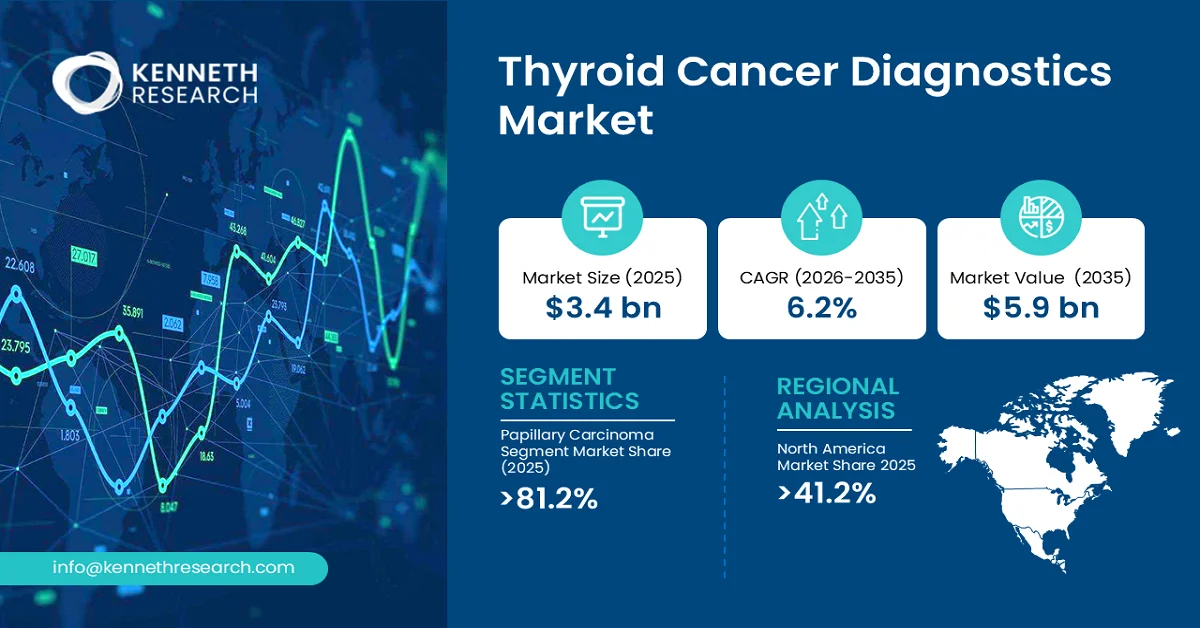
Thyroid Cancer Diagnostics Market size was valued at USD 3.4 billion in 2025 and is projected to reach USD 5.9 billion by the end of 2035, rising at a CAGR of 6.2% during the forecast period, i.e., 2026–2035. In 2026, the industry size of the thyroid cancer diagnostics is estimated at USD 3.6 billion.
The primary growth driver for the thyroid cancer diagnostics market is the rising adoption of advanced molecular diagnostics and high-resolution imaging technologies for early and accurate thyroid cancer detection. Increasing clinical emphasis on personalized treatment planning, improved diagnostic accuracy, and streamlined laboratory workflows is accelerating the demand for innovative diagnostic solutions across healthcare systems.
The thyroid cancer diagnostics market comprises diagnostic products, technologies, and laboratory services used to detect, classify, confirm, and monitor thyroid malignancies. It includes imaging modalities such as ultrasound, laboratory-based blood tests, fine-needle aspiration biopsy procedures, molecular diagnostic assays, immunohistochemistry, cytology analysis, and pathology services that support the identification of different thyroid cancer types. These diagnostic approaches help clinicians distinguish malignant thyroid nodules from benign conditions, enabling timely intervention and informed therapeutic decisions.
The market is characterized by continuous technological advancements that improve diagnostic precision, reduce indeterminate findings, and support risk stratification. Integration of molecular biomarkers, digital pathology, artificial intelligence-assisted image interpretation, and standardized laboratory protocols has strengthened diagnostic confidence while enhancing clinical efficiency. The market plays a critical role within oncology diagnostics by supporting disease detection, treatment selection, post-treatment surveillance, and recurrence monitoring. Its industrial relevance extends across hospitals, diagnostic laboratories, specialty cancer centers, research institutions, and biotechnology companies involved in developing innovative diagnostic platforms that improve patient outcomes and optimize healthcare resource utilization.
Key Thyroid Cancer Diagnostics Market Insights Summary:
Key Takeaways: Market Trends & Insights
- The thyroid cancer diagnostics market is projected to expand from USD 3.4 billion in 2025 to USD 5.9 billion by 2035, registering a 6.2% CAGR during 2026–2035
- Papillary Carcinoma remained the leading cancer type, accounting for 81.2% of the market in 2025 due to its high prevalence and strong demand for precision diagnostic technologies
- Hospital Laboratories are emerging as the fastest-growing end-use segment, supported by increasing adoption of molecular diagnostics, digital pathology, and integrated laboratory workflows
- North America held the largest regional share at 41.2% in 2025, driven by advanced healthcare infrastructure, widespread adoption of precision oncology, and strong diagnostic capabilities across the United States and Canada
- The market is witnessing sustained innovation through molecular testing, artificial intelligence-assisted diagnostics, high-resolution imaging, and digital pathology, strengthening early detection and personalized thyroid cancer management
Market Drivers
- Growing implementation of high-resolution ultrasound technologies in thyroid nodule assessment
- Increasing investment in hospital laboratory modernization and diagnostic automation
- Rising emphasis on early cancer detection through standardized clinical guidelines
- Continuous innovation in companion diagnostics and biomarker discovery for personalized oncology
Challenges
- Limited Diagnostic Accuracy in Indeterminate Thyroid Nodules
- Reimbursement Variability and High Adoption Costs for Advanced Diagnostics
Thyroid Cancer Diagnostics Market Overview & Supply Chain
The adoption of thyroid cancer diagnostics is increasing globally as healthcare providers focus on earlier detection, precision medicine, and evidence-based treatment planning. Continuous advances in high-resolution ultrasound, molecular diagnostics, digital pathology, and AI-assisted image analysis are improving diagnostic accuracy while reducing unnecessary invasive procedures. Investments in laboratory automation and standardized clinical pathways are further accelerating the adoption of advanced diagnostic technologies across hospitals and specialized cancer centers. According to the U.S. National Cancer Institute's SEER Program, an estimated 45,240 new cases of thyroid cancer are expected to be diagnosed in the United States in 2026, highlighting the sustained need for reliable diagnostic solutions that support timely diagnosis and personalized patient management.
The thyroid cancer diagnostics market value chain begins with suppliers of laboratory reagents, molecular assay components, antibodies, imaging equipment, biopsy needles, consumables, and software platforms that support diagnostic workflows. These inputs are integrated by manufacturers developing ultrasound systems, molecular diagnostic kits, pathology instruments, laboratory automation solutions, and digital health applications. Diagnostic products undergo rigorous quality validation, regulatory review, and commercialization before being distributed through specialized medical device distributors, laboratory suppliers, and direct sales networks. Hospitals, independent diagnostic laboratories, specialty cancer centers, academic medical institutions, and reference laboratories constitute the primary end users responsible for diagnostic testing and clinical interpretation. Major stakeholders include biotechnology companies, diagnostic equipment manufacturers, healthcare providers, pathology professionals, regulatory authorities, reimbursement organizations, research institutions, and healthcare information technology providers, all of which contribute to continuous innovation, quality assurance, and broader adoption of advanced thyroid cancer diagnostic solutions.
Thyroid Cancer Diagnostics Market: Growth Drivers & Challenges
Growth Drivers:
- Rising Adoption of Precision Diagnostics and Molecular Testing: The increasing adoption of precision diagnostics is transforming the thyroid cancer diagnostics landscape by enabling clinicians to accurately differentiate benign thyroid nodules from malignant lesions while minimizing unnecessary surgical interventions. Molecular testing, next-generation sequencing, and biomarker-based assays are enhancing diagnostic confidence, particularly in cases with indeterminate cytology results. These technologies improve clinical decision-making, facilitate personalized treatment strategies, and support better patient outcomes. Healthcare providers are also investing in advanced laboratory infrastructure and integrated diagnostic workflows to improve efficiency and standardization.
- Expansion of Digital Pathology and Artificial Intelligence Integration: The integration of digital pathology and artificial intelligence into thyroid cancer diagnostics is improving workflow efficiency and diagnostic consistency across healthcare institutions. AI-assisted image analysis supports pathologists by identifying subtle morphological characteristics, reducing interpretation variability, and enabling faster reporting. Digital pathology platforms also facilitate remote consultations, multidisciplinary case reviews, and seamless data sharing among healthcare providers. As hospitals and diagnostic laboratories continue their digital transformation initiatives, demand for interoperable diagnostic platforms is expected to increase. Future developments in machine learning algorithms, cloud-based pathology systems, and decision-support software will further strengthen diagnostic accuracy while enabling scalable, data-driven oncology services that improve operational efficiency and support precision medicine initiatives across diverse healthcare environments.
Challenges:
- Limited Diagnostic Accuracy in Indeterminate Thyroid Nodules: A significant restraint for the thyroid cancer diagnostics market is the persistent challenge of accurately classifying indeterminate thyroid nodules using conventional diagnostic methods. Fine-needle aspiration cytology can produce inconclusive findings, requiring additional molecular testing, repeat biopsies, or diagnostic surgery to establish a definitive diagnosis. This uncertainty increases clinical complexity, prolongs patient management timelines, and raises healthcare costs for providers and payers. Laboratories must invest in advanced diagnostic technologies and highly skilled personnel to improve diagnostic confidence, creating financial and operational burdens, particularly for smaller healthcare institutions. Commercially, manufacturers face increasing pressure to develop highly accurate, clinically validated diagnostic platforms that demonstrate clear value to healthcare systems. Future market growth will depend on innovations that reduce diagnostic ambiguity while supporting cost-effective, evidence-based clinical decision-making.
- Reimbursement Variability and High Adoption Costs for Advanced Diagnostics: The widespread adoption of advanced thyroid cancer diagnostic technologies is constrained by inconsistent reimbursement policies and the significant investment required for sophisticated laboratory infrastructure. Molecular assays, digital pathology platforms, and artificial intelligence-enabled diagnostic solutions often involve substantial implementation, validation, maintenance, and personnel training costs. Differences in reimbursement coverage across healthcare systems create uncertainty regarding return on investment, slowing technology adoption despite proven clinical benefits. These commercial barriers particularly affect community hospitals and independent diagnostic laboratories with limited financial resources. In addition, lengthy regulatory approval processes and evolving clinical guideline requirements can delay market entry for innovative products. Over the long term, broader reimbursement support, stronger clinical evidence, and improvements in affordability will be essential to accelerate adoption and expand access to advanced thyroid cancer diagnostic solutions.
Thyroid Cancer Diagnostics Market Size and Forecast:
| Report Attribute | Details |
|---|---|
| Base Year |
2025 |
| Forecast Year |
2026-2035 |
| CAGR |
6.2% |
| Base Year Market Size (2025) |
USD 3.4 billion |
| Forecast Year Market Size (2035) |
USD 5.9 billion |
| Regional Scope |
|
Thyroid Cancer Diagnostics Market Segmentation Analysis:
Cancer Type Segment Analysis
In the cancer type segment, the papillary carcinoma sub-segment is anticipated to capture the largest market share of 81.2% by the end of 2025.
The Papillary Carcinoma segment dominates the thyroid cancer diagnostics market owing to its high clinical prevalence and the extensive use of diagnostic testing throughout the patient care pathway. Individuals presenting with thyroid nodules are routinely evaluated using ultrasound imaging, fine-needle aspiration biopsy, cytological examination, and, where necessary, molecular diagnostic assays to accurately identify papillary thyroid carcinoma and distinguish it from benign lesions. Growing awareness of early cancer detection, wider access to advanced imaging technologies, and increasing adoption of precision diagnostics have further strengthened demand for diagnostic products targeting this cancer type. On the supply side, manufacturers continue to introduce enhanced molecular testing panels, digital pathology platforms, and artificial intelligence-enabled diagnostic solutions that improve diagnostic accuracy and laboratory efficiency. According to the National Cancer Institute (NCI), well-differentiated thyroid cancers account for about 95% of thyroid cancers, with papillary thyroid cancer representing 84% of all thyroid cancers, reinforcing the substantial clinical demand for diagnostic solutions focused on this subtype. As clinical guidelines increasingly emphasize risk stratification and personalized treatment, the segment is expected to maintain its leading position through continued technological innovation and broader adoption of advanced diagnostic workflows.
End Use Segment Analysis
The hospital laboratories segment is projected to grow as the second-largest segment in the thyroid cancer diagnostics market due to four converging demand drivers.
The Hospital Laboratories segment is projected to witness strong growth as hospitals continue to strengthen in-house diagnostic capabilities to deliver faster and more accurate thyroid cancer diagnoses. The increasing use of high-resolution ultrasound-guided biopsy procedures, molecular diagnostic assays, immunohistochemistry, and digital pathology within hospital settings is improving diagnostic efficiency and enabling multidisciplinary cancer care. Healthcare providers are also expanding laboratory automation and integrated information systems to enhance workflow, reduce turnaround times, and support precision oncology. On the supply side, diagnostic manufacturers are introducing advanced analyzers, molecular testing platforms, and laboratory software that integrate seamlessly into hospital laboratory environments. According to the U.S. Centers for Disease Control and Prevention (CDC), approximately 14 billion laboratory tests are performed annually in more than 266,000 CLIA-certified laboratories in the United States, demonstrating the critical role of regulated clinical laboratories in disease diagnosis and patient management. As hospitals continue investing in laboratory modernization and precision medicine infrastructure, hospital laboratories are expected to remain the fastest-growing end-use segment for thyroid cancer diagnostics.
Our in-depth analysis of the global thyroid cancer diagnostics market includes the following segments:
|
Segment |
Sub-segment |
|
Cancer Type |
|
|
Technique |
|
|
End Use |
|
Thyroid Cancer Diagnostics Market Regional Insights:
North America Market Trends & Insights:
North America thyroid cancer diagnostics market is projected to hold the largest revenue share of 41.2% by the end of 2025.
The region's dominance is supported by its well-established healthcare infrastructure, widespread availability of advanced diagnostic technologies, and strong adoption of precision oncology practices. Continuous investment in molecular diagnostics, digital pathology, laboratory automation, and artificial intelligence-enabled diagnostic platforms has strengthened diagnostic capabilities across hospitals and specialized cancer centers. Favorable reimbursement frameworks, rigorous regulatory oversight, and ongoing clinical research further encourage the adoption of innovative thyroid cancer diagnostic solutions. The presence of leading diagnostic manufacturers, biotechnology companies, and academic medical institutions also accelerates product development and commercialization, reinforcing North America's leadership in the global market.
The United States is the primary contributor to North America's leadership owing to its extensive network of cancer centers, advanced diagnostic laboratories, and high adoption of precision oncology technologies. Continuous investments in molecular diagnostics, artificial intelligence-enabled pathology, and translational cancer research have strengthened the country's diagnostic capabilities. According to the U.S. National Cancer Institute (NCI), there are 74 NCI-Designated Cancer Centers across 37 states and the District of Columbia, demonstrating the country's robust infrastructure for cancer diagnosis, research, and treatment.
Canada complements regional growth through its expanding adoption of advanced diagnostic technologies, publicly funded healthcare system, and increasing focus on improving oncology services. Continued investments in laboratory modernization and multidisciplinary cancer care are expected to further support the adoption of thyroid cancer diagnostic solutions across the country.
Asia Pacific Market Trends & Insights:
Asia Pacific is expected to witness significant growth in the thyroid cancer diagnostics market due to expanding healthcare infrastructure, rising awareness of thyroid disorders, and increasing adoption of advanced diagnostic technologies. Governments across the region are prioritizing cancer control strategies, strengthening diagnostic capabilities, and investing in laboratory modernization to improve early disease detection and treatment outcomes. The growing availability of high-resolution imaging systems, molecular diagnostic platforms, and digital pathology solutions is enabling healthcare providers to enhance diagnostic accuracy and streamline clinical workflows. In addition, collaborations between healthcare institutions, research organizations, and diagnostic technology companies are accelerating innovation and expanding access to precision oncology services. As healthcare expenditure and laboratory capacity continue to increase, Asia Pacific presents substantial opportunities for manufacturers of thyroid cancer diagnostic instruments, reagents, and software solutions.
Japan remains a key market owing to its advanced healthcare system, strong emphasis on precision medicine, and early adoption of innovative diagnostic technologies. The country's well-established clinical laboratory network and continuous investment in oncology research support the integration of molecular diagnostics and digital pathology into routine clinical practice.
China is emerging as a major growth engine due to ongoing healthcare reforms, rapid expansion of hospital infrastructure, increasing availability of specialized diagnostic laboratories, and growing investment in biotechnology innovation. Rising awareness of early cancer detection and continuous improvements in diagnostic accessibility are expected to further strengthen demand for thyroid cancer diagnostic solutions across both countries throughout the forecast period.
Leading Companies Operating in the Global Thyroid Cancer Diagnostics Market:
Here is a list of upstream, downstream, and key players operating in the global thyroid cancer diagnostics market competitive ecosystem:
- F. Hoffmann-La Roche Ltd (Switzerland)
- Company Overview
- Business Strategy
- Key Product Offerings
- Financial Performance
- Key Performance Indicators
- Risk Analysis
- Recent Development
- Siemens Healthcare GmbH (Germany)
- Guardant Health (United States)
- Interpace Biosciences, Inc. (United States)
- Veracyte, Inc. (United States)
- Myriad Genetics, Inc. (United States)
- QIAGEN N.V. (Netherlands)
Recent Developments
- In June 2025, Siemens Healthineers received FDA 510(k) clearance for its Atellica IM Thyroglobulin (Tg) assay, a fully automated chemiluminescent immunoassay for monitoring differentiated thyroid cancer patients post-thyroidectomy. The assay demonstrates high analytical sensitivity with a limit of detection of 0.044 ng/mL and standardization traceable to certified reference material.
- In July 2025, Compremium initiated a first-in-human clinical study for its CPMX2 compressibility-based diagnostic device, in collaboration with Bern University Hospital. The non-invasive technology measures tissue stiffness via ultrasound imaging to distinguish benign from malignant thyroid nodules, aiming to reduce unnecessary surgeries for Bethesda IV indeterminate nodules.
- In 2025, the American Thyroid Association (ATA) released updated guidelines for differentiated thyroid cancer, emphasizing more selective use of fine-needle aspiration—recommending against biopsy for nodules <1 cm without suspicious features. The guidelines also clarified that NIFTP (Non-Invasive Follicular Thyroid Neoplasm with Papillary-like Nuclear Features) is no longer classified as cancer, sparing patients unnecessary lifelong treatment
Frequently Asked Question
In 2025, the thyroid cancer diagnostics market exceeded USD 3.4 billion.
The thyroid cancer diagnostics market is projected to reach USD 5.9 billion by the end of 2035, expanding at a CAGR of 6.2% over the forecast period (2026–2035).
The major players in the market are F. Hoffmann-La Roche Ltd. (Switzerland), Siemens Healthcare GmbH (Germany), Guardant Health (United States), Interpace Biosciences, Inc. (United States), Veracyte, Inc. (United States), Myriad Genetics, Inc. (United States), QIAGEN N.V. (Netherlands), and others.
In the cancer type segment, the papillary carcinoma sub-segment is anticipated to capture the largest market share of 81.2% in the future and exhibit lucrative growth opportunities during 2026–2035. This growth trajectory is largely attributed to the increasing adoption of precision diagnostics, molecular testing, and advanced imaging technologies for early and accurate disease detection.
North America is projected to hold the largest market share of 41.2% by the end of 2035 and provide more business opportunities in the future. Continuous investments in advanced diagnostic infrastructure, precision oncology, and cancer research across the United States and Canada are fostering the region's dominance.
Why Choose Kenneth Research ?
-
Insight with Impact : We don’t just gather data — we uncover stories, trends, and opportunities that fuel business growth.
-
Experts Who Get It : Our team speaks your industry’s language and knows what really matters to your customers and market.
-
Custom-Built for You : Forget one-size-fits-all. We craft research and consulting solutions as unique as your business vision.
-
Partners, Not Just Providers : We work with you, not for you — collaborating closely to turn insights into smart, strategic moves.
-
Results That Speak : Our work powers brands, startups, and industry leaders alike — with a track record of ideas that work in the real world.
Report ID: 1044 |
Published Date: 28 Jul 2026 |
Report Format: |
Delivery Timeline: 48-72 Business Hours

Copyright © 2025 Kenneth Research. All rights reserved. Terms of Use | Privacy Policy
