Report ID: 1092 |
Published Date: 17 Aug 2026 |
Report Format: |
Delivery Timeline: 48-72 Business Hours
Thymus Cancer Market Outlook:
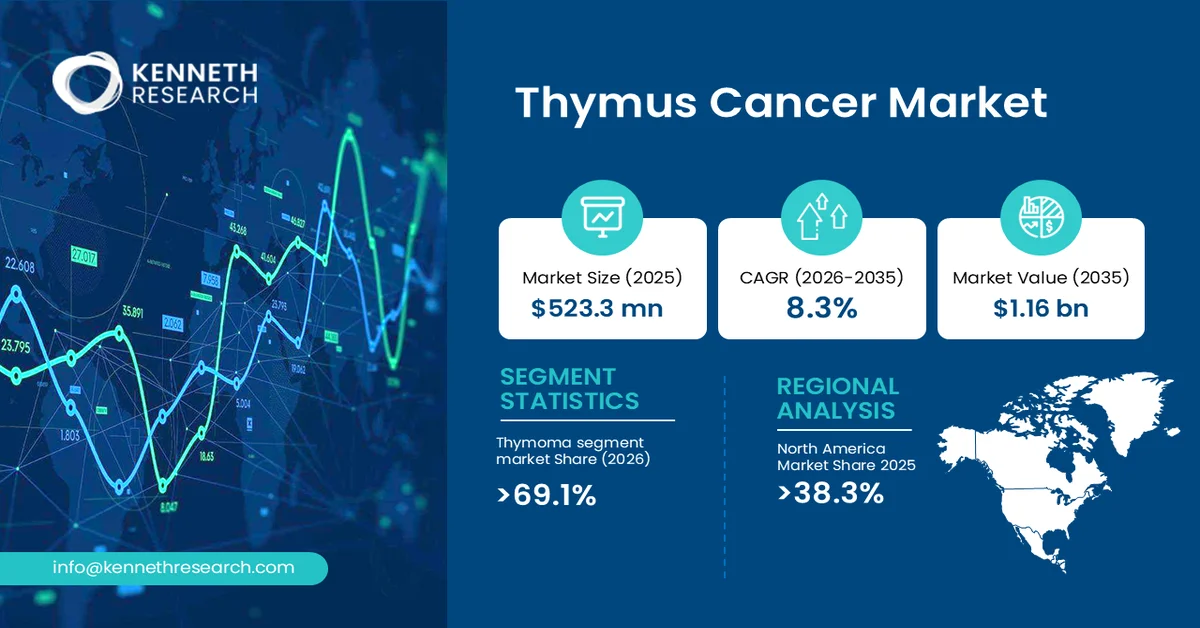
Thymus Cancer Market size was valued at USD 523.3 million in 2025 and is projected to reach USD 1.16 billion by 2035, expanding at a CAGR of 8.3% during the forecast period (2026-2035). In 2026, the industry size of the thymus cancer is estimated at USD 566.7 million.
The primary growth driver for the thymus cancer market is the increasing adoption of precision oncology supported by advances in molecular diagnostics and multimodal treatment strategies. Improved diagnostic accuracy, wider availability of targeted therapies, and expanding multidisciplinary cancer care are enabling earlier intervention, optimized treatment selection, and improved management of rare thymic malignancies worldwide.
The thymus cancer market comprises pharmaceuticals, biologics, immunotherapies, targeted therapies, diagnostic technologies, surgical solutions, and supportive healthcare services used for the diagnosis, treatment, and long-term management of malignant tumors originating in the thymus gland. The market primarily addresses thymoma and thymic carcinoma, with treatment approaches determined by disease stage, histological subtype, and patient-specific clinical characteristics. Standard therapeutic modalities include surgical resection, radiation therapy, chemotherapy, targeted therapy, and immunotherapy, while advanced molecular diagnostics increasingly support personalized treatment planning.
The market is characterized by its focus on rare oncology indications, multidisciplinary treatment pathways, and continuous research aimed at improving therapeutic efficacy and patient outcomes. Growing integration of biomarker-based diagnostics, precision medicine, and novel drug development has strengthened clinical decision-making and expanded treatment options for patients with advanced or recurrent disease.
Key Thymus Cancer Market Insights Summary:
Key Takeaways: Market Trends & Insights
- The thymus cancer market is projected to grow from USD 523.3 million in 2025 to USD 1.16 billion by 2035, at a CAGR of 8.3%.
- North America held the largest market share of 38.3% in 2025, supported by advanced oncology infrastructure and strong orphan drug development.
- Thymoma remains the leading type segment, accounting for 69.1% of the market in 2026.
- The Stage 1 Form segment is expected to witness notable growth due to increasing emphasis on early diagnosis and timely intervention.
- Growing adoption of precision oncology, biomarker-based diagnostics, and targeted therapies continues to drive market expansion.
Market Drivers
- Growing government support for precision oncology and rare cancer research
- Expanding adoption of multidisciplinary cancer care pathways
- Rising adoption of biomarker-based diagnostics for personalised treatment selection.
- Increasing development and regulatory support for orphan oncology drugs.
- Growing investment in specialised cancer centres and tertiary healthcare infrastructure.
- Expanding clinical research collaborations between pharmaceutical companies and academic institutions.
Challenges
- Limited patient population and difficulties in large-scale clinical research
- High treatment costs and uneven access to specialised oncology care
- Limited patient population and difficulties in large-scale clinical research.
- High treatment costs and uneven access to specialised oncology care.
Thymus Cancer Market Overview & Supply Chain
Global adoption of thymus cancer therapeutics is increasing as healthcare systems strengthen rare cancer diagnosis, precision oncology, and multidisciplinary treatment pathways. Advancements in molecular diagnostics, targeted therapies, minimally invasive thoracic surgery, and immunotherapy have improved treatment selection and disease management for patients with thymic malignancies. Regulatory support for orphan drug development and growing investments in specialized oncology centres are also expanding access to advanced therapies. The broader rise in cancer burden continues to reinforce demand for innovative oncology solutions, including those addressing rare malignancies. According to the World Health Organization (WHO) and the International Agency for Research on Cancer (IARC), an estimated 20 million new cancer cases and 9.7 million cancer deaths occurred worldwide in 2022, highlighting the increasing need for effective diagnostic and therapeutic infrastructure across the oncology continuum.
The thymus cancer market value chain begins with research institutions, biotechnology companies, and pharmaceutical developers engaged in identifying therapeutic targets, biomarkers, and novel oncology compounds. Upstream activities include sourcing active pharmaceutical ingredients, biologic materials, laboratory reagents, diagnostic components, and specialized manufacturing technologies that support oncology product development. Manufacturing involves formulation, biologics production, sterile filling, quality assurance, regulatory compliance, and packaging under stringent pharmaceutical standards. Distribution occurs through specialty pharmaceutical distributors, hospital procurement networks, and licensed healthcare providers, ensuring controlled delivery of oncology medicines and companion diagnostics. End users primarily include tertiary hospitals, cancer centres, academic medical institutions, specialty oncology clinics, and research organizations responsible for diagnosing and treating thymic malignancies. Key stakeholders across the ecosystem include pharmaceutical manufacturers, biotechnology firms, diagnostic developers, contract research organizations, regulatory authorities, healthcare providers, reimbursement agencies, and patient advocacy organizations that collectively support innovation, commercialization, and patient access to advanced thymus cancer therapies.
Thymus Cancer Market: Growth Drivers & Challenges
Growth Drivers:
- Expansion of precision oncology and targeted therapies: The thymus cancer market is benefiting from the increasing adoption of precision oncology and biomarker-guided treatment approaches. Advances in molecular diagnostics and genomic profiling are enabling personalized treatment strategies, improving clinical outcomes for patients with rare thymic malignancies. Pharmaceutical companies are also expanding investments in targeted therapies and immunotherapies, strengthening the development pipeline for thymus cancer treatment. According to the U.S. National Cancer Institute (NCI), the institute invested approximately USD 7.22 billion in cancer research during Fiscal Year 2023, supporting continued innovation in oncology therapeutics.
- Growing adoption of multidisciplinary cancer care: The increasing adoption of multidisciplinary cancer care is further driving market growth. Collaboration among thoracic surgeons, medical oncologists, radiation oncologists, and pathologists is improving treatment planning and patient outcomes. Expanding access to specialized cancer centres and standardized treatment pathways is encouraging the adoption of advanced therapies for thymic malignancies. Growing healthcare investment in integrated oncology services is expected to support sustained market growth during the forecast period.
Challenges:
- Limited patient population and difficulties in large-scale clinical research: The rarity of thymus cancer presents a significant challenge to the market by restricting the availability of large patient populations for clinical research and therapeutic development. Limited patient enrolment often prolongs clinical studies, delays evidence generation, and increases the cost of developing novel therapies. Pharmaceutical companies also face difficulties in demonstrating statistically robust efficacy and safety outcomes, which can extend regulatory review timelines and affect commercialization strategies. Healthcare providers may have limited clinical experience with these uncommon malignancies, resulting in variations in diagnosis and treatment approaches across regions. Although international research collaborations and rare disease networks are improving access to multicentre studies, overcoming the challenges associated with small patient populations will remain essential for accelerating innovation, expanding treatment options, and improving long-term commercial viability within the thymus cancer market.
- High treatment costs and uneven access to specialised oncology care: The growing complexity of thymus cancer treatment has increased dependence on specialised diagnostics, advanced surgical procedures, targeted therapies, immunotherapies, and multidisciplinary clinical management, leading to substantial treatment costs. In many healthcare systems, reimbursement policies for rare cancer therapies remain inconsistent, creating financial barriers for both providers and patients. Access to specialised thoracic oncology centres is also concentrated in major metropolitan regions, limiting timely diagnosis and treatment for patients in underserved areas. These disparities can delay therapeutic intervention and reduce the adoption of innovative treatment modalities. While governments and healthcare organisations continue expanding oncology infrastructure and reimbursement frameworks, improving affordability and equitable access to specialised care will remain critical to sustaining long-term market growth and ensuring broader availability of advanced thymus cancer therapies.
Thymus Cancer Market Size and Forecast:
| Report Attribute | Details |
|---|---|
| Base Year |
2025 |
| Forecast Year |
2026-2035 |
| CAGR |
8.3% |
| Base Year Market Size (2025) |
USD 523.3 million |
| Forecast Year Market Size (2035) |
USD 1.16 billion |
| Regional Scope |
|
Thymus Cancer Market - Segment Analysis
Type Segment Analysis
The thymoma segment dominates the thymus cancer market and accounted for 69.1% of the market in 2026, owing to its comparatively higher incidence among thymic epithelial tumours and well-established clinical management pathways. Thymoma is frequently diagnosed at an earlier stage than more aggressive thymic carcinomas, enabling greater use of curative surgical resection combined with adjuvant radiotherapy or systemic therapies when clinically indicated. Continuous improvements in diagnostic imaging, histopathological classification, and multidisciplinary treatment planning have further strengthened clinical adoption and patient outcomes. Growing awareness among healthcare professionals regarding thymic malignancies and increasing availability of specialised thoracic oncology centres are also supporting demand for effective thymoma management. On the supply side, pharmaceutical companies and research institutions continue to expand therapeutic development for thymic epithelial tumours through targeted therapies and immuno-oncology approaches, broadening future treatment options. According to the International Agency for Research on Cancer (IARC), there were an estimated 20 million people living within five years of a cancer diagnosis worldwide in 2022, reflecting the growing demand for long-term oncology management and specialised cancer care services that also benefit patients with rare malignancies such as thymoma.
By Form Segment Analysis
The Stage 1 form segment is projected to witness significant growth during the forecast period as healthcare systems continue to emphasise early cancer detection and timely therapeutic intervention. Patients diagnosed at Stage 1 generally present with localized disease, making them suitable candidates for complete surgical resection, often resulting in favourable long-term clinical outcomes. Improvements in diagnostic imaging, pathology, and multidisciplinary evaluation are enabling clinicians to identify thymic malignancies at earlier stages, supporting greater adoption of curative treatment strategies. In parallel, increasing awareness among healthcare professionals and enhanced referral pathways to specialised thoracic oncology centres are contributing to improved diagnosis and disease management. From the supply perspective, manufacturers are investing in advanced imaging technologies, minimally invasive surgical solutions, and precision oncology tools that facilitate early-stage treatment. According to the OECD, the demand for radiotherapy services across EU countries is projected to increase by 25% between 2022 and 2050, underscoring the growing need for comprehensive cancer treatment infrastructure that supports management across all disease stages, including early-stage thymic malignancies.
Our in-depth analysis of the global thymus cancer market includes the following segments:
|
Segment |
Sub-segment |
|---|---|
|
Type |
|
|
Form |
|
|
Treatment Type |
|
|
End-User |
|
|
Route of Administration |
|
Thymus Cancer Market Regional Insights:
North America Market Trends & Insights:
North America accounted for the largest revenue share of 38.1% in 2025.
The region dominates the thymus cancer market owing to its advanced oncology infrastructure, strong biopharmaceutical industry, and increasing adoption of precision medicine. Growing investment in orphan drug development, molecular diagnostics, and immuno-oncology continues to strengthen market growth.
The United States leads the regional market due to its extensive network of specialized cancer centres, active clinical research, and early adoption of innovative therapies. According to the U.S. Food and Drug Administration (FDA), 55 novel drugs were approved by the Center for Drug Evaluation and Research (CDER) in 2023, reflecting continued innovation in pharmaceutical development, including oncology therapies.
Canada supports regional expansion through its publicly funded healthcare system, growing oncology research, and improving access to specialized cancer care. Continued advancements in personalized medicine and multidisciplinary treatment are expected to sustain North America's leadership during the forecast period.
Asia Pacific Market Trends & Insights:
Asia Pacific is expected to witness the fastest growth during the forecast period, supported by expanding healthcare infrastructure, increasing cancer awareness, and rising investment in oncology care. Governments across the region are improving access to molecular diagnostics, targeted therapies, and specialized cancer treatment.
Japan remains a leading market within the region owing to its advanced healthcare system, well-established oncology research ecosystem, and widespread adoption of precision medicine. Strong government support for cancer research, access to specialised cancer centres, and rapid integration of innovative therapies continue to support market expansion.
China is experiencing robust growth through substantial investment in healthcare infrastructure, expansion of tertiary hospitals, and increasing domestic pharmaceutical innovation. Government initiatives to improve cancer screening, accelerate regulatory approvals, and strengthen biopharmaceutical research are enhancing patient access to advanced oncology treatments, positioning the country as a major contributor to future growth in the Asia Pacific thymus cancer market.
Leading Companies Operating in the Global Thymus Cancer Market:
The global thymus cancer market is moderately consolidated, with competition driven by companies focused on oncology therapeutics, immunotherapies, and targeted therapies for rare cancers. Market participants are strengthening their position through product innovation, strategic collaborations, and continued investment in clinical research to expand treatment options for thymic malignancies.
Here is a list of upstream, downstream, and key players operating in the global thymus cancer market competitive ecosystem:
- Merck & Co., Inc. (U.S.)
- Company Overview
- Business Strategy
- Key Product Offerings
- Financial Performance
- Key Performance Indicators
- Risk Analysis
- Recent Development
- Regional Presence
- SWOT Analysis
- Pfizer Inc. (U.S.)
- Roche Holding AG (Switzerland)
Recent Developments
- May 2025: Chugai Pharmaceutical submitted a regulatory application to Japan's Ministry of Health, Labour and Welfare for an additional indication of Tecentriq® (atezolizumab) for the treatment of thymic carcinoma.
- March 2025: Chugai Pharmaceutical received Orphan Drug Designation in Japan for Tecentriq® for thymic carcinoma, supporting accelerated regulatory review and development of therapies for rare cancers.
- February 2024: The FDA approved Amtagvi® (lifileucel), the first tumour-infiltrating lymphocyte (TIL) cell therapy for advanced melanoma.
Frequently Asked Question
The global thymus cancer market was valued at USD 523.3 million in 2025.
The market is projected to reach USD 1.16 billion by 2035, registering a CAGR of 8.3% during the forecast period.
The thymoma segment accounts for the largest market share, representing 69.1% of the global market in 2026.
North America leads the global market with a 38.3% share in 2025, supported by advanced oncology infrastructure and strong pharmaceutical innovation.
Key companies include Merck & Co., Inc., Pfizer Inc., Roche Holding AG, Eisai Co., Ltd., and Chugai Pharmaceutical Co., Ltd.
Why Choose Kenneth Research ?
-
Insight with Impact : We don’t just gather data — we uncover stories, trends, and opportunities that fuel business growth.
-
Experts Who Get It : Our team speaks your industry’s language and knows what really matters to your customers and market.
-
Custom-Built for You : Forget one-size-fits-all. We craft research and consulting solutions as unique as your business vision.
-
Partners, Not Just Providers : We work with you, not for you — collaborating closely to turn insights into smart, strategic moves.
-
Results That Speak : Our work powers brands, startups, and industry leaders alike — with a track record of ideas that work in the real world.
Report ID: 1092 |
Published Date: 17 Aug 2026 |
Report Format: |
Delivery Timeline: 48-72 Business Hours

Copyright © 2025 Kenneth Research. All rights reserved. Terms of Use | Privacy Policy
