Report ID: 1091 |
Published Date: 17 Aug 2026 |
Report Format: |
Delivery Timeline: 48-72 Business Hours
Throat Cancer Market Outlook:
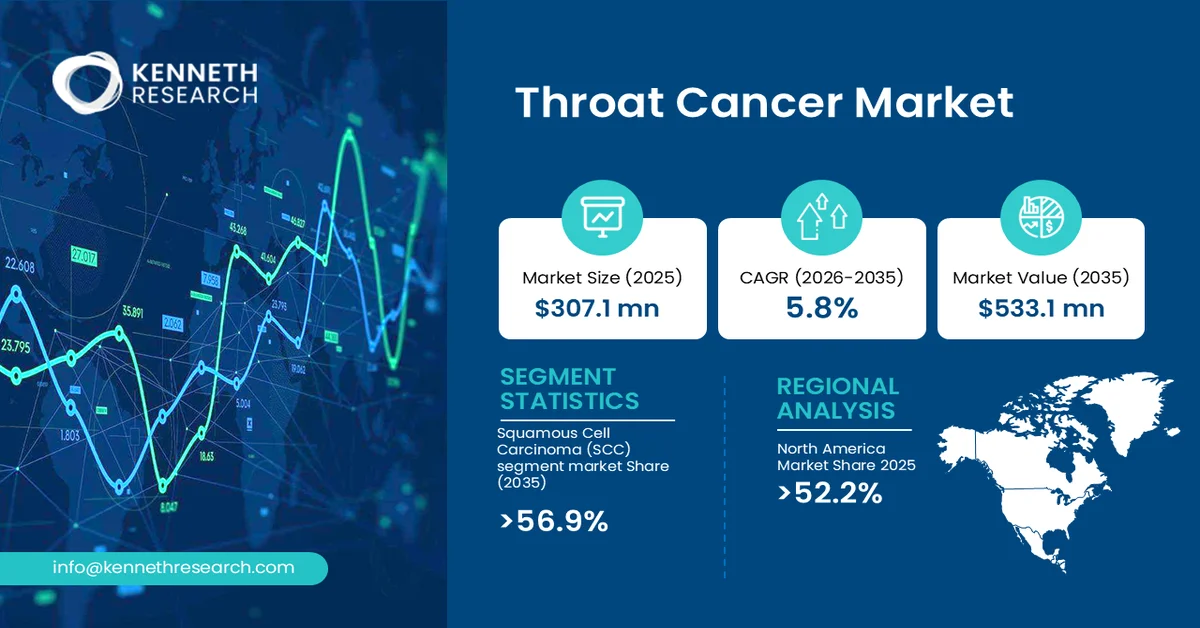
Throat Cancer Market size was valued at USD 307.1 million in 2025 and is projected to reach USD 533.1 million by the end of 2035, rising at a CAGR of 5.8% during the forecast period, i.e., 2026-2035. In 2026, the industry size of the throat cancer is estimated at USD 324.9 million.
The primary growth driver for the throat cancer market is the increasing burden of HPV-associated oropharyngeal cancers, which is accelerating demand for advanced diagnostics, targeted therapies, and multidisciplinary treatment approaches. According to the CDC, HPV is estimated to cause 60%–70% of oropharyngeal cancers in the United States, reinforcing the need for earlier detection and improved therapeutic interventions.
The throat cancer market comprises the development, manufacturing, commercialization, and clinical adoption of products and services used for the diagnosis, treatment, monitoring, and supportive care of malignancies affecting the pharynx, larynx, and other anatomical structures of the throat. The market encompasses pharmaceuticals, targeted therapies, immunotherapies, diagnostic technologies, biopsy procedures, imaging systems, surgical interventions, radiation therapy solutions, and post-treatment rehabilitation services delivered across hospitals, specialty cancer centers, and ambulatory healthcare facilities.
A defining characteristic of the market is its multidisciplinary care model, integrating oncology, otolaryngology, pathology, radiology, and supportive care to improve diagnostic accuracy and patient outcomes. The increasing use of precision medicine, biomarker-guided treatment selection, minimally invasive surgical techniques, and advanced imaging technologies continues to enhance clinical decision-making while supporting personalized treatment strategies.
Industrially, the market is strategically important due to ongoing investments in oncology research, expansion of cancer screening capabilities, and continuous innovation in targeted therapeutics and immuno-oncology. The sector also benefits from growing collaborations among healthcare providers, research institutions, biotechnology companies, and pharmaceutical manufacturers to improve treatment efficacy, optimize patient management, and address the evolving global burden of throat cancer.
Key Throat Cancer Market Insights Summary:
Key Takeaways: Market Trends & Insights
- Throat Cancer Market is projected to grow from USD 307.1 million in 2025 to USD 533.1 million by 2035 at a CAGR of 5.8%
- North America led the global market with a 52.2% share in 2025, supported by advanced oncology infrastructure and strong adoption of precision cancer therapies
- Squamous Cell Carcinoma (SCC) is expected to remain the leading type of throat cancer, accounting for 56.9% of the market by 2035 due to established treatment pathways and increasing use of targeted therapies
- The localized stage of cancer is anticipated to witness strong growth, driven by expanding early diagnosis programs, advanced imaging technologies, and precision diagnostic approaches
- Rising adoption of precision oncology, immunotherapies, molecular diagnostics, and multidisciplinary cancer care models continues to strengthen innovation and long-term growth opportunities across the global throat cancer market
Market Drivers
- Increasing adoption of precision oncology and immunotherapy
- Advancements in diagnostic imaging and molecular diagnostics
- Growing emphasis on HPV vaccination and early cancer screening
- Rising investment in oncology research and multidisciplinary cancer care programs
Challenges
- High clinical complexity and treatment costs
- Delayed diagnosis and variability in healthcare access
Throat Cancer Market Overview & Supply Chain
Global adoption in the throat cancer market is increasing as healthcare systems strengthen cancer screening pathways, expand precision oncology programs, and accelerate access to targeted therapies, immunotherapies, and minimally invasive diagnostic technologies. Advances in molecular diagnostics, biomarker testing, digital pathology, and image-guided interventions are improving diagnostic accuracy and supporting personalized treatment selection. Public health initiatives focused on HPV prevention and early cancer detection are also contributing to greater awareness and earlier clinical intervention. Industry investment is further supported by expanding oncology research collaborations between pharmaceutical companies, biotechnology firms, and academic medical centers. According to the U.S. Centers for Disease Control and Prevention (CDC), HPV is thought to cause 70% of oropharyngeal cancers in the United States, underscoring the growing importance of preventive healthcare strategies, early diagnosis, and innovation in throat cancer therapeutics.
The throat cancer industry value chain begins with the sourcing of pharmaceutical active ingredients, biologics, diagnostic reagents, imaging components, surgical instruments, laboratory consumables, and medical-grade materials used in oncology diagnostics and treatment. These inputs are transformed by pharmaceutical manufacturers, biotechnology companies, medical device producers, and diagnostic developers into targeted therapies, immunotherapies, biopsy systems, imaging equipment, radiation therapy technologies, and supportive care products through highly regulated manufacturing and quality assurance processes. Distribution is managed through specialty pharmaceutical distributors, medical device suppliers, hospital procurement organizations, and healthcare logistics providers to ensure timely product availability across clinical settings. End users primarily include hospitals, comprehensive cancer centers, specialty oncology clinics, ambulatory surgical centers, diagnostic laboratories, and research institutions. Major stakeholders encompass pharmaceutical and biotechnology companies, diagnostic manufacturers, healthcare providers, regulatory agencies, reimbursement organizations, contract research organizations, academic institutions, patient advocacy groups, and government health authorities that collectively support innovation, commercialization, clinical adoption, and long-term patient care.
Throat Cancer Market: Growth Drivers & Challenges
Growth Drivers:
- Expanding precision oncology and immunotherapy adoption: The growing integration of precision oncology into routine cancer care is a major driver for the throat cancer market. Healthcare providers are increasingly utilizing molecular profiling, biomarker-guided treatment selection, and immunotherapies to improve treatment outcomes while minimizing unnecessary exposure to conventional therapies. This transition is encouraging broader adoption of companion diagnostics, advanced pathology services, and targeted therapeutic regimens across tertiary hospitals and specialized cancer centers. Regulatory support for innovative oncology products, coupled with continued investments in translational research, is accelerating commercialization of next-generation treatment options. Future market growth is expected to benefit from broader clinical implementation of personalized medicine, increasing collaboration between pharmaceutical and biotechnology companies, and expanding indications for immunotherapeutic agents across head and neck malignancies. Reflecting this innovation trend, the U.S. Food and Drug Administration approved pembrolizumab in combination with chemotherapy for patients with locally advanced or metastatic esophageal or gastroesophageal junction carcinoma in 2021, demonstrating continued regulatory momentum for advanced immuno-oncology therapies relevant to upper aerodigestive tract cancers.
- Strengthening early diagnosis through advanced diagnostic technologies: The increasing adoption of advanced diagnostic technologies is creating substantial growth opportunities across the throat cancer care continuum. High-resolution imaging, digital pathology, minimally invasive biopsy techniques, artificial intelligence-assisted image interpretation, and molecular diagnostic platforms are enabling clinicians to identify malignancies with greater accuracy and at earlier stages. Earlier diagnosis supports more effective treatment planning, improves eligibility for organ-preserving therapeutic approaches, and enhances long-term patient management. Simultaneously, healthcare providers are investing in integrated diagnostic workflows that reduce turnaround times and facilitate multidisciplinary decision-making. As diagnostic technologies continue to evolve alongside precision medicine initiatives, manufacturers are expected to introduce increasingly sophisticated platforms that combine imaging, pathology, and genomic insights. This evolution will strengthen clinical confidence, improve operational efficiency within oncology practices, and expand demand for innovative diagnostic solutions across developed and emerging healthcare markets.
Challenges
- High clinical complexity and treatment costs: The management of throat cancer requires coordinated care involving surgical oncology, radiation oncology, medical oncology, pathology, radiology, and rehabilitation specialists. This multidisciplinary approach increases treatment complexity and places significant pressure on healthcare infrastructure. The introduction of advanced immunotherapies, targeted therapies, robotic surgical systems, and precision diagnostics has improved clinical outcomes but has also raised the overall cost of care. Commercially, high treatment expenses can slow technology adoption in cost-sensitive healthcare systems and create reimbursement challenges for providers and payers. Manufacturers must also invest heavily in clinical trials, regulatory compliance, and post-market evidence generation, increasing development costs. Looking ahead, broader reimbursement coverage, value-based care models, and continued innovation aimed at improving cost efficiency will be critical to expanding patient access while maintaining commercial sustainability.
- Delayed diagnosis and variability in healthcare access: A significant restraint in the throat cancer market is the continued occurrence of delayed diagnosis resulting from nonspecific early symptoms, limited public awareness, and unequal access to specialized oncology services. Many patients initially present with symptoms that resemble common respiratory or throat conditions, delaying referral for comprehensive diagnostic evaluation. This can reduce the opportunity for early intervention and increase the complexity of subsequent treatment pathways. From an industry perspective, inconsistent diagnostic capabilities across healthcare systems create uneven demand for advanced diagnostic technologies and specialized therapeutic products. Commercial expansion is further constrained by disparities in infrastructure, workforce availability, and reimbursement policies between developed and developing regions. Over the long term, investments in screening programs, specialist training, integrated referral networks, and expanded access to modern diagnostic platforms are expected to gradually reduce these barriers and support more consistent market adoption.
Throat Cancer Market Size and Forecast:
| Report Attribute | Details |
|---|---|
| Base Year |
2025 |
| Forecast Year |
2026-2035 |
| CAGR |
5.8% |
| Base Year Market Size (2025) |
USD 307.1 million |
| Forecast Year Market Size (2035) |
USD 533.1 million |
| Regional Scope |
|
Throat Cancer Market Segmentation Analysis:
Type Segment Analysis
In the type of throat cancer segment, the Squamous Cell Carcinoma (SCC) sub-segment is anticipated to capture the largest market share of 56.9% by the end of 2035.
Its dominance is supported by widespread clinical adoption of standardized diagnostic pathways involving endoscopy, imaging, histopathological evaluation, and biomarker testing, enabling timely therapeutic decision-making. On the supply side, pharmaceutical companies continue to prioritize the development of immunotherapies, targeted therapies, and combination treatment regimens specifically evaluated in squamous cell carcinoma, while medical device manufacturers expand advanced surgical and radiation technologies optimized for these patients. The extensive availability of clinical guidelines, specialized oncology expertise, and established reimbursement pathways further reinforces adoption across healthcare systems. According to the U.S. Centers for Disease Control and Prevention, based on 2018–2022 U.S. Cancer Statistics data, oropharyngeal cancers accounted for 22,585 HPV-associated cancer cases annually, and cancers at this site are defined as squamous cell carcinomas, highlighting the substantial clinical burden supporting demand for SCC-focused diagnostics and therapeutics.
Stage Segment Analysis
The localized is projected to grow as the second-largest segment in the throat cancer market due to four converging demand drivers.
The localized stage is projected to experience significant growth in the throat cancer market as healthcare systems increasingly prioritize early diagnosis to improve survival outcomes and reduce the need for extensive multimodal treatment. Greater public awareness of head and neck cancer symptoms, expanded access to advanced imaging, endoscopic examinations, molecular diagnostics, and multidisciplinary cancer care are contributing to higher detection rates at earlier disease stages. Clinicians are also adopting evidence-based screening and referral pathways that enable timely intervention, supporting greater utilization of surgery, radiation therapy, and organ-preserving treatment approaches for localized disease. On the supply side, manufacturers continue to introduce high-resolution diagnostic technologies, minimally invasive surgical platforms, and precision treatment solutions designed for early-stage cancers. Looking ahead, continued investment in early detection initiatives, precision diagnostics, and integrated oncology care is expected to strengthen demand for localized-stage diagnosis and treatment.
Our in-depth analysis of the global throat cancer market includes the following segments:
|
Segment |
Sub-segment |
|
Type of Throat Cancer |
|
|
Treatment Modality |
|
|
Stage of Cancer |
|
Throat Cancer Market Regional Insights:
North America Market Trends & Insights:
North America throat cancer market is projected to hold the largest revenue share of 52.2% by the end of 2025.
North America accounted for 52.2% of the throat cancer market in 2025, making it the dominant regional market. Its leadership is supported by advanced oncology infrastructure, widespread adoption of precision medicine, strong pharmaceutical and biotechnology research capabilities, and well-established reimbursement frameworks for cancer diagnosis and treatment. The region continues to attract substantial investment in immuno-oncology, targeted therapeutics, molecular diagnostics, and minimally invasive surgical technologies. Favorable regulatory pathways and extensive collaboration among academic institutions, healthcare providers, and life sciences companies further accelerate the commercialization and adoption of innovative therapies. In addition, comprehensive cancer registries, established clinical guidelines, and high healthcare expenditure contribute to consistent demand for advanced throat cancer management solutions across the region.
The United States remains the principal contributor to regional leadership due to its robust oncology research ecosystem, extensive clinical trial activity, and rapid adoption of innovative therapeutics and diagnostic technologies.
Canada complements regional growth through publicly funded healthcare services, expanding cancer control initiatives, and increasing integration of precision oncology into routine clinical practice.
Europe Market Trends & Insights:
Europe represents a strategically important region in the throat cancer market, supported by strong demand for advanced oncology diagnostics, precision medicine, and multidisciplinary cancer care. The region benefits from established public healthcare systems, extensive cancer research networks, and growing adoption of biomarker-guided treatment approaches. Continued investments in immuno-oncology, minimally invasive surgical technologies, and digital pathology are strengthening the region's clinical capabilities for head and neck cancer management. Government-led cancer control initiatives, expanded screening and prevention programs, and coordinated research funding are further encouraging innovation and improving access to modern therapeutic options. Collaboration among academic institutions, biotechnology companies, pharmaceutical manufacturers, and healthcare providers continues to accelerate clinical research and technology adoption. Looking ahead, increasing emphasis on personalized medicine, artificial intelligence-enabled diagnostics, and integrated cancer care pathways is expected to create significant opportunities for product innovation and broader commercialization across the European healthcare landscape.
Germany serves as a major contributor to the regional market through its advanced hospital infrastructure, strong pharmaceutical and medical technology industries, and extensive participation in oncology research and clinical trials. The country's focus on precision oncology and early diagnosis supports sustained demand for innovative diagnostic platforms and targeted therapies.
France complements regional growth through comprehensive national cancer strategies, well-established reimbursement mechanisms, and continuous investment in cancer prevention, research, and specialized treatment centers. Ongoing expansion of genomic medicine programs, multidisciplinary care models, and public health initiatives is expected to further strengthen the adoption of advanced throat cancer diagnostics and therapeutics across both countries.
Leading Companies Operating in the Global Throat Cancer Market:
Here is a list of upstream, downstream, and key players operating in the global throat cancer market competitive ecosystem:
Bristol-Myers Squibb (United States)
- Company Overview
- Business Strategy
- Key Product Offerings
- Financial Performance
- Key Performance Indicators
- Risk Analysis
- Recent Development
- Regional Presence
- SWOT Analysis
- Pfizer Inc. (United States)
- Eli Lilly and Company (United States)
- Amgen Inc. (United States)
- GlaxoSmithKline plc (United Kingdom)
- Inovio Pharmaceuticals Inc. (United States)
Recent Developments
- September 2024: Results presented at the ESMO Congress 2024 showed that Akeso's ivonescimab, a PD-1/VEGF bispecific antibody, demonstrated encouraging clinical activity in recurrent or metastatic head and neck squamous cell carcinoma, supporting continued development of next-generation immunotherapies for throat cancer.
- May 2025: Johnson & Johnson announced the submission of a supplemental Biologics License Application (sBLA) to the U.S. FDA for subcutaneous amivantamab in recurrent or metastatic head and neck squamous cell carcinoma, following the therapy's Breakthrough Therapy Designation. The application aims to expand treatment options for advanced head and neck cancers, including throat cancer.
Frequently Asked Question
In 2025, the throat cancer market exceeded USD 307.1 million.
The throat cancer market is projected to reach USD 533.1 million by the end of 2035, expanding at a CAGR of 5.8% over the forecast period (2026-2035).
The major players in the market are Bristol-Myers Squibb (United States), Pfizer Inc. (United States), Eli Lilly and Company (United States), Amgen Inc. (United States), GlaxoSmithKline plc (United Kingdom), Inovio Pharmaceuticals Inc. (United States), and others.
In the type of throat cancer segment, the squamous cell carcinoma (SCC) sub-segment is anticipated to capture the largest market share of 56.9% in the future and exhibit lucrative growth opportunities during 2026-2035. This growth trajectory is largely attributed to increasing adoption of precision oncology, biomarker-guided diagnosis, and targeted treatment approaches for squamous cell malignancies.
North America is projected to hold the largest market share of 52.2% by the end of 2025 and provide more business opportunities in the future. Continuous investments in oncology research, precision medicine, and advanced cancer care infrastructure across the United States and Canada are fostering the region's dominance.
Why Choose Kenneth Research ?
-
Insight with Impact : We don’t just gather data — we uncover stories, trends, and opportunities that fuel business growth.
-
Experts Who Get It : Our team speaks your industry’s language and knows what really matters to your customers and market.
-
Custom-Built for You : Forget one-size-fits-all. We craft research and consulting solutions as unique as your business vision.
-
Partners, Not Just Providers : We work with you, not for you — collaborating closely to turn insights into smart, strategic moves.
-
Results That Speak : Our work powers brands, startups, and industry leaders alike — with a track record of ideas that work in the real world.
Report ID: 1091 |
Published Date: 17 Aug 2026 |
Report Format: |
Delivery Timeline: 48-72 Business Hours

Copyright © 2025 Kenneth Research. All rights reserved. Terms of Use | Privacy Policy
