Report ID: 1176 |
Published Date: 26 Aug 2026 |
Report Format: |
Delivery Timeline: 48-72 Business Hours
Telecom Edge Load Balancer Market Outlook:
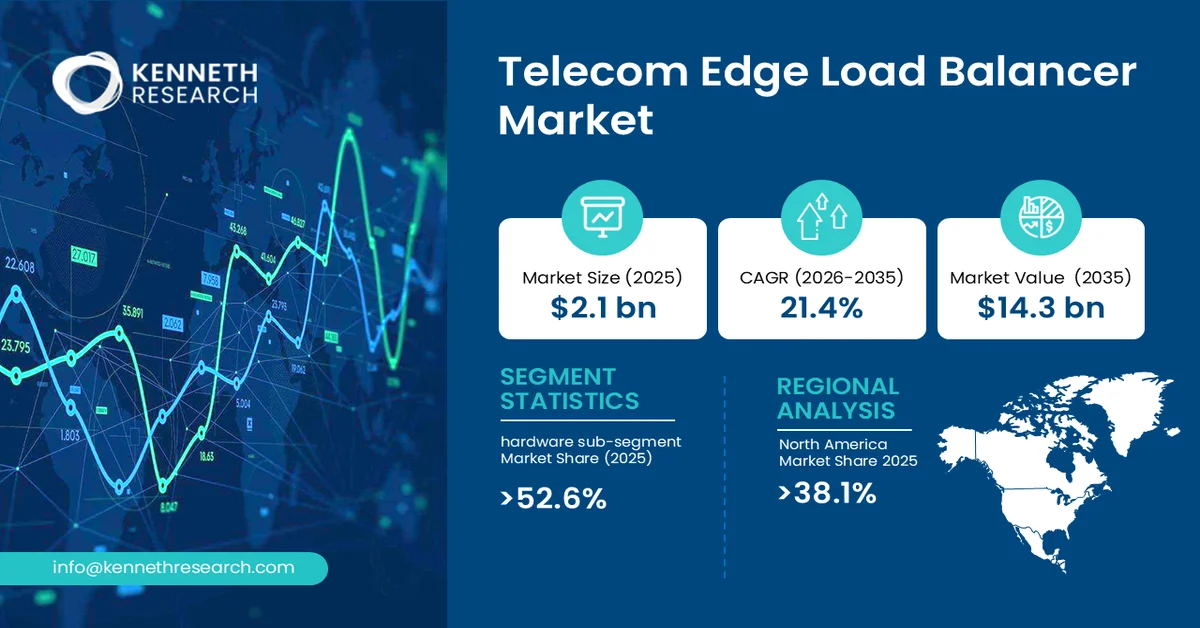
Telecom Edge Load Balancer Market size was valued at USD 2.1 billion in 2025 and is projected to reach USD 14.3 billion by the end of 2035, rising at a CAGR of 21.4% during the forecast period, i.e., 2026-2035. In 2026, the industry size of the telecom edge load balancer is estimated at USD 2.5 billion.
The primary growth driver for the telecom edge load balancer market is the rapid expansion of edge computing and distributed telecom infrastructure.
The telecom edge load balancer market comprises hardware and software technologies designed to distribute network and application traffic across servers, network functions, and computing resources positioned at or near telecommunications network edges. These systems manage traffic flows to improve application availability, optimize resource utilization, reduce latency, and maintain service continuity across distributed telecom environments.
Key characteristics include intelligent traffic distribution, application delivery optimization, session management, health monitoring, failover, scalability, traffic prioritization, and integration with virtualized and cloud-native network architectures. Edge load balancers can operate across physical, virtual, and containerized environments and increasingly incorporate automation and software-defined networking capabilities.
Key Telecom Edge Load Balancer Market Insights Summary:
Key Takeaways: Telecom Edge Load Balancer Market
- Telecom Edge Load Balancer Market projected to grow from USD 2.1 billion in 2025 to USD 14.3 billion by 2035 at a 21.4% CAGR.
- North America accounted for the largest regional share at 38.1% in 2025, supported by advanced 5G infrastructure, distributed computing, and strong investment in edge technologies.
- Hardware remained the leading component segment with a 52.6% share in 2025, supported by requirements for high-performance, reliable traffic distribution across telecom edge environments.
- On-premises deployment is positioned for continued adoption as telecom operators prioritize direct infrastructure control, predictable performance, security, and integration with existing network environments.
Market Drivers
- Expansion of 5G and edge computing infrastructure.
- Growing demand for low-latency and distributed applications.
- Increasing deployment of cloud-native telecom network functions.
- Rising adoption of IoT and real-time enterprise applications.
Challenges
- Integration complexity across distributed network architectures.
- Performance, reliability, and security requirements at the edge.
Telecom Edge Load Balancer Market Overview & Supply Chain
Adoption of telecom edge load-balancing technologies is increasing as telecommunications operators deploy 5G, distributed computing, cloud-native network functions, and latency-sensitive digital services closer to users. These architectures distribute workloads across numerous edge locations, increasing the need for intelligent traffic distribution, application availability, workload optimization, and rapid failover. The OECD reported that 5G subscriptions represented 37% of mobile broadband subscriptions across OECD economies by 2024, reflecting the continued expansion of advanced mobile connectivity infrastructure.
The Telecom Edge Load Balancer value chain begins with semiconductor, networking hardware, software, and virtualization technology providers supplying processors, network interfaces, operating environments, and traffic-management technologies. Equipment manufacturers and software developers integrate these components into physical appliances, virtual load balancers, containerized platforms, and cloud-native traffic-management solutions. Telecom technology vendors and system integrators then customize and deploy these platforms within operator networks, edge data centers, and distributed computing environments. Distribution occurs through direct enterprise and carrier sales, technology partnerships, systems integrators, managed-service providers, and cloud marketplaces.
Telecom Edge Load Balancer Market: Growth Drivers & Challenges
Growth Drivers:
- Expansion of 5G and Edge Computing Infrastructure: The deployment of 5G networks alongside distributed edge-computing infrastructure is increasing demand for efficient traffic distribution across geographically dispersed computing resources. Edge environments place processing closer to users and applications, creating a need to dynamically route traffic among available servers, network functions, and edge sites while maintaining service quality. The International Telecommunication Union (ITU) specifies that edge-cloud environments should provide load balancing of virtual resources and network traffic across multiple paths, together with monitoring and automatic resource scaling.
- Growing Demand for Low-Latency and Distributed Applications: The increasing deployment of latency-sensitive applications is encouraging telecom operators to distribute computing and networking resources closer to end users. Applications such as industrial automation, connected vehicles, immersive digital services, real-time analytics, and IoT require consistent traffic management and rapid access to available computing resources. Edge load balancers help distribute requests across local servers and edge clusters, preventing individual resources from becoming bottlenecks while supporting service continuity during failures or traffic fluctuations.
Challenges
- Integration Complexity Across Distributed Network Architectures: A major restraint is the complexity of integrating edge load balancers across heterogeneous telecom environments that combine physical infrastructure, virtualized network functions, containers, cloud platforms, and multiple network domains. Operators must maintain consistent traffic policies and visibility while coordinating resources distributed across numerous edge locations. This increases configuration requirements and can complicate interoperability between legacy and cloud-native systems. NIST notes that 5G network functions can operate as numerous software containers across distributed servers, with orchestration required to manage these dynamically provisioned functions.
- Performance, Reliability, and Security Requirements at the Edge: Edge environments place computing and networking resources closer to users, but their distributed architecture also creates demanding requirements for performance, availability, and security. Load balancers must distribute traffic efficiently without introducing additional latency while maintaining reliable failover and protecting increasingly exposed edge infrastructure. NIST highlights that emerging 5G and cloud-based network architectures create new cybersecurity and privacy risks because of the complexity of modern cellular infrastructure.
Telecom Edge Load Balancer Market Size and Forecast:
| Report Attribute | Details |
|---|---|
| Base Year |
2025 |
| Forecast Year |
2026-2035 |
| CAGR |
21.4% |
| Base Year Market Size (2025) |
USD 2.1 billion |
| Forecast Year Market Size (2035) |
USD 14.3 billion |
| Regional Scope |
|
Telecom Edge Load Balancer Market Segmentation Analysis:
Component Segment Analysis
In the component segment, the hardware sub-segment is anticipated to capture the largest market share of 52.6% in 2025.
Its leadership is supported by the continued deployment of physical telecom infrastructure required to process, route, and distribute increasingly complex traffic at network edges. Hardware-based load-balancing platforms remain relevant where operators require predictable throughput, dedicated processing, high availability, and direct integration with network equipment. The expansion of 5G, edge computing, and distributed data-processing environments is further increasing requirements for specialized infrastructure capable of handling traffic closer to users. The U.S. Federal Communications Commission identifies edge computing as complementary to 5G because locating computing resources closer to users can reduce latency and support applications including IoT and private 5G networks.
Deployment Mode Segment Analysis
In the Deployment Mode segment, the On-premises sub-segment is projected to grow as telecommunications operators continue to prioritize direct control over network infrastructure, traffic management, data handling, and service availability. On-premises deployment is particularly relevant for operators managing sensitive workloads, specialized network functions, and infrastructure requiring predictable performance and integration with existing telecom environments. It can also provide greater control over configuration, security policies, and resource allocation compared with externally hosted infrastructure. Government telecom initiatives supporting physical network expansion further reinforce the need for locally deployed networking infrastructure. India's Department of Telecommunications continues to establish technical requirements for telecom transmission, networking, and optical systems, supporting standardized deployment of carrier-grade infrastructure.
Our in-depth analysis of the global telecom edge load balancer market includes the following segments:
|
Segment |
Sub-segment |
|
Component |
|
|
Deployment Mode |
|
|
Application |
|
|
End User |
|
Telecom Edge Load Balancer Market Regional Insights:
North America Market Trends & Insights:
North America accounted for 38.1% of the telecom edge load balancer market in 2025, maintaining its leading position due to advanced telecommunications infrastructure, extensive 5G deployment, mature cloud ecosystems, and growing investment in edge computing.
The U.S. is the principal regional market, supported by major telecommunications operators, hyperscale cloud providers, data-center operators, and technology vendors developing distributed computing architectures. The Federal Communications Commission recognizes edge computing as complementary to 5G because locating computing resources closer to users can reduce latency and support applications such as IoT and private 5G networks.
Canada is also developing its edge-computing ecosystem as telecommunications operators and technology companies modernize networks and expand distributed digital infrastructure. Together, the two countries provide a strong combination of advanced telecom networks, cloud capabilities, enterprise demand, and technology innovation.
Europe Market Trends & Insights:
Asia Pacific is emerging as a significant growth region for the telecom edge load balancer market, supported by rapid 5G deployment, distributed computing, cloud infrastructure expansion, and increasing demand for low-latency digital services. Governments are encouraging the integration of 5G with edge computing and digital infrastructure, creating favorable conditions for traffic-management technologies at distributed network locations.
Japan represents a technologically mature market where telecom operators are advancing multi-access edge computing to support low-latency applications. SoftBank has conducted 5G MEC trials using SRv6 MUP technology to simplify connectivity between mobile devices and edge servers, supporting more efficient distributed network architectures.
China offers substantial opportunities due to its large-scale 5G deployment and government-backed development of edge infrastructure. Its national 5G strategy promotes industry virtual private networks alongside cloud platforms and edge-computing nodes, strengthening the ecosystem for telecom edge traffic-management solutions.
Leading Companies Operating in the Global Magnetic Carbon Nanofoam Market:
Here is a list of upstream, downstream, and key players operating in the global telecom edge load balancer market competitive ecosystem:
- F5(United States)
- Company Overview
- Business Strategy
- Key Product Offerings
- Financial Performance
- Key Performance Indicators
- Risk Analysis
- Recent Development
- Regional Presence
- SWOT Analysis
- A10 Networks(United States)
- Radware(Israel)
- Cisco(United States)
Recent Developments
- June 2026 –A10 Networks acquired TrojAI Inc. to expand its AI roadmap and strengthen capabilities addressing security and performance requirements associated with AI infrastructure.
Frequently Asked Question
In 2025, the telecom edge load balancer market exceeded USD 2.1 billion.
The telecom edge load balancer market is projected to reach USD 14.3 billion by the end of 2035, expanding at a CAGR of 21.4% over the forecast period (2026-2035).
The major players in the market are F5, A10 Networks, Radware, Cisco, and others.
In the Component segment, the Hardware sub-segment is anticipated to capture the largest market share of 52.6% in the future and exhibit lucrative growth opportunities during 2026-2035.
North America is projected to hold the largest market share of 38.1% by the end of 2025 and provide more business opportunities in the future.
Why Choose Kenneth Research ?
-
Insight with Impact : We don’t just gather data — we uncover stories, trends, and opportunities that fuel business growth.
-
Experts Who Get It : Our team speaks your industry’s language and knows what really matters to your customers and market.
-
Custom-Built for You : Forget one-size-fits-all. We craft research and consulting solutions as unique as your business vision.
-
Partners, Not Just Providers : We work with you, not for you — collaborating closely to turn insights into smart, strategic moves.
-
Results That Speak : Our work powers brands, startups, and industry leaders alike — with a track record of ideas that work in the real world.
Report ID: 1176 |
Published Date: 26 Aug 2026 |
Report Format: |
Delivery Timeline: 48-72 Business Hours

Copyright © 2025 Kenneth Research. All rights reserved. Terms of Use | Privacy Policy
