Report ID: 1043 |
Published Date: 28 Jul 2026 |
Report Format: |
Delivery Timeline: 48-72 Business Hours
TD Vaccine Market Outlook:
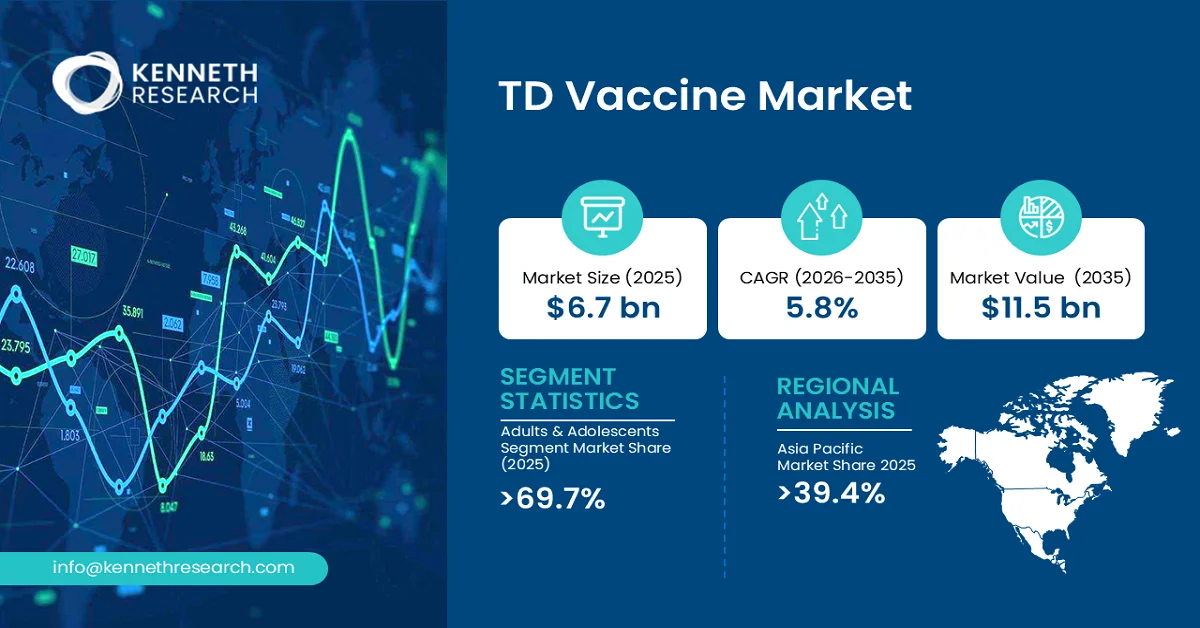
TD Vaccine Market size was valued at USD 6.7 billion in 2025 and is projected to reach USD 11.5 billion by the end of 2035, rising at a CAGR of 5.8% during the forecast period, i.e., 2026–2035. In 2026, the industry size of the TD vaccine is estimated at USD 7.1 billion.
The primary growth driver of the TD vaccine market is the expansion of national immunization programs and adult booster vaccination initiatives. Governments and public health organizations are strengthening routine vaccination schedules to reduce tetanus and diphtheria incidence, while increasing awareness of preventive healthcare, occupational immunization, and maternal vaccination continues to support sustained market demand.
The TD vaccine market comprises vaccines formulated to provide active immunization against tetanus and diphtheria through the administration of tetanus toxoid and reduced-dose diphtheria toxoid antigens. These vaccines are widely used as booster doses for adolescents and adults to maintain long-term immunity after completion of childhood immunization schedules. They are manufactured in multiple formulations, including single-dose prefilled syringes, single-dose vials, and multidose presentations, enabling their use across public immunization programs, hospitals, clinics, pharmacies, and occupational healthcare settings.
The market plays a vital role in preventive healthcare by supporting national immunization strategies, emergency wound management, travel medicine, military vaccination programs, and maternal immunization initiatives. Continuous regulatory oversight ensures stringent standards for vaccine safety, efficacy, cold-chain distribution, and quality assurance. Increasing emphasis on life-course immunization, broader healthcare accessibility, and strengthened public health infrastructure has reinforced the strategic importance of TD vaccines within global vaccination programs. As governments continue investing in disease prevention and immunization coverage, the market remains an essential component of infectious disease control and public health preparedness.
Key TD Vaccine Market Insights Summary:
Key Takeaways: Market Trends & Insights
- TD vaccine market valued at USD 6.7 billion in 2025 and projected to reach USD 11.5 billion by 2035 at a CAGR of 5.8%
- Adults & Adolescents led the age group segment with a 69.7% share in 2025 driven by expanding booster immunization programs
- Single-Dose Vials/Prefilled Syringes are expected to witness strong growth owing to increasing preference for safe and convenient vaccine administration
- Asia Pacific accounted for the largest regional share of 39.4% in 2025 supported by strong immunization infrastructure across India and China
- Africa is anticipated to emerge as a key growth region with expanding public health initiatives and increasing investments in vaccine access and immunization systems
Market Drivers
- Growing investments in vaccine manufacturing capacity and regional supply chain resilience
- Expansion of maternal immunization and preventive public health initiatives
- Advancements in cold-chain logistics and vaccine distribution infrastructure
- Increasing international collaboration supporting equitable immunization access
Challenges
- Complex cold-chain requirements and distribution constraints
- Lengthy regulatory approval processes and manufacturing compliance requirements
TD Vaccine Market Overview & Supply Chain
The adoption of TD vaccines is increasing globally as countries strengthen life-course immunization strategies, expand adult booster programs, and reinforce preparedness against vaccine-preventable diseases. Growing awareness of occupational immunization, maternal healthcare, travel medicine, and emergency wound prophylaxis has increased the demand for routine tetanus and diphtheria protection beyond childhood. Regulatory agencies and national immunization programs continue to prioritize vaccine quality, cold-chain integrity, and equitable access through public procurement and immunization campaigns. According to the World Health Organization (WHO) and UNICEF estimates, 108 million children received three doses of the diphtheria, tetanus, and pertussis (DTP) vaccine in 2023, demonstrating the continued scale and importance of global immunization systems that support long-term demand for tetanus- and diphtheria-containing vaccines.
The TD vaccine industry value chain begins with the procurement of biological raw materials, including purified toxoids, culture media, stabilizers, adjuvants, preservatives where applicable, sterile packaging components, and pharmaceutical-grade consumables sourced from qualified suppliers operating under stringent regulatory standards. Vaccine manufacturers then undertake antigen production, detoxification, purification, formulation, aseptic filling, packaging, quality assurance, and batch-release testing in compliance with Good Manufacturing Practices and national regulatory requirements. Following production, vaccines move through validated cold-chain logistics providers, central procurement agencies, wholesalers, and healthcare distributors before reaching hospitals, vaccination clinics, pharmacies, public immunization programs, and humanitarian organizations. End users include adolescents, adults, pregnant women, travelers, military personnel, and individuals requiring post-exposure prophylaxis. Major stakeholders across the value chain include raw material suppliers, contract manufacturing organizations, vaccine developers, regulatory authorities, public health agencies, logistics providers, healthcare professionals, procurement bodies, and international immunization organizations working to maintain uninterrupted vaccine availability and quality.
TD Vaccine Market: Growth Drivers & Challenges
Growth Drivers:
- Expansion of National Immunization and Booster Vaccination Programs: The growing emphasis on life-course immunization is significantly strengthening demand for TD vaccines across both developed and emerging healthcare systems. Governments are increasingly incorporating adolescent and adult booster doses into national vaccination schedules to sustain immunity against tetanus and diphtheria while reducing the burden of preventable infectious diseases. This trend is further supported by workplace vaccination initiatives, maternal immunization strategies, and improved access through public healthcare facilities. International organizations continue to assist countries in expanding immunization infrastructure, cold-chain capacity, and vaccine availability.
- Increasing Focus on Adult Preventive Healthcare and High-Risk Population Protection: Healthcare systems are placing greater emphasis on preventive medicine, resulting in stronger adoption of TD vaccines among adults, travelers, healthcare professionals, industrial workers, military personnel, and individuals with wound-related injury risks. Aging populations and expanding occupational health regulations are encouraging periodic booster vaccination to maintain long-term immunity. At the same time, employers, insurers, and healthcare providers are integrating preventive immunization into routine wellness initiatives, improving vaccination awareness and accessibility. Pharmaceutical companies continue to optimize manufacturing efficiency, packaging formats, and distribution capabilities to meet the evolving needs of public and private immunization programs. Looking ahead, broader digital immunization records, improved patient reminder systems, and stronger public-private healthcare partnerships are expected to enhance vaccination compliance, supporting sustained demand and encouraging greater integration of adult booster immunization into routine healthcare delivery.
Challenges:
- Complex Cold-Chain Requirements and Distribution Constraints: The TD vaccine market continues to face operational challenges due to the stringent storage and transportation conditions required to preserve vaccine potency throughout the supply chain. Temperature deviations during warehousing, transit, or last-mile delivery can compromise product integrity, resulting in inventory losses and increased operational costs. These issues are particularly significant in remote and resource-constrained regions where refrigeration infrastructure, power reliability, and logistics networks remain underdeveloped. For manufacturers and distributors, maintaining validated cold-chain systems demands continuous investment in specialized equipment, monitoring technologies, and compliance procedures. Commercially, these requirements increase distribution expenses and can limit market penetration in underserved areas. Looking ahead, broader adoption of advanced cold-chain monitoring solutions, infrastructure modernization, and stronger public-private logistics partnerships will be essential to improve supply reliability and support wider vaccine accessibility.
- Lengthy Regulatory Approval Processes and Manufacturing Compliance Requirements: Developing and supplying TD vaccines requires strict adherence to evolving regulatory standards governing manufacturing quality, product consistency, pharmacovigilance, and batch release. Regulatory authorities conduct comprehensive reviews and inspections before approving production facilities or product modifications, extending development and commercialization timelines. Manufacturers must continuously invest in process validation, quality management systems, documentation, and regulatory compliance to maintain market authorization across multiple jurisdictions. These obligations increase production complexity and create significant barriers for new market entrants while raising operating costs for existing suppliers. Commercially, prolonged approval cycles may delay product availability and reduce flexibility in responding to procurement opportunities or changing healthcare requirements. Future improvements in regulatory harmonization, digital documentation, and collaborative review mechanisms may help streamline approvals while preserving the rigorous safety and quality standards expected for vaccine products.
TD Vaccine Market Size and Forecast:
| Report Attribute | Details |
|---|---|
| Base Year |
2025 |
| Forecast Year |
2026-2035 |
| CAGR |
5.8% |
| Base Year Market Size (2025) |
USD 6.7 billion |
| Forecast Year Market Size (2035) |
USD 11.5 billion |
| Regional Scope |
|
TD Vaccine Market Segmentation Analysis:
Age Group Segment Analysis
In the age group segment, the adults & adolescents sub-segment is anticipated to capture the largest market share of 69.7% by the end of 2025.
The Adults & Adolescents segment dominates the TD vaccine market because routine booster immunization is essential to maintaining long-term protection against tetanus and diphtheria after childhood vaccination. Rising awareness of preventive healthcare, occupational immunization requirements, maternal vaccination, travel-related health precautions, and post-exposure prophylaxis has strengthened demand across this age group. Healthcare providers and public immunization authorities increasingly recommend periodic booster doses, encouraging higher vaccine uptake among adolescents transitioning into adulthood and older adults with declining immunity. On the supply side, manufacturers prioritize this segment by producing formulations tailored for booster administration through government procurement programs, hospitals, pharmacies, and primary healthcare facilities. According to UNICEF Supply Division, the demand for Td vaccine through UNICEF increased sixfold between 2014 and 2022, driven by the global transition from TT to Td vaccines following WHO recommendations, highlighting the growing demand for adolescent and adult immunization. Looking ahead, continued expansion of life-course vaccination strategies, digital immunization tracking, and stronger preventive healthcare policies are expected to reinforce the long-term dominance of this segment.
Formulation Segment Analysis
The Single-Dose Vials/Prefilled Syringes is projected to grow as the second-largest segment in the TD vaccine market due to four converging demand drivers.
The Single-Dose Vials/Prefilled Syringes segment is projected to witness strong growth as healthcare providers increasingly prioritize safe, efficient, and convenient vaccine administration across routine immunization programs and outreach campaigns. Single-dose presentations reduce the risk of contamination, eliminate concerns related to multidose vial handling, and simplify inventory management, making them well suited for hospitals, primary healthcare centers, pharmacies, and mobile vaccination units. The growing emphasis on injection safety, accurate dosing, and reduced vaccine wastage has further accelerated adoption among public health authorities and immunization service providers. On the supply side, manufacturers are expanding production of prefilled syringe and single-dose formats to improve operational efficiency, facilitate rapid administration, and support standardized vaccination practices. According to UNICEF Supply Division, UNICEF delivers an average of 800 million auto-disable syringes for childhood vaccinations across more than 90 countries each year, reflecting the global preference for single-use injection systems that complement single-dose vaccine administration. Looking ahead, continued investments in injection safety, expansion of immunization infrastructure, and broader adoption of ready-to-use vaccine presentations are expected to strengthen the growth trajectory of this formulation segment.
Our in-depth analysis of the global TD vaccine market includes the following segments:
|
Segment |
Sub-segment |
|
Product Type |
|
|
Age Group |
|
|
End User |
|
|
Distribution Channel |
|
|
Formulation |
|
TD Vaccine Market Regional Insights:
Asia Pacific Market Trends & Insights:
Asia Pacific TD vaccine market is projected to hold the largest revenue share of 39.4% by the end of 2025.
The region's leadership is driven by its extensive immunization infrastructure, large target population, expanding domestic vaccine manufacturing capabilities, and sustained government investments in preventive healthcare. Countries across the region continue to strengthen routine vaccination programs, improve cold-chain logistics, and expand healthcare access through public immunization initiatives. Strong regulatory oversight, favorable procurement policies, and continuous investments in vaccine research and production have created a resilient ecosystem for vaccine supply and distribution. The presence of leading vaccine manufacturers and increasing collaboration between governments and public health organizations further reinforces the region's ability to meet growing immunization requirements while supporting long-term public health objectives.
India and China are the primary contributors to Asia Pacific's dominance. India operates one of the world's largest immunization programs, supported by an extensive healthcare delivery network and continuous investments in indigenous vaccine manufacturing. According to the Press Information Bureau (Government of India), the Universal Immunisation Programme reaches approximately 2.9 crore pregnant women and 2.54 crore newborns annually, while full immunization coverage has increased to 98.4% as of January 2026. The government has also introduced an indigenously manufactured Td vaccine, strengthening domestic production capacity and improving vaccine accessibility.
China complements the regional market through its advanced vaccine manufacturing ecosystem, robust regulatory framework, and sustained investments in immunization infrastructure, enabling reliable vaccine production and supporting large-scale public vaccination initiatives.
Africa Market Trends & Insights:
Africa is emerging as a strategically important region for the TD vaccine market supported by expanding immunization coverage, increasing investments in public health systems, and stronger collaboration between governments and international health organizations. Many countries across the region are prioritizing the prevention of vaccine-preventable diseases by strengthening routine immunization services, improving maternal healthcare, and enhancing vaccine distribution through upgraded cold-chain infrastructure. Ongoing efforts to localize vaccine manufacturing, modernize regulatory frameworks, and improve healthcare accessibility are creating favorable conditions for market expansion. International partnerships focused on immunization financing, healthcare workforce development, and supply chain resilience are further supporting vaccine availability across underserved populations. As governments continue to invest in preventive healthcare and expand adult immunization initiatives, Africa presents significant long-term opportunities for vaccine manufacturers, procurement agencies, and healthcare providers seeking sustainable market growth.
South Africa remains one of the region's leading markets due to its comparatively advanced healthcare infrastructure, established vaccine procurement systems, and active participation in immunization and disease prevention programs. The country is also strengthening local biopharmaceutical capabilities and expanding collaborations to improve vaccine manufacturing and distribution resilience.
Nigeria represents another key growth market, driven by its large population, increasing healthcare investments, and continuous efforts to improve routine immunization coverage through nationwide public health initiatives. Government-supported vaccination campaigns, enhanced primary healthcare services, and expanded partnerships with international organizations are improving vaccine accessibility across the country. Together, South Africa and Nigeria are expected to play pivotal roles in advancing immunization capacity and supporting the continued development of the TD vaccine market across Africa.
Leading Companies Operating in the Global TD Vaccine Market:
Here is a list of upstream, downstream, and key players operating in the global TD vaccine market competitive ecosystem:
- Sanofi (France)
- Company Overview
- Business Strategy
- Key Product Offerings
- Financial Performance
- Key Performance Indicators
- Risk Analysis
- Recent Development
- GlaxoSmithKline plc (GSK) (United Kingdom)
- Merck & Co., Inc. (United States)
- Pfizer Inc. (United States)
- Serum Institute of India Pvt. Ltd. (India)
- Bharat Biotech (India)
- Sinovac Biotech (China)
Recent Developments
- In 2025-2026, UNICEF adjusted its DTwP-containing vaccine tender strategy, postponing Phase 2 tender to 2025 to incorporate updated demand forecasts following the Gavi hexavalent and DTP booster programme rollout in December 2023, ensuring more accurate supply planning.
- In February 2026, India's Central Research Institute (CRI) launched an indigenously manufactured Tetanus and Adult Diphtheria (Td) vaccine, transitioning from the older TT vaccine to provide broader diphtheria protection. The vaccine will supply 55 lakh doses to India's Universal Immunization Programme by April 2026, strengthening domestic vaccine self-reliance.
Frequently Asked Question
In 2025, the TD vaccine market exceeded USD 6.7 billion.
The TD vaccine market is projected to reach USD 11.5 billion by the end of 2035, expanding at a CAGR of 5.8% over the forecast period (2026–2035).
The major players in the market are Sanofi (France), GlaxoSmithKline plc (GSK) (United Kingdom), Merck & Co., Inc. (United States), Pfizer Inc. (United States), Serum Institute of India Pvt. Ltd. (India), Bharat Biotech (India), Sinovac Biotech (China), and others.
In the Age Group segment, the Adults & Adolescents sub-segment is anticipated to capture the largest market share of 69.7% in the future and exhibit lucrative growth opportunities during 2026–2035. This growth trajectory is largely attributed to the expansion of adult booster vaccination programs and increasing adoption of life-course immunization strategies.
Asia Pacific is projected to hold the largest market share of 39.4% by the end of 2035 and provide more business opportunities in the future. Continuous investments in immunization infrastructure, domestic vaccine manufacturing, and public healthcare programs across India and China are fostering the region's dominance.
Why Choose Kenneth Research ?
-
Insight with Impact : We don’t just gather data — we uncover stories, trends, and opportunities that fuel business growth.
-
Experts Who Get It : Our team speaks your industry’s language and knows what really matters to your customers and market.
-
Custom-Built for You : Forget one-size-fits-all. We craft research and consulting solutions as unique as your business vision.
-
Partners, Not Just Providers : We work with you, not for you — collaborating closely to turn insights into smart, strategic moves.
-
Results That Speak : Our work powers brands, startups, and industry leaders alike — with a track record of ideas that work in the real world.
Report ID: 1043 |
Published Date: 28 Jul 2026 |
Report Format: |
Delivery Timeline: 48-72 Business Hours

Copyright © 2025 Kenneth Research. All rights reserved. Terms of Use | Privacy Policy
