Report ID: 1090 |
Published Date: 17 Aug 2026 |
Report Format: |
Delivery Timeline: 48-72 Business Hours
Swine Vaccines Market Outlook:
Swine Vaccines Market size was valued at USD 1.8 billion in 2025 and is projected to reach USD 3.1 billion by the end of 2035, rising at a CAGR of 6.4% during the forecast period, i.e., 2026-2035. In 2026, the industry size of the swine vaccines is estimated at USD 2 billion.
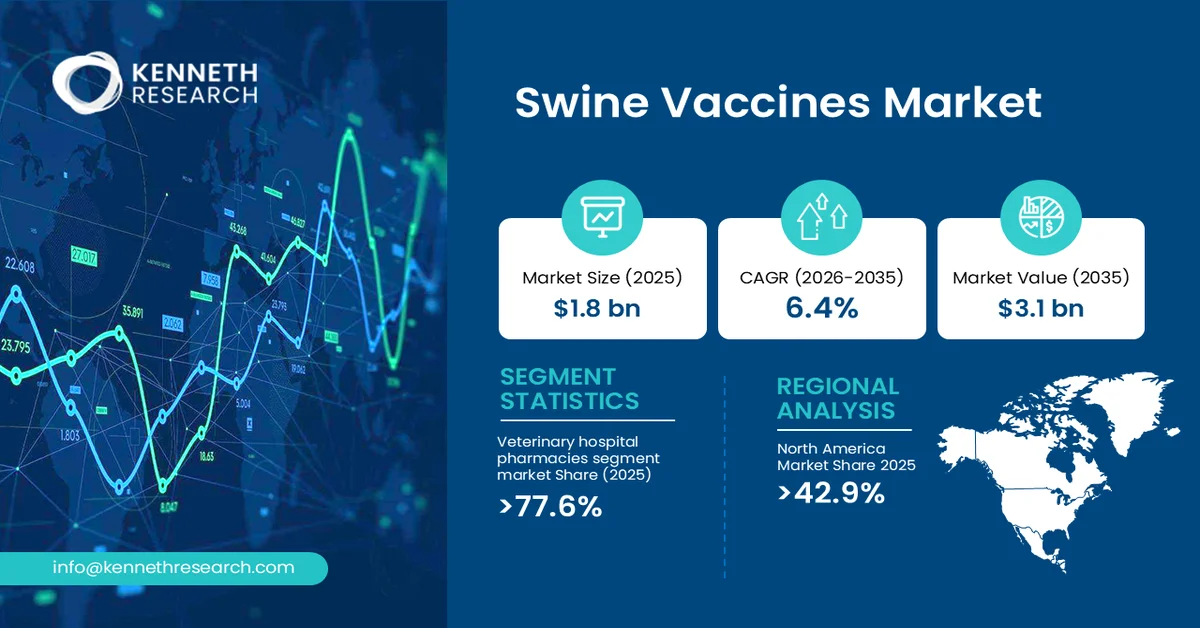
Growing emphasis on preventing economically significant swine diseases through routine immunization is the primary growth driver for the swine vaccines market. Expanding commercial pig production and stronger government-led animal health surveillance are encouraging wider vaccine adoption, helping producers improve herd health, productivity, biosecurity, and resilience against transboundary disease threats.
The swine vaccines market comprises vaccines developed to prevent viral and bacterial diseases affecting domestic pigs across breeding, nursery, grower, and finishing production systems. These biologics are administered through various routes, including injectable and oral formulations, to stimulate protective immunity against pathogens that can reduce productivity, reproductive performance, and overall herd health. The market includes both preventive vaccination products and associated veterinary immunization programs supplied through veterinary hospital pharmacies, retail veterinary channels, and other authorized distribution networks.
A key characteristic of this market is its integration with comprehensive herd health management, combining vaccination with disease surveillance, biosecurity, diagnostics, and veterinary care to reduce disease transmission and production losses. The market also benefits from continuous research into improved vaccine efficacy, broader pathogen coverage, and advanced vaccine technologies designed for commercial swine operations.
From an industrial perspective, the swine vaccines market is an essential component of the global livestock value chain, supporting sustainable pork production, facilitating animal disease control, enabling regulatory compliance, and strengthening domestic and international trade by improving herd health and reducing the risk of infectious disease outbreaks across commercial production systems.
Key Swine Vaccines Market Insights Summary:
Key Takeaways: Market Trends & Insights
- Swine Vaccines Market is projected to grow from USD 1.8 billion in 2025 to USD 3.1 billion by 2035 at a CAGR of 6.4%
- Veterinary Hospital Pharmacies remained the leading distribution channel with a 77.6% share in 2025 driven by increasing reliance on veterinary-supervised vaccination and integrated herd health management
- North America accounted for the largest regional share of 42.9% in 2025 supported by advanced commercial swine production strong veterinary infrastructure and proactive animal disease prevention programs
- Injection Vaccines are expected to witness robust growth owing to their reliable immune response standardized administration and widespread adoption across commercial swine production systems
- Growing emphasis on transboundary disease prevention enhanced biosecurity measures and continuous innovation in veterinary vaccine technologies is expected to support sustained long-term market expansion
Market Drivers
- Rising focus on transboundary disease prevention and biosecurity
- Expansion of commercial swine production and precision herd health management
- Continuous innovation in veterinary vaccine technologies
- Increasing regulatory emphasis on preventive livestock healthcare and disease surveillance
Challenges
- High pathogen diversity and continuous strain evolution
- Stringent regulatory approval and complex manufacturing requirements
Swine Vaccines Market Overview & Supply Chain
Global adoption of swine vaccines is increasing as commercial pork producers place greater emphasis on preventive animal health management, biosecurity, and disease resilience. Vaccination has become an integral component of herd health programs because it helps reduce production losses, supports animal welfare, and strengthens the continuity of livestock supply chains. Governments are also reinforcing surveillance and preparedness against transboundary animal diseases, encouraging wider implementation of immunization protocols across intensive farming systems. The growing scale of commercial swine production further amplifies the need for systematic vaccination strategies. For example, the U.S. Department of Agriculture (USDA) reported that there were 75.8 million hogs and pigs on U.S. farms as of December 1, 2024, highlighting the importance of comprehensive disease prevention measures for one of the world's largest commercial swine populations. This expanding production base continues to support sustained demand for effective swine vaccination programs.
The swine vaccines market value chain begins with the sourcing of biological materials, including pathogen strains, cell cultures, antigens, adjuvants, stabilizers, preservatives, and specialized pharmaceutical-grade packaging materials. These inputs undergo extensive research, strain selection, formulation development, laboratory validation, and quality testing before entering commercial manufacturing under stringent veterinary pharmaceutical regulations and good manufacturing practices. Production is followed by sterile filling, packaging, cold-chain storage, and batch release procedures to ensure vaccine safety, potency, and traceability. Distribution is carried out through veterinary hospital pharmacies, animal health distributors, wholesalers, and licensed veterinary clinics that maintain temperature-controlled logistics throughout transportation. End users include commercial swine farms, breeding operations, integrated pork producers, contract growers, and veterinary practitioners responsible for herd health management. Major stakeholders across the value chain include biotechnology companies, veterinary pharmaceutical manufacturers, contract research and manufacturing organizations, regulatory agencies, livestock producers, veterinarians, distributors, and animal health associations collaborating to improve disease prevention and livestock productivity.
Swine Vaccines Market: Growth Drivers & Challenges
Growth Drivers:
- Rising focus on transboundary disease prevention and national animal health preparedness: The increasing threat of transboundary swine diseases is accelerating investment in preventive vaccination strategies across commercial pork production systems. Governments, veterinary authorities, and livestock producers are strengthening surveillance, biosecurity, and immunization programs to reduce the risk of disease outbreaks that can disrupt domestic production and international trade. As disease preparedness becomes a strategic priority, vaccine manufacturers are expanding research, improving antigen coverage, and developing products that address evolving pathogen strains. These efforts also encourage closer collaboration between public institutions and the animal health industry, creating a favorable environment for innovation and regulatory support. Looking ahead, continued emphasis on early disease prevention, emergency response planning, and resilient livestock production systems is expected to increase the integration of advanced vaccines into routine herd health programs. Supporting this trend, the USDA Agricultural Research Service reported in its 2024 Annual Report that field studies in Vietnam involving more than 150,000 vaccinated pigs demonstrated the commercial application of the ASFV-G-D177L African swine fever vaccine, illustrating growing momentum in veterinary vaccine innovation.
- Expansion of commercial swine production and precision herd health management: The modernization of commercial swine production is creating sustained demand for comprehensive preventive healthcare solutions, with vaccination serving as a cornerstone of herd health management. Large-scale production systems increasingly rely on structured immunization schedules to improve animal productivity, reproductive performance, and operational continuity while minimizing disease-related losses. At the same time, digital livestock monitoring, precision farming technologies, and veterinary diagnostics are enabling producers to optimize vaccination timing and evaluate herd immunity more effectively. These advancements support evidence-based disease prevention strategies and encourage broader adoption of high-quality veterinary biologics. Future market development is expected to be reinforced by integrated livestock management models in which vaccination, diagnostics, biosecurity, and data-driven health monitoring operate together to improve production efficiency, animal welfare, and supply chain resilience while supporting compliance with evolving animal health standards.
Challenges:
- High pathogen diversity and continuous strain evolution: One of the most significant restraints in the swine vaccines market is the continuous evolution and genetic diversity of disease-causing pathogens. Viruses and bacteria affecting swine frequently mutate or exist in multiple circulating strains, making it difficult for a single vaccine formulation to provide broad and long-lasting protection across different production environments. This complexity increases research and development requirements, extends product validation timelines, and necessitates frequent updates to vaccine formulations. For livestock producers, inconsistent field performance against emerging variants can reduce confidence in vaccination programs and require complementary disease control measures, increasing operational costs. Commercially, manufacturers must invest heavily in surveillance, strain characterization, and next-generation vaccine platforms to remain competitive. As pathogen evolution continues, the market will increasingly shift toward adaptable vaccine technologies and integrated disease management strategies that combine vaccination with diagnostics and enhanced biosecurity.
- Stringent regulatory approval and complex manufacturing requirements: The development and commercialization of swine vaccines are constrained by rigorous regulatory requirements governing product safety, efficacy, quality, and manufacturing consistency. Veterinary biologics undergo extensive laboratory studies, field evaluations, quality assurance testing, and regulatory review before receiving market authorization, resulting in prolonged development cycles and substantial investment. In addition, biological manufacturing demands specialized production facilities, validated processes, sterile environments, and robust cold-chain infrastructure to maintain product integrity throughout distribution. These requirements create significant barriers for new entrants and increase production costs for established manufacturers. Commercially, extended approval timelines can delay product launches and reduce the ability to respond rapidly to newly emerging disease threats. Looking ahead, while regulatory harmonization and advances in manufacturing technologies may improve efficiency, compliance expectations are expected to remain stringent, making operational excellence and regulatory expertise key competitive differentiators.
Swine Vaccines Market Size and Forecast:
| Report Attribute | Details |
|---|---|
| Base Year |
2025 |
| Forecast Year |
2026-2035 |
| CAGR |
6.4% |
| Base Year Market Size (2025) |
USD 1.8 billion |
| Forecast Year Market Size (2035) |
USD 3.1 billion |
| Regional Scope |
|
Swine Vaccines Market Segmentation Analysis:
Distribution Channel Segment Analysis
In the distribution channel segment, the Veterinary Hospital Pharmacies sub-segment is anticipated to capture the largest market share of 77.6% by the end of 2025.
Veterinary hospital pharmacies dominate the swine vaccines market because they serve as the primary point of access for prescription veterinary biologics, particularly for commercial livestock operations that require professional diagnosis, vaccination planning, and herd health management. Swine vaccines are typically administered under veterinary supervision to ensure appropriate product selection, storage, handling, and compliance with national animal health regulations. As commercial pig farming becomes increasingly focused on preventive healthcare, producers are relying more heavily on veterinary hospitals for integrated services that combine diagnostics, vaccination protocols, disease surveillance, and post-vaccination monitoring. On the supply side, vaccine manufacturers prioritize veterinary hospital pharmacies because they offer established cold-chain infrastructure, qualified personnel, and direct relationships with livestock producers, ensuring product integrity and traceability. Demand is further reinforced by the expanding veterinary workforce supporting food-animal healthcare.
Route of Administration Segment Analysis
The Injection Vaccines is projected to grow as the second-largest segment in the swine vaccines market due to four converging demand drivers.
Injection vaccines are projected to experience sustained growth in the swine vaccines market because they provide reliable immune responses, precise dosage administration, and broad applicability across breeding, nursery, and finishing herds. Injectable formulations remain the preferred route for many commercially available inactivated and live veterinary vaccines, allowing veterinarians to implement standardized immunization protocols tailored to herd health requirements. Demand is being reinforced by increasing adoption of preventive vaccination programs in intensive swine production systems, where producers prioritize disease control, productivity, and regulatory compliance. On the supply side, manufacturers continue to invest in improved injectable formulations, combination vaccines, advanced adjuvants, and user-friendly delivery systems that enhance efficacy while simplifying administration. Regulatory confidence and established manufacturing capabilities further support widespread availability of injectable products through veterinary distribution networks. Supporting this trend, the U.S. Department of Agriculture (USDA) reported that 69.0 million of the 75.0 million hogs and pigs in the United States were market hogs as of December 1, 2023, reflecting the large commercial production base that depends on structured vaccination programs throughout the production cycle. Looking ahead, continued advances in vaccine technology, herd health management, and precision livestock production are expected to reinforce the long-term growth of injectable swine vaccines.
Our in-depth analysis of the global swine vaccines market includes the following segments:
|
Segment |
Sub-segment |
|
Type |
|
|
Application |
|
|
Route of Administration |
|
|
Distribution Channel |
|
Swine Vaccines Market Regional Insights:
North America Market Trends & Insights:
North America swine vaccines market is projected to hold the largest revenue share of 42.9% by the end of 2025.
The region benefits from widespread adoption of preventive vaccination programs, supported by established biosecurity standards and continuous investment in livestock health management. Leading animal health companies maintain significant research, manufacturing, and distribution capabilities across the region, enabling rapid commercialization of innovative veterinary biologics. Government agencies also play a critical role by promoting disease surveillance, emergency preparedness, and science-based animal health policies that encourage the routine use of vaccines. Supporting the region's leadership, the U.S. Department of Agriculture (USDA) reported that 35.2 million pigs were weaned on U.S. farms between September and November 2024, reflecting the scale of commercial swine production that requires structured vaccination programs throughout the production cycle.
The United States represents the largest contributor to regional demand, supported by large integrated pork production systems, sophisticated veterinary service networks, and ongoing investment in animal health innovation. The country continues to prioritize biosecurity and disease prevention to protect domestic production and export competitiveness.
Canada complements regional growth through its modern swine production sector, stringent animal health regulations, and strong collaboration between producers, veterinary professionals, and government agencies. Canadian producers increasingly emphasize preventive herd health management and vaccination to maintain productivity and meet international trade requirements, reinforcing North America's position as the leading regional market for swine vaccines.
Europe Market Trends & Insights:
Europe represents a strategically important region in the swine vaccines market, supported by advanced livestock production systems, strong veterinary healthcare infrastructure, and comprehensive animal health regulations. Demand for swine vaccines continues to increase as producers prioritize preventive disease management, improved herd productivity, and compliance with stringent animal welfare and biosecurity standards. The region benefits from close collaboration among veterinary authorities, research institutions, and animal health companies focused on developing innovative vaccines against economically significant swine diseases. Regulatory frameworks encourage continuous disease surveillance, responsible vaccination practices, and rapid response to emerging animal health risks. Ongoing investments in veterinary biotechnology, diagnostic capabilities, and precision livestock management are further strengthening the adoption of immunization programs. Looking ahead, increasing emphasis on sustainable livestock production, antimicrobial stewardship, and integrated herd health management is expected to create additional opportunities for vaccine manufacturers, contract research organizations, and veterinary service providers across the European swine industry.
Germany is a leading contributor to the regional market owing to its well-established commercial pork production sector, robust veterinary pharmaceutical industry, and strong emphasis on preventive animal healthcare. Continuous investment in livestock biosecurity, veterinary research, and disease monitoring supports sustained demand for advanced swine vaccines.
The United Kingdom is also an important market, driven by its science-based animal health policies, expanding veterinary services, and focus on maintaining resilient livestock production systems. Increasing collaboration between government agencies, industry participants, and academic institutions is promoting innovation in vaccine development and disease surveillance, while ongoing modernization of swine production practices is expected to reinforce long-term adoption of preventive vaccination programs across the country's commercial pig farming sector.
Leading Companies Operating in the Global Swine Vaccines Market:
Here is a list of upstream, downstream, and key players operating in the global swine vaccines market competitive ecosystem:
- Merck Animal Health (United States)
- Company Overview
- Business Strategy
- Key Product Offerings
- Financial Performance
- Key Performance Indicators
- Risk Analysis
- Recent Development
- Regional Presence
- SWOT Analysis
- Zoetis Inc. (United States)
- Elanco Animal Health Incorporated (United States)
- Virbac S.A. (France)
- HIPRA (Spain)
- Indian Immunologicals Limited (India)
Recent Developments
- October 2024: Ceva Animal Health received European Commission marketing authorization for Cirbloc® M Hyo, a ready-to-use combination vaccine protecting pigs against Porcine Circovirus Type 2 (PCV2) and Mycoplasma hyopneumoniae. The vaccine provides protection throughout the fattening period with a single injection, strengthening Ceva's swine vaccine portfolio.
- February 2025: Zoetis announced that the USDA granted a conditional license for its Avian Influenza Vaccine, H5N2 Subtype, Killed Virus for chickens. While primarily a poultry vaccine, the announcement highlighted Zoetis' continued expansion of its livestock vaccine capabilities and ongoing investments across its swine vaccine business.
Frequently Asked Question
In 2025, the swine vaccines market exceeded USD 1.8 billion.
The swine vaccines market is projected to reach USD 3.1 billion by the end of 2035, expanding at a CAGR of 6.4% over the forecast period (2026-2035).
The major players in the market are Merck Animal Health (United States), Zoetis Inc. (United States), Elanco Animal Health Incorporated (United States), Virbac S.A. (France), HIPRA (Spain), Indian Immunologicals Limited (India), and others.
In the distribution channel segment, the veterinary hospital pharmacies sub-segment is anticipated to capture the largest market share of 77.6% in the future and exhibit lucrative growth opportunities during 2026-2035. This growth trajectory is largely attributed to increasing reliance on veterinary-supervised vaccination programs, integrated herd health management, and expanding preventive animal healthcare practices.
North America is projected to hold the largest market share of 42.9% by the end of 2025 and provide more business opportunities in the future. Continuous investments in commercial swine production, veterinary healthcare infrastructure, and disease prevention initiatives across the United States and Canada are fostering the region's dominance.
Why Choose Kenneth Research ?
-
Insight with Impact : We don’t just gather data — we uncover stories, trends, and opportunities that fuel business growth.
-
Experts Who Get It : Our team speaks your industry’s language and knows what really matters to your customers and market.
-
Custom-Built for You : Forget one-size-fits-all. We craft research and consulting solutions as unique as your business vision.
-
Partners, Not Just Providers : We work with you, not for you — collaborating closely to turn insights into smart, strategic moves.
-
Results That Speak : Our work powers brands, startups, and industry leaders alike — with a track record of ideas that work in the real world.
Report ID: 1090 |
Published Date: 17 Aug 2026 |
Report Format: |
Delivery Timeline: 48-72 Business Hours

Copyright © 2025 Kenneth Research. All rights reserved. Terms of Use | Privacy Policy
