Report ID: 1066 |
Published Date: 10 Aug 2026 |
Report Format: |
Delivery Timeline: 48-72 Business Hours
Surgical Table Market Outlook:
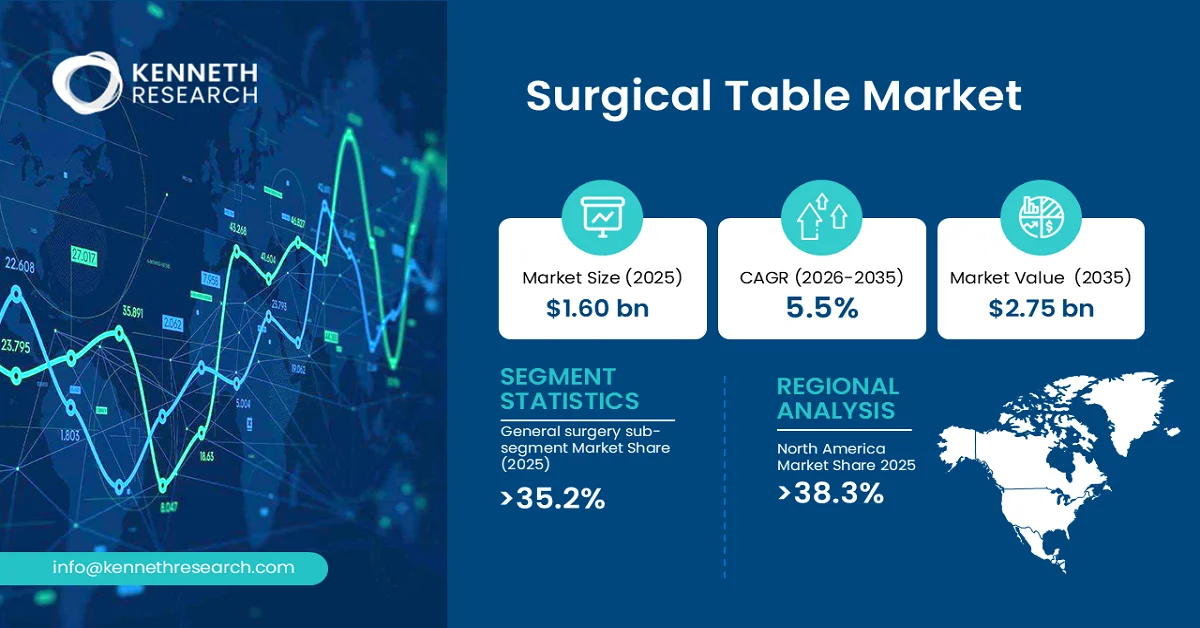
Surgical Table Market size was valued at USD 1.60 billion in 2025 and is projected to reach USD 2.75 billion by the end of 2035, rising at a CAGR of 5.5% during the forecast period, i.e., 2026–2035. In 2026, the industry size of the surgical table is estimated at USD 1.70 billion.
The primary growth driver for the surgical table market is the increasing volume of surgical procedures worldwide, supported by expanding hospital infrastructure and investments in advanced operating room equipment. Healthcare providers are adopting technologically advanced surgical tables to improve patient positioning, surgical precision, workflow efficiency, and compatibility with minimally invasive and image-guided procedures.
The surgical table market comprises the global industry engaged in the design, manufacturing, and commercialization of operating tables used to position patients safely and precisely during surgical procedures. These tables are engineered to support a broad spectrum of specialties, including general surgery, orthopedic, cardiovascular, neurosurgical, gynecological, urological, and minimally invasive interventions. Modern surgical tables incorporate features such as electrohydraulic or electromechanical height adjustment, multi-axis positioning, radiolucent tabletops, modular accessories, and imaging compatibility to accommodate increasingly complex surgical workflows.
Surgical tables are an essential component of operating rooms across hospitals, ambulatory surgical centers, and specialty clinics, enabling optimal patient access while enhancing surgeon ergonomics and procedural efficiency. Their integration with advanced imaging systems, robotic-assisted surgery platforms, and hybrid operating rooms has increased their strategic importance in modern healthcare infrastructure. The market is closely linked to investments in surgical capacity expansion, operating room modernization, and healthcare infrastructure development. According to the World Health Organization, the number of operating rooms is recognized as a structural indicator of a health system's capacity to deliver surgical care, underscoring the critical role of surgical tables within healthcare delivery systems.
Key Surgical Table Market Insights Summary:
Key Takeaways: Market Trends & Insights
- Surgical table market projected to grow from USD 1.60 billion in 2025 to USD 2.75 billion by 2035 at a 5.5% CAGR.
- North America is projected to lead the global market with a 38.3% share by 2035, supported by advanced healthcare infrastructure, continuous operating room modernization, and high adoption of technologically advanced surgical equipment.
- General surgery accounted for the largest application segment with a 35.2% market share in 2025, driven by the high volume of routine and complex surgical procedures requiring versatile operating tables.
- Hospitals are expected to witness significant growth as the leading end-user segment due to sustained investments in operating room expansion, hybrid surgical suites, and replacement of legacy surgical equipment.
- The market is benefiting from increasing adoption of electrically powered and imaging-compatible surgical tables, growing integration with hybrid operating rooms and robotic-assisted surgery, and continuous advancements in ergonomic and modular operating room technologies.
Market Drivers
- Rising global volume of elective and complex surgical procedures.
- Continuous modernization of hospital operating room infrastructure.
- Increasing adoption of minimally invasive and robotic-assisted surgery.
- Growing investment in hybrid operating rooms and integrated surgical technologies.
Challenges
- High capital investment requirements and long equipment replacement cycles.
- Diverse clinical requirements coupled with complex hospital procurement processes.
Surgical Table Market Overview & Supply Chain
The global adoption of surgical tables is increasing as healthcare systems continue to modernize operating rooms and expand access to safe surgical care. Hospitals are replacing conventional operating tables with electrically powered, imaging-compatible, and modular systems that improve patient positioning, surgeon ergonomics, and procedural efficiency. The growing integration of hybrid operating rooms, robotic-assisted surgery, and image-guided interventions has further elevated the importance of technologically advanced surgical tables. In addition, governments and international health organizations continue to emphasize strengthening surgical capacity as a core component of healthcare delivery. The World Health Organization (WHO) identifies total surgical volume as one of its six global surgical system indicators and has established a target of a minimum of 5,000 procedures per 100,000 population by 2030, underscoring the need for adequate operating room infrastructure and supporting equipment worldwide.
The surgical table market value chain begins with the sourcing of high-grade stainless steel, aluminum alloys, engineering plastics, carbon-fiber composite tabletops, electronic control systems, hydraulic and electro-mechanical actuators, batteries, sensors, and precision mechanical components from specialized industrial suppliers. Manufacturers integrate these components into manual, hydraulic, and powered surgical tables while ensuring compliance with international medical device quality and safety standards through rigorous testing and certification. Finished products are distributed through direct sales teams, authorized medical equipment distributors, and healthcare procurement channels serving public and private hospitals, ambulatory surgical centers, and specialty clinics. Key stakeholders include raw material suppliers, component manufacturers, surgical table manufacturers, regulatory authorities, hospital procurement departments, healthcare providers, biomedical engineers, and after-sales service organizations that support installation, maintenance, upgrades, and lifecycle management across healthcare facilities.
Surgical Table Market: Growth Drivers & Challenges
Growth Drivers:
- Expansion of surgical infrastructure and operating room capacity: The continued expansion of surgical infrastructure across developed and emerging economies is a major driver of the surgical table market. Governments and healthcare providers are investing in new hospitals, specialty surgical centers, and operating room modernization to improve access to essential and complex surgical care. Every newly commissioned operating room requires advanced surgical tables capable of supporting diverse procedures, imaging compatibility, and ergonomic patient positioning. As healthcare systems focus on improving surgical efficiency and reducing procedure delays, demand for technologically advanced operating tables continues to strengthen. The transition toward hybrid operating rooms and minimally invasive surgical environments further accelerates replacement demand for electrically powered and modular surgical tables. Looking ahead, sustained public investment in healthcare infrastructure, combined with increasing adoption of digital operating room technologies, is expected to create long-term opportunities for manufacturers offering versatile and integrated surgical table solutions.
The WHO European health information gateway continues to maintain and update its official indicator for "Total number of inpatient surgical procedures per year," with data available through 2024 and last updated in April 2026, demonstrating the continued monitoring and expansion of surgical service delivery across member countries. This sustained emphasis on surgical capacity supports investments in operating room equipment, including surgical tables. - Increasing adoption of advanced and hybrid operating rooms: Healthcare providers are increasingly upgrading conventional operating theatres into digitally integrated and hybrid surgical environments that combine advanced imaging, navigation systems, robotic platforms, and connected medical devices. Surgical tables have become a central component of these operating rooms because they must provide precise positioning, radiolucent surfaces, high load capacity, and seamless compatibility with imaging equipment. Manufacturers are therefore focusing on modular designs, programmable positioning systems, and enhanced mobility to meet evolving clinical requirements. The growing preference for minimally invasive, image-guided, and robotic-assisted procedures is further driving demand for technologically sophisticated surgical tables capable of supporting multiple specialties within a single operating suite. Over the forecast period, continued digital transformation of operating rooms is expected to encourage replacement of legacy equipment and accelerate procurement of next-generation surgical tables across hospitals and ambulatory surgical facilities.
Challenges:
- High capital investment and lengthy equipment replacement cycles: One of the primary restraints affecting the surgical table market is the substantial capital investment required for acquiring advanced surgical tables equipped with electrohydraulic controls, imaging compatibility, modular accessories, and digital integration capabilities. Healthcare providers, particularly smaller hospitals and community healthcare facilities, often prioritize investments in diagnostic systems, life-support equipment, or surgical robots before replacing existing operating tables that remain functional. Procurement decisions are therefore influenced by budget constraints, capital expenditure approvals, and long depreciation cycles. This delays product replacement and limits recurring sales opportunities for manufacturers. Commercially, vendors face extended sales cycles, competitive pricing pressures, and increased demand for customized financing and service contracts. Looking ahead, replacement demand is expected to remain gradual, making product innovation, lifecycle support, and value-based procurement strategies increasingly important for sustaining long-term market growth.
- Diverse clinical requirements and complex procurement standards: The surgical table market is also constrained by the need to satisfy highly diverse clinical requirements across multiple surgical specialties and healthcare settings. Different procedures require varying patient positioning capabilities, weight capacities, tabletop configurations, accessory compatibility, and imaging performance, making standardized product offerings difficult. In addition, procurement decisions typically involve multidisciplinary evaluation by surgeons, biomedical engineers, hospital administrators, and procurement committees, each with distinct technical and operational priorities. This complexity extends product development timelines and increases manufacturing and customization costs. From a commercial perspective, manufacturers must maintain broad product portfolios, extensive accessory ecosystems, and comprehensive after-sales support to remain competitive. As healthcare providers continue demanding multifunctional, interoperable equipment, suppliers will need to balance innovation, customization, regulatory compliance, and cost efficiency to strengthen their market position.
Surgical Tape Market Size and Forecast:
| Report Attribute | Details |
|---|---|
| Base Year |
2025 |
| Forecast Year |
2026-2035 |
| CAGR |
5.5% |
| Base Year Market Size (2025) |
USD 1.60 billion |
| Forecast Year Market Size (2035) |
USD 2.75 billion |
| Regional Scope |
|
Surgical Table Market Segmentation Analysis:
Application Type Segment Analysis
In the application segment, the general surgery sub-segment is anticipated to capture the largest market share of 35.2% by the end of 2035.
The general surgery segment dominates the surgical table market owing to the broad range of procedures performed under this specialty and the requirement for highly versatile operating tables capable of accommodating diverse patient positioning needs. General surgery departments perform abdominal, gastrointestinal, colorectal, endocrine, trauma, and soft tissue procedures, creating consistent demand for multipurpose surgical tables across hospitals and surgical centers. Healthcare providers increasingly prefer modular and electrically powered tables that can be quickly reconfigured for different procedures, improving operating room utilization and reducing setup time between surgeries. On the supply side, manufacturers prioritize general surgery-compatible platforms because they serve the largest customer base and support numerous interchangeable accessories, making them commercially attractive for healthcare facilities seeking standardized equipment. Future demand is expected to remain strong as hospitals continue investing in flexible operating room infrastructure capable of supporting multiple specialties while maximizing equipment utilization and workflow efficiency.
According to the WHO European health information gateway, the indicator "Inpatient surgical procedures per year per 100,000 population" includes reported data through 2023, reflecting sustained demand for inpatient surgical services across healthcare systems and reinforcing the need for general surgery operating infrastructure and associated surgical tables.
Hospitals Segment Analysis
The hospitals segment is projected to witness significant growth in the surgical table market because hospitals remain the primary setting for performing complex, emergency, and multidisciplinary surgical procedures. Large hospitals continuously invest in advanced operating room infrastructure to improve clinical efficiency, patient safety, and compatibility with modern surgical technologies such as robotic-assisted surgery and intraoperative imaging. Demand is further supported by the expansion of tertiary care centers, increasing adoption of hybrid operating rooms, and ongoing replacement of aging surgical equipment with electrically powered, multifunctional surgical tables. From the supply perspective, manufacturers prioritize hospitals as their principal customer base by offering modular product portfolios, comprehensive installation services, maintenance contracts, and training programs tailored to high-volume surgical environments. Looking ahead, sustained investments in hospital modernization, digital operating rooms, and integrated surgical workflows are expected to reinforce hospitals' position as the fastest-growing end-user segment for advanced surgical tables.
According to the OECD – Health at a glance 2025, OECD countries had an average of 4.2 hospital beds per 1,000 population in 2023, reflecting continued investment in inpatient healthcare infrastructure that supports demand for operating room equipment, including surgical tables
Our in-depth analysis of the global surgical table market includes the following segments:
|
Segment |
Sub-segment |
|
Application |
|
|
Product Type |
|
|
Technology |
|
|
End User |
|
|
Material |
|
Surgical Table Market Regional Insights:
North America Market Trends & Insights:
North America is projected to account for 38.3% of the surgical table market by 2035, maintaining its position as the leading regional market. The region's dominance is supported by its mature healthcare infrastructure, widespread adoption of technologically advanced operating room equipment, and continuous investment in hospital modernization. Healthcare providers across the region prioritize advanced surgical tables that offer imaging compatibility, modular configurations, and precise patient positioning to support increasingly complex and minimally invasive procedures. Strong regulatory oversight and well-established procurement standards also encourage the adoption of high-quality surgical equipment. On the supply side, the presence of leading medical device manufacturers, extensive distributor networks, and robust after-sales service capabilities further strengthens regional leadership. Continuous investments in digital operating rooms and integrated surgical environments are expected to sustain demand for advanced surgical tables throughout the forecast period.
The United States represents the largest contributor to regional demand owing to its extensive hospital network, high adoption of advanced surgical technologies, and continuous investments in operating room modernization.
Canada complements regional growth through sustained public healthcare investments, hospital infrastructure upgrades, and increasing procurement of technologically advanced surgical equipment to improve surgical capacity and patient outcomes. Together, these countries create a favorable ecosystem for manufacturers through established reimbursement systems, stringent quality standards, and ongoing replacement of legacy operating room equipment.
According to the OECD data explorer – surgical procedures (last updated 24 November 2025), OECD maintains comprehensive and continuously updated data on surgical procedures performed across member countries, including the United States and Canada, highlighting North America's strong surgical activity and healthcare utilization that underpin demand for operating room equipment.
Europe Market Trends & Insights:
Asia Pacific is expected to emerge as one of the fastest-growing regions in the surgical table market, driven by expanding healthcare infrastructure, rising surgical volumes, and increasing investments in modern operating room technologies. Governments across the region are prioritizing healthcare capacity expansion through new hospital construction, modernization of existing medical facilities, and improvements in surgical service delivery. The growing adoption of minimally invasive procedures, image-guided interventions, and integrated operating rooms is encouraging healthcare providers to procure technologically advanced surgical tables with enhanced positioning capabilities and compatibility with digital surgical equipment. At the same time, regional manufacturing capabilities and strengthening medical device supply chains are improving product availability and encouraging broader adoption across public and private healthcare institutions. As healthcare systems continue to emphasize quality surgical care and operational efficiency, the region is expected to present substantial long-term opportunities for manufacturers offering innovative, modular, and digitally integrated surgical table solutions.
Japan remains a key contributor to regional demand due to its technologically advanced healthcare system, high adoption of precision surgical equipment, and continuous replacement of aging operating room infrastructure with sophisticated medical technologies. Hospitals increasingly prioritize surgical tables that support complex procedures, imaging integration, and ergonomic patient positioning.
China is witnessing strong momentum through continued expansion of hospital infrastructure, growing domestic medical device manufacturing capabilities, and increasing investment in advanced surgical facilities. Government support for healthcare modernization, combined with rising adoption of high-end operating room equipment across tertiary hospitals, is expected to strengthen demand for advanced surgical tables throughout the forecast period.
Leading Companies Operating in the Global Surgical Table Market:
Here is a list of upstream, downstream, and key players operating in the global surgical table market competitive ecosystem:
- Getinge AB(Sweden)
- STERIS plc(Ireland)
- Skytron LLC(United States)
- Mizuho Corporation(Japan)
Recent Developments
- May 2025 : Getinge introduced the maquet corin operating table, a new generation surgical table designed for advanced image-guided and hybrid operating room procedures with enhanced patient positioning and workflow flexibility.
- October 2024: STERIS expanded its operating room equipment portfolio by highlighting its latest Amsco surgical table solutions integrated with comprehensive operating room workflow technologies at major healthcare exhibitions.
- September 2024 : Skytron showcased its latest imaging-compatible surgical table portfolio and integrated operating room technologies during a major healthcare industry event, emphasizing improved patient positioning and OR efficiency.
Frequently Asked Question
In 2025, the surgical table market exceeded USD 1.60 billion.
The surgical table market is projected to reach USD 2.75 billion by the end of 2035, expanding at a 5.5% CAGR over the forecast period (2026-2035).
The major players in the market are Getinge AB, STERIS plc, Skytron LLC, Mizuho Corporation, Merivaara Corporation, and others.
In the general surgery segment, the general surgery sub-segment is anticipated to capture the largest market share of 35.2% in the future and exhibit lucrative growth opportunities during 2026-2035. This growth trajectory is largely attributed to the increasing demand for versatile operating room equipment capable of supporting a wide range of surgical procedures and modern surgical workflows.
North America is projected to hold the largest market share of 38.3% by the end of 2025 and provide more business opportunities in the future. Continuous investments in healthcare infrastructure, operating room modernization, and advanced surgical technologies across the U.S. and Canada are fostering the region's dominance.
Why Choose Kenneth Research ?
-
Insight with Impact : We don’t just gather data — we uncover stories, trends, and opportunities that fuel business growth.
-
Experts Who Get It : Our team speaks your industry’s language and knows what really matters to your customers and market.
-
Custom-Built for You : Forget one-size-fits-all. We craft research and consulting solutions as unique as your business vision.
-
Partners, Not Just Providers : We work with you, not for you — collaborating closely to turn insights into smart, strategic moves.
-
Results That Speak : Our work powers brands, startups, and industry leaders alike — with a track record of ideas that work in the real world.
Report ID: 1066 |
Published Date: 10 Aug 2026 |
Report Format: |
Delivery Timeline: 48-72 Business Hours

Copyright © 2025 Kenneth Research. All rights reserved. Terms of Use | Privacy Policy
