Report ID: 1089 |
Published Date: 14 Aug 2026 |
Report Format: |
Delivery Timeline: 48-72 Business Hours
Surgical Rasp Market Outlook:
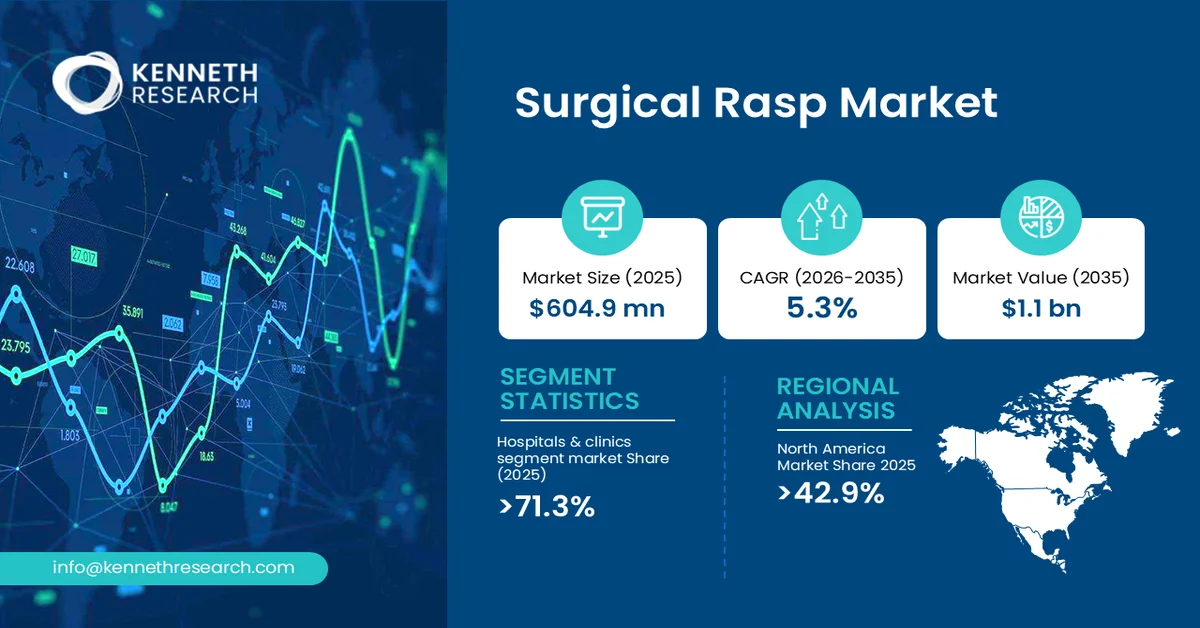
Surgical Rasp Market size was valued at USD 546.9 million in 2025 and is projected to reach USD 696.1 million by the end of 2035, rising at a CAGR of 4.2% during the forecast period, i.e., 2026-2035. In 2026, the industry size of surgical rasps is estimated at USD 569.2 million.
The primary growth driver for the surgical rasp market is the sustained increase in surgical procedures supported by expanding healthcare capacity and advances in operative techniques. OECD data indicates continued growth in same-day surgical care enabled by less invasive procedures and improved surgical technologies, reinforcing demand for precision surgical instruments across healthcare settings.
The surgical rasp market comprises specialized handheld surgical instruments designed to shape, smooth, contour, or remove bone and other hard tissues during orthopedic, maxillofacial, reconstructive, spinal, and trauma procedures. Surgical rasps feature textured or serrated working surfaces that enable controlled removal of tissue while preserving surgical precision. They are manufactured in multiple configurations, including single-ended and double-ended designs, and are commonly produced from medical-grade stainless steel or other high-performance materials to withstand repeated sterilization and clinical use.
The market is characterized by continuous product refinement focused on ergonomic handling, procedural accuracy, durability, and compatibility with evolving surgical techniques. Surgical rasps are essential components of instrument sets used during bone preparation, implant fitting, corrective reconstruction, and anatomical contouring, where consistent tactile feedback and controlled material removal are critical for procedural success.
Industrial relevance stems from their indispensable role in modern surgical workflows across hospitals, specialty clinics, ambulatory surgical centers, and academic medical institutions. As healthcare systems continue to perform a broad range of surgical interventions across multiple specialties, demand for dependable, high-quality surgical instruments such as rasps remains fundamental to achieving consistent clinical outcomes.
Key Surgical Rasp Market Insights Summary:
Key Takeaways: Market Trends & Insights
- Surgical rasp market reached USD 546.9 million in 2025 and is projected to expand to USD 696.1 million by 2035 at a CAGR of 4.2%
- Hospitals & clinics dominated the end user segment with a 71.3% share in 2025, supported by rising demand for orthopedic, spinal, trauma, and reconstructive surgical procedures
- North America led the surgical rasp market with a 42.9% share in 2025 due to advanced healthcare infrastructure, strong medical device capabilities, and high surgical adoption across the United States and Canada
- Double-ended surgical rasps are gaining adoption as their dual-functional design supports efficient bone preparation, reduced instrument exchanges, and improved surgical workflow optimization
- Regulatory compliance, precision manufacturing, ergonomic innovation, and increasing focus on surgical quality are shaping future opportunities for surgical rasp market participants
Market Drivers
- Increasing adoption of advanced orthopedic and reconstructive surgical procedures
- Increasing emphasis on precision and instrument quality in surgical practice
- Expansion of ambulatory surgical centers performing orthopedic interventions
- Continuous innovation in ergonomic and specialty-specific surgical instrument designs
Challenges
- Lengthy product validation and regulatory compliance requirements
- Pricing pressure and procurement standardization across healthcare systems
Surgical Rasp Market Overview & Supply Chain
Global adoption of surgical rasps is increasing as healthcare systems expand access to surgical care, modernize operating rooms, and prioritize precision-based orthopedic, spinal, maxillofacial, and reconstructive procedures. Demand is further supported by the growing use of advanced surgical techniques that require durable, ergonomically designed instruments capable of controlled bone shaping and tissue preparation. Regulatory emphasis on patient safety, sterilization standards, and high-quality reusable surgical instruments has also encouraged healthcare providers to invest in reliable surgical toolsets. From an industry perspective, surgical rasps remain indispensable within standardized surgical instrument trays because they contribute directly to procedural accuracy and implant preparation. Supporting this trend, the World Health Organization (WHO) reported in its 2023 Universal Health Coverage Global Monitoring Report that 4.5 billion people were not fully covered by essential health services, underscoring the continued global investment required to expand surgical capacity and healthcare infrastructure, which strengthens long-term demand for essential surgical instruments.
The surgical rasp market value chain begins with the procurement of high-grade raw materials, primarily medical-grade stainless steel and specialty alloys selected for corrosion resistance, durability, and repeated sterilization compatibility. Material suppliers work closely with instrument manufacturers that employ precision forging, CNC machining, heat treatment, surface finishing, polishing, and rigorous quality assurance to produce surgical rasps meeting stringent medical device standards. Finished products undergo cleaning, passivation, inspection, packaging, and sterilization preparation before being distributed through direct sales organizations, specialized medical device distributors, procurement groups, and hospital supply networks. Inventory management and regulatory compliance play critical roles throughout distribution to ensure product traceability and uninterrupted clinical availability. End users include hospitals, specialty surgical centers, ambulatory surgical centers, academic medical institutions, and reconstructive surgery facilities. Key stakeholders across the value chain include raw material suppliers, contract manufacturers, original equipment manufacturers, regulatory authorities, sterilization service providers, logistics partners, healthcare procurement teams, surgeons, and clinical staff responsible for instrument selection, maintenance, and lifecycle management.
Surgical Rasp Market: Growth Drivers & Challenges
Growth Drivers:
- Rising adoption of advanced orthopedic and reconstructive surgical procedures: The increasing adoption of advanced orthopedic, trauma, spinal, and reconstructive surgical procedures is a major driver for the surgical rasp market. Surgical rasps remain essential instruments for precise bone contouring, implant site preparation, and anatomical reshaping during complex procedures. As healthcare providers continue investing in technology-enabled operating rooms and standardized surgical instrument sets, demand for high-performance manual instruments grows alongside powered and robotic surgical platforms. Product innovation also supports this trend by improving compatibility between manual instruments and modern surgical workflows. For example, the U.S. Food and Drug Administration granted 510(k) clearance for Aesculap Implants Systems LLC's activL® Next Generation Instrumentation in 2023, reflecting continued advancement in orthopedic surgical instrumentation used in spine procedures. Such regulatory milestones encourage broader adoption of complementary precision instruments, including surgical rasps, while promoting procedural efficiency, improved ergonomics, and long-term modernization of surgical practices.
- Increasing emphasis on precision and instrument quality in surgical practice: Healthcare providers are placing greater emphasis on surgical precision, instrument durability, and workflow efficiency, creating sustained demand for premium-quality surgical rasps. Surgeons increasingly prefer instruments that provide consistent tactile feedback, ergonomic handling, and reliable performance across orthopedic, craniofacial, and reconstructive procedures. Manufacturers are responding by developing refined surface geometries, enhanced corrosion-resistant materials, and optimized handle designs that improve control during delicate bone preparation. In addition, stricter quality management systems and evolving sterilization requirements encourage healthcare facilities to procure instruments capable of maintaining structural integrity through repeated reprocessing cycles. Looking ahead, integration of advanced manufacturing technologies such as precision machining, additive manufacturing for prototypes, and improved surface finishing techniques is expected to enhance product performance further. These developments will strengthen supplier competitiveness, extend instrument lifecycle value, and support continued adoption across both established and emerging healthcare markets.
Challenges:
- Lengthy product validation and regulatory compliance requirements: Manufacturers of surgical rasps face significant challenges associated with stringent regulatory and quality assurance requirements governing reusable surgical instruments. Product development involves extensive material validation, biocompatibility testing, dimensional accuracy verification, sterilization compatibility assessments, and comprehensive quality management documentation before commercialization. Even relatively simple manual instruments must comply with evolving medical device regulations and post-market surveillance obligations across different jurisdictions. These requirements increase development timelines, raise compliance costs, and create barriers for smaller manufacturers seeking market entry. Commercially, suppliers must invest continuously in regulatory expertise, manufacturing process validation, and documentation systems to maintain market access. Looking ahead, increasingly harmonized but more rigorous international regulatory expectations are likely to further elevate compliance standards, making operational excellence and regulatory capabilities important competitive differentiators within the surgical rasp market.
- Pricing pressure and procurement standardization across healthcare systems: Healthcare providers are under growing pressure to optimize procurement spending while maintaining high standards of clinical performance, creating pricing challenges for surgical rasp manufacturers. Hospitals and integrated healthcare networks increasingly rely on centralized purchasing organizations, long-term supply agreements, and standardized instrument sets to reduce procurement complexity and control operating costs. As a result, purchasing decisions are often influenced by total lifecycle value, supplier reliability, and contract pricing rather than product differentiation alone. This environment limits pricing flexibility, particularly for manufacturers offering premium or specialty surgical rasps without clearly demonstrated operational advantages. Commercially, companies must balance investment in product innovation with competitive pricing strategies and value-added service offerings. Over the long term, suppliers that combine manufacturing efficiency, consistent product quality, dependable supply chains, and strong clinical support will be better positioned to sustain margins despite increasing procurement consolidation.
Surgical Rasp Market Size and Forecast:
| Report Attribute | Details |
|---|---|
| Base Year |
2025 |
| Forecast Year |
2026-2035 |
| CAGR |
4.2% |
| Base Year Market Size (2025) |
USD 546. 9 million |
| Forecast Year Market Size (2035) |
USD 696.1 million |
| Regional Scope |
|
Surgical Rasp Market Segmentation Analysis:
End User Segment Analysis
In the end user segment, the hospitals & clinics sub-segment is anticipated to capture the largest market share of 71.3% by the end of 2025.
Hospitals & Clinics represent the leading end-user segment in the surgical rasp market because they perform the majority of orthopedic, spinal, trauma, maxillofacial, and reconstructive procedures that require precision bone-shaping instruments. These healthcare facilities maintain comprehensive surgical departments, advanced sterilization capabilities, and standardized instrument inventories, enabling consistent procurement of high-quality reusable surgical rasps. Demand is further supported by the concentration of specialized surgeons, multidisciplinary operating teams, and increasing adoption of complex surgical interventions that rely on dependable manual instruments alongside advanced surgical technologies. On the supply side, manufacturers prioritize hospitals and clinics through long-term procurement agreements, customized surgical instrument sets, after-sales servicing, and regulatory-compliant product portfolios, ensuring reliable product availability and lifecycle support. Supporting this demand, the U.S. Centers for Disease Control and Prevention (CDC) reports that hospital-based ambulatory surgery data collection has been an integral component of the National Hospital Ambulatory Medical Care Survey since 2009, with public-use data available through 2022, reflecting the continued importance of hospitals as primary providers of surgical care. Looking ahead, ongoing investments in surgical infrastructure, digital operating rooms, and specialized clinical services are expected to reinforce the dominant position of hospitals and clinics within the surgical rasp market.
Product Type Segment Analysis
The double-ended surgical rasps is projected to grow as the second-largest segment in the surgical rasp market due to four converging demand drivers.
Double-ended surgical rasps are projected to experience sustained growth due to their versatility, allowing surgeons to perform multiple bone-shaping and contouring functions with a single instrument during orthopedic, spinal, trauma, and maxillofacial procedures. Their dual working ends improve procedural efficiency by reducing instrument exchanges, supporting streamlined surgical workflows and minimizing operating room interruptions. Healthcare facilities also favor these instruments because they contribute to optimized instrument tray configurations and inventory management while maintaining precision across diverse surgical applications. On the supply side, manufacturers continue to introduce ergonomically enhanced designs, improved surface finishes, and high-grade materials that withstand repeated sterilization cycles and intensive clinical use. The expanding volume of joint reconstruction procedures further supports demand for multifunctional surgical instruments. Reflecting this trend, the National Joint Registry (United Kingdom) reported that 116,845 primary knee replacement procedures were recorded in 2023, the highest annual total entered into the registry, demonstrating continued demand for orthopedic procedures where precision bone preparation instruments, including double-ended surgical rasps, play a critical role. Looking ahead, increasing procedural complexity, hospital efficiency initiatives, and ongoing innovation in surgical instrument design are expected to reinforce adoption of double-ended surgical rasps across advanced surgical settings.
Our in-depth analysis of the global surgical rasp market includes the following segments:
|
Segment |
Sub-segment |
|
Product Type |
|
|
Technology |
|
|
Application |
|
|
End User |
|
Surgical Rasp Market Regional Insights:
North America Market Trends & Insights:
North America surgical rasp market is projected to hold the largest revenue share of 42.9% by the end of 2025.
The region's leadership is supported by a mature healthcare ecosystem, high procedural volumes across orthopedic, spinal, trauma, and reconstructive specialties, and sustained investment in advanced surgical infrastructure. Well-established medical device manufacturers, sophisticated hospital procurement systems, and stringent regulatory oversight contribute to the widespread adoption of high-quality surgical instruments. The region also benefits from strong clinical training programs, ongoing innovation in surgical technologies, and robust reimbursement frameworks that encourage the use of precision surgical instruments in both routine and complex procedures. Supporting the region's clinical relevance, the OECD's Health at a Glance 2025 reports that the number of hip and knee replacements per 100,000 population increased across OECD countries over the past decade, with volumes in most countries returning to pre-pandemic levels by 2023, reflecting sustained demand for orthopedic procedures that rely on precision bone preparation instruments.
The United States remains the largest contributor within North America due to its extensive network of hospitals, ambulatory surgical centers, academic medical institutions, and specialized orthopedic facilities. Continuous investment in surgical technologies, broad adoption of advanced orthopedic procedures, and the presence of leading medical device manufacturers reinforce demand for premium surgical rasps.
Canada complements regional growth through its publicly funded healthcare system, increasing orthopedic procedure capacity, and ongoing investments in hospital modernization and surgical efficiency. Canadian healthcare providers continue to strengthen orthopedic and reconstructive surgical services while emphasizing standardized, high-quality reusable instruments. Together, the United States and Canada create a stable, innovation-driven environment characterized by advanced manufacturing capabilities, strong regulatory compliance, and consistent procurement of precision surgical instruments, sustaining North America's leadership in the surgical rasp market.
Europe Market Trends & Insights:
Europe represents a significant secondary market for surgical rasps, supported by strong demand from advanced healthcare systems, established orthopedic capabilities, and increasing emphasis on high-quality surgical outcomes. The region’s healthcare infrastructure includes a large network of public and private hospitals, specialized orthopedic centers, and academic medical institutions that regularly require reliable surgical instrumentation. Industrial activity is strengthened by the presence of established medical device manufacturers, precision engineering capabilities, and a well-developed ecosystem for medical technology innovation. Government initiatives focused on improving healthcare access, strengthening hospital capacity, and supporting medical device safety standards continue to influence procurement practices across European countries. Future opportunities are expected to emerge from modernization of surgical facilities, increasing adoption of minimally invasive and precision-oriented procedures, and demand for durable instruments that support efficient operating room workflows. Manufacturers that can provide regulatory-compliant, ergonomically optimized, and lifecycle-efficient surgical rasps are positioned to benefit from evolving clinical requirements across the region.
Germany remains one of Europe’s most influential healthcare markets due to its advanced hospital infrastructure, strong medical technology manufacturing base, and emphasis on engineering quality. The country’s orthopedic and reconstructive surgery capabilities support consistent demand for specialized surgical instruments.
The United Kingdom contributes to regional growth through its extensive National Health Service network, investment in surgical service capacity, and focus on improving healthcare efficiency. Both countries provide attractive opportunities for surgical rasp suppliers through established procurement systems, skilled clinical professionals, and continued healthcare innovation.
Leading Companies Operating in the Global Surgical Rasp Market:
Here is a list of upstream, downstream, and key players operating in the global surgical rasp market competitive ecosystem:
- Ambler Surgical (United States)
- Company Overview
- Business Strategy
- Key Product Offerings
- Financial Performance
- Key Performance Indicators
- Risk Analysis
- Recent Development
- Regional Presence
- SWOT Analysis
- Aspen Surgical Products, Inc. (United States)
- SurgiPro, Inc. (United States)
- Surgical Holdings (United Kingdom)
- Novo Surgical (United States)
- Sklar Surgical Instruments (United States)
Recent Developments
- In September 2025, Treace Medical Concepts, Inc. placed its Rasp device (Model 02-00420) into commercial distribution in the U.S., adding a single-use bone rasp option to its product lineup for surgical bone contouring procedures.
- In 2025–2026, major manufacturers including Stryker and Zimmer Biomet have accelerated development of robot-integrated surgical rasps designed to work with robotic-assisted surgery systems. These specialized rasps are engineered for precise bone shaping and smoothing in joint replacement procedures (knee and hip), where precision is critical. The growing preference for minimally invasive options is pushing the market to develop ergonomic, lightweight, and more effective surgical rasps catering to hospitals and ambulatory surgical centers.
Frequently Asked Question
In 2025, the surgical rasp market exceeded USD 546.9 million.
The surgical rasp market is projected to reach USD 696.1 million by the end of 2035, expanding at a CAGR of 4.2% over the forecast period (2026-2035).
The major players in the market are Ambler Surgical (United States), Aspen Surgical Products, Inc. (United States), SurgiPro, Inc. (United States), Surgical Holdings (United Kingdom), Novo Surgical (United States), Sklar Surgical Instruments (United States), and others.
In the end user segment, the hospitals & clinics sub-segment is anticipated to capture the largest market share of 71.3% in the future and exhibit lucrative growth opportunities during 2026-2035. This growth trajectory is largely attributed to increasing demand for orthopedic, spinal, trauma, and reconstructive surgical procedures performed in hospital-based settings.
North America is projected to hold the largest market share of 42.9% by the end of 2025 and provide more business opportunities in the future. Continuous investments in advanced healthcare infrastructure, orthopedic surgical capabilities, and medical device innovation across the United States and Canada are fostering the region's dominance.
Why Choose Kenneth Research ?
-
Insight with Impact : We don’t just gather data — we uncover stories, trends, and opportunities that fuel business growth.
-
Experts Who Get It : Our team speaks your industry’s language and knows what really matters to your customers and market.
-
Custom-Built for You : Forget one-size-fits-all. We craft research and consulting solutions as unique as your business vision.
-
Partners, Not Just Providers : We work with you, not for you — collaborating closely to turn insights into smart, strategic moves.
-
Results That Speak : Our work powers brands, startups, and industry leaders alike — with a track record of ideas that work in the real world.
Report ID: 1089 |
Published Date: 14 Aug 2026 |
Report Format: |
Delivery Timeline: 48-72 Business Hours

Copyright © 2025 Kenneth Research. All rights reserved. Terms of Use | Privacy Policy
