Report ID: 1063 |
Published Date: 10 Aug 2026 |
Report Format: |
Delivery Timeline: 48-72 Business Hours
Surgical Mask Market Outlook:
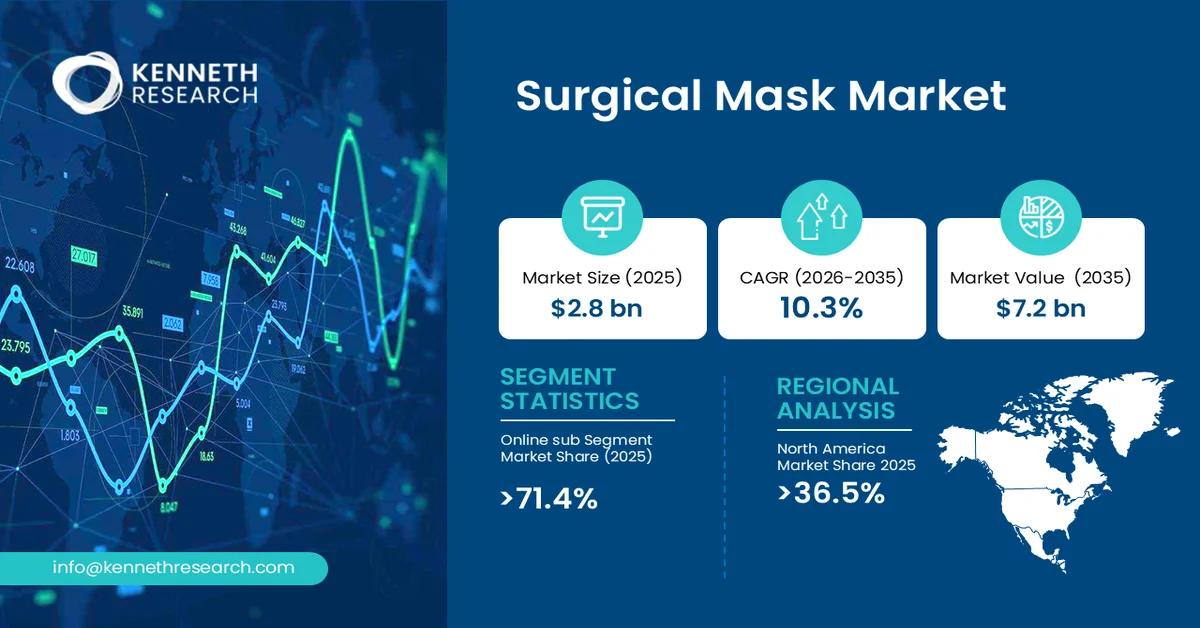
Surgical Mask Market size was valued at USD 2.8 billion in 2025 and is projected to reach USD 7.2 billion by the end of 2035, rising at a CAGR of 10.3% during the forecast period, i.e., 2026–2035. In 2026, the industry size of the surgical mask is estimated at USD 3 billion.
The primary growth driver for the surgical mask market is the sustained emphasis on infection prevention across healthcare systems. Hospitals, ambulatory care centers, and surgical facilities continue to strengthen routine protective equipment usage as healthcare-associated infection prevention remains a clinical priority, supporting consistent demand for surgical masks beyond pandemic-driven procurement.
The surgical mask market comprises the manufacturing, distribution, and commercialization of disposable medical masks designed to reduce the transmission of infectious agents, droplets, and fluid splashes in healthcare environments. Surgical masks are primarily intended for use by healthcare professionals, patients, and caregivers during surgical procedures, clinical examinations, and other medical activities where barrier protection is required. These products are manufactured using multilayer nonwoven materials and are designed to deliver filtration efficiency, breathability, fluid resistance, and wearer comfort while complying with applicable medical device standards.
The market serves hospitals, clinics, ambulatory surgical centers, diagnostic laboratories, dental facilities, and other healthcare institutions, in addition to supporting emergency preparedness programs and public health stockpiles. Its industrial relevance extends across medical device manufacturing, healthcare procurement, infection prevention, and occupational safety. Demand is influenced by evolving infection control protocols, healthcare infrastructure expansion, surgical procedure volumes, and regulatory quality requirements. According to the U.S. Centers for Disease Control and Prevention (CDC), surgical masks are used in healthcare settings to protect healthcare personnel from infectious material, protect patients during sterile procedures, and reduce the spread of respiratory secretions from symptomatic patients, underscoring their essential role in modern clinical practice.
Key Surgical Mask Market Insights Summary:
Key Takeaways: Market Trends & Insights
- Global surgical mask market is expected to grow from USD 2.8 billion in 2025 to USD 7.2 billion by 2035, registering a 10.3% CAGR during 2026-2035
- The online distribution channel leads the market with a 71.4% share in 2025, driven by expanding digital procurement platforms and increasing healthcare e-commerce adoption
- Basic surgical masks are projected to witness strong future growth owing to their cost-effectiveness, widespread clinical usage, and scalable manufacturing capabilities
- North America held the largest regional share at 36.5% in 2025, supported by advanced healthcare infrastructure, strong infection prevention standards, and established medical device manufacturing across the United States and Canada
- Rising emphasis on infection prevention, healthcare worker safety, digital procurement, and expanding outpatient healthcare services will continue to create long-term growth opportunities for surgical mask manufacturers and suppliers
Market Drivers
- Expansion of outpatient and ambulatory surgical procedures
- Increasing domestic manufacturing of medical protective equipment
- Growing regulatory focus on healthcare worker safety and compliance
- Advancements in sustainable and high-performance surgical mask materials
Challenges
- Volatility in medical-grade raw material supply and input costs
- Stringent regulatory compliance and product certification requirements
Surgical Mask Market Overview & Supply Chain
Global adoption of surgical masks continues to increase as healthcare systems reinforce infection prevention protocols, strengthen occupational safety practices, and prioritize preparedness for infectious disease outbreaks. The market benefits from ongoing investments in healthcare infrastructure, higher procedural volumes, and stricter regulatory expectations for personal protective equipment used in clinical settings. Growing awareness of healthcare-associated infections has further elevated the routine use of surgical masks across hospitals, outpatient facilities, and long-term care environments. The industrial relevance of surgical masks is reinforced by their role in protecting both healthcare professionals and patients during medical procedures. According to the World Health Organization (WHO), effective infection prevention and control (IPC) programmes can prevent up to 70% of healthcare-associated infections, highlighting the importance of protective measures, including appropriate medical barrier products, in modern healthcare delivery.
The surgical mask market operates through a vertically integrated value chain beginning with the procurement of raw materials such as polypropylene nonwoven fabric, melt-blown filtration media, nose clips, elastic ear loops, and packaging materials sourced from petrochemical, textile, and component suppliers. Manufacturers convert these inputs into finished surgical masks through automated processes that include fabric layering, ultrasonic welding, sterilization where applicable, quality inspection, and regulatory compliance testing. Products are then distributed through medical wholesalers, group purchasing organizations, healthcare distributors, e-commerce platforms, pharmacies, and direct institutional procurement channels. End users include hospitals, ambulatory surgical centers, clinics, diagnostic laboratories, dental practices, long-term care facilities, emergency response organizations, and government healthcare agencies. Major stakeholders across the value chain comprise raw material suppliers, medical device manufacturers, contract manufacturers, regulatory authorities, logistics providers, healthcare procurement organizations, distributors, and institutional buyers responsible for infection prevention and occupational safety.
Surgical Mask Market: Growth Drivers & Challenges
Growth Drivers:
- Strengthening infection prevention standards across healthcare systems: The increasing emphasis on infection prevention and control (IPC) across healthcare systems is a major driver for the surgical mask market. Governments, healthcare providers, and accreditation bodies continue to reinforce standardized protective measures for healthcare personnel and patients, resulting in sustained procurement of surgical masks for routine clinical use. As healthcare facilities modernize their IPC frameworks, surgical masks are becoming an indispensable component of occupational safety, surgical procedures, and patient management protocols. This trend also encourages manufacturers to improve product quality, regulatory compliance, and production resilience to meet evolving healthcare requirements. Over the long term, expanding IPC programmes are expected to support stable institutional demand, stimulate innovation in medical-grade protective products, and strengthen supply chain investments. According to the World Health Organization, only 38% of countries had a national infection prevention and control programme fully implemented nationwide based on 2021-2022 data, underscoring the continued need for stronger healthcare protection measures and related medical supplies.
- Expansion of digital procurement and healthcare e-commerce: The rapid expansion of digital procurement platforms is accelerating access to surgical masks for institutional and commercial buyers worldwide. Hospitals, clinics, pharmacies, and independent healthcare providers increasingly rely on online procurement systems to improve purchasing efficiency, inventory visibility, and supplier diversification. Digital distribution enables faster replenishment, transparent product comparisons, and streamlined compliance documentation, making procurement more efficient than traditional purchasing channels. Manufacturers also benefit from broader market reach through direct-to-customer sales models, reducing dependence on conventional distributor networks while improving customer engagement. Looking ahead, integration of e-procurement platforms with hospital inventory management systems, predictive demand planning, and automated replenishment is expected to enhance supply chain responsiveness. These developments will encourage greater procurement efficiency, strengthen manufacturer–buyer relationships, and support sustained adoption of surgical masks across healthcare institutions and allied medical sectors.
Challenges:
- Volatility in medical-grade raw material supply and input costs: The surgical mask market remains vulnerable to fluctuations in the availability and pricing of critical raw materials, particularly medical-grade nonwoven fabrics, melt-blown filtration media, elastic components, and packaging materials. These materials depend on specialized manufacturing capacity and petrochemical feedstocks, making the supply chain sensitive to energy price movements, transportation disruptions, and geopolitical uncertainties. Manufacturers often face compressed margins when input costs rise faster than procurement contracts can be adjusted, particularly for long-term institutional supply agreements. Smaller producers are disproportionately affected because they typically possess lower purchasing power and limited inventory buffers. Commercially, prolonged cost volatility can delay capacity expansion, discourage investment in advanced manufacturing technologies, and intensify competition based on pricing rather than product innovation. Going forward, companies are expected to strengthen supplier diversification, regional sourcing strategies, and inventory planning to improve resilience against recurring supply-side disruptions.
- Stringent regulatory compliance and product certification requirements: Manufacturers operating in the surgical mask market must comply with rigorous regulatory frameworks governing product safety, filtration performance, biocompatibility, quality management systems, labeling, and manufacturing processes. Regulatory expectations differ across jurisdictions, requiring companies to navigate multiple certification pathways before entering international markets. Continuous updates to medical device regulations further increase compliance complexity and necessitate ongoing investments in testing, documentation, and quality assurance. For new entrants and small manufacturers, these requirements can lengthen commercialization timelines and increase operating expenses, creating barriers to market expansion. Commercially, non-compliance may result in product recalls, procurement disqualification, reputational damage, or restricted market access. In the future, harmonization efforts may simplify certain regulatory processes, but manufacturers will continue prioritizing robust quality systems and regulatory expertise to remain competitive in increasingly compliance-driven healthcare markets.
Surgical Mask Market Size and Forecast:
| Report Attribute | Details |
|---|---|
| Base Year |
2025 |
| Forecast Year |
2026-2035 |
| CAGR |
10.3% |
| Base Year Market Size (2025) |
USD 2.8 billion |
| Forecast Year Market Size (2035) |
USD 7.2 billion |
| Regional Scope |
|
Surgical Mask Market Segmentation Analysis:
Distribution Channel Segment Analysis
In the distribution channel segment, the online sub-segment is anticipated to capture the largest market share of 71.4% by the end of 2025.
The online distribution channel dominates the surgical mask market because healthcare providers, institutional buyers, pharmacies, and individual purchasers increasingly prefer digital procurement platforms that offer broader product availability, transparent pricing, and faster order fulfillment. Hospitals and healthcare organizations are integrating e-procurement systems into their supply chain operations to streamline purchasing, improve inventory visibility, and reduce administrative costs. Online channels also enable manufacturers to expand geographic reach while offering direct sales, subscription-based replenishment, and real-time inventory updates. The growing digitalization of healthcare procurement has strengthened supplier responsiveness and enhanced procurement efficiency, particularly for standardized products such as surgical masks. Demand is further supported by rising adoption of digital health technologies. According to the U.S. Centers for Disease Control and Prevention (National Center for Health Statistics), 58.5% of U.S. adults used the Internet to look for health or medical information during July–December 2022, reflecting the broader shift toward digital engagement in healthcare that supports online purchasing of medical products and supplies. Looking ahead, integration of artificial intelligence, automated procurement platforms, and digital supply chain management is expected to reinforce the leadership of the online distribution channel.
Product Type Segment Analysis
The basic surgical masks is projected to grow as the second-largest segment in surgical mask market due to four converging demand drivers.
Basic surgical masks are projected to experience strong growth as healthcare providers continue to prioritize cost-effective infection prevention products for routine clinical use. These masks remain the preferred choice for general patient care, outpatient consultations, diagnostic services, and non-aerosol-generating medical procedures where standard barrier protection is appropriate. Their widespread adoption is driven by ease of use, regulatory acceptance, high-volume procurement by healthcare institutions, and compatibility with established infection prevention protocols. On the supply side, manufacturers benefit from mature production technologies, standardized raw materials, and scalable automated manufacturing processes that support consistent product availability and competitive pricing. As healthcare infrastructure expands and routine medical services continue to recover, procurement of basic surgical masks is expected to remain robust across both public and private healthcare systems. According to the OECD, the number of same-day (ambulatory) surgical procedures has increased markedly over the past few decades, driven by advances in medical technologies and improved anaesthetics that enhance patient safety and healthcare efficiency. This sustained growth in routine surgical activity supports continued demand for basic surgical masks across clinical settings.
Our in-depth analysis of the global surgical mask market includes the following segments:
|
Segment |
Sub-segment |
|
Product Type |
|
|
Material Type |
|
|
Usage Type |
|
|
Distribution Channel |
|
Surgical Mask Market Regional Insights:
North America Market Trends & Insights:
North America surgical mask market is projected to hold the largest revenue share of 36.5% by the end of 2025.
The region benefits from substantial investments in healthcare modernization, robust institutional procurement systems, and stringent regulatory oversight governing medical protective equipment. Hospitals, ambulatory surgical centers, and long-term care facilities maintain consistent demand for surgical masks as part of routine clinical operations and occupational safety programmes. In addition, domestic manufacturing capabilities and diversified distribution networks improve supply reliability, while continuous investments in healthcare preparedness strengthen procurement across both public and private sectors. Regional leadership is further supported by ongoing surveillance and infection prevention initiatives.
The United States represents the largest contributor within North America owing to its extensive hospital network, advanced medical device industry, high procedural volumes, and comprehensive regulatory framework for medical products. Strong public and private healthcare expenditure, combined with established procurement practices, supports sustained adoption of surgical masks across diverse healthcare environments.
Canada complements regional growth through universal healthcare coverage, expanding investments in healthcare infrastructure, and increasing emphasis on domestic medical supply resilience. Canadian healthcare authorities continue to prioritize preparedness, strategic procurement, and infection prevention across hospitals, community healthcare facilities, and long-term care institutions, creating stable opportunities for manufacturers and distributors serving the regional surgical mask market.
Europe Market Trends & Insights:
Europe represents a significant market for surgical masks, supported by a well-established healthcare system, strong regulatory oversight for medical devices, and sustained emphasis on infection prevention across clinical settings. Demand is driven by routine use of surgical masks in hospitals, outpatient facilities, dental clinics, diagnostic laboratories, and long-term care institutions. The region also benefits from an advanced medical device manufacturing base and an integrated healthcare supply chain that supports reliable production and distribution. Government initiatives focused on strengthening healthcare resilience, improving emergency preparedness, and encouraging domestic production of critical medical supplies continue to reinforce market development. In addition, evolving sustainability objectives are encouraging manufacturers to adopt environmentally responsible materials, improve production efficiency, and optimize packaging solutions. Looking ahead, digital procurement platforms, investments in healthcare infrastructure, and continued regulatory harmonization under the European medical device framework are expected to create new opportunities for manufacturers, suppliers, and healthcare procurement organizations operating across the region.
Germany serves as a key contributor to the European market owing to its extensive healthcare infrastructure, globally recognized medical device manufacturing capabilities, and strong focus on quality standards and technological innovation. The country's established industrial base and institutional procurement systems support consistent demand for surgical masks across both public and private healthcare providers.
The United Kingdom remains another important market, supported by ongoing investments in healthcare services, infection prevention programmes, and supply chain resilience. Continued modernization of healthcare procurement, increased emphasis on domestic manufacturing capacity, and sustained focus on healthcare worker protection are expected to strengthen long-term demand for surgical masks across the country's healthcare ecosystem.
Leading Companies Operating in the Global Surgical Mask Market:
Here is a list of upstream, downstream, and key players operating in the global surgical mask market competitive ecosystem:
- Medline Industries, Inc. (United States)
- Company Overview
- Business Strategy
- Key Product Offerings
- Financial Performance
- Key Performance Indicators
- Risk Analysis
- Recent Development
- Regional Presence
- SWOT Analysis
- Winner Medical (China)
- DYNAREX Corporation (United States)
- Karl Storz (Germany)
Recent Developments
- In June 2025, Winner Medical Co., Ltd. received FDA 510(k) clearance (K250082) for its surgical mask product, classified under product code FXX (Mask, Surgical) with Class II special controls. The Traditional 510(k) pathway established substantial equivalence to a legally marketed predicate device through a review process that concluded on June 18, 2025.
- In October 2025, the European Commission adopted Implementing Decision (EU) 2025/2078, updating harmonized standards for medical face masks to align with Regulation (EU) 2017/745 on medical devices. The revision resulted in the adoption of EN 14683:2025 for medical face masks, along with updated standards for surgical clothing and drapes (EN 13795-1:2025, EN 13795-2:2025). The decision took effect upon publication in the Official Journal on October 20, 2025.
Frequently Asked Question
In 2025, the surgical mask market exceeded USD 2.8 billion.
The surgical mask market is projected to reach USD 7.2 billion by the end of 2035, expanding at a CAGR of 10.3% over the forecast period (2026-2035).
The major players in the market are Medline Industries, Inc. (United States), Winner Medical (China), DYNAREX Corporation (United States), Karl Storz (Germany), and others.
In the distribution channel segment, the online sub-segment is anticipated to capture the largest market share of 71.4% in the future and exhibit lucrative growth opportunities during 2026-2035. This growth trajectory is largely attributed to the increasing adoption of digital procurement platforms by healthcare institutions and medical supply buyers.
North America is projected to hold the largest market share of 36.5% by the end of 2025 and provide more business opportunities in the future. Continuous investments in healthcare infrastructure and infection prevention initiatives across the United States and Canada are fostering the region's dominance.
Why Choose Kenneth Research ?
-
Insight with Impact : We don’t just gather data — we uncover stories, trends, and opportunities that fuel business growth.
-
Experts Who Get It : Our team speaks your industry’s language and knows what really matters to your customers and market.
-
Custom-Built for You : Forget one-size-fits-all. We craft research and consulting solutions as unique as your business vision.
-
Partners, Not Just Providers : We work with you, not for you — collaborating closely to turn insights into smart, strategic moves.
-
Results That Speak : Our work powers brands, startups, and industry leaders alike — with a track record of ideas that work in the real world.
Report ID: 1063 |
Published Date: 10 Aug 2026 |
Report Format: |
Delivery Timeline: 48-72 Business Hours

Copyright © 2025 Kenneth Research. All rights reserved. Terms of Use | Privacy Policy
