Report ID: 1062 |
Published Date: 07 Aug 2026 |
Report Format: |
Delivery Timeline: 48-72 Business Hours
Surgical Laser Market Outlook:
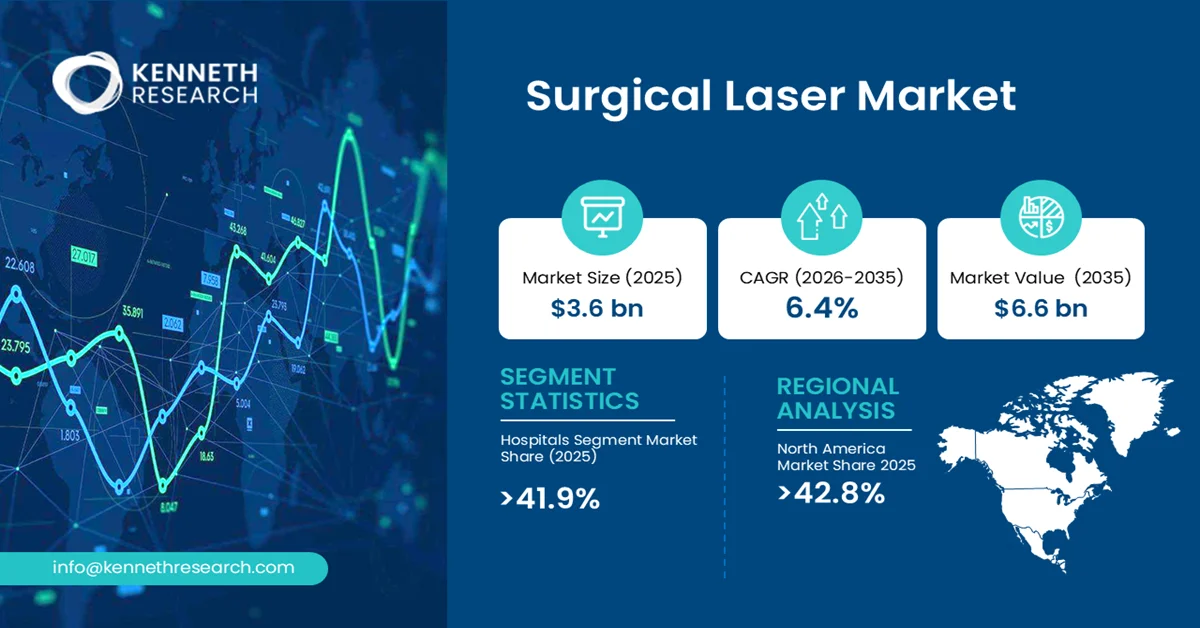
Surgical Laser Market size was valued at USD 3.6 billion in 2025 and is projected to reach USD 6.6 billion by the end of 2035, rising at a CAGR of 6.4% during the forecast period, i.e., 2026-2035. In 2026, the industry size of surgical laser is estimated at USD 3.8 billion.
The primary growth driver for the surgical laser market is the increasing adoption of minimally invasive surgical procedures across multiple specialties. Advances in laser-assisted techniques enable greater precision, reduced tissue trauma, faster patient recovery, and improved clinical outcomes, encouraging healthcare providers to integrate surgical laser systems into routine hospital and specialty surgical workflows.
The surgical laser market comprises medical laser systems and associated technologies designed to perform or assist surgical procedures through the controlled delivery of concentrated light energy. These systems are used across diverse clinical specialties, including ophthalmology, dermatology, gynecology, urology, oncology, cardiovascular surgery, dentistry, and general surgery, where precision tissue cutting, ablation, coagulation, and vaporization are required.
Surgical laser are characterized by their ability to deliver highly focused energy with minimal damage to surrounding tissues, resulting in improved surgical precision, reduced intraoperative bleeding, lower infection risk, and shorter recovery periods compared with many conventional surgical techniques. Depending on the clinical application, healthcare providers utilize different laser technologies, including solid-state, gas, diode, and fiber-based systems, each offering specific wavelength characteristics and tissue interaction profiles.
The market holds significant industrial relevance as healthcare systems increasingly prioritize advanced surgical technologies that improve procedural efficiency, support minimally invasive treatment approaches, and enhance patient outcomes. Growing investments in hospital infrastructure, technological innovation, and expanding adoption of precision surgical equipment continue to strengthen the role of surgical laser within modern healthcare delivery and specialized surgical practice.
Key Surgical Laser Market Insights Summary:
Key Takeaways: Market Trends & Insights
- Surgical laser market is valued at USD 3.6 billion in 2025 and is projected to reach USD 6.6 billion by 2035, expanding at a CAGR of 6.4% during 2026-2035
- Hospitals represent the leading end-use segment with a 41.9% market share in 2025, driven by increasing adoption of minimally invasive surgical technologies and advanced healthcare infrastructure
- North America dominates the surgical laser market with a 42.8% market share in 2025, supported by strong medical technology adoption, advanced healthcare systems, and investments across the United States and Canada
- Solid-state laser systems are emerging as a high-growth product type due to improved energy efficiency, precision performance, reliability, and expanding applications across ophthalmology, urology, dermatology, and specialty surgeries
- Rising demand for precision surgical procedures, technological advancements in laser platforms, and healthcare modernization initiatives are strengthening long-term adoption opportunities across global markets
Market Drivers
- Increasing investments in advanced hospital infrastructure and surgical modernization
- Growing prevalence of chronic diseases requiring surgical intervention
- Rising demand for outpatient and ambulatory surgical procedures
- Expanding clinical applications across multiple medical specialties
Challenges
- High capital investment and lifecycle ownership costs
- Complex regulatory compliance and clinical validation requirements
Surgical Laser Market Overview & Supply Chain
Global adoption of surgical laser is accelerating as healthcare providers expand minimally invasive treatment pathways that improve procedural precision, reduce blood loss, shorten recovery periods, and support higher operating room efficiency. Technological advancements in laser delivery systems, imaging integration, and energy control have broadened their use across ophthalmology, oncology, dermatology, urology, and gynecology. Regulatory emphasis on quality care, coupled with increasing investments in advanced surgical infrastructure, further strengthens adoption across developed and emerging healthcare systems. Industry relevance is reinforced by the continued shift toward same-day procedures. The OECD's health at a glance 2023 reports that the number of surgical procedures performed on a same-day basis has increased markedly over recent decades, enabled by advances in less invasive medical technologies and improved anaesthetics that enhance patient safety and outcomes. This trend supports sustained demand for precision surgical technologies, including laser-based systems.
The surgical laser industry value chain begins with the procurement of specialized optical components, semiconductor materials, laser crystals, optical fibers, precision lenses, electronic control modules, cooling assemblies, and medical-grade metals sourced from advanced photonics and electronics suppliers. Manufacturers integrate these components into complete laser platforms through precision engineering, software development, calibration, quality assurance, and regulatory compliance processes aligned with medical device standards. Finished systems are distributed through direct sales organizations, regional medical equipment distributors, and specialized healthcare technology partners responsible for installation, commissioning, user training, and lifecycle maintenance. Hospitals, ambulatory surgical centers, specialty clinics, and academic medical institutions represent the primary end users, supported by service providers offering maintenance, upgrades, and consumables. Key stakeholders across the value chain include component manufacturers, laser system developers, software providers, regulatory authorities, healthcare providers, purchasing organizations, distributors, clinical professionals, and research institutions driving continuous product innovation and clinical adoption.
Surgical Laser Market: Growth Drivers & Challenges
Growth Drivers:
- Expanding adoption of minimally invasive surgical technologies: The increasing preference for minimally invasive procedures is a key growth driver for the surgical laser market. Healthcare providers are adopting laser-assisted surgical systems because they enable highly precise tissue interaction, reduce blood loss, minimize postoperative discomfort, and shorten patient recovery times. These clinical advantages improve operating room efficiency while supporting enhanced patient outcomes across ophthalmology, dermatology, urology, gynecology, oncology, and general surgery. As healthcare systems continue to prioritize value-based care, hospitals and specialty centers are investing in advanced laser platforms that improve procedural consistency and reduce hospitalization requirements. Regulatory oversight and continuous innovation in medical laser technologies are further expanding clinical acceptance. Future market growth is expected to be supported by broader integration of image-guided surgery, digital treatment planning, and next-generation laser platforms capable of delivering higher precision across increasingly complex surgical applications. The U.S. Food and Drug Administration's database also reflects ongoing technological innovation, including the clearance of the TECHNOLAS TENEO 317 (MODEL 2) excimer laser system in November 2023, highlighting continued commercialization of advanced surgical laser technologies.
- Continuous innovation in laser platform performance: Continuous advances in laser engineering are expanding the clinical capabilities of surgical laser systems across multiple medical specialties. Improvements in beam delivery, wavelength optimization, thermal control, fiber-optic integration, and software-assisted energy modulation enable surgeons to perform increasingly complex procedures with greater accuracy and reproducibility. These innovations improve workflow efficiency while reducing collateral tissue damage and supporting personalized treatment protocols. Integration with digital imaging, robotic-assisted surgery, and artificial intelligence-assisted planning is further strengthening the value proposition of surgical lasers within modern operating environments. Manufacturers are also focusing on compact system designs, enhanced portability, and simplified user interfaces that improve adoption across hospitals and specialty clinics. Looking ahead, sustained investment in photonics research, precision optics, and intelligent surgical platforms is expected to broaden procedural indications, encourage replacement of conventional surgical instruments in selected applications, and reinforce long-term technological competitiveness across the surgical laser industry.
Challenges:
- High capital investment and lifecycle ownership costs: The high acquisition cost of surgical laser systems remains a significant restraint, particularly for healthcare providers operating under constrained capital budgets. Beyond the initial equipment purchase, organizations must account for installation, facility modifications, software upgrades, preventive maintenance, calibration, consumables, and specialized service contracts throughout the product lifecycle. Training surgeons and clinical staff to operate advanced laser platforms also adds to implementation costs and extends adoption timelines. These financial requirements can delay procurement decisions, especially among smaller hospitals and independent specialty clinics, while encouraging longer replacement cycles for existing equipment. Commercially, manufacturers face extended sales cycles and increased demand for flexible financing, leasing, and service-based business models. Looking ahead, broader adoption will depend on continued product innovation that lowers ownership costs, improves system reliability, and demonstrates clear long-term clinical and operational value to healthcare providers.
- Complex regulatory compliance and clinical validation requirements: Surgical laser technologies are subject to rigorous regulatory oversight because of their direct interaction with human tissue and the need to ensure patient safety. Manufacturers must complete extensive design verification, clinical validation, quality management, and regulatory documentation before introducing new systems or expanding approved clinical indications. Differences in regulatory frameworks across regions further increase development complexity, requiring customized approval strategies for multiple markets. These requirements lengthen product development timelines, increase research and compliance expenditures, and can delay commercialization of innovative technologies. For healthcare providers, additional certification, user training, and operational protocols may slow implementation following product approval. In the long term, companies with strong regulatory expertise, robust quality systems, and well-planned global compliance strategies will be better positioned to accelerate market entry and maintain competitive differentiation.
Surgical Laser Market Size and Forecast:
| Report Attribute | Details |
|---|---|
| Base Year |
2025 |
| Forecast Year |
2026-2035 |
| CAGR |
6.4% |
| Base Year Market Size (2025) |
USD 3.6 billion |
| Forecast Year Market Size (2035) |
USD 6.6 billion |
| Regional Scope |
|
Surgical Laser Market Segmentation Analysis:
End-Use Segment Analysis
In the end-use segment, the hospitals sub-segment is anticipated to capture the largest market share of 41.9% by the end of 2025.
Hospitals represent the leading end-use segment in the surgical laser market due to their extensive requirement for advanced surgical technologies across multiple specialties, including ophthalmology, urology, oncology, dermatology, and general surgery. Hospitals are increasingly adopting laser-based platforms to improve surgical precision, enhance workflow efficiency, and support minimally invasive treatment approaches. The growing focus on reducing patient recovery times and optimizing operating room performance is encouraging healthcare institutions to upgrade conventional surgical capabilities with energy-based technologies. From a supply-side perspective, manufacturers are prioritizing hospital-focused solutions through integrated systems, service agreements, clinical training programs, and advanced laser platforms designed for multidisciplinary use. The expansion of ambulatory and same-day surgical procedures is also strengthening hospital demand for technologies that support efficient patient throughput. The OECD reported that advances in medical technologies, particularly less invasive surgical interventions, have contributed to increased same-day surgical procedures across OECD countries, supporting broader adoption of advanced surgical equipment within hospital environments. Future demand is expected to remain strong as hospitals continue investing in precision medicine, digital operating rooms, and next-generation surgical infrastructure.
Product Type Segment Analysis
The solid-state laser systems is projected to grow as the second-largest segment in the surgical laser market due to four converging demand drivers.
Solid-state laser systems are projected to experience strong growth within the surgical laser market due to their combination of high energy efficiency, operational reliability, compact architecture, and suitability across a broad range of surgical applications. These systems are increasingly preferred in procedures requiring precise tissue interaction, including ophthalmic, dermatological, urological, and aesthetic interventions. Demand is supported by healthcare providers seeking advanced platforms that offer improved control, reduced maintenance requirements, and compatibility with fiber-based delivery systems. On the supply side, manufacturers are investing in improved laser crystals, diode pumping technologies, thermal management systems, and integrated software controls to enhance clinical performance. Regulatory activity also reflects continued innovation in powered laser surgical instruments, with the U.S. FDA documenting multiple recent clearances for advanced laser surgical devices, including the 2023 clearance of the PICOSECOND Nd:YAG Laser System under the powered laser surgical instrument category. This continued product development pipeline is expected to support broader adoption as hospitals and specialty clinics modernize surgical capabilities. Future growth will be driven by expanding clinical applications, improved portability, and integration with digital surgical ecosystems.
Our in-depth analysis of the surgical laser market includes the following segments:
|
Segment |
Sub-segment |
|
Product Type |
|
|
Application |
|
|
End-Use |
|
Surgical Laser Market Regional Insights:
North America Market Trends & Insights:
North America surgical laser market is projected to hold the largest revenue share of 42.8% by the end of 2025.
The region maintains its leadership position due to advanced healthcare infrastructure, strong adoption of minimally invasive surgical technologies, high concentration of specialty hospitals, and significant investment in medical device innovation. The United States and Canada have well-established healthcare ecosystems that support the adoption of advanced surgical equipment through hospital modernization programs, clinical research activities, and regulatory frameworks focused on medical technology safety and effectiveness. North America also benefits from a strong production ecosystem, with leading medical technology companies developing laser-based surgical platforms, optical components, and integrated treatment systems. The presence of advanced manufacturing capabilities, skilled healthcare professionals, and established reimbursement structures further supports regional consumption and technology adoption.
The United States represents the largest contributor within North America due to its extensive hospital network, high procedural volumes, and strong medical technology commercialization environment. The country continues to support innovation through regulatory pathways and healthcare research investments.
Canada is also contributing to regional growth through healthcare system modernization, adoption of advanced medical equipment, and investments in specialized surgical care. The U.S. National Institutes of Health reported that its annual research funding supports thousands of research institutions across the country, reinforcing the United States’ position as a global center for biomedical innovation and healthcare technology advancement.
Asia Pacific Market Trends & Insights:
Asia Pacific is emerging as a significant growth region for the surgical laser market, supported by expanding healthcare infrastructure, rising demand for advanced surgical procedures, and increasing adoption of minimally invasive treatment technologies. Growing investments in hospital modernization, specialty care facilities, and medical technology capabilities are encouraging healthcare providers across the region to integrate laser-based surgical systems into clinical workflows. Governments across Asia Pacific are strengthening healthcare access, promoting medical innovation, and supporting the development of advanced healthcare ecosystems, creating favorable conditions for surgical technology adoption. The region also benefits from expanding domestic medical device manufacturing capabilities, improving clinical expertise, and increasing collaboration between healthcare institutions and technology providers. Future opportunities are expected to arise from rising demand for precision surgical procedures, greater adoption of advanced operating room technologies, and increasing focus on improving healthcare outcomes across developing healthcare markets.
China represents a major contributor to Asia Pacific’s surgical laser adoption due to its large healthcare system, expanding hospital infrastructure, and emphasis on upgrading medical technologies. The country is encouraging innovation in medical devices while improving access to advanced healthcare services across urban and regional areas.
India is also experiencing increasing demand for surgical laser technologies, driven by expanding private healthcare networks, rising specialty hospitals, and growing awareness of minimally invasive procedures. Continued healthcare investment, medical device ecosystem development, and increasing clinical adoption are expected to strengthen the region’s long-term role in the global surgical laser industry.
Leading Companies Operating in the Global Surgical Laser Market:
Here is a list of upstream, downstream, and key players operating in the global surgical laser market competitive ecosystem:
- Lumenis Ltd. (United States)
- Company Overview
- Business Strategy
- Key Product Offerings
- Financial Performance
- Key Performance Indicators
- Risk Analysis
- Recent Development
- Regional Presence
- SWOT Analysis
- Candela Corporation (United States)
- Fotona d.o.o. (Slovenia)
- Alma Lasers Ltd. (Israel)
- Cynosure, Inc. (Hologic) (United States)
- IPG Photonics Corporation (United States)
- biolitec AG (Germany)
Recent Developments
- In July 2025, Cutera, Inc. received FDA 510(k) clearance for the AviClear Laser System (K251149), a powered laser surgical instrument classified under product code GEX for general and plastic surgery applications . The FDA issued a clearance decision on July 11, 2025, after an 88-day review cycle—notably faster than the panel average of 115 days . The device was cleared through the Traditional 510(k) pathway, establishing substantial equivalence to a predicate device without requiring clinical trial data.
- In October 2025, Risu Medical Technology Co., Ltd. received FDA 510(k) clearance for the picosecond laser device (PF131-BI) (K252345), a Class II powered laser surgical instrument regulated under 21 CFR 878.4810 . The device was cleared on October 23, 2025, after an 87-day review—28 days faster than the panel average . The Traditional 510(k) pathway established substantial equivalence without requiring clinical trials.
Frequently Asked Question
In 2025, the surgical laser market exceeded USD 3.6 billion.
The surgical laser market is projected to reach USD 6.6 billion by the end of 2035, expanding at a CAGR of 6.4% over the forecast period (2026-2035).
The major players in the market are Lumenis Ltd. (United States), Candela Corporation (United States), Fotona d.o.o. (Slovenia), Alma Lasers Ltd. (Israel), Cynosure, Inc. (Hologic) (United States), IPG Photonics Corporation (United States), biolitec AG (Germany) and others.
In the end-use segment, the hospitals sub-segment is anticipated to capture the largest market share of 41.9% in the future and exhibit lucrative growth opportunities during 2026-2035. This growth trajectory is largely attributed to increasing adoption of minimally invasive surgical technologies and advanced surgical infrastructure investments.
North America is projected to hold the largest market share of 42.8% by the end of 2025 and provide more business opportunities in the future. Continuous investments in advanced healthcare infrastructure, surgical technology adoption, and medical device innovation across the United States and Canada are fostering the region's dominance.
Why Choose Kenneth Research ?
-
Insight with Impact : We don’t just gather data — we uncover stories, trends, and opportunities that fuel business growth.
-
Experts Who Get It : Our team speaks your industry’s language and knows what really matters to your customers and market.
-
Custom-Built for You : Forget one-size-fits-all. We craft research and consulting solutions as unique as your business vision.
-
Partners, Not Just Providers : We work with you, not for you — collaborating closely to turn insights into smart, strategic moves.
-
Results That Speak : Our work powers brands, startups, and industry leaders alike — with a track record of ideas that work in the real world.
Report ID: 1062 |
Published Date: 07 Aug 2026 |
Report Format: |
Delivery Timeline: 48-72 Business Hours

Copyright © 2025 Kenneth Research. All rights reserved. Terms of Use | Privacy Policy
