Report ID: 1061 |
Published Date: 07 Aug 2026 |
Report Format: |
Delivery Timeline: 48-72 Business Hours
Surgical Dental Loupes Camera Market Outlook:
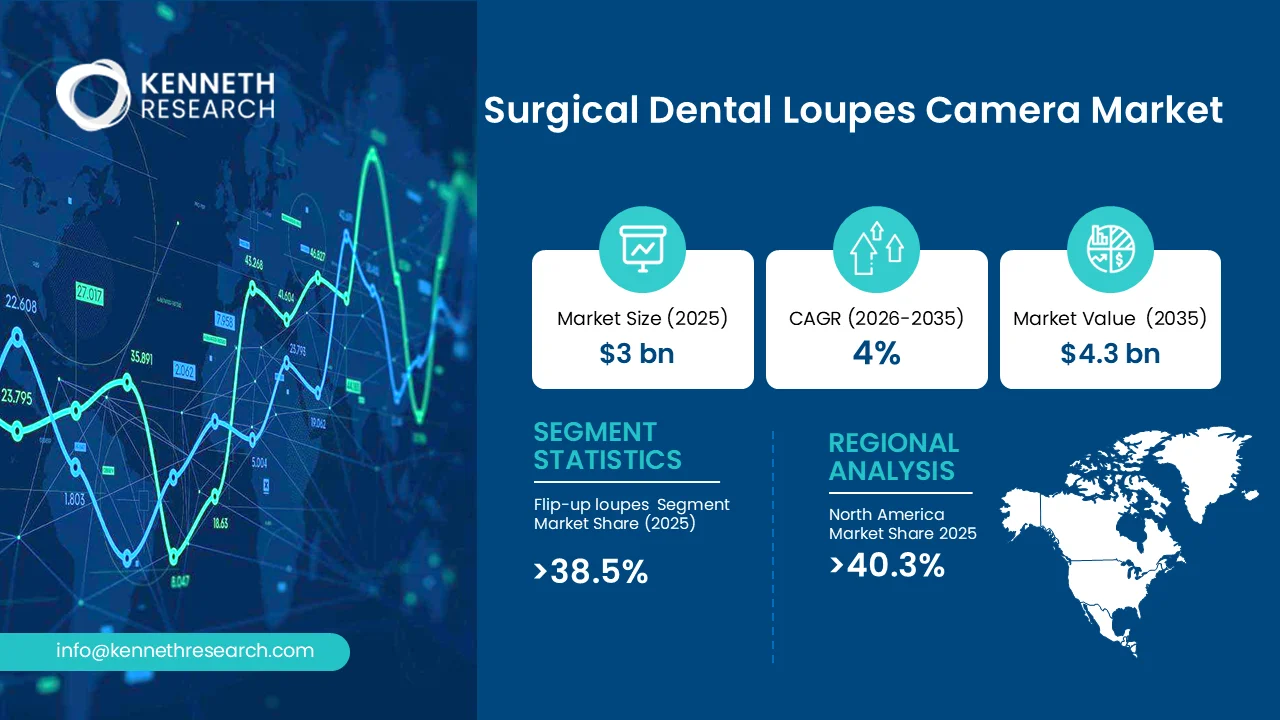
Surgical Dental Loupes Camera Market size was valued at USD 3 billion in 2025 and is projected to reach USD 4.3 billion by the end of 2035, rising at a CAGR of 4% during the forecast period, i.e., 2026-2035. In 2026, the industry size of the surgical dental loupes camera is estimated at USD 3.1 billion.
The primary growth driver for the surgical dental loupes camera market is the increasing emphasis on early diagnosis and precision-based dental treatment. Rising oral disease prevalence is encouraging dental professionals to adopt enhanced visualization technologies that improve clinical accuracy, ergonomics, documentation, and patient communication during both routine and complex dental procedures.
The surgical dental loupes camera market comprises magnification and imaging devices designed to enhance visualization, diagnostic accuracy, and procedural precision during dental examinations and surgical interventions. The market primarily includes surgical loupes, such as flip-up and through-the-lens designs, alongside intraoral cameras and related imaging systems used across general dentistry, restorative dentistry, endodontics, periodontics, prosthodontics, orthodontics, and oral surgery.
These products provide magnified visualization, optimized illumination, ergonomic support, and real-time image capture, enabling clinicians to identify fine anatomical details while reducing physical strain during prolonged procedures. Intraoral cameras further support clinical documentation, treatment planning, patient education, and digital record integration by producing high-resolution images of the oral cavity. The market is closely aligned with the broader transition toward digitally enabled dental workflows, preventive care, and evidence-based clinical decision-making. Surgical dental loupes and cameras are increasingly integrated into modern dental practices, hospitals, academic institutions, and specialty clinics to improve treatment quality, workflow efficiency, regulatory compliance, and communication between practitioners and patients while supporting standardized infection prevention practices in clinical settings.
Key Surgical Dental Loupes Camera Market Insights Summary:
Key Takeaways: Market Trends & Insights
- The surgical dental loupes camera market is projected to grow from USD 3.1 billion in 2026 to USD 4.3 billion by 2035, registering a 4% CAGR during the forecast period
- Flip-up loupes led the market with a 38.5% share in 2025, driven by their ergonomic flexibility, adjustable optics, and widespread adoption across general and specialty dental procedures
- North America accounted for the largest regional share at 40.3% in 2025, supported by advanced dental infrastructure, strong technology adoption, and continued investments across the United States and Canada
- Intraoral cameras are expected to witness the fastest growth, fueled by increasing digital dentistry adoption, enhanced clinical documentation, and greater integration with digital diagnostic workflows
- Rising demand for precision-focused dental care, ergonomic visualization systems, and advanced imaging technologies is accelerating innovation and long-term adoption across hospitals, specialty clinics, academic institutions, and private dental practices
Market Drivers
- Expansion of digital dentistry and advanced clinical imaging
- Growing focus on clinician ergonomics and procedural accuracy
- Increasing adoption of minimally invasive dental procedures
- Rising investments in modern dental clinics and specialty oral healthcare infrastructure
Challenges
- High capital investment and budget constraints
- Integration complexity and learning curve for clinical adoption
Surgical Dental Loupes Camera Market Overview & Supply Chain
Global adoption of the surgical dental loupes camera market is increasing as dental providers prioritize precision-driven diagnostics, minimally invasive procedures, and digital clinical documentation. Enhanced magnification systems and intraoral imaging technologies improve visualization, support accurate treatment planning, and strengthen patient communication while reducing clinician fatigue through ergonomic designs. Regulatory emphasis on quality of care and expanding digital dentistry initiatives are also accelerating equipment modernization across hospitals, specialty clinics, and private dental practices.
The value chain of the surgical dental loupes camera market begins with suppliers of precision optical glass, lightweight metal alloys, engineering polymers, electronic sensors, LED illumination modules, miniature cameras, batteries, and semiconductor components. These materials are integrated by specialized manufacturers that design optical systems, assemble imaging hardware, calibrate magnification performance, and conduct quality assurance in compliance with medical device regulations. Original equipment manufacturers collaborate with component suppliers, software developers, and contract manufacturers to enhance product functionality and ergonomic performance. Finished products are distributed through authorized medical device distributors, dental equipment suppliers, direct sales networks, and e-commerce procurement channels serving institutional buyers and private practices. End users include dental clinics, hospitals, academic institutions, specialty oral surgery centers, and teaching facilities. Major stakeholders across the ecosystem comprise component manufacturers, device producers, regulatory authorities, healthcare providers, distributors, procurement organizations, training institutions, and after-sales service providers that support installation, maintenance, and clinical education.
Surgical Dental Loupes Camera Market: Growth Drivers & Challenges
Growth Drivers:
- Expansion of digital dentistry and advanced clinical imaging: The increasing adoption of digital dentistry is a major catalyst for the surgical dental loupes camera market. Dental practices are integrating magnification systems with digital imaging technologies to improve diagnostic precision, treatment planning, clinical documentation, and patient engagement. High-definition visualization supports minimally invasive procedures while enabling clinicians to capture and store images within digital practice management systems. As healthcare providers modernize dental infrastructure, demand is rising for ergonomic loupes and camera-enabled visualization devices that seamlessly integrate into digital workflows. Product innovation is also reinforcing market expansion. In March 2023, the U.S. Food and Drug Administration approved the CALCIVIS imaging system, an imaging device designed to assist dental professionals in detecting and planning treatment for tooth decay, demonstrating continued regulatory support for advanced dental imaging technologies that complement visualization solutions used in modern clinical practice.
- Growing focus on clinician ergonomics and procedural accuracy: Increasing awareness of occupational health among dental professionals is driving investment in ergonomically designed visualization equipment. Dental practitioners frequently perform lengthy procedures requiring sustained concentration and precise hand-eye coordination, making posture and visual clarity critical to clinical performance. Modern surgical loupes with customized working distances, lightweight frames, and optimized magnification help reduce neck and back strain while improving procedural accuracy. Camera-enabled systems further enhance workflow by allowing clinicians to document procedures, collaborate with peers, and educate patients without interrupting treatment. As dental education institutions increasingly familiarize students with magnification-assisted procedures and practices seek to improve operational efficiency, ergonomically advanced loupes and integrated imaging solutions are expected to become standard equipment across general and specialty dentistry, supporting sustained long-term market adoption.
Challenges:
- High capital investment and budget constraints: The adoption of advanced visualization systems in the surgical dental loupes camera market is constrained by the significant upfront investment required for premium surgical loupes, integrated camera systems, specialized lighting, and supporting software. Smaller dental practices, newly established clinics, and independent practitioners often prioritize essential clinical equipment over advanced visualization technologies due to limited capital budgets. Additional expenditures associated with maintenance, calibration, accessories, software updates, and staff training further increase the total cost of ownership. These financial barriers can delay purchasing decisions and encourage the continued use of conventional optical equipment with lower functionality. Although technological advancements are expected to improve affordability over time, pricing pressure remains a critical commercial challenge, particularly in cost-sensitive healthcare markets where procurement decisions are closely linked to return on investment and long-term operational expenditures.
- Integration complexity and learning curve for clinical adoption: Successful implementation of advanced dental loupes and camera systems requires seamless integration with existing clinical workflows, digital imaging platforms, and electronic patient record systems. Many dental professionals must adapt to new visualization techniques, ergonomic positioning, and image documentation processes before achieving maximum clinical efficiency. Variations in equipment compatibility, software interoperability, and user preferences can further complicate deployment across multi-site practices and healthcare institutions. Inadequate training may reduce utilization rates and limit the realization of productivity and diagnostic benefits. From a commercial perspective, manufacturers must invest in technical support, product demonstrations, and clinician education to encourage adoption. As digital dentistry continues to evolve, suppliers that simplify integration, improve usability, and provide comprehensive training services are likely to overcome these barriers and strengthen long-term customer retention.
Surgical Dental Loupes Camera Market Size and Forecast:
| Report Attribute | Details |
|---|---|
| Base Year |
2025 |
| Forecast Year |
2026-2035 |
| CAGR |
4% |
| Base Year Market Size (2025) |
USD 3 billion |
| Forecast Year Market Size (2035) |
USD 4.3 billion |
| Regional Scope |
|
Surgical Dental Loupes Camera Market Segmentation Analysis:
Loupes Design Segment Analysis
In the loupes design segment, the flip-up loupes sub-segment is anticipated to capture the largest market share of 38.5% by the end of 2025.
Flip-up loupes dominate the surgical dental loupes camera market because they offer an effective balance between clinical flexibility, cost efficiency, and ergonomic adaptability. Unlike fixed-design alternatives, flip-up systems enable clinicians to adjust interpupillary distance and viewing angles to suit individual preferences, making them particularly attractive for multi-user practices, teaching institutions, and professionals transitioning to magnification-assisted dentistry. Their versatility supports a broad range of procedures across general dentistry and specialized disciplines, driving sustained demand. On the supply side, manufacturers continue to enhance these products with lightweight materials, improved optical coatings, integrated LED illumination, and compatibility with camera attachments, expanding their appeal without requiring complete equipment replacement. Demand is further supported by continued utilization of preventive and restorative dental services.
Camera Type Segment Analysis
The intraoral cameras are projected to grow as the second-largest segment in the Surgical Dental market due to four converging demand drivers.
Intraoral cameras are projected to register strong growth in the surgical dental loupes camera market as dental providers increasingly prioritize digital diagnostics, patient engagement, and efficient clinical documentation. These devices enable real-time, high-resolution visualization of the oral cavity, allowing clinicians to detect abnormalities earlier, explain treatment plans more effectively, and maintain comprehensive digital patient records. Their compatibility with practice management software and chairside imaging workflows has accelerated adoption across general and specialty dental practices. On the supply side, manufacturers are introducing compact designs, enhanced image sensors, wireless connectivity, and artificial intelligence-enabled image analysis to improve diagnostic capabilities and workflow efficiency. The regulatory environment also supports broader utilization of these technologies. The U.S. food and drug administration (FDA) classifies dental image analyzers as prescription medical devices that use optical camera-based intraoral images to aid healthcare professionals in diagnosing oral health conditions and monitoring treatment progress, reflecting the growing clinical role of intraoral imaging technologies. Continued digital transformation of dentistry and ongoing product innovation are expected to sustain robust demand for intraoral cameras over the coming years.
Our in-depth analysis of the surgical dental loupes camera market includes the following segments:
|
Segment |
Sub-segment |
|
Loupes Magnification |
|
|
Loupes Design |
|
|
Camera Type |
|
|
Camera Resolution |
|
Surgical Dental Loupes Camera Market Regional Insights:
North America Market Trends & Insights:
North America surgical dental loupes camera market is projected to hold the largest revenue share of 40.3% by the end of 2025.
The region benefits from a mature ecosystem of medical device manufacturers, optical technology developers, and specialized dental equipment suppliers that continuously introduce ergonomic and imaging-enhanced visualization solutions. Supportive regulatory frameworks and well-established quality standards encourage the commercialization of technologically advanced dental devices, while continuous investments in digital clinical workflows accelerate replacement demand for modern visualization equipment. Regional leadership is also reinforced by sustained utilization of dental services. According to the U.S. centers for disease control and prevention (CDC), 63.7% of U.S. adults aged 65 years and older had a dental visit in the past 12 months in 2022, demonstrating consistent demand for dental services that support investment in advanced clinical visualization technologies.
The United States serves as the primary growth engine within the region, supported by extensive adoption of digital imaging systems, strong manufacturer presence, high clinician awareness of ergonomic practice, and ongoing investments in advanced dental equipment across private practices, hospitals, and academic institutions. Continuous innovation in optical magnification, integrated imaging, and workflow digitization further strengthens market demand.
Canada complements regional growth through expanding access to oral healthcare, modernization of dental practices, and increasing adoption of digital diagnostic technologies. Government initiatives to improve access to dental services, together with investments in technologically advanced clinical equipment and professional training, are encouraging broader utilization of surgical loupes and intraoral camera solutions across both urban and community-based dental care settings.
Europe Market Trends & Insights:
Europe represents a strategically important region in the surgical dental loupes camera market, supported by growing demand for precision-oriented dental care, increasing adoption of digital dentistry, and a well-established medical device manufacturing ecosystem. Dental professionals across the region are investing in advanced magnification and imaging technologies to improve diagnostic accuracy, enhance treatment planning, and support minimally invasive clinical procedures. The region benefits from harmonized medical device regulations that emphasize product quality, safety, and clinical performance, encouraging manufacturers to develop innovative visualization solutions. Increasing digitalization of dental practices, greater emphasis on clinician ergonomics, and expanding integration of imaging technologies into routine workflows are further strengthening market demand. Future opportunities are expected to emerge from continued modernization of dental infrastructure, wider adoption of connected diagnostic platforms, and advancements in optical engineering, wireless imaging, and artificial intelligence-assisted clinical documentation.
Germany remains a key contributor due to its strong medical technology industry, advanced manufacturing capabilities, and widespread adoption of high-performance dental equipment across private clinics, hospitals, and academic institutions. The country's focus on technological innovation and precision engineering supports continuous product development and early adoption of premium visualization systems.
The United Kingdom is witnessing increasing implementation of digital dental workflows, supported by investments in modern clinical infrastructure and growing awareness of ergonomic practice among dental professionals. Rising integration of digital imaging into routine dental care, combined with expanding professional training and technology adoption, is expected to sustain demand for surgical loupes and intraoral camera solutions across the country's public and private dental sectors.
Leading Companies Operating in the Global Surgical Dental Loupes Camera Market:
Here is a list of upstream, downstream, and key players operating in the global surgical dental loupes camera market competitive ecosystem:
- Admetec (Australia)
- Company Overview
- Business Strategy
- Key Product Offerings
- Financial Performance
- Key Performance Indicators
- Risk Analysis
- Recent Development
- Regional Presence
- SWOT Analysis
- Designs For Vision, Inc. (United States)
- Orascoptic (United States)
- SurgiTel (United States)
- e-con Systems (India)
- Mantis Health, Inc. (United States)
Recent Developments
- In December 2023, NuEyes received FDA Class I 510(k) exemption for its NuLoupes AR smartglasses, the first electronic 3-dimensional stereoscopic wearable surgical magnifier. Unlike traditional analog loupes with fixed magnification, NuLoupes provides continuous high-resolution magnification from 1x to 13x with enhanced depth perception, a 42-degree field of view, dual headlamps, voice control, and image/video capture capabilities. The device was slated for release in Q1 2025 and is engineered for both dental and medical use.
- In February 2025, ZEISS Medical Technology presented its EXTARO® 300 surgical microscope and digital workflow solutions at the AEEDC Dubai. The EXTARO 300 is the first dental microscope supporting precise caries detection and simplified tooth preservation procedures. Integrated with ZEISS Connect, ZEISS Surgical Cloud, and ZEISS Livestream, the system allows images and videos taken with the microscope's integrated camera to be accessed directly for patient communication, data management, and remote collaboration. ZEISS also showcased its redesigned EyeMag® family of medical loupes with enhanced optics.
Frequently Asked Question
In 2025, the surgical dental loupes camera market exceeded USD 3 billion.
The surgical dental loupes camera market is projected to reach USD 4.3 billion by the end of 2035, expanding at a CAGR of 4% over the forecast period (2026-2035).
The major players in the market are Admetec (Australia), Designs For Vision, Inc. (United States), Orascoptic (United States), SurgiTel (United States), e-con Systems (India), Mantis Health, Inc. (United States), and others.
In the loupes design segment, the flip-up loupes sub-segment is anticipated to capture the largest market share of 38.5% in the future and exhibit lucrative growth opportunities during 2026-2035. This growth trajectory is largely attributed to increasing adoption of digital dentistry and the growing need for precision visualization and ergonomic clinical workflows.
North America is projected to hold the largest market share of 40.3% by the end of 2035 and provide more business opportunities in the future. Continuous investments in advanced dental technologies, digital dentistry, and strong adoption across the United States and Canada are fostering the region's dominance.
Why Choose Kenneth Research ?
-
Insight with Impact : We don’t just gather data — we uncover stories, trends, and opportunities that fuel business growth.
-
Experts Who Get It : Our team speaks your industry’s language and knows what really matters to your customers and market.
-
Custom-Built for You : Forget one-size-fits-all. We craft research and consulting solutions as unique as your business vision.
-
Partners, Not Just Providers : We work with you, not for you — collaborating closely to turn insights into smart, strategic moves.
-
Results That Speak : Our work powers brands, startups, and industry leaders alike — with a track record of ideas that work in the real world.
Report ID: 1061 |
Published Date: 07 Aug 2026 |
Report Format: |
Delivery Timeline: 48-72 Business Hours

Copyright © 2025 Kenneth Research. All rights reserved. Terms of Use | Privacy Policy
