Report ID: 1060 |
Published Date: 07 Aug 2026 |
Report Format: |
Delivery Timeline: 48-72 Business Hours
Surgical Chips Market Outlook:
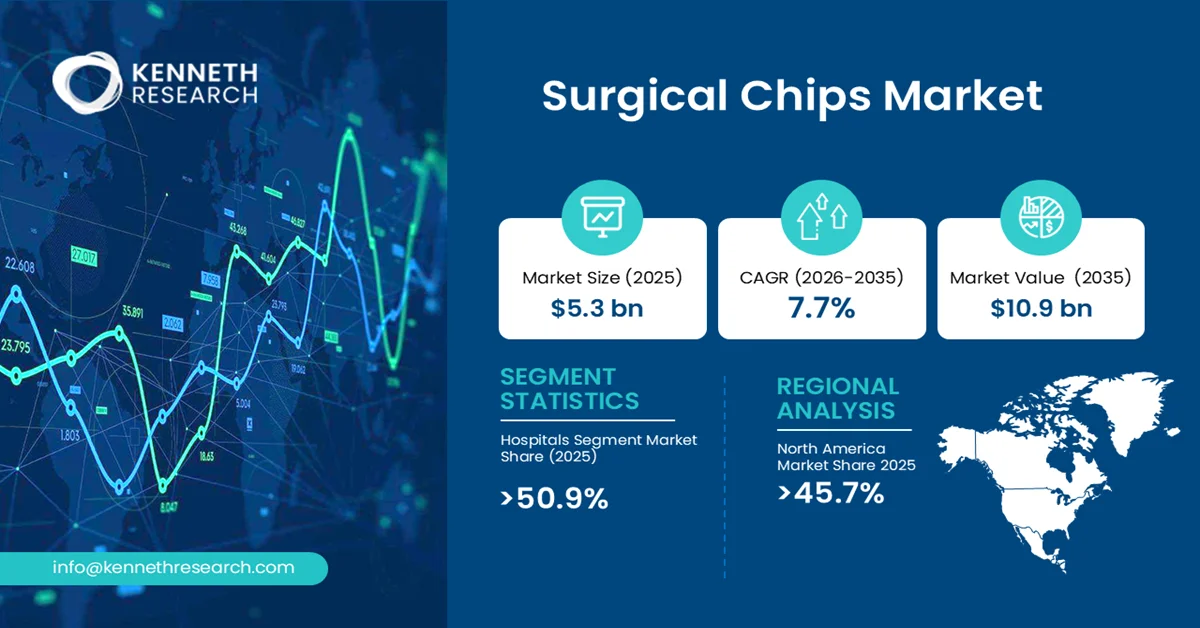
Surgical Chips Market size was valued at USD 5.3 billion in 2025 and is projected to reach USD 10.9 billion by the end of 2035, rising at a CAGR of 7.7% during the forecast period, i.e., 2026-2035. In 2026, the industry size of the surgical chips is estimated at USD 5.6 billion.
The primary growth driver for the surgical chips market is the increasing adoption of miniaturized microfluidic and tissue-chip technologies that enable precise disease diagnosis, surgical planning, biomarker analysis, and personalized treatment. Their ability to improve analytical accuracy, reduce sample requirements, and accelerate clinical decision-making is expanding adoption across hospitals and research institutions.
The surgical chips market comprises microfabricated devices, including lab-on-chip, microfluidic, and tissue-chip platforms, designed to support surgical diagnostics, disease characterization, intraoperative decision-making, and translational medical research. These chips integrate biological samples with microscale fluidic channels, sensors, and analytical components to perform rapid biochemical, cellular, or molecular analyses using minimal specimen volumes. The technology combines principles of microengineering, biotechnology, and semiconductor fabrication to deliver highly accurate and reproducible results. The U.S. National Library of Medicine defines lab-on-chip devices as microdevices that integrate microfluidics with electrical or mechanical functions to analyze very small fluid volumes.
Surgical chips are increasingly relevant across modern healthcare because they facilitate rapid diagnostics, precision oncology, biomarker detection, drug response assessment, and surgical research. They support clinicians in improving diagnostic confidence while enabling researchers to model human tissues and evaluate therapeutic interventions under controlled conditions. Their integration into hospitals, research laboratories, and pharmaceutical development is strengthening precision medicine initiatives, reducing reliance on conventional laboratory workflows, and advancing innovation in minimally invasive and patient-specific healthcare solutions.
Key Surgical Chips Market Insights Summary:
Key Takeaways: Market Trends & Insights
- The surgical chips market is projected to grow from USD 5.6 billion in 2026 to USD 10.9 billion by 2035, registering a CAGR of 7.7% during the forecast period
- Hospitals are expected to remain the leading end-user segment, accounting for 50.9% of the market share by 2035 due to increasing adoption of precision diagnostics and advanced surgical technologies
- Cancer diagnosis and treatment is projected to be the fastest-growing application segment, supported by rising demand for precision oncology, biomarker analysis, and personalized treatment approaches
- North America held the dominant regional share of 45.7% in 2025, driven by strong biomedical research capabilities, advanced healthcare infrastructure, and continuous innovation across the United States and Canada
- Europe is expected to witness sustained growth, supported by expanding investments in precision medicine, medical technology innovation, and translational research across Germany and France
Market Drivers
- Expansion of precision medicine and human-relevant research platforms
- Rising integration of microfluidics into clinical diagnostics
- Growing adoption of minimally invasive surgical procedures
- Increasing investments in biomedical research and translational healthcare innovation
Challenges
- Complex manufacturing and validation requirements
- Limited standardization across clinical workflows
Surgical Chips Market Overview & Supply Chain
The adoption of surgical chips is increasing globally as healthcare systems prioritize precision diagnostics, minimally invasive procedures, and personalized treatment pathways. Advances in microfluidics, biosensing, and semiconductor-enabled biomedical devices are enabling clinicians to perform rapid molecular analyses using small biological samples, improving surgical planning and postoperative decision-making. The technology is also gaining traction in translational research by supporting realistic tissue modeling and accelerating biomarker discovery. Regulatory emphasis on earlier disease detection and precision medicine is further reinforcing demand for chip-based diagnostic platforms. The growing clinical burden of cancer is a major catalyst for innovation in this field. According to the World Health Organization (WHO), cancer accounted for nearly 10 million deaths worldwide in 2024, highlighting the increasing need for advanced diagnostic and treatment technologies that can support timely and accurate clinical intervention.
The value chain of the surgical chips market begins with the sourcing of specialized raw materials and inputs, including semiconductor substrates, silicon wafers, glass, polymers, microelectronic components, biosensors, reagents, antibodies, and biological materials used for chip functionalization. Manufacturers combine microfabrication, photolithography, microfluidic engineering, and precision assembly processes to produce highly integrated diagnostic and analytical chips that comply with stringent medical quality and regulatory requirements. Following production, products undergo validation, sterilization, packaging, and distribution through direct sales networks, medical device distributors, and specialized laboratory suppliers serving regional and global healthcare markets. End users primarily include hospitals, diagnostic laboratories, research institutes, biotechnology companies, pharmaceutical manufacturers, and academic organizations. Key stakeholders across the ecosystem comprise material suppliers, semiconductor foundries, contract manufacturers, technology developers, healthcare providers, regulatory authorities, reimbursement organizations, research institutions, and distribution partners that collectively support commercialization, clinical adoption, and ongoing product innovation.
Surgical Chips Market: Growth Drivers & Challenges
Growth Drivers:
- Expansion of precision medicine and human-relevant research platforms: The increasing emphasis on precision medicine is accelerating the adoption of surgical chips by enabling clinicians and researchers to replicate human physiological conditions more accurately than conventional laboratory models. Microfluidic and organ-on-chip technologies facilitate rapid biomarker analysis, disease modeling, and treatment response evaluation, supporting informed surgical decisions and personalized therapeutic strategies. These capabilities are becoming increasingly valuable in oncology, regenerative medicine, and translational research, where patient-specific insights are essential for improving clinical outcomes. Regulatory agencies are also recognizing the potential of human-relevant testing platforms to complement or replace traditional preclinical approaches. The U.S. Food and Drug Administration (FDA) continues to advance research on organ-on-chip technology, evaluating micro-engineered human organ systems to better understand biological responses and improve safety assessment of medical products. This institutional support is expected to strengthen technology validation, encourage broader healthcare adoption, and stimulate long-term innovation across the surgical chips ecosystem.
- Rising integration of microfluidics into clinical diagnostics: The integration of microfluidic technologies into clinical diagnostics is creating substantial opportunities for the surgical chips market by enabling faster, more accurate, and less invasive diagnostic workflows. These platforms combine sample preparation, biomarker detection, and analytical processing within compact devices, reducing laboratory complexity while improving turnaround times for critical surgical decisions. Their compatibility with molecular diagnostics, liquid biopsy applications, and point-of-care testing enhances their value across hospitals, research centers, and specialized diagnostic laboratories. As healthcare providers increasingly prioritize workflow efficiency and precision-based treatment planning, demand for highly integrated chip-based analytical systems continues to expand. Future technological convergence with artificial intelligence, digital pathology, and advanced imaging platforms is expected to further improve diagnostic accuracy, facilitate personalized treatment strategies, and broaden the clinical adoption of surgical chips across multiple therapeutic specialties.
Challenges:
- Complex manufacturing and validation requirements: The development of surgical chips involves sophisticated microfabrication techniques, integration of biological components, and stringent quality control processes that significantly increase manufacturing complexity. Variability in biomaterials, fluidic channel precision, sensor calibration, and device reproducibility creates challenges in achieving consistent clinical performance across production batches. Manufacturers must also satisfy demanding validation protocols covering analytical accuracy, biocompatibility, sterility, and regulatory compliance before commercialization. These requirements extend development timelines, increase operational costs, and limit the participation of smaller technology developers with constrained manufacturing capabilities. Commercially, lengthy qualification cycles can delay product launches and reduce the speed at which innovations reach healthcare providers. As clinical applications become more specialized, companies are expected to invest in automated manufacturing, standardized production processes, and advanced quality assurance systems to improve scalability while maintaining the reliability required for widespread clinical adoption.
- Limited standardization across clinical workflows: A significant restraint for the surgical chips market is the lack of standardized protocols governing device design, biological sample handling, analytical validation, and integration with existing clinical workflows. Healthcare institutions often operate with different laboratory procedures, instrumentation, and information management systems, making seamless implementation of chip-based technologies difficult. This inconsistency complicates interoperability between products from different manufacturers and increases the resources required for user training, workflow redesign, and clinical validation. From a commercial perspective, fragmented standards can slow procurement decisions, prolong evaluation periods, and create uncertainty regarding long-term compatibility with hospital infrastructure. Future market expansion will depend on stronger collaboration among technology developers, healthcare providers, regulatory authorities, and standards organizations to establish harmonized performance benchmarks and interoperability frameworks that facilitate broader clinical acceptance.
Surgical Chips Market Size and Forecast:
| Report Attribute | Details |
|---|---|
| Base Year |
2025 |
| Forecast Year |
2026-2035 |
| CAGR |
7.7% |
| Base Year Market Size (2025) |
USD 5.3 billion |
| Forecast Year Market Size (2035) |
USD 10.9 billion |
| Regional Scope |
|
Surgical Chips Market Segmentation Analysis:
End User Segment Analysis
In the end user segment, the hospitals sub-segment is anticipated to capture the largest market share of 50.9% by the end of 2035.
Hospitals dominate the surgical chips market because they serve as the primary setting for complex surgical procedures, advanced diagnostics, and multidisciplinary patient management. The growing integration of precision medicine, molecular diagnostics, and minimally invasive surgical workflows has increased demand for chip-based technologies that provide rapid and accurate clinical insights. Hospitals are also more likely to possess the infrastructure, specialized laboratories, and skilled personnel required to deploy sophisticated microfluidic and biosensing platforms. On the supply side, manufacturers prioritize hospital networks for commercialization because they offer higher testing volumes, opportunities for clinical validation, and long-term procurement partnerships. Continuous investments in digital pathology, integrated diagnostic systems, and translational research further reinforce hospital adoption of surgical chips.
Application Segment Analysis
The cancer diagnosis and treatment is projected to grow as the second-largest segment in the surgical chips market due to four converging demand drivers.
The cancer diagnosis and treatment application segment is projected to experience strong growth as healthcare providers increasingly adopt technologies that enable earlier disease detection, precision oncology, and personalized therapeutic planning. Surgical chips support rapid molecular profiling, biomarker detection, and analysis of tumor biology using minimal sample volumes, making them valuable tools for improving diagnostic accuracy and guiding treatment selection. Growing integration of microfluidic platforms into oncology research and clinical workflows is accelerating adoption across hospitals, cancer centers, and translational research institutions. On the supply side, continued advances in semiconductor manufacturing, biosensor miniaturization, and microfluidic engineering are enabling developers to produce more reliable, scalable, and clinically compatible chip-based solutions. Demand is further reinforced by the rising global burden of cancer. According to the U.S. national cancer institute (NCI), an estimated 18.1 million cancer survivors were living in the United States as of January 2022, with that number projected to reach 26 million by 2040, underscoring the growing need for advanced diagnostic and treatment technologies throughout the continuum of cancer care. As precision medicine becomes more deeply embedded in oncology practice, surgical chips are expected to play an increasingly important role in supporting individualized clinical decision-making and improving patient outcomes.
Our in-depth analysis of the surgical chips market includes the following segments:
|
Segment |
Sub-segment |
|
Type |
|
|
Application |
|
|
End User |
|
Surgical Chips Market Regional Insights:
North America Market Trends & Insights:
North America surgical chips market is projected to hold the largest revenue share of 45.7% by the end of 2025.
The region benefits from sustained investments in precision medicine, semiconductor-enabled medical devices, and translational research, supported by collaboration among research institutions, healthcare providers, and technology developers. Favorable regulatory pathways for innovative diagnostic technologies, together with robust intellectual property protection and a mature medical device manufacturing base, continue to encourage product development and clinical adoption. Government support for biomedical innovation further strengthens the regional ecosystem. According to the U.S. national institutes of health (NIH), its annual budget exceeds USD 47 billion, and in fiscal year 2023 NIH funding generated an estimated USD 92.89 billion in economic activity, reflecting the scale of public investment supporting biomedical innovation and advanced healthcare technologies. This environment reinforces North America's leadership in the development and adoption of surgical chip technologies.
Within the region, the United States serves as the primary innovation hub, supported by extensive biomedical research, leading academic medical centers, and a strong concentration of medical device and biotechnology companies developing next-generation surgical chip platforms. Federal research initiatives and collaboration between industry and regulatory agencies continue to accelerate clinical translation and commercialization.
Canada complements regional growth through its expanding life sciences sector, government-backed health research programs, and increasing investments in precision medicine, microfluidics, and translational healthcare. Canadian universities, research hospitals, and biotechnology firms actively collaborate to develop advanced diagnostic technologies, strengthening the country's role in clinical validation and innovation. Together, the United States and Canada provide an integrated ecosystem of research excellence, manufacturing capability, regulatory support, and healthcare adoption that sustains North America's dominant position in the surgical chips market.
Europe Market Trends & Insights:
Europe represents a strategically important region for the surgical chips market, driven by increasing demand for precision diagnostics, translational medicine, and advanced surgical technologies. The region has a mature healthcare ecosystem supported by strong biomedical research capabilities, established medical device manufacturers, and collaborative innovation programs involving academia, healthcare providers, and industry participants. Growing emphasis on personalized medicine, early disease detection, and minimally invasive clinical procedures is encouraging broader adoption of microfluidic and chip-based diagnostic platforms across hospitals and research institutions. Government-supported research initiatives and regulatory frameworks promoting safe and effective medical technologies continue to foster innovation and commercialization. In addition, increasing investments in biotechnology, semiconductor-enabled healthcare applications, and digital health integration are creating opportunities for the development of next-generation surgical chips. As healthcare systems seek to improve diagnostic accuracy and clinical efficiency, Europe is expected to remain an attractive market for technology developers and medical device manufacturers.
Germany is a key contributor to regional growth owing to its strong medical technology industry, advanced manufacturing capabilities, and extensive network of research institutes and university hospitals engaged in biomedical innovation. The country's focus on precision healthcare and collaboration between industry and academia supports the development and clinical adoption of surgical chip technologies.
France complements regional expansion through sustained investments in life sciences, translational research, and healthcare modernization. Its research organizations, hospitals, and biotechnology companies are increasingly adopting microfluidic platforms for oncology, diagnostics, and personalized medicine applications. Together, Germany and France strengthen Europe's competitive position by advancing innovation, clinical validation, and commercialization of surgical chip solutions across diverse healthcare settings.
Leading Companies Operating in the Global Surgical Chips Market:
Here is a list of upstream, downstream, and key players operating in the global surgical chips market competitive ecosystem:
- BD (Becton, Dickinson and Company) (United States)
- Company Overview
- Business Strategy
- Key Product Offerings
- Financial Performance
- Key Performance Indicators
- Risk Analysis
- Recent Development
- Regional Presence
- SWOT Analysis
- Drägerwerk AG & Co. KGaA (Germany)
- Getinge AB (Sweden)
Recent Developments
- In July 2025, chinese researchers from peking university and the chinese academy of sciences published a breakthrough in Science for a 40-nanometer computing chip that models complex brain structures in real time. The chip reconstructs the brain's intricate folded surface in less than half a second and is 50 to 478 times faster than systems powered by NVIDIA's A100 GPU for this task. The technology could enable real-time cortical surface tracking during neurosurgery and potentially be integrated into clinical decision-making.
- In November 2025, valens semiconductor announced the launch of the first endoscopes powered by its VA7000 chipset by three OEMs. The products include an innovative laparoscope, a 3D imaging solution for robotic surgery, and the first disposable colonoscope with 4K video quality. The VA7000 chipset is the first on the market with built-in electrosurgical noise suppression, enabling reliable high-resolution video during endoscopic procedures, and supports multi-gigabit connectivity via ultra-thin coax and UTP cables.
Frequently Asked Question
In 2025, the surgical chips market exceeded USD 5.3 billion.
The surgical chips market is projected to reach USD 10.9 billion by the end of 2035, expanding at a CAGR of 7.7% over the forecast period (2026-2035).
The major players in the market are BD (Becton, Dickinson and Company) (United States), Dragerwerk AG & Co. KGaA (Germany), Getinge AB (Sweden), and others.
In the end user segment, the hospitals sub-segment is anticipated to capture the largest market share of 50.9% in the future and exhibit lucrative growth opportunities during 2026-2035. This growth trajectory is largely attributed to the increasing adoption of precision diagnostics and advanced surgical technologies across healthcare institutions.
North America is projected to hold the largest market share of 45.7% by the end of 2025 and provide more business opportunities in the future. Continuous investments in biomedical research, precision medicine, and healthcare innovation across the United States and Canada are fostering the region's dominance.
Why Choose Kenneth Research ?
-
Insight with Impact : We don’t just gather data — we uncover stories, trends, and opportunities that fuel business growth.
-
Experts Who Get It : Our team speaks your industry’s language and knows what really matters to your customers and market.
-
Custom-Built for You : Forget one-size-fits-all. We craft research and consulting solutions as unique as your business vision.
-
Partners, Not Just Providers : We work with you, not for you — collaborating closely to turn insights into smart, strategic moves.
-
Results That Speak : Our work powers brands, startups, and industry leaders alike — with a track record of ideas that work in the real world.
Report ID: 1060 |
Published Date: 07 Aug 2026 |
Report Format: |
Delivery Timeline: 48-72 Business Hours

Copyright © 2025 Kenneth Research. All rights reserved. Terms of Use | Privacy Policy
