Report ID: 1081 |
Published Date: 14 Aug 2026 |
Report Format: |
Delivery Timeline: 48-72 Business Hours
Stem Cell Therapy Market Outlook:
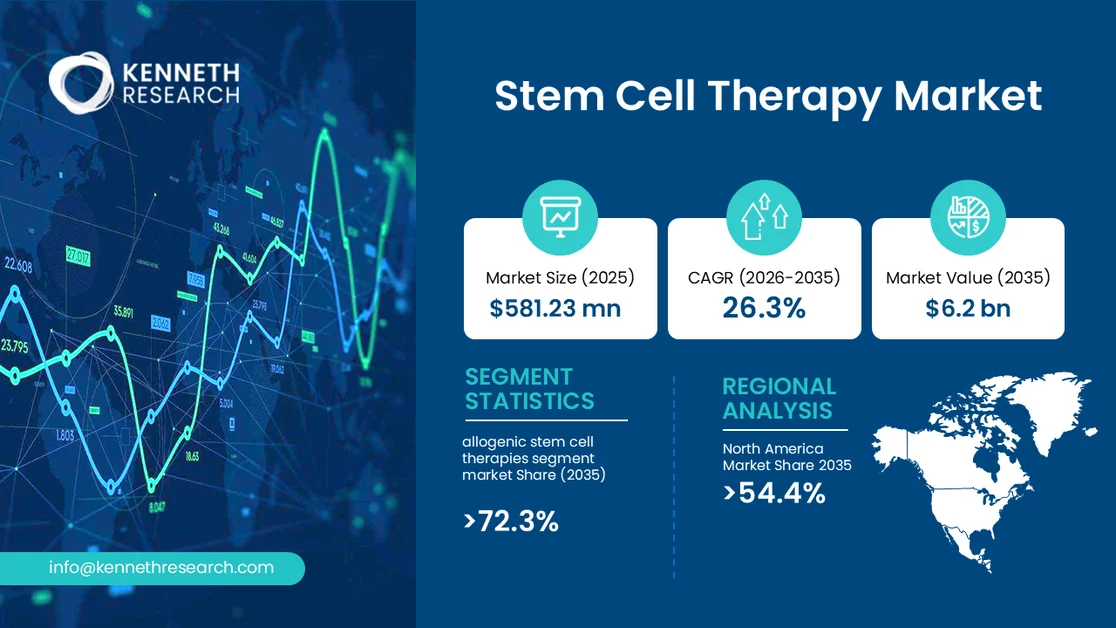
Stem Cell Therapy Market size is valued at USD 581.23 million in 2025 and is projected to reach USD 6.2 billion by the end of 2035, rising at a CAGR of 26.3% during the forecast period, i.e., 2026-2035. In 2026, the industry size of the stem cell therapy is estimated at USD 734.1 million.
The increasing adoption of regenerative medicine for treating chronic, degenerative, and life-threatening diseases is the primary driver for the stem cell therapy market. Advancements in cell engineering, expanding regulatory support for advanced therapies, and growing investments in translational research are accelerating the commercialization and clinical adoption of stem cell-based treatments.
The stem cell therapy market comprises therapeutic products and treatment approaches that utilize stem cells to repair, replace, regenerate, or restore damaged tissues and organs affected by disease, injury, or genetic disorders. These therapies are increasingly applied in oncology, haematology, neurology, orthopaedics, cardiology, and autoimmune disorders, supported by advances in cell processing, manufacturing, and regenerative medicine technologies. Industrial relevance continues to expand as biotechnology companies, pharmaceutical manufacturers, healthcare providers, and academic research institutions invest in advanced therapy medicinal products, scalable cell manufacturing capabilities, and translational research programs.
Key Stem Cell Therapy Market Insights Summary:
Key Takeaways: Market Trends & Insights
- In the therapy type segment, the allogenic stem cell therapies sub-segment is anticipated to capture the revenue share of 72.3% during 2026-2035
- North America stem cell therapy market is projected to hold the largest revenue share of 54.4% by the end of 2035
- The major players in the market are Mesoblast Limited, Takeda Pharmaceutical Company, MEDIPOST Co., Ltd., Anterogen Co., Ltd., Pharmicell Co., Ltd., and FUJIFILM Cellular Dynamics, Inc.
Market Drivers
- Increasing investment in regenerative medicine research and commercialization.
- Advancements in automated cell manufacturing and bioprocessing technologies.
- Expanding regulatory support for advanced cell and gene therapies.
- Increasing adoption of regenerative medicine across multiple therapeutic areas.
Challenges
- Stringent regulatory requirements and complex product standardization.
- High manufacturing costs and limited commercial scalability.
Stem Cell Therapy Market Overview & Supply Chain
Global adoption of stem cell therapies is increasing as healthcare systems seek regenerative treatment options capable of addressing diseases with limited conventional therapeutic outcomes. Rapid advancements in cell engineering, gene editing, bioprocessing, and cryopreservation technologies have improved the scalability and quality of stem cell-based products. The expanding prevalence of chronic diseases and the increasing focus on personalized medicine are further strengthening industry demand. The World Health Organization (WHO) reported that noncommunicable diseases account for 43 million deaths annually worldwide, representing approximately 75% of all non-pandemic deaths, highlighting the growing need for regenerative therapies that can restore tissue function and improve long-term clinical outcomes.
The stem cell therapy market value chain begins with the sourcing of biological materials, including donor-derived or patient-derived stem cells, cell culture media, growth factors, reagents, cryopreservation materials, and specialized laboratory consumables supplied by qualified life science vendors. These inputs undergo cell isolation, expansion, characterization, genetic modification where applicable, and quality testing within Good Manufacturing Practice (GMP)-compliant manufacturing facilities to ensure product safety, consistency, and regulatory compliance.
Stem Cell Therapy Market: Growth Drivers & Challenges
Growth Drivers:
- Expanding regulatory support for advanced cell and gene therapies: The global stem cell therapy industry is benefiting from increasing regulatory support for advanced cellular medicines, creating a more favorable environment for product development and commercialization. Regulatory agencies are refining pathways for regenerative medicine products, providing clearer guidance for developers while facilitating innovation in manufacturing, quality control, and clinical translation. Improved regulatory clarity also strengthens investor confidence and promotes strategic collaborations across the regenerative medicine ecosystem. Over the long term, continued regulatory evolution is expected to accelerate the availability of innovative stem cell therapies for a broader range of diseases while supporting the industry's transition toward scalable commercial manufacturing. The U.S. Food and Drug Administration (FDA) maintains an expanding list of approved cellular and gene therapy products, reflecting the growing maturity of advanced therapeutic technologies and regulatory oversight.
- Increasing adoption of regenerative medicine across multiple therapeutic areas: Growing acceptance of regenerative medicine is driving demand for stem cell therapies across oncology, hematology, neurology, orthopedics, and autoimmune disease management. Healthcare providers are increasingly recognizing the potential of stem cell therapies to repair damaged tissues, restore biological function, and address underlying disease mechanisms rather than merely alleviating symptoms. This shift is encouraging biotechnology companies to expand product pipelines while healthcare institutions invest in specialized treatment capabilities and cell processing infrastructure. Supply-side advancements in cell isolation, expansion technologies, cryopreservation, and automated manufacturing are improving production efficiency and product consistency. Looking ahead, continued integration of precision medicine, gene editing, and advanced bioprocessing technologies is expected to broaden therapeutic applications, strengthen commercial scalability, and accelerate global adoption of stem cell therapies as regenerative medicine becomes an increasingly important component of modern healthcare.Bottom of Form
Challenges:
- Stringent regulatory requirements and complex product standardization: One of the primary restraints affecting the stem cell therapy market is the complexity of regulatory approval and product standardization. Stem cell therapies are living biological products whose safety, potency, identity, and consistency must be demonstrated through rigorous manufacturing and quality control processes. Variability in donor material, cell processing methods, and manufacturing protocols creates challenges in establishing standardized products that consistently meet regulatory expectations across different jurisdictions. These requirements extend development timelines, increase documentation and validation costs, and create barriers for companies seeking multinational commercialization. Commercially, prolonged approval processes can delay market entry and reduce the ability of smaller biotechnology firms to compete with well-capitalized organizations.
- High Manufacturing Costs and Limited Commercial Scalability: Stem cell therapies require highly specialized manufacturing environments, skilled personnel, sophisticated equipment, and tightly controlled production processes, making commercial-scale production both technically demanding and capital intensive. Cell sourcing, expansion, characterization, cryopreservation, sterility assurance, and cold-chain distribution introduce additional operational complexity compared with conventional pharmaceutical manufacturing. These factors increase production costs and can limit manufacturing capacity, particularly for therapies requiring individualized or small-batch production. From a commercial perspective, elevated production expenses influence pricing strategies, reimbursement negotiations, and healthcare provider adoption, while also creating financial challenges for emerging biotechnology companies expanding their product portfolios.
Stem Cell Therapy Market Size and Forecast:
| Report Attribute | Details |
|---|---|
| Base Year |
2025 |
| Forecast Year |
2026-2035 |
| CAGR |
26.3% |
| Base Year Market Size (2025) |
USD 581.23 million |
| Forecast Year Market Size (2035) |
USD 6.2 billion |
| Regional Scope |
|
Stem Cell Therapy Market Segmentation Analysis:
Therapy Type Segment Analysis
Allogenic stem cell therapies sub-segment is estimated to hold largest revenue share of 72.3% by the end of 2035, in stem cell therapy market.
Allogenic Stem Cell Therapies are expected to remain the dominant sub-segment because they offer broad clinical applicability, immediate treatment availability through donor-derived cell sources, and greater scalability than patient-specific therapies. Demand continues to increase as healthcare providers adopt standardized regenerative treatment approaches for hematological disorders, oncology, immune-related diseases, and other conditions requiring cell-based interventions. Industry adoption is further supported by the growing number of specialized transplant centers, expanding manufacturing capabilities, and investments in cryopreservation and cell banking infrastructure that enable large-scale production and distribution of allogenic products. On the supply side, advances in Good Manufacturing Practice (GMP)-compliant cell processing, automated manufacturing, and donor screening technologies are improving product consistency and commercial viability. Future growth is expected to be driven by expanding therapeutic indications, combination regenerative medicine strategies, and continued innovation in off-the-shelf cell therapies.
Therapeutic Application Segment Analysis
Oncology sub-segment is projected to be the second-largest segment in the stem cell therapy market during the forecast period.
The oncology sub-segment is projected to witness significant growth as stem cell therapies become increasingly integrated into cancer treatment strategies for hematological malignancies and selected solid tumors. Demand is being driven by the need for regenerative and immune-restorative therapies that improve patient outcomes following intensive chemotherapy, radiation therapy, and hematopoietic stem cell transplantation. On the supply side, advancements in cell processing, donor matching technologies, cryopreservation, and Good Manufacturing Practice (GMP)-compliant manufacturing are improving product quality and commercial scalability. Future growth is expected to be supported by continued innovation in cell engineering, broader therapeutic indications, and increasing integration of personalized medicine into oncology treatment pathways. Reinforcing the sustained demand for advanced cancer therapies, the U.S. National Cancer Institute (NCI) estimates that 2,041,910 new cancer cases will be diagnosed in the United States in 2025, highlighting the ongoing need for innovative regenerative treatment approaches. Bottom of Form
Our in-depth analysis of the global stem cell therapy market includes the following segments:
|
Segment |
Sub-segment |
|---|---|
|
Therapy Type |
|
|
Therapeutic Application |
|
Stem Cell Therapy Market Regional Insights:
North America Market Trends & Insights:
North America is projected to account for 54.4% of the stem cell therapy market in 2035, reflecting its strong position in regenerative medicine research, advanced biomanufacturing capabilities, and favorable commercialization ecosystem. The region benefits from a well-established network of biotechnology companies, pharmaceutical manufacturers, academic medical centers, and specialized healthcare institutions engaged in the development and application of stem cell therapies. Continuous investment in advanced therapy manufacturing infrastructure, widespread adoption of precision medicine, and supportive regulatory pathways for cellular therapies have strengthened the region's competitive advantage. In addition, robust intellectual property protection, extensive clinical research capabilities, and collaboration between industry and research organizations continue to accelerate product development and commercialization, reinforcing North America's leadership in the global stem cell therapy landscape.
The United States remains the primary contributor to regional growth due to its advanced regenerative medicine ecosystem, strong biotechnology investment, and leadership in developing cellular therapies. Canada complements this position through its expanding stem cell research infrastructure, supportive innovation policies, and internationally recognized academic institutions focused on regenerative medicine. The U.S. Food and Drug Administration (FDA) has granted Regenerative Medicine Advanced Therapy (RMAT) designation to various regenerative medicine products since the program's inception, demonstrating the region's active pipeline and regulatory support for advanced cell therapies. This regulatory environment continues to encourage innovation and investment across the stem cell therapy industry.
Asia Pacific Market Trends & Insights:
Asia Pacific is expected to emerge as one of the fastest-growing regions in the stem cell therapy market, supported by increasing demand for regenerative medicine, expanding healthcare infrastructure, and sustained investment in biotechnology innovation. The region is experiencing rapid growth in stem cell research, advanced biomanufacturing, and translational medicine as healthcare systems seek innovative therapies for chronic, degenerative, and life-threatening diseases. Governments across the region are strengthening regulatory frameworks, supporting regenerative medicine research, and encouraging collaboration between academic institutions, biotechnology companies, and healthcare providers. Industrial activity is further reinforced by the establishment of specialized cell processing facilities, technology parks, and manufacturing hubs dedicated to advanced therapy medicinal products. Future opportunities are expected to arise from expanding commercialization of stem cell therapies, greater adoption of personalized medicine, increasing cross-border research collaborations, and continued investment in scalable manufacturing technologies that improve treatment accessibility and production efficiency.
China is a major regional growth engine due to its expanding biotechnology sector, strong government support for regenerative medicine research, and increasing investment in advanced manufacturing capabilities. The country is also enhancing its clinical research ecosystem and strengthening innovation through collaborations among research institutes, hospitals, and biotechnology companies.
Japan plays a pivotal role through its mature regenerative medicine framework, advanced healthcare infrastructure, and established expertise in stem cell science. The country's supportive regulatory environment for regenerative medicine and continued investment in cell-based therapeutic innovation position it as a key contributor to regional technological advancement and commercial development.
Leading Companies Operating in the Global Stem Cell Therapy Market:
Here is a list of upstream, downstream, and key players operating in the global stem cell therapy market competitive ecosystem:
- Mesoblast Limited (Australia)
- Company Overview
- Business Strategy
- Key Product Offerings
- Financial Performance
- Key Performance Indicators
- Risk Analysis
- Recent Development
- Regional Presence
- SWOT Analysis
- Takeda Pharmaceutical Company (Japan)
- MEDIPOST Co., Ltd. (South Korea)
- Anterogen Co., Ltd. (South Korea)
- Pharmicell Co., Ltd. (South Korea)
- FUJIFILM Cellular Dynamics, Inc. (United States)
Recent Developments
- In September 2025, Pluristyx and BioLamina announced a strategic partnership to accelerate development of stem cell-based therapies by combining Pluristyx’s induced pluripotent stem cell (iPSC) platform with BioLamina’s cell culture matrix technologies. The partnership supports more efficient iPSC-based therapy development by improving workflow integration and enabling researchers to advance scalable stem cell manufacturing approaches.
- In March 2025, Alcon acquired a majority interest in Aurion Biotech to advance innovative cell therapy solutions for corneal endothelial disease. The transaction combines Alcon’s global commercialization capabilities with Aurion’s cell therapy expertise. The acquisition expands Alcon’s presence in regenerative medicine and demonstrates growing interest from established healthcare companies in integrating cell therapy platforms into specialty treatment markets.
Frequently Asked Question
In 2025, the stem cell therapy market exceeded USD 581.23 million.
The stem cell therapy market is projected to reach USD 6.2 billion by the end of 2035, expanding at a CAGR of 26.3% over the forecast period (2026-2035).
The major players in the market are Mesoblast Limited, Takeda Pharmaceutical Company, MEDIPOST Co., Ltd., Anterogen Co., Ltd., Pharmicell Co., Ltd., and others.
In the therapy type segment, the allogenic stem cell therapies sub-segment is anticipated to capture the largest market share of 72.3% in the future and exhibit lucrative growth opportunities during 2026-2035. This growth trajectory is largely attributed to increasing adoption of standardized regenerative treatment approaches and expanding applications across multiple therapeutic areas.
North America is projected to hold the largest market share of 54.4% by the end of 2035 and provide more business opportunities in the future. Continuous investments in regenerative medicine research, advanced cell therapy manufacturing, and biotechnology innovation in the U.S. and Canada are fostering the region's dominance.
Why Choose Kenneth Research ?
-
Insight with Impact : We don’t just gather data — we uncover stories, trends, and opportunities that fuel business growth.
-
Experts Who Get It : Our team speaks your industry’s language and knows what really matters to your customers and market.
-
Custom-Built for You : Forget one-size-fits-all. We craft research and consulting solutions as unique as your business vision.
-
Partners, Not Just Providers : We work with you, not for you — collaborating closely to turn insights into smart, strategic moves.
-
Results That Speak : Our work powers brands, startups, and industry leaders alike — with a track record of ideas that work in the real world.
Report ID: 1081 |
Published Date: 14 Aug 2026 |
Report Format: |
Delivery Timeline: 48-72 Business Hours

Copyright © 2025 Kenneth Research. All rights reserved. Terms of Use | Privacy Policy
