Report ID: 1171 |
Published Date: 25 Aug 2026 |
Report Format: |
Delivery Timeline: 48-72 Business Hours
Spray Foam Market Outlook:
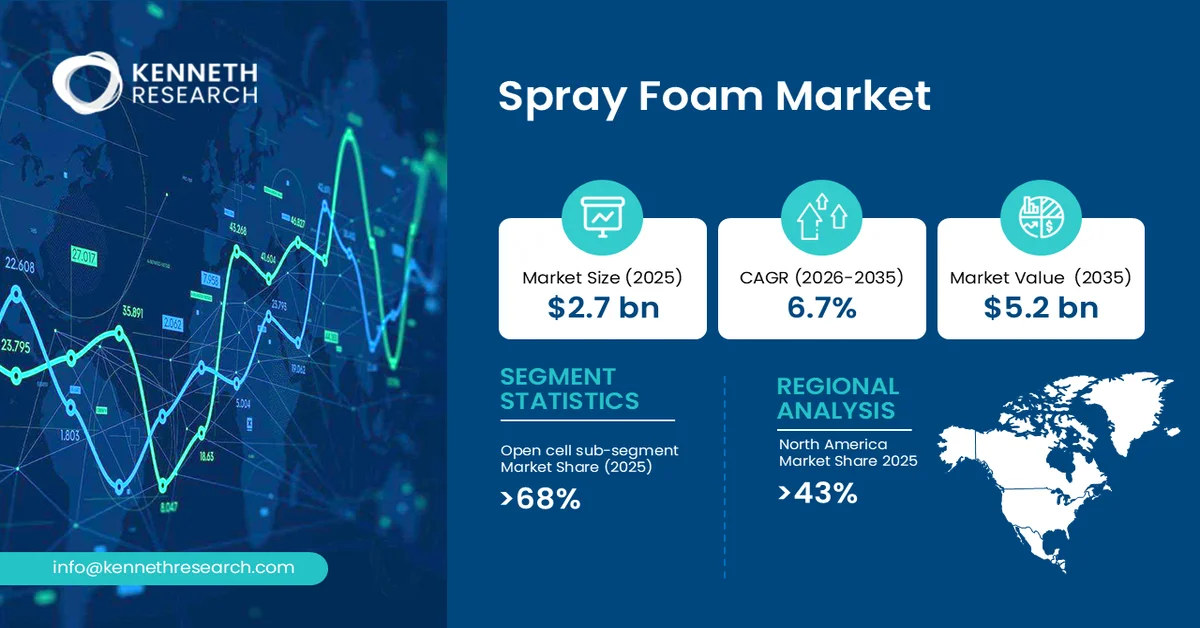
Spray Foam Market size was valued at USD 2.7 billion in 2025 and is projected to reach USD 5.2 billion by the end of 2035, rising at a CAGR of 6.7% during the forecast period, i.e., 2026-2035. In 2026, the industry size of the spray foam is estimated at USD 2.9 billion.
Rising emphasis on building energy efficiency is a key growth driver for the spray foam market. Spray foam creates continuous insulation and air-sealing layers that reduce unwanted heat transfer and air leakage. Increasing demand for high-performance building envelopes, energy-efficient renovations, and improved thermal comfort is encouraging wider adoption across construction projects.
The spray foam market comprises the production and application of polyurethane-based foam insulation systems that are sprayed onto building surfaces and expand to form an insulating and air-sealing layer. Spray foam is primarily available in open-cell and closed-cell formulations, with each structure offering different performance characteristics and suitability for specific construction requirements. Open-cell formulations are lightweight and flexible, while closed-cell formulations provide denser insulation and enhanced resistance to moisture and air infiltration.
The material is characterized by its ability to conform to irregular surfaces, fill gaps and cavities, create continuous insulation, and reduce air movement through building envelopes. These properties make spray foam particularly relevant to modern construction and renovation activities where thermal performance, moisture management, and airtightness are important considerations.
Key Spray Foam Market Insights Summary:
Key Takeaways: Market Trends & Insights
- Spray Foam Market projected to grow from USD 2.7 billion in 2025 to USD 5.2 billion by 2035 at a 6.7% CAGR.
- North America accounted for the largest regional share at 43% in 2025, supported by established construction activity, building-energy-efficiency initiatives, and widespread adoption of advanced insulation solutions.
- Open Cell is expected to remain the leading Product segment with a 68% market share, driven by its lightweight structure, flexibility, insulation performance, and air-sealing capabilities across building applications.
- Construction is projected to remain a key application segment, supported by demand for high-performance building envelopes, energy-efficient structures, renovation activity, and advanced insulation systems.
- The market is benefiting from increasing emphasis on energy-efficient buildings, improved air sealing, sustainable insulation technologies, low-GWP formulations, and building-envelope modernization, creating opportunities for manufacturers and professional spray foam applicators.
Market Drivers
- Rising demand for energy-efficient building envelopes
- Growing adoption of advanced insulation in construction and retrofit projects
- Increasing focus on sustainable and low-emission building materials
- Expansion of residential and commercial construction activity
Challenges
- Health and Safety Concerns Associated with Isocyanate Exposure
- Regulatory Pressure on Blowing Agents and Product Formulations
Spray Foam Market: Market Overview & Supply Chain
Global adoption of spray foam is increasing as building owners, contractors, and developers place greater emphasis on energy efficiency, airtight building envelopes, moisture management, and retrofit performance. Spray-applied insulation can conform to irregular surfaces while simultaneously providing thermal insulation and air sealing, making it relevant to new construction as well as renovation projects. Regulatory efforts to improve building efficiency are also strengthening demand for higher-performance envelope materials. The International Energy Agency (IEA) reports that buildings account for around 30% of global energy demand, highlighting the importance of building-envelope improvements and efficient insulation technologies.
The spray foam market value chain begins with petrochemical-derived inputs, principally polyurethane-related chemicals, including polyols and isocyanates, alongside catalysts, blowing agents, surfactants, and performance additives. Chemical manufacturers supply these inputs to spray foam producers and system formulators, which engineer two-component formulations and package them for professional application. Manufacturing activities include formulation, blending, quality testing, packaging, and preparation of application systems compatible with specialized spraying equipment. Products reach the market through direct sales, specialty construction-material suppliers, insulation contractors, and building-product channels. End users include residential builders, commercial developers, industrial facilities, roofing contractors, retrofit specialists, and property owners.
Spray Foam Market: Growth Drivers & Challenges
Growth Drivers:
- Rising demand for energy-efficient building envelopes: Increasing emphasis on building energy performance is strengthening demand for spray foam because the material can provide both insulation and air sealing within a continuous building envelope. This combination helps address heat transfer and uncontrolled air leakage, making spray-applied systems attractive for new construction and renovation projects. Government energy-efficiency initiatives are reinforcing this opportunity. In October 2024, the U.S. Department of Energy highlighted insulation and air sealing as measures covered by the 2021 International Energy Conservation Code framework for energy-efficient residential construction and retrofits. This regulatory focus encourages contractors and building owners to adopt higher-performance envelope solutions.
- Growing adoption of advanced insulation in construction and retrofit projects: The growing need to upgrade poorly insulated buildings is creating additional opportunities for spray foam systems. Unlike rigid insulation products that require precise cutting and fitting, spray-applied foam can conform to irregular surfaces and integrate insulation with air-sealing functions. This makes it particularly useful for complex building envelopes, renovation projects, roofs, walls, foundations, and hard-to-reach cavities. The technology is also being incorporated into newer retrofit approaches designed to reduce installation complexity and disruption. As building owners increasingly prioritize energy performance alongside construction productivity, contractors are seeking insulation systems that can be installed efficiently while delivering consistent envelope coverage.
Challenges:
- Health and safety concerns associated with isocyanate exposure: Spray foam application involves reactive chemicals, particularly isocyanates, creating safety and compliance challenges during installation. Exposure can occur through vapors, aerosols, dust, or uncured material, requiring controlled work environments, appropriate personal protective equipment, ventilation, and trained applicators. These requirements can increase installation complexity and labor costs while limiting application flexibility, particularly for contractors without specialized expertise. The U.S. Environmental Protection Agency identifies potential respiratory, skin, and eye risks associated with SPF chemicals and emphasizes exposure-control practices.
- Regulatory pressure on blowing agents and product formulations: Increasing environmental regulation of high-global-warming-potential blowing agents presents a significant challenge for spray foam manufacturers. Changes in chemical requirements can force producers to reformulate products, modify manufacturing processes, qualify alternative blowing agents, and manage additional compliance costs. The U.S. Environmental Protection Agency's technology-transition framework includes restrictions affecting polyurethane foam products, increasing pressure on manufacturers to adopt lower-impact formulations. Such transitions can influence product availability, development timelines, equipment compatibility, and pricing throughout the supply chain.
Spray Foam Market Size and Forecast:
| Report Attribute | Details |
|---|---|
| Base Year |
2025 |
| Forecast Year |
2026-2035 |
| CAGR |
6.7% |
| Base Year Market Size (2025) |
USD 2.7 billion |
| Forecast Year Market Size (2035) |
USD 5.2 billion |
| Regional Scope |
|
Spray Foam Market Segmentation Analysis
Product Segment Analysis
In the product segment, the Open Cell sub-segment is anticipated to capture the largest market share of 68% by the end of 2035.
In the Product segment, Open Cell is anticipated to maintain its leading position, supported by its lightweight structure, flexibility, effective air-sealing capability, and suitability for residential and commercial building applications. Demand is strengthened by construction and retrofit projects seeking efficient insulation solutions that can conform to irregular cavities and complex building assemblies. Industry adoption is also supported by its applicability to roof assemblies, walls, attics, and other envelope areas where continuous coverage is important. On the supply side, established polyurethane processing technologies and widespread availability of professional spray equipment support product accessibility and application. The U.S. Department of Energy highlights spray polyurethane foam as a technology capable of providing thermal, air, and vapor control layers in both new and retrofit construction, reinforcing its relevance to modern building-envelope applications
Application Segment Analysis
The Construction application segment is projected to grow as builders increasingly incorporate spray foam into residential, commercial, and renovation projects requiring effective insulation and air sealing. Demand is supported by the need to improve building-envelope performance, address irregular cavities, and reduce thermal losses without extensive structural modifications. Adoption is also expanding as contractors seek materials capable of combining insulation with air-barrier functions in a single application. Supply-side developments in polyurethane formulations, application equipment, and installer expertise are improving the availability and practicality of spray foam for diverse construction requirements. The U.S. Census Bureau reported that private construction spending totaled $1,688.5 billion in December 2024, demonstrating the substantial construction activity that provides an addressable base for insulation technologies.
Our in-depth analysis of the global spray foam market includes the following segments:
|
Segment |
Sub-segment |
|
Product |
|
|
Application |
|
|
End User |
|
|
Installation |
|
Spray Foam Market Regional Insights:
North America Market Trends & Insights:
North America accounted for 43% of the spray foam market in 2025, maintaining regional leadership due to established construction industries, widespread use of advanced insulation systems, and strong emphasis on building energy efficiency. The region benefits from mature spray foam manufacturing and application capabilities, established building codes, and substantial renovation activity. Regulatory and government-backed energy-efficiency initiatives further support demand for high-performance building-envelope materials.
The United States represents the region's principal market, supported by extensive residential and commercial construction, building retrofits, and continued emphasis on energy-efficient building envelopes. Federal building-efficiency requirements also encourage the incorporation of improved insulation and air-sealing approaches into new construction and major renovations. The Department of Energy requires new federal buildings to meet specified energy-efficiency standards, reinforcing the broader market environment for advanced insulation technologies.
Canada is another important market, supported by energy-efficiency initiatives, cold-climate insulation requirements, and growing attention to building performance. Continued cooperation between U.S. and Canadian authorities on building efficiency, combined with construction modernization and retrofit opportunities, should sustain North America's leadership in spray foam adoption.
Europe Market Trends & Insights:
Asia Pacific is emerging as an attractive growth region for the spray foam market, supported by expanding construction activity, urban development, building modernization, and increasing attention to energy-efficient building envelopes. Government initiatives aimed at improving building energy performance are creating a favorable environment for advanced insulation technologies. Across the region, opportunities are expected to expand through residential construction, commercial buildings, industrial facilities, and retrofit projects, particularly as governments pursue more efficient and lower-emission building stock.
Japan represents a mature opportunity, with stringent building-performance requirements and increasing focus on improving the energy efficiency of new and existing structures.
China offers substantial long-term potential due to its extensive urban construction activity, expanding commercial and industrial building base, and growing emphasis on energy-efficient construction. Together, Japan's regulatory advancement and China's large-scale construction ecosystem are expected to support broader adoption of spray foam insulation across Asia Pacific.
Leading Companies Operating in the Global Spray Foam Market:
Here is a list of upstream, downstream, and key players operating in the global spray foam market competitive ecosystem:
- BASF(Germany)
- Company Overview
- Business Strategy
- Key Product Offerings
- Financial Performance
- Key Performance Indicators
- Risk Analysis
- Recent Development
- Regional Presence
- SWOT Analysis
- Huntsman Building Solutions(United States)
- ICP Building Solutions Group(United States)
- United Polychem, Inc. (UPC)(United States)
Recent Developments
- December 2025: BASF launched WALLTITE® RSB, a next-generation closed-cell spray polyurethane foam incorporating recycled and renewable raw materials.
Frequently Asked Question
In 2025, the spray foam market exceeded USD 2.7 billion.
The spray foam market is projected to reach USD 5.2 billion by the end of 2035, expanding at a CAGR of 6.7% over the forecast period (2026–2035).
The major players in the market are BASF, Huntsman Building Solutions, ICP Building Solutions Group, United Polychem, Inc. (UPC), Accufoam, and others.
In the Product segment, the Open Cell sub-segment is anticipated to capture the largest market share of 68% in the future and exhibit lucrative growth opportunities during 2026–2035. This growth trajectory is largely attributed to its widespread use for insulation and air sealing across residential and commercial construction applications.
North America is projected to hold the largest market share of 43% by the end of 2025 and provide more business opportunities in the future. Strong construction activity, building-energy-efficiency initiatives, and widespread adoption of advanced insulation solutions across the U.S. and Canada are fostering the region's dominance.
Why Choose Kenneth Research ?
-
Insight with Impact : We don’t just gather data — we uncover stories, trends, and opportunities that fuel business growth.
-
Experts Who Get It : Our team speaks your industry’s language and knows what really matters to your customers and market.
-
Custom-Built for You : Forget one-size-fits-all. We craft research and consulting solutions as unique as your business vision.
-
Partners, Not Just Providers : We work with you, not for you — collaborating closely to turn insights into smart, strategic moves.
-
Results That Speak : Our work powers brands, startups, and industry leaders alike — with a track record of ideas that work in the real world.
Report ID: 1171 |
Published Date: 25 Aug 2026 |
Report Format: |
Delivery Timeline: 48-72 Business Hours

Copyright © 2025 Kenneth Research. All rights reserved. Terms of Use | Privacy Policy
