Report ID: 1059 |
Published Date: 07 Aug 2026 |
Report Format: |
Delivery Timeline: 48-72 Business Hours
Spinal Imaging Market Outlook:
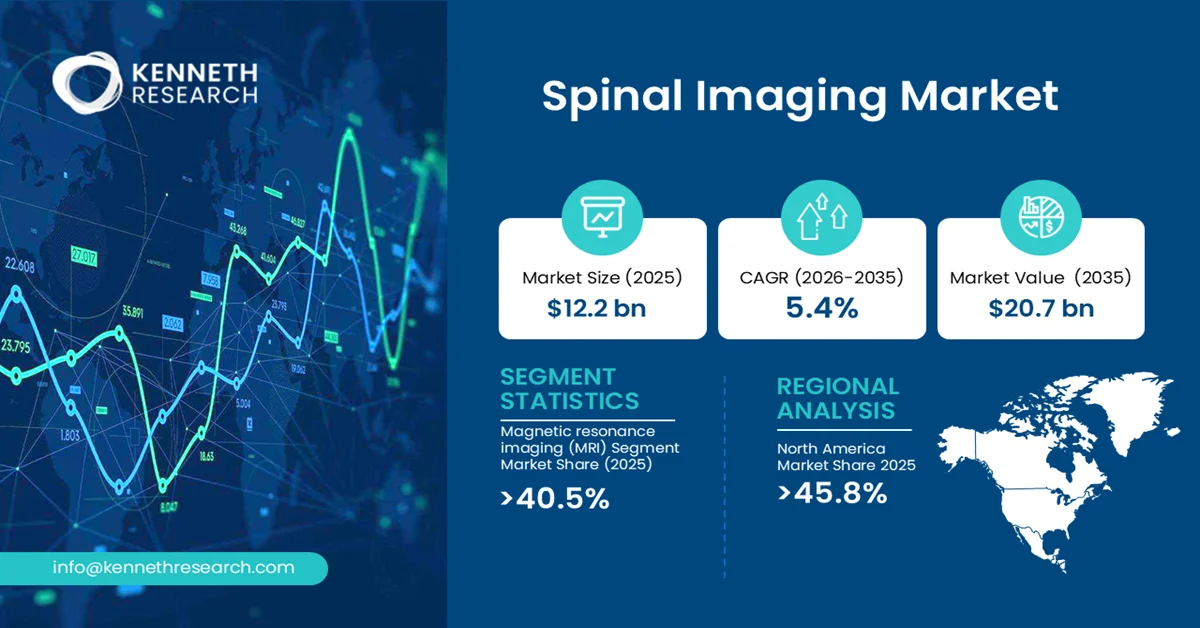
Spinal Imaging Market size was valued at USD 12.2 billion in 2025 and is projected to reach USD 20.7 billion by the end of 2035, rising at a CAGR of 5.4% during the forecast period, i.e., 2026-2035. In 2026, the industry size of the spinal imaging is estimated at USD 12.8 billion.
The growing burden of spinal disorders and increasing utilization of advanced diagnostic imaging are driving the spinal imaging market. Government-backed healthcare systems continue expanding access to MRI and CT services to improve diagnostic accuracy, accelerate treatment planning, and support management of degenerative, traumatic, and age-related spinal conditions.
The spinal imaging market comprises diagnostic imaging technologies, equipment, software, and related services used to visualize the spinal column, spinal cord, intervertebral discs, vertebrae, and surrounding soft tissues for clinical evaluation. The market primarily includes magnetic resonance imaging (MRI), computed tomography (CT), X-ray, and other advanced imaging modalities that assist healthcare professionals in detecting spinal abnormalities, traumatic injuries, degenerative diseases, congenital disorders, infections, tumors, and postoperative complications.
Spinal imaging is characterized by its ability to provide detailed anatomical and functional information that supports accurate diagnosis, treatment planning, surgical guidance, and long-term patient monitoring. Modern imaging technologies also integrate digital workflows, image reconstruction, and advanced visualization capabilities to improve diagnostic efficiency and clinical decision-making across healthcare settings.
The market plays a vital role in hospitals, diagnostic imaging centers, specialty spine clinics, and academic medical institutions by enabling evidence-based management of musculoskeletal and neurological disorders. Its industrial relevance continues to strengthen as healthcare systems expand diagnostic imaging capacity and utilization, with many OECD countries reporting sustained growth in the availability and use of MRI and CT technologies to meet increasing diagnostic demand.
Key Spinal Imaging Market Insights Summary:
Key Takeaways: Market Trends & Insights
- The spinal imaging market is valued at USD 12.2 billion in 2025 and is projected to reach USD 20.7 billion by 2035, growing at a 5.4% CAGR during 2026-2035.
- Magnetic resonance imaging (MRI) leads the imaging type segment with a 40.5% market share in 2025, supported by high diagnostic accuracy and advanced imaging capabilities.
- North America accounts for 45.8% of the market in 2025, driven by strong healthcare infrastructure and continued investment in imaging technologies.
- The hospital end-user segment is expected to record the fastest growth due to increasing demand for integrated diagnostic and spine care services.
- Major companies include Siemens Healthineers, GE HealthCare, Fujifilm Holdings Corporation, Canon Medical Systems Corporation, Shimadzu Corporation, and Bruker Corporation.
Market Drivers
- Expansion of AI-enabled imaging and advanced diagnostic technologies
- Rising demand for early diagnosis and integrated spine care
- Increasing adoption of minimally invasive spine surgeries requiring advanced imaging guidance
- Continuous investments in digital radiology infrastructure and healthcare modernization initiatives
Challenges
- High capital investment and lifecycle ownership costs
- Workforce shortages and imaging workflow constraints
Spinal Imaging Market Overview & Supply Chain
The adoption of spinal imaging is increasing globally as healthcare systems prioritize earlier diagnosis of musculoskeletal and neurological disorders, improve access to advanced diagnostic services, and expand evidence-based care pathways. Technological advances in magnetic resonance imaging (MRI), computed tomography (CT), digital radiography, artificial intelligence-assisted image analysis, and integrated imaging workflows are enhancing diagnostic precision while supporting clinical decision-making for degenerative, traumatic, infectious, and oncological spinal conditions. Government-backed initiatives to strengthen rehabilitation and chronic disease management are also increasing demand for accurate spinal visualization across acute and long-term care settings. This trend is reinforced by the growing clinical burden of spinal disorders. According to the World Health Organization (WHO), 619 million people worldwide were living with low back pain in 2020, with cases projected to reach 843 million by 2050, underscoring the increasing need for timely spinal assessment and diagnostic imaging services.
The spinal imaging industry value chain begins with the procurement of specialized raw materials and components, including superconducting magnets, gradient coils, X-ray tubes, digital detectors, semiconductors, imaging sensors, radiofrequency systems, precision electronics, and medical-grade software. Original equipment manufacturers integrate these components into MRI, CT, X-ray, and other spinal imaging systems while ensuring compliance with medical device quality and regulatory standards. Software developers further enhance these platforms through image processing, visualization, workflow management, and artificial intelligence-enabled diagnostic applications. Distribution occurs through direct sales channels, regional distributors, healthcare equipment suppliers, and long-term service partnerships that include installation, maintenance, calibration, and training. End users primarily comprise hospitals, diagnostic imaging centers, specialty spine clinics, ambulatory surgical centers, and academic research institutions. Major stakeholders include component suppliers, imaging equipment manufacturers, software providers, healthcare providers, regulatory authorities, reimbursement agencies, service organizations, and research institutions collaborating to improve diagnostic accuracy, operational efficiency, and patient outcomes.
Spinal Imaging Market: Growth Drivers & Challenges
Growth Drivers:
- Expansion of AI-enabled imaging and advanced diagnostic technologies: The integration of artificial intelligence, advanced image reconstruction, and high-performance visualization technologies is accelerating growth in the spinal imaging market by improving diagnostic confidence and workflow efficiency. AI-assisted image interpretation enables radiologists to identify spinal abnormalities more consistently while reducing reporting time and supporting clinical decision-making. These capabilities are particularly valuable for detecting degenerative disorders, traumatic injuries, and postoperative complications, allowing healthcare providers to optimize patient management. Regulatory support for innovative imaging technologies is further strengthening market adoption by encouraging commercialization of advanced diagnostic solutions. According to the U.S. food and drug administration (FDA), its publicly available AI-enabled medical device list includes a rapidly expanding portfolio of FDA-authorized radiology devices, reflecting continued regulatory acceptance of AI in medical imaging. This trend is expected to drive continued investment in intelligent spinal imaging platforms, software integration, and precision diagnostics.
- Rising demand for early diagnosis and integrated spine care: Growing emphasis on early diagnosis and multidisciplinary spine care is increasing demand for advanced spinal imaging across hospitals, specialty clinics, and diagnostic centers. Healthcare providers are increasingly incorporating imaging into standardized clinical pathways to improve treatment planning, monitor disease progression, and evaluate surgical outcomes. The expanding prevalence of minimally invasive spine procedures also requires high-resolution preoperative and postoperative imaging, encouraging healthcare facilities to upgrade diagnostic capabilities. Furthermore, the integration of spinal imaging with electronic health records, surgical navigation platforms, and tele-radiology services is enhancing collaboration among radiologists, neurologists, orthopedic surgeons, and rehabilitation specialists. As healthcare systems continue prioritizing value-based care and precision medicine, spinal imaging will become an even more essential component of personalized treatment strategies, supporting sustained innovation across imaging hardware, software, and clinical service ecosystems.
Challenges:
- High capital investment and lifecycle ownership costs: The adoption of advanced spinal imaging systems is constrained by the substantial capital investment required for equipment acquisition, installation, facility modifications, and ongoing maintenance. High-field MRI and advanced CT systems require specialized infrastructure, including shielding, cooling systems, uninterrupted power supply, and dedicated installation environments, significantly increasing total ownership costs. Beyond procurement, healthcare providers must allocate resources for software upgrades, equipment calibration, service contracts, cybersecurity compliance, and workforce training. These financial commitments create barriers for smaller hospitals, independent imaging centers, and healthcare facilities operating under constrained budgets. Commercially, vendors often face extended procurement cycles and increased competition for institutional purchasing decisions, particularly in price-sensitive markets. Over the long term, manufacturers are expected to focus on flexible financing models, equipment leasing, managed imaging services, and modular system configurations to improve affordability while expanding access to advanced spinal imaging technologies.
- Workforce shortages and imaging workflow constraints: The spinal imaging market continues to face operational challenges due to shortages of skilled radiologists, MRI technologists, and imaging specialists capable of managing increasingly sophisticated diagnostic systems. Growing imaging volumes place additional pressure on existing clinical teams, resulting in scheduling delays, reporting backlogs, and reduced operational efficiency. Healthcare providers also encounter difficulties integrating new imaging platforms with legacy information systems while maintaining regulatory compliance and data security standards. These workflow constraints can limit the clinical benefits of advanced imaging technologies despite ongoing technological innovation. From a commercial perspective, healthcare organizations may postpone technology upgrades until sufficient workforce capacity and digital infrastructure are available, slowing equipment replacement cycles. Looking ahead, greater adoption of artificial intelligence-assisted workflows, remote image interpretation, standardized reporting systems, and workforce development initiatives is expected to improve operational efficiency and support broader utilization of spinal imaging solutions.
Spinal Imaging Market Size and Forecast:
| Report Attribute | Details |
|---|---|
| Base Year |
2025 |
| Forecast Year |
2026-2035 |
| CAGR |
5.4% |
| Base Year Market Size (2025) |
USD 12.2 billion |
| Forecast Year Market Size (2035) |
USD 20.7 billion |
| Regional Scope |
|
Spinal Imaging Market Segmentation Analysis:
Imaging Type Segment Analysis
In the imaging type segment, the Magnetic Resonance Imaging (MRI) sub-segment is anticipated to capture the largest market share of 40.5% by the end of 2025.
Magnetic Resonance Imaging (MRI) remains the leading imaging type in the spinal imaging market because it provides superior visualization of soft tissues, spinal cord structures, intervertebral discs, nerve roots, ligaments, and surrounding anatomy without exposing patients to ionizing radiation. The modality has become the preferred diagnostic approach for evaluating degenerative spinal diseases, disc herniation, spinal tumors, infections, congenital abnormalities, and postoperative complications, driving sustained demand across hospitals and diagnostic imaging centers. Continuous advancements in high-field MRI systems, accelerated image acquisition, artificial intelligence-assisted reconstruction, and improved image quality have further strengthened clinical adoption. On the supply side, manufacturers continue investing in enhanced scanner performance, workflow automation, and software innovations to improve diagnostic efficiency while reducing examination times. Industry demand is also supported by expanding imaging utilization across developed healthcare systems. According to the OECD health statistics 2023, the combined use of CT, MRI, and PET diagnostic examinations exceeded 360 exams per 1,000 population in 2021 in countries including the United States, Luxembourg, Korea, France, and Austria, reflecting the increasing role of advanced diagnostic imaging in clinical practice. Looking ahead, continued technological innovation and broader integration of AI-enabled imaging platforms are expected to reinforce MRI's dominant position in spinal diagnostics.
End User Segment Analysis
The Hospitals is projected to grow as the second-largest segment in the spinal imaging market due to four converging demand drivers.
Hospitals are projected to register strong growth as an end-user segment in the spinal imaging market because they provide comprehensive diagnostic, surgical, emergency, and rehabilitation services within integrated care environments. Increasing patient preference for multidisciplinary treatment pathways has encouraged hospitals to expand advanced imaging capabilities that support rapid diagnosis and coordinated management of spinal trauma, degenerative disorders, tumors, and neurological conditions. Adoption is also being driven by greater investment in digital imaging infrastructure, enterprise imaging platforms, and integrated radiology information systems that improve workflow efficiency and clinical collaboration. On the supply side, imaging equipment manufacturers continue to strengthen partnerships with hospitals through long-term service agreements, technology upgrades, workforce training, and lifecycle support programs, enabling healthcare institutions to modernize diagnostic capabilities.
Our in-depth analysis of the spinal imaging market includes the following segments:
|
Segment |
Sub-segment |
|
Imaging Type |
|
|
Application |
|
|
Indication |
|
|
End Users |
|
Spinal Imaging Market Regional Insights:
North America Market Trends & Insights:
North America spinal imaging market is projected to hold the largest revenue share of 45.8% by the end of 2025.
The region also benefits from the presence of leading medical imaging manufacturers, extensive research collaborations, and widespread implementation of digital radiology platforms across healthcare networks. Continuous investment in hospital modernization, precision medicine, and integrated diagnostic workflows has further strengthened the adoption of MRI, CT, and other spinal imaging modalities. In addition, favorable reimbursement frameworks and consistent capital expenditure on healthcare technology enable providers to maintain and upgrade imaging infrastructure, reinforcing North America's leadership in the global spinal imaging industry.
The United States remains the primary contributor to regional growth due to its advanced hospital network, high utilization of diagnostic imaging, and continuous investment in healthcare technology innovation.
Canada complements regional leadership through expanding access to diagnostic imaging services, provincial investments in healthcare infrastructure, and initiatives aimed at reducing imaging wait times.
Europe Market Trends & Insights:
Europe represents a strategically important region in the spinal imaging market, supported by mature healthcare systems, widespread adoption of advanced diagnostic technologies, and strong emphasis on early disease detection. Demand for spinal imaging continues to increase as healthcare providers prioritize accurate diagnosis of degenerative spinal disorders, traumatic injuries, and neurological conditions through advanced MRI, CT, and digital radiography systems. The region also benefits from a well-established medical technology manufacturing base, extensive clinical research, and close collaboration between healthcare providers, academic institutions, and imaging equipment manufacturers. Government initiatives focused on healthcare digitalization, modernization of diagnostic infrastructure, and cross-border health innovation continue to strengthen imaging capabilities across public healthcare systems. Looking ahead, opportunities are expected to emerge from artificial intelligence-enabled imaging, integrated radiology workflows, value-based healthcare models, and investments in precision diagnostics that enhance clinical efficiency and patient outcomes.
Germany serves as a major contributor to the regional market due to its advanced hospital infrastructure, strong medical device manufacturing ecosystem, and continuous investment in high-end diagnostic imaging technologies. The country also benefits from active research collaborations that support innovation in radiology and digital healthcare solutions.
France is strengthening its position through ongoing modernization of public healthcare facilities, expanded deployment of advanced imaging equipment, and initiatives to improve patient access to diagnostic services. Increasing adoption of digital health technologies and integrated imaging networks across both countries is expected to support sustained demand for spinal imaging solutions and encourage continued investment in next-generation diagnostic platforms.
Leading Companies Operating in the Global Spinal Imaging Market:
Here is a list of upstream, downstream, and key players operating in the global spinal imaging market competitive ecosystem:
- Siemens Healthineers (Germany)
- Company Overview
- Business Strategy
- Key Product Offerings
- Financial Performance
- Key Performance Indicators
- Risk Analysis
- Recent Development
- Regional Presence
- SWOT Analysis
- GE HealthCare (United States)
- Fujifilm Holdings Corporation (Japan)
- Canon Medical Systems Corporation (Japan)
- Shimadzu Corporation (Japan)
- Bruker Corporation (United States)
Recent Developments
- In November 2025, Driving force acquired the Vertebral Motion Analysis (VMA®) technology from Wenzel Spine . The FDA-cleared system uses dynamic fluoroscopy and proprietary software to deliver quantifiable evidence of spinal ligament injuries often missed by standard MRI and X-ray. Driving Force plans to build a national network of imaging centers offering exclusive regional rights to medical groups adopting the technology.
- In July 2026, VB Spine signed a definitive agreement with Augmedics to acquire exclusive rights to the CT-Fluoro technology for spine applications . The technology enables surgeons to register a patient's preoperative CT scan using standard fluoroscopic imaging, potentially reducing reliance on intraoperative CT or 3D imaging systems during spinal procedures.
Frequently Asked Question
In 2025, the spinal imaging market exceeded USD 12.2 billion.
The spinal imaging market is projected to reach USD 20.7 billion by the end of 2035, expanding at a CAGR of 5.4% over the forecast period (2026-2035).
The major players in the market are Siemens Healthineers (Germany), GE HealthCare (United States), Fujifilm Holdings Corporation (Japan), Canon Medical Systems Corporation (Japan), Shimadzu Corporation (Japan), Bruker Corporation (United States), and others
In the imaging type segment, the magnetic resonance imaging (MRI) sub-segment is anticipated to capture the largest market share of 40.5% in the future and exhibit lucrative growth opportunities during 2026-2035. This growth trajectory is largely attributed to increasing adoption of advanced MRI technologies for accurate diagnosis of spinal disorders and continuous integration of AI-enabled imaging capabilities.
North America is projected to hold the largest market share of 45.8% by the end of 2025 and provide more business opportunities in the future. Continuous investments in advanced diagnostic imaging infrastructure, healthcare technology innovation, and hospital modernization across the United States and Canada are fostering the region's dominance.
Why Choose Kenneth Research ?
-
Insight with Impact : We don’t just gather data — we uncover stories, trends, and opportunities that fuel business growth.
-
Experts Who Get It : Our team speaks your industry’s language and knows what really matters to your customers and market.
-
Custom-Built for You : Forget one-size-fits-all. We craft research and consulting solutions as unique as your business vision.
-
Partners, Not Just Providers : We work with you, not for you — collaborating closely to turn insights into smart, strategic moves.
-
Results That Speak : Our work powers brands, startups, and industry leaders alike — with a track record of ideas that work in the real world.
Report ID: 1059 |
Published Date: 07 Aug 2026 |
Report Format: |
Delivery Timeline: 48-72 Business Hours

Copyright © 2025 Kenneth Research. All rights reserved. Terms of Use | Privacy Policy
