Report ID: 1409 |
Published Date: 25 Sep 2026 |
Report Format: |
Delivery Timeline: 48-72 Business Hours
Solar Water Heater Market Outlook:
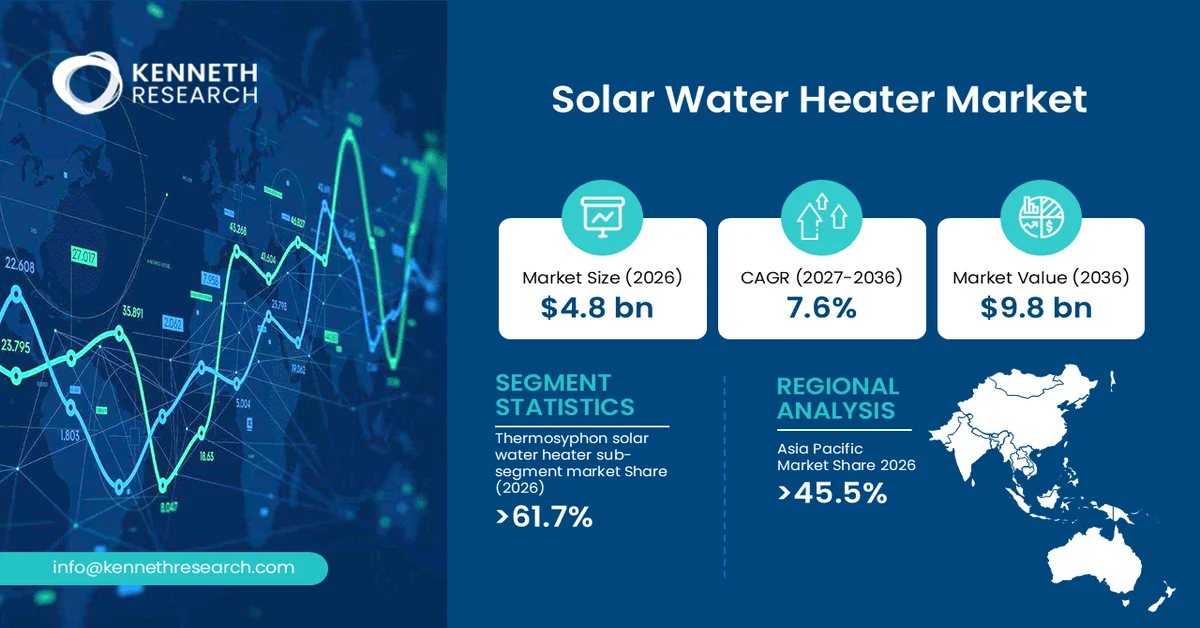
Solar Water Heater Market size was valued at USD 4.8 billion in 2026 and is projected to reach USD 9.8 billion by the end of 2036, rising at a CAGR of 7.6% during the forecast period, i.e., 2027-2036. In 2027, the industry size of the solar water heater is estimated at USD 5.1 billion.
The primary growth driver for the solar water heater market is the increasing emphasis on renewable energy adoption and energy-efficient water heating solutions, as governments, businesses, and households seek to reduce dependence on conventional fuels, lower energy consumption, and support decarbonization goals.
The solar water heater market refers to the industry involved in the development, manufacturing, distribution, and deployment of systems that use solar energy to heat water for residential, commercial, institutional, and industrial applications. These systems generally consist of solar collectors, storage tanks, circulation mechanisms, controls, and associated components that capture solar radiation and transfer the resulting thermal energy to water.
Solar water heaters include different system configurations, with thermosyphon systems using natural circulation between the collector and storage tank, while pumped systems employ active circulation. The market encompasses technologies such as flat-plate and evacuated-tube collectors and serves applications including domestic hot water, commercial facilities, hospitality, and process-water heating.
Key Solar Water Heater Market Insights Summary:
Key Takeaways: Market Trends & Insights
- The solar water heater market is projected to expand from USD 4.8 billion in 2026 to USD 9.8 billion by 2036, registering a 7.6% CAGR during 2027-2036.
- Thermosyphon solar water heater is the leading system type segment, accounting for 61.7% in 2026, supported by its simple configuration, passive circulation, and relatively low operating complexity.
- Evacuated tube collector is a significant technology segment, supported by its thermal insulation characteristics and suitability for varying environmental conditions.
- Asia-Pacific dominates the regional landscape with a 45.5% share in 2026, with Japan and China serving as important markets for solar thermal adoption.
Market Drivers
- Increasing adoption of renewable energy for water heating
- Rising focus on energy-efficient building technologies
- Government support for clean-energy and solar thermal deployment
- Growing demand for lower-cost and lower-emission hot-water solutions
Challenges
- High initial installation cost
- Dependence on solar availability and installation conditions
Solar Water Heater Market Overview & Supply Chain
The solar water heater market is supported by the transition toward renewable heat technologies, increasing emphasis on energy efficiency, and the need to reduce conventional energy consumption for water heating. Solar water heating systems capture solar radiation through collectors and transfer thermal energy to water, either through natural circulation or active circulation mechanisms.
The market ecosystem includes manufacturers of solar collectors, storage tanks, circulation systems, controllers, heat-transfer components, and complete solar water heating systems. Product performance depends on collector efficiency, thermal insulation, storage capacity, installation configuration, climate conditions, and system controls.
The supply chain begins with raw-material and component suppliers, which provide materials such as metals, glass, insulation materials, polymers, heat-transfer components, valves, pumps, sensors, and control equipment. These inputs are supplied to solar water heater manufacturers, which produce collectors, storage tanks, circulation assemblies, and integrated systems. The next stage involves system integration and quality testing, where manufacturers assemble components, verify thermal performance, and configure systems according to application requirements.
Solar Water Heater Market: Growth Drivers & Challenges
Growth Drivers:
- Increasing adoption of renewable energy for water heating: The growing shift toward renewable energy is supporting demand for solar water heating systems as governments, building owners, and consumers seek alternatives to conventional water-heating technologies. Solar water heaters can reduce reliance on electricity and fossil fuels for hot-water generation while supporting broader energy-efficiency and decarbonization objectives. The ability to integrate solar thermal systems into residential, commercial, and institutional buildings is further strengthening their relevance within renewable heating strategies.
- Rising focus on energy-efficient building technologies: Increasing emphasis on energy-efficient buildings is creating opportunities for solar water heaters as building owners seek to reduce operational energy requirements. Solar thermal systems can be incorporated into building energy strategies alongside efficient plumbing, insulation, heating, and control technologies. This integration is particularly relevant for facilities with substantial and consistent hot-water demand, including hotels, hospitals, educational institutions, and commercial buildings.
Challenges:
- High initial installation cost: The relatively high upfront cost of solar water heater systems, including collectors, storage tanks, mounting structures, plumbing, controls, and installation, can limit adoption among price-sensitive customers. Although these systems can provide long-term energy savings, the initial investment may create a barrier for residential consumers and smaller commercial facilities, particularly in markets where conventional water-heating technologies remain readily available.
- Dependence on solar availability and installation conditions: Solar water heater performance is influenced by solar radiation, seasonal weather conditions, collector orientation, available installation space, and shading. Regions experiencing extended periods of low solar availability may require auxiliary heating systems to maintain consistent hot-water supply. This can increase system complexity and affect the economic attractiveness of solar water heating, particularly for applications requiring reliable hot-water availability throughout the year.
Solar Water Heater Market Size and Forecast:
| Report Attribute | Details |
|---|---|
| Base Year |
2026 |
| Forecast Period |
2027-2036 |
| CAGR |
7.6% |
| Base Year Market Size (2026) |
USD 4.8 billion |
| Forecast Year Market Size (2036) |
USD 9.8 billion |
| Regional Scope |
|
Solar Water Heater Market Segmentation Analysis:
System Type Segment Analysis
In the system type segment, the thermosyphon solar water heater sub-segment is anticipated to capture the largest market share of 61.7% in 2026.
Thermosyphon systems are widely adopted because they enable natural circulation of heated water between the solar collector and storage tank without requiring a circulation pump, resulting in a comparatively simple system configuration, lower operating complexity, and easier maintenance. Their suitability for residential and small-scale hot-water applications supports continued demand across markets with favorable solar conditions.
The segment is also benefiting from the ability of thermosyphon systems to provide a relatively straightforward approach to solar water heating. Their passive circulation mechanism reduces dependence on electrically driven circulation equipment, while integrated storage arrangements can simplify installation and system operation.
Technology Segment Analysis
In the Technology segment, the evacuated tube collector sub-segment is positioned as a significant technology within the solar water heater market. Evacuated tube collectors use insulated glass tubes with a vacuum layer that reduces heat loss and enables effective solar-energy absorption. This configuration makes ETC-based systems suitable for applications requiring reliable thermal performance across varying environmental conditions. The technology is particularly relevant in markets where solar thermal water heating has achieved broad adoption. The technology is expected to remain important as manufacturers continue improving tube design, selective coatings, heat-transfer mechanisms, insulation, and system integration.
Our in-depth analysis of the global solar water heater market includes the following segments:
|
Segment |
Sub-segment |
|
Technology |
|
|
System Type |
|
|
Capacity |
|
|
End User |
|
Solar Water Heater Market Regional Insights:
Asia-Pacific Market Trends & Insights:
In the regional segment, Asia-Pacific is anticipated to capture the largest market share of 45.5% in 2026, supported by the established adoption of solar thermal technologies and continued government attention toward renewable heating solutions across major markets such as Japan and China.
China remains an important market for solar thermal deployment. It continues to support the Asia-Pacific market through its established solar thermal manufacturing base and broad deployment of solar water-heating systems, while ongoing efforts to improve building energy efficiency are supporting demand for renewable hot-water technologies.
Japan also contributes to the regional market through established solar thermal technology capabilities, technical standards, and ongoing emphasis on energy-efficient heating solutions. The broader Asia-Pacific market is therefore supported by technology development, established manufacturing capabilities, renewable-energy policies, and demand for efficient hot-water generation.
North America Market Trends & Insights:
North America represents an important regional market for solar water heating, supported by increasing emphasis on energy-efficient water-heating technologies and the integration of renewable energy into building infrastructure. The U.S. and Canada are key markets within the region, with opportunities arising across residential, commercial, institutional, and government facilities.
In the U.S., the Department of Energy's Federal Energy Management Program provides a dedicated solar hot-water system calculator for federal facilities, reflecting the applicability of solar water heating in government buildings and major renovation projects.
Canada also presents opportunities for solar water-heating technologies as buildings and energy systems increasingly incorporate renewable and energy-efficient solutions. Across North America, demand is expected to benefit from technological improvements, energy-efficiency objectives, and the growing integration of solar thermal systems with conventional water-heating equipment.
Leading Companies Operating in the Global Solar Water Heater Market:
Here is a list of upstream, downstream, and key players operating in the global solar water heater market competitive ecosystem:
- Sunrain (China)
- Company Overview
- Business Strategy
- Key Product Offerings
- Financial Performance
- Key Performance Indicators
- Risk Analysis
- Recent Development
- Regional Presence
- SWOT Analysis
- Solahart (Australia)
- Rheem (U.S)
- Himin Solar Energy Group (China)
- Micoe (China)
- V-Guard Industries Ltd (India)
Recent Developments
- In March 2025, Sunrain hosted the 2025 Carbon Neutrality Summit and Clean Thermal Energy Industry Development Conference. The company announced its upgraded 2025 product portfolio and unveiled its Gaia Smart Energy Management System and new energy technologies.
Frequently Asked Question
In 2026, the solar water heater market exceeded USD 4.8 billion.
The solar water heater market is projected to reach USD 9.8 billion by the end of 2036, expanding at a CAGR of 7.6% over the forecast period (2027-2036).
The major players in the market are Sunrain, Solahart, Rheem, Himin Solar, Apricus, and others.
In the system type segment, the thermosyphon solar water heater sub-segment is anticipated to capture the largest market share of 61.7% in the future and exhibit lucrative growth opportunities during 2027-2036.
Asia-Pacific is projected to hold the largest market share of 45.5% by the end of 2026 and provide more business opportunities in the future.
Why Choose Kenneth Research ?
-
Insight with Impact : We don’t just gather data — we uncover stories, trends, and opportunities that fuel business growth.
-
Experts Who Get It : Our team speaks your industry’s language and knows what really matters to your customers and market.
-
Custom-Built for You : Forget one-size-fits-all. We craft research and consulting solutions as unique as your business vision.
-
Partners, Not Just Providers : We work with you, not for you — collaborating closely to turn insights into smart, strategic moves.
-
Results That Speak : Our work powers brands, startups, and industry leaders alike — with a track record of ideas that work in the real world.
Report ID: 1409 |
Published Date: 25 Sep 2026 |
Report Format: |
Delivery Timeline: 48-72 Business Hours

Copyright © 2025 Kenneth Research. All rights reserved. Terms of Use | Privacy Policy
