Report ID: 1432 |
Published Date: 25 Sep 2026 |
Report Format: |
Delivery Timeline: 48-72 Business Hours
Solar Simulator Market Outlook:
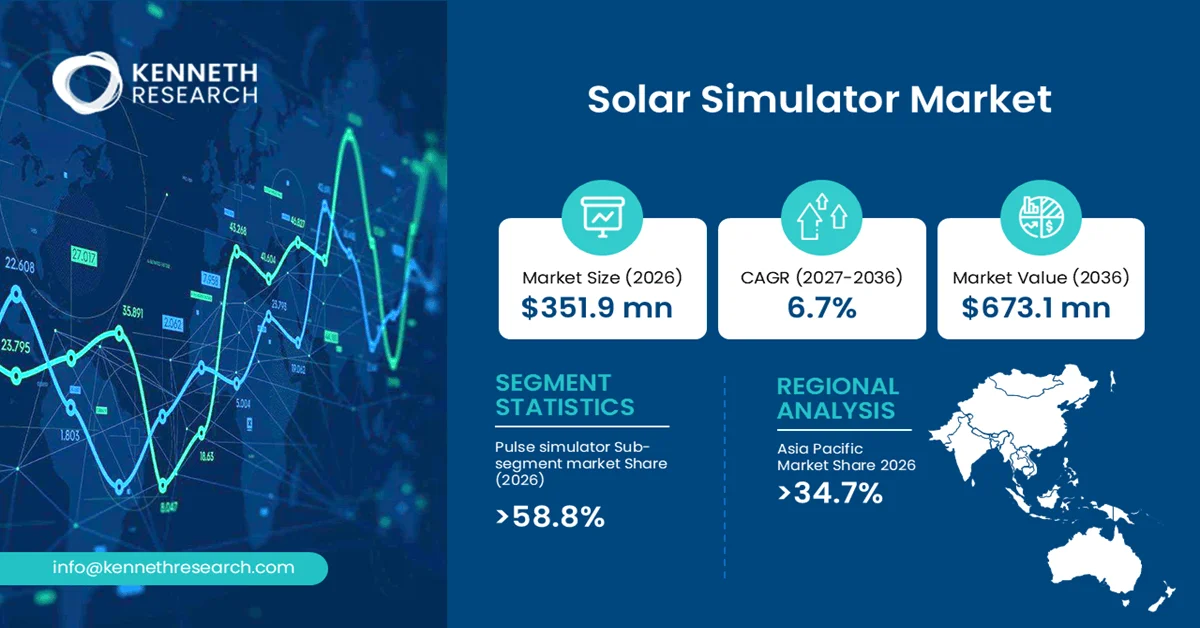
Solar Simulator Market size was valued at USD 351.9 million in 2026 and is projected to reach USD 673.1 million by the end of 2036, rising at a CAGR of 6.7% during the forecast period, i.e., 2027-2036. In 2027, the industry size of the solar simulator is estimated at USD 375.5 million.
The primary growth driver for the solar simulator market is the expanding deployment and technological advancement of photovoltaic systems, which increases demand for accurate laboratory testing, characterization, and performance validation.
The solar simulator market refers to the industry involved in designing, manufacturing, and supplying specialized equipment that reproduces the spectral distribution, intensity, and spatial characteristics of natural sunlight for controlled testing and research applications. Solar simulators are used to evaluate photovoltaic cells and modules, characterize solar materials, validate device performance, and support research and development under repeatable laboratory conditions.
Key characteristics include controlled illumination intensity, spectral matching, spatial uniformity, temporal stability, and configurable testing environments. Major technologies include continuous-light and pulsed-light systems, with equipment available in different configurations to accommodate research laboratories, production lines, certification facilities, and specialized testing environments.
Key Solar Simulator Market Insights Summary:
Key Takeaways: Market Trends & Insights
- The solar simulator market is projected to grow from USD 375.5 million in 2027 to USD 673.1 million by 2036, supported by expanding photovoltaic testing and research requirements.
- Pulse simulators dominated the type segment with a 58.8% share in 2026, driven by demand for rapid and controlled photovoltaic performance testing.
- Solar cell testing is emerging as a key application as manufacturers and research institutions increasingly evaluate advanced and high-efficiency photovoltaic technologies.
- Asia-Pacific led the market with a 34.7% share in 2026, supported by strong photovoltaic manufacturing and solar-energy activity in China and Japan.
Market Drivers
- Expansion of photovoltaic manufacturing and testing infrastructure
- Technological advancement in solar simulation systems
- Increasing development of high-efficiency and next-generation PV technologies
- Growing demand for standardized and repeatable photovoltaic performance testing
Challenges
- High capital and maintenance costs
- Measurement complexity and calibration requirements
Solar Simulator Market Overview & Supply Chain
Global adoption of solar simulators is increasing as photovoltaic manufacturers, research institutions, and certification laboratories require controlled and repeatable sunlight conditions for evaluating cell and module performance. The technology is particularly important as PV developers advance higher-efficiency architectures and emerging solar technologies that require precise characterization.
The solar simulator value chain begins with specialized inputs including optical components, lamps or solid-state light sources, reflectors, filters, power electronics, sensors, mechanical structures, and control systems. Manufacturers integrate these components into complete illumination and testing platforms, calibrating systems for spectral match, spatial uniformity, temporal stability, and controlled irradiance. Equipment is distributed through direct manufacturer sales, specialized laboratory-equipment channels, technical representatives, and system integrators.
Solar Simulator Market: Growth Drivers & Challenges
Growth Drivers:
- Expansion of photovoltaic manufacturing and testing infrastructure: The rapid expansion of photovoltaic manufacturing and research is increasing the need for controlled testing systems that can accurately characterize solar cells and modules. Solar simulators enable manufacturers to reproduce standardized illumination conditions and measure electrical performance without relying on variable outdoor sunlight. This is particularly important as PV manufacturers develop higher-efficiency cell architectures and new materials that require precise laboratory validation.
- Technological advancement in solar simulation systems: Technological development is strengthening demand for more precise, flexible, and energy-efficient solar simulation equipment. Manufacturers are improving optical configurations, light sources, programmable controls, measurement interfaces, and automated testing capabilities to meet increasingly demanding PV characterization requirements. Modern systems must reproduce reference solar spectra while maintaining stable irradiance across the testing plane, making accuracy a key purchasing criterion.
Challenges:
- High capital and maintenance costs: Advanced solar simulators require substantial investment in precision light sources, optical assemblies, irradiance-control systems, measurement instruments, and calibration infrastructure. The cost burden is particularly significant for smaller research laboratories, universities, and emerging PV manufacturers that may have limited equipment budgets. In addition, periodic calibration, lamp replacement, optical maintenance, and performance verification increase total ownership costs. These requirements can delay equipment replacement and encourage some users to continue operating older systems, potentially limiting adoption of newer, higher-performance platforms.
- Measurement complexity and calibration requirements: Solar simulator performance depends on multiple parameters, including spectral match, irradiance uniformity, and temporal stability. IEC 60904-9:2020 classifies simulators according to these characteristics, while measurement uncertainty also depends on calibration procedures, operating conditions, and the characteristics of the device under test. This creates technical complexity for laboratories and manufacturers that must maintain reliable, traceable measurements. Aging light sources, optical contamination, component replacement, and changes in operating conditions can also affect performance and require periodic verification.
Solar Simulator Market Size and Forecast:
| Report Attribute | Details |
|---|---|
| Base Year |
2026 |
| Forecast Period |
2027-2036 |
| CAGR |
6.7% |
| Base Year Market Size (2026) |
USD 351.9 million |
| Forecast Year Market Size (2036) |
USD 673.1 million |
| Regional Scope |
|
Solar Simulator Market Segmentation Analysis:
Type Segment Analysis
In the type segment, the pulse simulator sub-segment is anticipated to capture the largest market share of 58.8% by the end of 2026.
Pulse simulators dominate the type segment because they provide short-duration, high-intensity illumination that enables rapid photovoltaic performance measurements while limiting heat accumulation in the device under test. This makes them particularly suitable for high-throughput cell and module characterization, advanced PV research, and applications where temperature changes could distort measurement accuracy. Demand is being reinforced by the development of high-efficiency, tandem, multijunction, and other emerging photovoltaic technologies that require increasingly sophisticated testing conditions.
Application Type Segment Analysis
Solar cell testing is projected to grow as photovoltaic manufacturers and research institutions increasingly require precise, repeatable measurements to validate cell efficiency, electrical characteristics, and material performance. The application benefits from expanding development of high-efficiency, multijunction, perovskite, and other advanced photovoltaic technologies, each requiring controlled illumination and reliable characterization before commercialization. Government-backed research infrastructure demonstrates the importance of this application.
Our in-depth analysis of the global solar simulator market includes the following segments:
|
Segment |
Sub-segment |
|
By Type |
|
|
By Light Source |
|
|
Application |
|
Solar Simulator Market Regional Insights:
Asia-Pacific Market Trends & Insights:
Asia-Pacific accounted for 34.7% of the solar simulator market in 2026, making it the dominant regional market. Leadership is supported by the region’s extensive photovoltaic manufacturing base, accelerating solar deployment, expanding R&D infrastructure, and government-backed renewable-energy programs.
Japan represents a technologically advanced testing and research market, supported by continued renewable-energy deployment, sophisticated PV manufacturing capabilities, and government programs promoting solar innovation.
China remains the region’s largest demand center because of its enormous PV manufacturing ecosystem and rapid capacity additions. The combination of large-scale module production, technology development, and expanding utility-scale and distributed installations supports sustained investment in high-precision solar simulation and testing infrastructure.
North America Market Trends & Insights:
North America represents a significant market for solar simulators, supported by strong photovoltaic research activity, established testing infrastructure, and continued investment in solar power generation. Demand is concentrated across PV manufacturers, national laboratories, universities, certification organizations, and specialized testing facilities.
The United States is the principal demand center in North America, supported by extensive PV research infrastructure and a large installed solar base. National laboratories, manufacturers, universities, and certification facilities create diversified demand for laboratory-grade and production-oriented simulators.
Canada offers additional opportunities through its growing clean-energy sector, research institutions, and increasing interest in solar deployment.
Leading Companies Operating in the Global Solar Simulator Market:
Here is a list of upstream, downstream, and key players operating in the global solar simulator market competitive ecosystem:
- EnliTech Co., Ltd. (Taiwan)
- Company Overview
- Business Strategy
- Key Product Offerings
- Financial Performance
- Key Performance Indicators
- Risk Analysis
- Recent Development
- Regional Presence
- SWOT Analysis
- Newport Corporation (U.S)
- Spectrolab, Inc. (U.S)
Recent Developments
- January 2026 — EnliTech published information on January 27, 2026 describing the SS-LED220 for precision spectrum control in PVK/Si tandem-cell characterization. The announcement highlights tunable spectral control intended to separately investigate the spectral responses of tandem-cell subcells.
- January 2026 — On January 16, 2026, EnliTech published an announcement presenting the SS-LED220 as an LED solar simulator with A++ spectral-match performance, targeting high-precision solar-cell research.
Frequently Asked Question
In 2026, the solar simulator market exceeded USD 351.9 million.
The solar simulator market is projected to reach USD 673.1 million by the end of 2036, expanding at a CAGR of 6.7% over the forecast period (2027-2036).
The major players in the market are Newport Corporation, Spectrolab, Inc., Pasan SA, Sciencetech Inc., G2V Optics Inc., and EnliTech Co., Ltd.
In the type segment, the pulse simulator sub-segment is anticipated to capture the largest market share of 58.8% in the future and exhibit lucrative growth opportunities during 2027-2036.
Asia-Pacific is projected to hold the largest market share of 34.7% by the end of 2026 and provide more business opportunities in the future.
Why Choose Kenneth Research ?
-
Insight with Impact : We don’t just gather data — we uncover stories, trends, and opportunities that fuel business growth.
-
Experts Who Get It : Our team speaks your industry’s language and knows what really matters to your customers and market.
-
Custom-Built for You : Forget one-size-fits-all. We craft research and consulting solutions as unique as your business vision.
-
Partners, Not Just Providers : We work with you, not for you — collaborating closely to turn insights into smart, strategic moves.
-
Results That Speak : Our work powers brands, startups, and industry leaders alike — with a track record of ideas that work in the real world.
Report ID: 1432 |
Published Date: 25 Sep 2026 |
Report Format: |
Delivery Timeline: 48-72 Business Hours

Copyright © 2025 Kenneth Research. All rights reserved. Terms of Use | Privacy Policy
