Report ID: 1318 |
Published Date: 10 Sep 2026 |
Report Format: |
Delivery Timeline: 48-72 Business Hours
Solar Power Sunroom Systems Market Outlook:
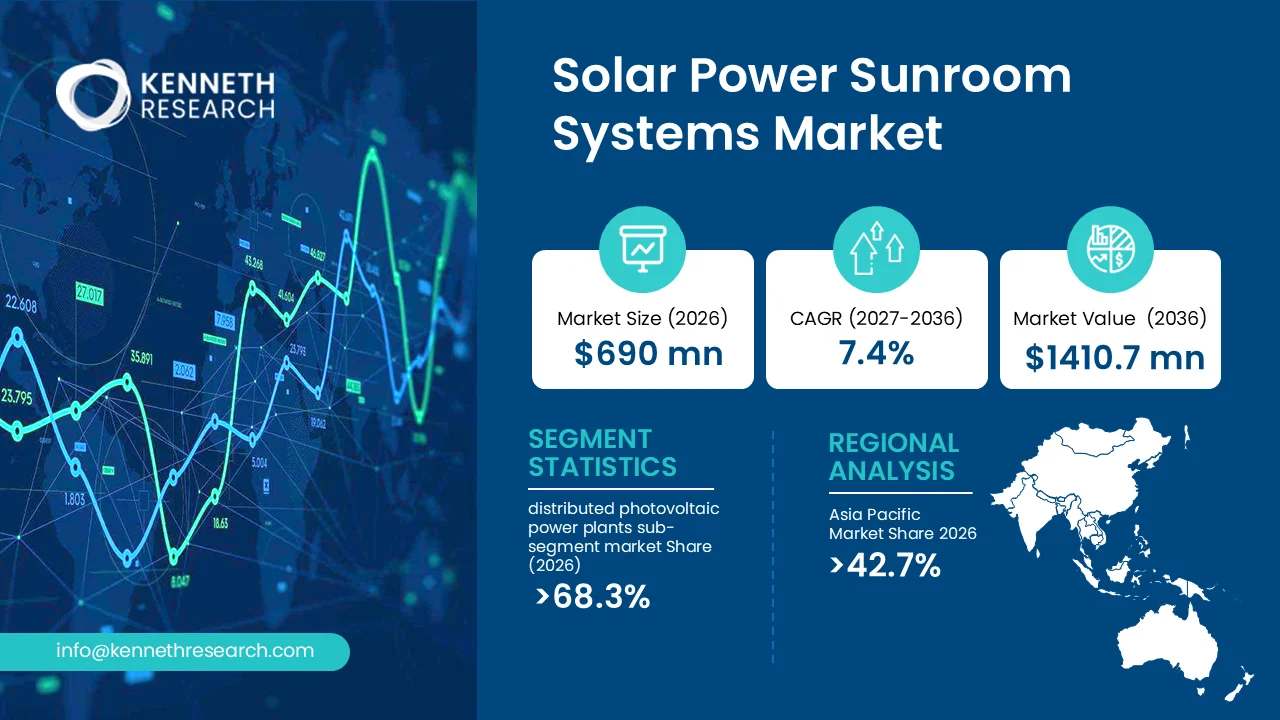
Solar Power Sunroom Systems Market size was valued at USD 690.9 million in 2026 and is projected to reach USD 1,410.7 million by the end of 2036, rising at a CAGR of 7.4% during the forecast period, i.e., 2027–2036. In 2027, the industry size of the solar power sunroom systems is estimated at USD 742 million.
The primary growth driver of the solar power sunroom systems market is the increasing integration of photovoltaic technology into building structures to generate electricity while providing functional architectural space.
The solar power sunroom systems market comprises sunroom and enclosed building-space systems that incorporate photovoltaic technology to generate electricity while providing usable indoor or semi-outdoor space. These systems can integrate solar modules into roofs, glazing, skylights, façades, or other structural components, allowing the building envelope to serve both architectural and energy-generation functions.
The market includes photovoltaic-integrated sunroom structures, solar glazing, supporting frames, mounting systems, electrical components, energy-management equipment, and installation services. Applications can span residential properties, commercial buildings, recreational facilities, hospitality properties, and other structures seeking to combine additional usable space with onsite renewable electricity generation.
Key Solar Power Sunroom Systems Market Insights Summary:
Key Takeaways: Market Trends & Insights
- Solar power sunroom systems market is projected to grow from USD 690.9 Million in 2026 to USD 1,410.7 Million by 2036, expanding at a 7.4% CAGR.
- Asia-Pacific held the leading regional position with a 42.7% share in 2026, supported by expanding solar deployment and strong photovoltaic manufacturing ecosystems in Japan and China.
- Distributed photovoltaic power plants represented the dominant type segment with a 68.3% share in 2026, reflecting the increasing adoption of decentralized solar-generation systems.
- New installation is expected to remain an important growth area as photovoltaic systems can be incorporated into sunroom structures during initial building design and construction.
Market Drivers
- Expansion of building-integrated solar applications
- Growth of distributed solar generation
- Increasing demand for multifunctional building structures
- Advancements in photovoltaic integration, energy management, and building design
Challenges
- High Installation Cost and Technical Complexity
- Certification, Permitting, and Performance Requirements
Solar Power Sunroom Systems Market Overview & Supply Chain
The solar power sunroom systems market is developing alongside the broader adoption of distributed and building-integrated photovoltaic solutions. Solar-integrated building structures can combine usable architectural space with onsite electricity generation, creating opportunities for residential and commercial applications. Building-integrated photovoltaics can also expand the surfaces available for solar generation beyond conventional rooftop installations.
The supply chain begins with solar cell and module manufacturers, followed by suppliers of glass, framing systems, mounting structures, wiring, inverters, batteries, and other electrical components. System manufacturers and fabricators integrate these components into sunroom structures, while installers handle site preparation, structural integration, electrical connections, and commissioning. Distributors and construction-material suppliers connect manufacturers with building contractors and project developers before systems reach residential and commercial end users.
Solar Power Sunroom Systems Market: Growth Drivers & Challenges
Growth Drivers
- Expansion of building-integrated solar applications: The increasing integration of photovoltaic technology into building structures is supporting demand for solar-integrated architectural solutions. Building-integrated photovoltaics can replace conventional materials in roofs, skylights, awnings, façades, and windows, allowing buildings to generate electricity without relying solely on conventional rooftop installations. The U.S. Department of Energy identifies BIPV as an emerging application with potential to expand solar deployment across the built environment.
- Growth of distributed solar generation: The expansion of distributed photovoltaic generation is creating a favorable environment for solar power sunroom systems. Distributed PV allows electricity to be generated close to where it is consumed, reducing reliance on centralized generation and supporting greater onsite energy utilization. Government programs and grid-modernization initiatives are increasingly addressing the integration of distributed PV into electricity networks.
Challenges
- High installation cost and technical complexity: Solar-integrated sunroom systems can involve higher upfront costs than conventional sunroom or rooftop solar solutions because photovoltaic components must be incorporated into the building structure. The U.S. Department of Energy identifies cost, installation complexity, reliability, and supply-chain integration as important barriers for building-integrated photovoltaic applications. Customized designs can also require additional engineering, specialized installation expertise, and coordination between construction and solar contractors, increasing project complexity and timelines.
- Certification, permitting, and performance requirements: Solar-integrated building products must satisfy requirements from both the construction and photovoltaic industries, creating additional certification and permitting challenges. DOE notes that BIPV products can face multiple testing protocols, inconsistent code requirements, and difficulties associated with customized product dimensions. Performance can also vary because building-integrated systems may have suboptimal orientation, shading, and limited available surface area.
Solar Power Sunroom Systems Market Size and Forecast:
| Report Attribute | Details |
|---|---|
| Base Year |
2026 |
| Forecast Period |
2027-2036 |
| CAGR |
7.4% |
| Base Year Market Size (2026) |
USD 690 Million |
| Forecast Year Market Size (2036) |
USD 1410.7 Million |
| Regional Scope |
|
Solar Power Sunroom Systems Market: Segment Analysis
Type Segment Analysis
In the Type segment, distributed photovoltaic power plants accounted for the largest share of 68.3% in 2026.
Their leading position is supported by the growing deployment of decentralized solar generation close to electricity consumers. Distributed PV can also complement building-integrated applications by enabling onsite electricity generation without relying exclusively on centralized power infrastructure. The U.S. Department of Energy identifies building-integrated PV as a pathway for incorporating solar generation into roofs, skylights, awnings, façades, and other building elements.
Government programs are also supporting distributed solar deployment. India's Ministry of New and Renewable Energy, for example, supports decentralized ground- and stilt-mounted solar power plants through PM-KUSUM, demonstrating continued policy support for distributed generation.
Installation Type Segment Analysis
In the installation type segment, new installation is expected to remain a key growth area as new construction provides greater flexibility to integrate photovoltaic systems directly into sunroom structures. Designing solar components into the building during the initial construction stage can simplify structural coordination and electrical integration compared with retrofitting existing structures.
Government support for rooftop and distributed solar is also strengthening the installation ecosystem. India's Ministry of New and Renewable Energy provides financial assistance for residential rooftop solar and requires installation through approved processes and vendors, supporting a more organized solar-installation market. New installations can incorporate photovoltaic glazing, solar roofing, optimized orientation, wiring, inverters, and energy-management systems from the design stage.
Our in-depth analysis of the global solar power sunroom systems market includes the following segments:
|
Segment |
Sub-segment |
|
Type |
|
|
Installation Type |
|
|
Application |
|
Solar Power Sunroom Systems Market Regional Insights:
Asia-Pacific Market Trends & Insights:
Asia-Pacific accounted for 42.7% of the solar power sunroom systems market in 2026, supported by expanding solar deployment, government-backed renewable-energy programs, and growing adoption of distributed photovoltaic systems. Japan and China are key markets, with strong photovoltaic manufacturing ecosystems and continued investment in next-generation solar technologies. Japan's government is also promoting flexible and next-generation photovoltaic solutions for building surfaces.
Japan is advancing building-integrated and next-generation solar deployment through government programs and industry initiatives. METI's renewable-energy framework continues to support solar generation, including rooftop installations, while its next-generation solar strategy focuses on expanding adoption and strengthening industrial competitiveness.
China remains a major regional market because of its extensive solar manufacturing base and large-scale deployment of photovoltaic systems. Its established supply chain for solar cells, modules, and related equipment provides favorable conditions for expanding distributed and building-integrated solar applications.
North America Market Trends & Insights:
North America represents a significant opportunity for the Solar Power Sunroom Systems Market, supported by expanding distributed and utility-scale photovoltaic deployment. In the U.S., small-scale solar PV capacity reached 59,506 MW at the end of 2025, demonstrating the scale of distributed solar adoption.
U.S. remains the leading market in the region, supported by continued solar capacity additions and growing adoption of distributed generation. The U.S. Energy Information Administration expects solar to remain a major source of new electricity-generation capacity, supporting demand for solar-integrated building solutions.
Canada offers additional opportunities through its expanding PV industry and increasing adoption of rooftop and ground-mounted systems. Canada's PV market includes both centralized and distributed installations, creating a supportive environment for solar-integrated building applications.
Leading Companies Operating in the Global Solar Power Sunroom Systems Market:
Here is a list of upstream, downstream, and key players operating in the global solar power sunroom systems market competitive ecosystem:
- Canadian Solar Inc. (Canada)
- Company Overview
- Business Strategy
- Key Product Offerings
- Financial Performance
- Key Performance Indicators
- Risk Analysis
- Recent Development
- Regional Presence
- SWOT Analysis
- JinkoSolar Holding Co., Ltd. (China)
- LONGi Green Energy Technology Co., Ltd. (China)
Recent Developments
- July 2026: Canadian Solar opened a new solar cell manufacturing facility in Indiana, U.S., representing an investment of nearly USD 1 billion.
- July 2026: LONGi announced that its independently developed crystalline-silicon/perovskite tandem solar cell achieved a 35.5% conversion efficiency, certified by the European Solar Test Installation.
Frequently Asked Question
The solar power sunroom systems market was valued at USD 690.9 million in 2026 and is estimated to reach USD 742 million in 2027.
The market is projected to reach USD 1,410.7 million by 2036, expanding at a 7.4% CAGR during 2027–2036.
Key companies include Canadian Solar Inc., JinkoSolar Holding Co., Ltd., LONGi Green Energy Technology Co., Ltd., Trina Solar Co., Ltd., and First Solar, Inc
Distributed photovoltaic power plants, under the Type segment, held the largest share at 68.3% in 2026. Its dominance is supported by increasing adoption of decentralized solar generation and building-integrated photovoltaic applications.
Asia-Pacific is projected to remain the leading region, accounting for 42.7% in 2026, supported by strong photovoltaic manufacturing capabilities and expanding solar deployment in Japan and China.
Why Choose Kenneth Research ?
-
Insight with Impact : We don’t just gather data — we uncover stories, trends, and opportunities that fuel business growth.
-
Experts Who Get It : Our team speaks your industry’s language and knows what really matters to your customers and market.
-
Custom-Built for You : Forget one-size-fits-all. We craft research and consulting solutions as unique as your business vision.
-
Partners, Not Just Providers : We work with you, not for you — collaborating closely to turn insights into smart, strategic moves.
-
Results That Speak : Our work powers brands, startups, and industry leaders alike — with a track record of ideas that work in the real world.
Report ID: 1318 |
Published Date: 10 Sep 2026 |
Report Format: |
Delivery Timeline: 48-72 Business Hours

Copyright © 2025 Kenneth Research. All rights reserved. Terms of Use | Privacy Policy
