Report ID: 1346 |
Published Date: 10 Sep 2026 |
Report Format: |
Delivery Timeline: 48-72 Business Hours
Solar Power Mobile Devices Market Outlook:
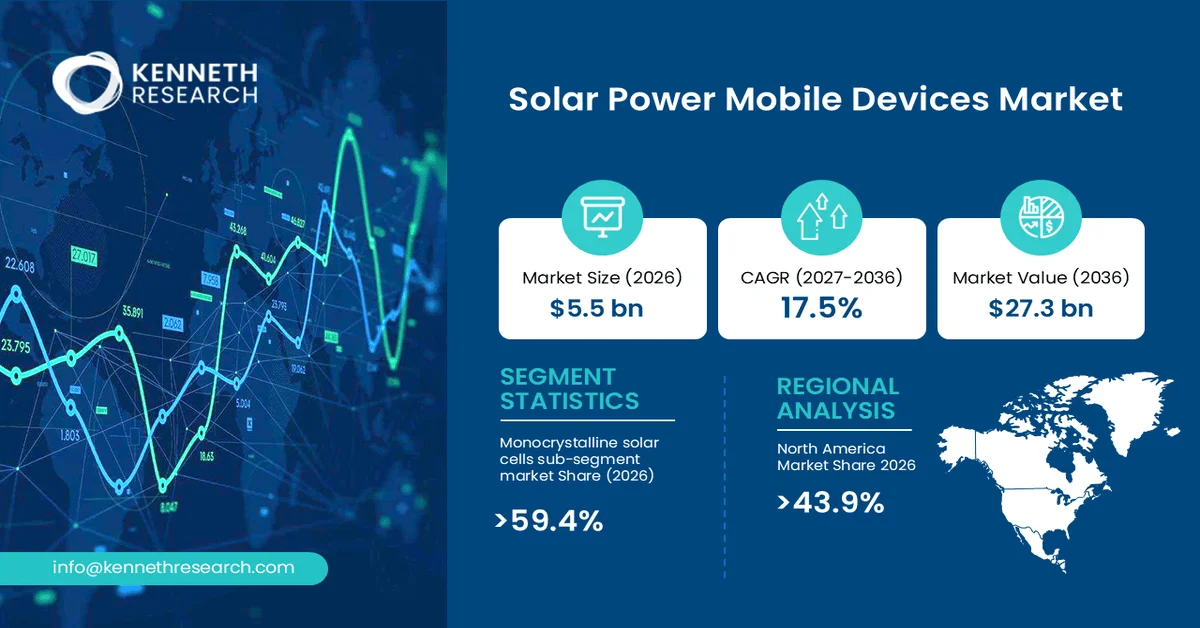
Solar Power Mobile Devices Market size was valued at USD 5.5 billion in 2026 and is projected to reach USD 27.3 billion by the end of 2036, rising at a CAGR of 17.5% during the forecast period, i.e., 2027-2036. In 2027, the industry size of the solar power mobile devices is estimated at USD 6.4 billion.
The primary growth driver of the solar power mobile devices market is increasing demand for portable electronics that can operate with reduced dependence on conventional charging infrastructure. Consumers, outdoor professionals, travelers, and remote users increasingly value devices capable of harvesting solar energy to extend operating time and improve energy autonomy.
The solar power mobile devices market comprises portable electronic devices and associated charging solutions that incorporate photovoltaic technology to convert sunlight into electrical energy for powering or charging mobile equipment. These products can include solar-powered chargers, power banks, smartphones, wearables, portable communication devices, outdoor electronics, and other battery-operated consumer or professional equipment.
The market combines photovoltaic cells, energy-storage systems, power-management electronics, batteries, charging interfaces, and device-level integration. Solar technology enables users to supplement conventional electricity with renewable energy, supporting greater portability and energy independence. Applications span consumer electronics, outdoor and recreational equipment, emergency communications, remote operations, and mobile power systems, with product development increasingly emphasizing compactness, durability, charging efficiency, and ease of use.
Key Solar Power Mobile Devices Market Insights Summary:
Key Takeaways: Market Trends & Insights
- The solar power mobile devices market is projected to grow from USD 5.5 billion in 2026 to USD 27.3 billion by 2036, expanding at a 17.5% CAGR.
- North America accounted for the largest regional share at 43.9% in 2026, supported by strong solar adoption and demand for portable, renewable-powered electronics.
- Monocrystalline solar cells represented the leading solar technology segment with a 59.4% share in 2026, supported by their high efficiency and suitability for compact devices.
- Consumer electronics is a key application area, driven by demand for solar-assisted charging solutions for smartphones, tablets, wearables, and portable electronics.
Market Drivers
- Rising efficiency of monocrystalline solar technology
- Growing demand for energy-autonomous portable electronics
- Advancements in compact photovoltaic and battery integration
- Increasing adoption of renewable-powered outdoor, remote, and connected devices
Challenges
- Limited solar-generation area and variable power output
- Durability and product integration
Solar Power Mobile Devices Market Overview & Supply Chain
The solar power mobile devices market is developing as photovoltaic technology becomes increasingly integrated into portable electronics, charging accessories, wearables, and off-grid communication equipment. Demand is supported by the broader expansion of solar power, rising adoption of connected mobile devices, and consumer interest in convenient renewable charging options. Solar integration is particularly valuable for products used outdoors or in locations where access to conventional electricity is limited.
The supply chain begins with photovoltaic cell manufacturers producing solar cells and modules, followed by suppliers of batteries, power-management integrated circuits, charging controllers, substrates, protective materials, and electronic components. Device manufacturers integrate these components into solar-powered mobile products, charging accessories, and portable energy systems. Assembly and testing ensure that photovoltaic generation, energy storage, and electronic power management operate efficiently within compact form factors. Distribution occurs through electronics retailers, online channels, specialized outdoor-equipment providers, and technology distributors before reaching consumers, businesses, and institutional users.
Solar Power Mobile Devices Market: Growth Drivers & Challenges
Growth Drivers:
- Rising efficiency of monocrystalline solar technology: Advancements in crystalline-silicon technology are strengthening the suitability of photovoltaic cells for compact solar-powered mobile devices. Monocrystalline Solar Cells benefit from high conversion efficiency, allowing manufacturers to generate more electricity from relatively limited surface areas—an important advantage when integrating solar cells into portable electronics, chargers, wearables, and other space-constrained products. The U.S. Department of Energy reports that monocrystalline silicon represented 96% of global solar shipments in 2022, demonstrating its strong technology position within the photovoltaic industry.
- Growing demand for energy-autonomous portable electronics: The increasing use of smartphones, wearables, outdoor electronics, connected sensors, and portable communication equipment is creating demand for convenient supplementary power sources. Solar integration can extend battery operating time and reduce dependence on conventional electrical outlets, particularly for devices used during travel, outdoor activities, remote operations, and emergency situations. Manufacturers are increasingly focusing on compact photovoltaic modules, improved energy-storage systems, power-management electronics, and durable device integration.
Challenges:
- Limited solar-generation area and variable power output: A key challenge for solar-powered mobile devices is the limited surface area available for photovoltaic integration. Compact devices cannot accommodate large solar modules, restricting the amount of electricity that can be generated. Output also varies with sunlight intensity, device orientation, shading, and temperature, making solar power difficult to use as a sole energy source. The U.S. Department of Energy notes that PV electricity production depends on light characteristics and that higher temperatures can reduce photovoltaic performance. Manufacturers therefore need efficient power-management systems and batteries to store intermittent solar energy and maintain reliable device operation.
- Durability and product integration: Integrating photovoltaic cells into mobile devices creates challenges related to mechanical stress, moisture exposure, thermal conditions, and long-term performance. Solar components must remain lightweight and compact while protecting sensitive electrical connections and maintaining charging efficiency. The U.S. Department of Energy identifies degradation, weather exposure, module damage, and reliability as important PV performance considerations.
Solar Power Mobile Devices Market Size and Forecast:
| Report Attribute | Details |
|---|---|
| Base Year |
2026 |
| Forecast Period |
2027-2036 |
| CAGR |
17.5% |
| Base Year Market Size (2026) |
USD 5.5 billion |
| Forecast Year Market Size (2036) |
USD 27.3 billion |
| Regional Scope |
|
Solar Power Mobile Devices Market Segmentation Analysis:
Solar Technology Segment Analysis
In the solar technology segment, the monocrystalline solar cells sub-segment is anticipated to capture the largest market share of 59.4% in 2026.
Its leading position is supported by high conversion efficiency and suitability for compact photovoltaic applications where available surface area is limited. Monocrystalline technology can generate useful power from relatively small solar-cell footprints, making it suitable for integration into portable chargers, mobile power devices, wearables, and other space-constrained electronics.
The technology also benefits from an established manufacturing ecosystem and continued improvements in photovoltaic cell performance. India's Ministry of New and Renewable Energy maintains dedicated approval lists for solar PV cells and modules, reflecting the importance of quality, reliability, and standardized manufacturing within the photovoltaic supply chain.
Application Type Segment Analysis
In the application segment, the consumer electronics sub-segment is expected to remain a major area of adoption as smartphones, tablets, wearable devices, and portable chargers increasingly require convenient and supplementary power sources. Solar-enabled solutions can provide charging support during travel, outdoor activities, and situations where conventional electricity is unavailable. Industry analysis also identifies consumer electronics as a leading application for solar power mobile devices, reflecting the broad use of solar charging solutions across portable electronic products.
Demand is further supported by advances in compact photovoltaic modules, battery storage, and power-management electronics that allow solar components to be integrated into increasingly portable products. Manufacturers are developing solutions that combine solar generation with conventional USB-C, wireless, and battery-based charging, improving flexibility for users.
Our in-depth analysis of the global solar power mobile devices market includes the following segments:
|
Segment |
Sub-segment |
|
Device Type |
|
|
Solar Technology |
|
|
Application |
|
Solar Power Mobile Devices Market Regional Insights:
North America Market Trends & Insights:
North America accounted for 43.9% of the solar power mobile devices market in 2026, supported by strong solar deployment, advanced electronics manufacturing, and growing demand for portable and renewable-powered charging solutions.
It is the leading region for the solar power mobile devices market, supported by strong solar deployment, advanced electronics manufacturing, and consumer demand for portable energy solutions. The U.S. remains the primary market, with solar representing a major share of new electricity-generation capacity. Canada is also expanding its photovoltaic base, supporting opportunities for solar-powered portable devices.
U.S. benefits from a mature solar ecosystem and continued expansion of photovoltaic capacity, creating favorable conditions for solar-powered mobile charging and portable electronics. The U.S. added substantial solar capacity in 2025, reinforcing the broader market ecosystem.
Canada offers additional opportunities as distributed and centralized PV deployment expands. Its cumulative PV capacity reached 5.29 GWAC by the end of 2024, supporting continued development of solar-based applications.
Asia-Pacific Market Trends & Insights:
Asia-Pacific represents a significant growth opportunity for the solar power mobile devices market, supported by large consumer-electronics manufacturing ecosystems, expanding renewable-energy adoption, and growing demand for portable charging solutions.
Japan benefits from advanced electronics capabilities and continued development of energy-efficient technologies.
China provides a strong manufacturing base for photovoltaic components and mobile electronics. Consumer demand for smartphones, wearables, portable chargers, and outdoor electronics is expected to support regional adoption. Market research also identifies Consumer Electronics as a leading application, reinforcing the importance of the region's electronics ecosystem.
Leading Companies Operating in the Global Solar Power Mobile Devices Market:
Here is a list of upstream, downstream, and key players operating in the global solar power mobile devices market competitive ecosystem:
- Goal Zero (United States)
- Company Overview
- Business Strategy
- Key Product Offerings
- Financial Performance
- Key Performance Indicators
- Risk Analysis
- Recent Development
- Regional Presence
- SWOT Analysis
- Anker Innovations (China)
- Renogy (United States)
Recent Developments
- March 2026: Goal Zero launched the Yeti 1500 portable power station in 2026, adding a new solar-compatible portable energy product designed for off-grid use and emergency power applications.
- May 2026: Anker introduced the SOLIX S2000 portable power station, designed with a 2 kWh battery system and support for solar charging.
Frequently Asked Question
The solar power mobile devices market was valued at USD 5.5 billion in 2026.
The market is projected to reach USD 27.3 billion by 2036, expanding at a 17.5% CAGR during 2027-2036.
Key companies include Goal Zero, Anker Innovations, Renogy, and BioLite.
Monocrystalline Solar Cells, under Solar Technology, held the largest share at 59.4% in 2026, supported by their high efficiency and suitability for compact mobile applications.
North America is projected to remain the leading region, accounting for 43.9% in 2026, with the U.S. and Canada serving as the primary country markets.
Why Choose Kenneth Research ?
-
Insight with Impact : We don’t just gather data — we uncover stories, trends, and opportunities that fuel business growth.
-
Experts Who Get It : Our team speaks your industry’s language and knows what really matters to your customers and market.
-
Custom-Built for You : Forget one-size-fits-all. We craft research and consulting solutions as unique as your business vision.
-
Partners, Not Just Providers : We work with you, not for you — collaborating closely to turn insights into smart, strategic moves.
-
Results That Speak : Our work powers brands, startups, and industry leaders alike — with a track record of ideas that work in the real world.
Report ID: 1346 |
Published Date: 10 Sep 2026 |
Report Format: |
Delivery Timeline: 48-72 Business Hours

Copyright © 2025 Kenneth Research. All rights reserved. Terms of Use | Privacy Policy
