Report ID: 1335 |
Published Date: 09 Sep 2026 |
Report Format: |
Delivery Timeline: 48-72 Business Hours
Solar Power Meters Market Outlook:
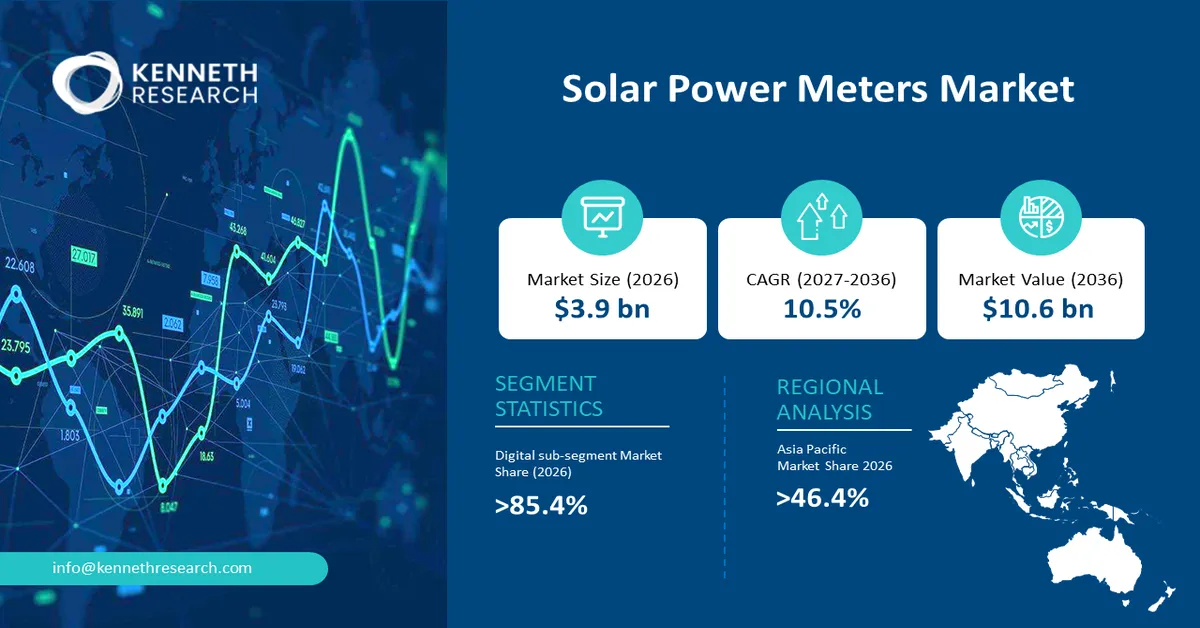
Solar Power Meters Market size was valued at USD 3.9 billion in 2026 and is projected to reach USD 10.6 billion by the end of 2036, rising at a CAGR of 10.5% during the forecast period, i.e., 2027-2036. In 2027, the industry size of the solar power meters is estimated at USD 4.3 billion.
The primary growth driver is the expansion of solar generation and the resulting need for accurate, continuous measurement of electricity production, system performance, and grid interaction. Rising clean-energy investment is reinforcing this requirement: the IEA reports that clean energy received 83% of India’s power-sector investment in 2024, supporting broader deployment of solar monitoring infrastructure.
The solar power meters market comprises electrical measurement devices and associated metering technologies used to measure, record, communicate, and monitor electricity generated by solar photovoltaic (PV) systems. These meters support measurement of parameters such as real and reactive power, voltage, current, and delivered electricity, depending on system configuration and monitoring requirements. The U.S. Department of Energy identifies metering and instrumentation as important components of PV performance monitoring and notes that inverter equipment can incorporate metering functions or operate alongside dedicated measurement instruments.
Solar power meters can serve residential, commercial, industrial, utility-scale, and remote solar installations. Their characteristics increasingly include digital measurement, data communication, remote monitoring, and integration with broader energy-management or grid-monitoring platforms. These capabilities allow operators to observe production performance, identify abnormal operating conditions, and support maintenance decisions.
Key Solar Power Meters Market Insights Summary:
Key Takeaways: Market Trends & Insights
- Solar power meters market is valued at USD 3.9 billion in 2026 and is projected to reach USD 10.6 billion by 2036
- The market is expected to expand at a CAGR of 10.5% during 2027-2036
- Digital solar power meters lead the Technology segment with an 85.4% market share in 2026
- On-grid Solar Power Meters represent the fastest-growing sub-segment under Integration Type, supported by increasing grid-connected solar deployment
- Asia Pacific dominates the market with a 46.4% share in 2026, with China and Japan serving as key country markets
Market Drivers
- Expansion of distributed solar generation
- Increasing adoption of smart-grid and remote-monitoring technologies
- Need for higher operational visibility across renewable-energy assets
- Demand for reliable measurement in grid-connected solar installations
Challenges
- Interoperability and Integration Complexity
- Cybersecurity Exposure of Connected Metering Infrastructure
Solar Power Meters Market Overview & Supply Chain
Global adoption of solar power meters is increasing alongside the expansion of photovoltaic generation, greater emphasis on asset-performance monitoring, and the integration of distributed and utility-scale solar resources into electricity networks. Solar meters provide the measurement layer required to quantify generation, monitor operating performance, support billing and settlement, and provide data for maintenance and energy-management decisions. Their relevance is increasing as solar moves deeper into mainstream power systems and operators require more granular visibility across generation assets.
The solar power meters market value chain begins with input materials and electronic components, including semiconductor devices, sensing elements, conductive materials, circuit boards, display components, communications modules, enclosures, and other electrical and mechanical parts. Manufacturers integrate these inputs into metering hardware, firmware, communication interfaces, and measurement systems, followed by calibration, testing, certification, and quality assurance. Distribution typically operates through direct sales, electrical-equipment distributors, solar-system integrators, engineering-procurement-construction contractors, and specialist channel partners. End users include residential solar operators, commercial and industrial facilities, utilities, renewable-energy developers, microgrid operators, and other asset owners requiring generation or grid-interaction measurement.
Solar Power Meters Market: Growth Drivers & Challenges
Growth Drivers:
- Expansion of solar PV deployment and monitoring requirements: The rapid expansion of solar photovoltaic generation is increasing the installed base that requires accurate electricity measurement, performance monitoring, and operational data. As solar projects become more numerous and geographically distributed, operators need reliable metering infrastructure to verify generation, assess system performance, support maintenance, and manage electricity flows between generation assets and the grid. The market therefore benefits not only from new solar installations but also from the growing operational requirements associated with managing an expanding global PV asset base.
- Increasing grid integration and digital energy management: Greater integration of solar generation into electricity networks is strengthening the need for sophisticated metering and data-management capabilities. Solar power meters increasingly function as part of a broader digital infrastructure that connects generation assets with inverters, monitoring platforms, energy-management systems, utilities, and grid operators. This enables operators to observe electricity flows, identify performance deviations, support operational decisions, and manage distributed generation more effectively. The shift toward interconnected energy systems also increases the value of communication-enabled meters that can transmit measurements remotely rather than relying solely on local readings.
Challenges:
- Interoperability and integration complexity: A major restraint is the difficulty of integrating solar power meters with heterogeneous inverters, monitoring platforms, communication protocols, legacy electrical infrastructure, and utility systems. Solar installations frequently combine equipment from multiple vendors, creating compatibility requirements that can complicate commissioning, data exchange, calibration, and ongoing maintenance. The National Laboratory of the Rockies identifies interoperability, equipment testing and certification, communication channels, and interconnection procedures as significant challenges for distributed-energy-resource integration. For meter manufacturers and system integrators, this translates into higher engineering effort, longer deployment cycles, additional testing, and greater after-sales support requirements.
- Cybersecurity exposure of connected metering infrastructure: The increasing connectivity of solar power meters creates cybersecurity exposure because metering systems can communicate with remote monitoring platforms, building-management systems, utilities, and other operational technologies. Connected devices introduce additional interfaces that must be protected against unauthorized access, manipulation, and disruption. The National Laboratory of the Rockies notes that greater connectivity in distributed energy systems can create additional opportunities for cyberattacks and that cybersecurity requirements for devices can be outdated or insufficiently enforced. For manufacturers, addressing this risk requires secure communications, authentication, software maintenance, vulnerability management, and security-oriented product development.
Solar Power Meters Market Size and Forecast:
| Report Attribute | Details |
|---|---|
| Base Year |
2026 |
| Forecast Period |
2027-2036 |
| CAGR |
10.5% |
| Base Year Market Size (2026) |
USD 3.9 billion |
| Forecast Year Market Size (2036) |
USD 10.6 billion |
| Regional Scope |
|
Solar Power Meters Market Segmentation Analysis:
Technology Segment Analysis
In the technology segment, Digital sub-segment is anticipated to capture the largest market share of 85.4% the end of 2026.
The digital technology segment leads the solar power meters market because modern solar installations increasingly require precise, continuously accessible electricity data rather than basic local measurement. Digital meters can capture electrical parameters, communicate readings to monitoring platforms, support remote diagnostics, and integrate with inverter, energy-management, and utility systems. This functionality aligns with the operational needs of distributed and grid-connected photovoltaic assets, where visibility into generation and electricity flows is increasingly important. U.S. Energy Information Administration data show that estimated small-scale solar photovoltaic generation reached 57,547 thousand megawatthours in 2024, demonstrating the expanding operational base for technologies that provide granular generation data.
Integration Type Segment Analysis
The On-grid Solar Power Meters is projected to grow as the second-largest segment in the solar power meters market due to four converging demand drivers.
The on-grid solar power meters sub-segment is positioned for strong growth because solar installations increasingly operate as active participants in electricity networks rather than as isolated generation assets. Grid-connected systems require dependable measurement of electricity exchanged between solar installations and the network, supporting monitoring, settlement, system management, and operational visibility. On the supply side, meter manufacturers are developing products with communication capabilities and compatibility with modern energy-management systems. Future demand should increasingly favor on-grid meters that combine measurement accuracy with remote data transmission, interoperability, and grid-management functionality.
Our in-depth analysis of the solar power meters market includes the following segments:
|
Segment |
Sub-segment |
|
Integration Type |
|
|
Product |
|
|
Measurement |
|
|
Technology |
|
|
End Use |
|
Solar Power Meters Market Regional Insights:
Asia Pacific Market Trends & Insights:
Asia Pacific solar power meters market is projected to hold the largest revenue share of 46.4% by the end of 2026.
It is supported by the region’s large and expanding solar-generation base, extensive manufacturing capabilities, and continued investment in electricity infrastructure. China is a particularly important production and consumption center, with substantial photovoltaic manufacturing capacity and strong domestic deployment. Government policy support for renewable-energy development, grid modernization, and distributed generation further strengthens the regional ecosystem for metering technologies.
Within the region, China represents the principal country market because of its extensive solar manufacturing base, large domestic installations, and continued grid investment.
Japan provides a complementary demand center, supported by established photovoltaic deployment, distributed generation, and policies encouraging renewable electricity integration.
North America Market Trends & Insights:
North America represents an important market for solar power meters, supported by expanding photovoltaic deployment, grid modernization, distributed-energy integration, and increasing demand for granular electricity data. The region’s mature electricity infrastructure creates opportunities for advanced metering technologies that can communicate with monitoring platforms, inverters, utilities, and energy-management systems.
Within North America, the United States is the principal country market, supported by extensive solar deployment, utility investment, distributed-generation growth, and federal incentives for clean-energy and grid infrastructure.
Canada offers additional opportunities through expanding photovoltaic activity and government-backed programs supporting clean electricity, renewable generation, storage, and grid modernization. Its emphasis on integrating renewable resources into reliable electricity systems creates a favorable environment for advanced solar metering technologies and associated monitoring solutions.
Leading Companies Operating in the Global Solar Power Meters Market:
Here is a list of upstream, downstream, and key players operating in the solar power meters competitive ecosystem:
- Landis+Gyr Group AG (Switzerland)
- Company Overview
- Business Strategy
- Key Product Offerings
- Financial Performance
- Key Performance Indicators
- Risk Analysis
- Recent Development
- Regional Presence
- SWOT Analysis
- Kamstrup A/S (Denmark)
- Siemens AG (Germany)
- Solar Light Company, LLC (United States)
Recent Developments
- In February 2025, Kamstrup completed a smart meter replacement project for Mölndal Energi Nät in Sweden, installing 23,000 new smart meters that achieved 100% data collection frequency and improved grid monitoring capabilities.
- In January 2026, Siemens introduced its new Inhab Meter Combination with RapidFlx Technology, offering flexibility for installing solar panels, EV charging, batteries, or additional electrical loads as part of its meter combinations portfolio.
Frequently Asked Question
In 2026, the solar power meters market is USD 3.9 billion.
The solar power meters market is projected to reach USD 10.6 billion by the end of 2036, expanding at a CAGR of 10.5% over the forecast period (2027-2036).
The major players in the market are Landis+Gyr Group AG, Kamstrup A/S, Siemens AG, Solar Light Company, LLC, and others.
In the technology segment, the digital sub-segment is anticipated to capture the largest market share of 85.4% in the future and exhibit lucrative growth opportunities during 2027-2036. This growth trajectory is largely attributed to increasing demand for precise, continuously accessible electricity data.
Asia Pacific is projected to hold the largest market share of 46.4% by the end of 2026 and provide more business opportunities in the future. Continuous investments in solar generation, grid infrastructure, and photovoltaic deployment across China and Japan are fostering the region's dominance.
Why Choose Kenneth Research ?
-
Insight with Impact : We don’t just gather data — we uncover stories, trends, and opportunities that fuel business growth.
-
Experts Who Get It : Our team speaks your industry’s language and knows what really matters to your customers and market.
-
Custom-Built for You : Forget one-size-fits-all. We craft research and consulting solutions as unique as your business vision.
-
Partners, Not Just Providers : We work with you, not for you — collaborating closely to turn insights into smart, strategic moves.
-
Results That Speak : Our work powers brands, startups, and industry leaders alike — with a track record of ideas that work in the real world.
Report ID: 1335 |
Published Date: 09 Sep 2026 |
Report Format: |
Delivery Timeline: 48-72 Business Hours

Copyright © 2025 Kenneth Research. All rights reserved. Terms of Use | Privacy Policy
