Report ID: 1321 |
Published Date: 11 Sep 2026 |
Report Format: |
Delivery Timeline: 48-72 Business Hours
Solar Power Market outlook:
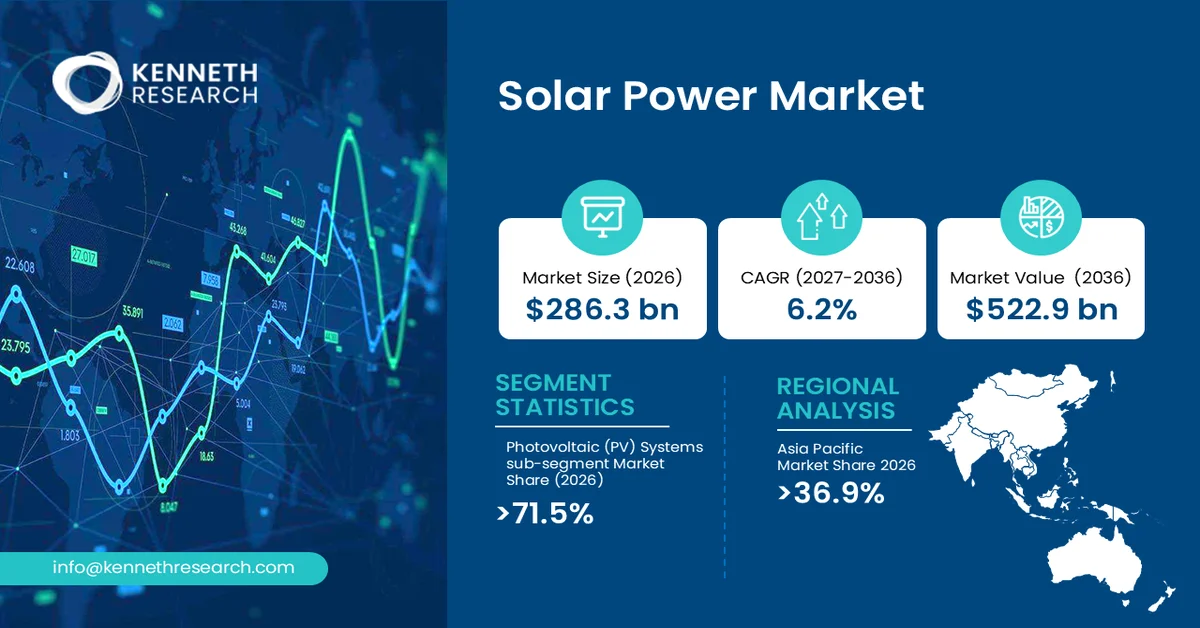
Solar Power Market size was valued at USD 286.3 billion in 2026 and is projected to reach USD 522.9 billion by the end of 2036, rising at a CAGR of 6.2% during the forecast period, i.e., 2027–2036. In 2027, the industry size of the solar power market is estimated at USD 304.6 billion.
Rapid growth in electricity demand and the accelerating deployment of low-emission generation are strengthening solar power investment. The IEA reported that solar PV generation increased by about 480 TWh in 2024, the largest increase among electricity-generation sources, reinforcing solar’s role in meeting rising power requirements.
The solar power market encompasses the technologies, equipment, systems, project development activities, and associated services used to convert sunlight into usable electricity. The market primarily includes photovoltaic (PV) systems, which generate electricity directly through semiconductor-based solar cells, as well as concentrated solar power technologies that use thermal processes to produce electricity.
Key characteristics include modular system architecture, scalability across residential, commercial, industrial, and utility-scale applications, and integration with electricity grids or standalone energy systems. Solar power projects can range from distributed installations serving individual consumers or businesses to large utility-scale facilities supplying electricity to regional grids. Supporting components include solar modules, inverters, mounting structures, electrical equipment, monitoring systems, and related engineering, procurement, construction, operation, and maintenance services.
Key Solar Power Market Insights Summary:
Key Takeaways: Market Trends & Insights
- Solar power market is projected to grow from USD 286.3 billion in 2026 to USD 522.9 billion by 2036 at a CAGR of 6.2%
- Photovoltaic (PV) Systems dominated the Technology segment with a 71.5% market share in 2026
- Asia Pacific led the solar power market with a 36.9% market share in 2026
- Industrial is projected to be the fastest-growing sub-segment within the Application category during 2027–2036
- China and Japan represent key country markets supporting Asia Pacific’s leadership in solar power deployment
Market Drivers
- Advancements in Solar PV Performance and Technology
- Expansion of Renewable-Energy Procurement and Policy Support
- Increasing Industrial Electricity Demand and Corporate Decarbonization Commitments
- Integration of Solar PV with Battery Storage and Flexible Electricity Systems
Challenges
- Grid Integration and Transmission Constraints
- Land, Permitting, and Project-Development Complexity
Solar Power Market Overview & Supply Chain
Solar power adoption is increasing globally as governments, utilities, industrial operators, and commercial users prioritize energy security, emissions reduction, and diversification of electricity supply. Improvements in photovoltaic efficiency, manufacturing scale, system integration, storage compatibility, and project economics are supporting deployment across utility-scale and distributed applications. Regulatory mechanisms—including renewable-energy targets, auctions, incentives, grid-access reforms, and permitting initiatives—are also strengthening investment visibility.
The solar power value chain begins with raw-material and component inputs, including silicon, conductive metals, glass, polymers, semiconductor materials, and specialized electrical components. These inputs feed cell, wafer, module, inverter, mounting-system, and other equipment manufacturing. Manufacturers and system integrators then supply products through distributors, engineering-procurement-construction contractors, project developers, utilities, and specialized installers. Project development integrates site assessment, system design, financing, permitting, equipment procurement, construction, grid interconnection, commissioning, and operations and maintenance. End users span utilities, industrial facilities, commercial buildings, residential consumers, public-sector entities, and off-grid applications.
Solar Power Market - Growth Drivers & Challenges
Growth Drivers
- Advancements in Solar PV Performance and Technology: Continuous improvements in photovoltaic technology are strengthening the productivity and commercial attractiveness of solar installations. Advances in cell architecture, bifacial modules, tracking systems, inverter efficiency, system design, and operations and maintenance practices allow projects to generate more electricity from available sites while reducing system losses. These improvements directly affect project economics by increasing energy yield and improving asset utilization over operating lifetimes.
- Expansion of Renewable-Energy Procurement and Policy Support: Government renewable-energy targets, competitive procurement mechanisms, distributed-generation programs, grid-decarbonization policies, and corporate clean-energy purchasing are creating stronger demand visibility for solar developers and equipment suppliers. Policy frameworks can improve project bankability by establishing procurement pathways, long-term contracting structures, or incentives that reduce uncertainty around electricity revenues and investment returns. Competitive auctions also enable governments and utilities to procure renewable electricity through structured processes, encouraging developers to optimize project costs and technical performance.
Challenges
- Grid Integration and Transmission Constraints: A major restraint is the mismatch between the rapid development of solar projects and the slower expansion of transmission and distribution infrastructure. Solar generation is variable and often concentrated in locations with strong irradiation but limited local electricity demand, creating congestion and requiring network reinforcement, storage, demand-side flexibility, and improved system-management capabilities. Where connection capacity is unavailable, developers can face lengthy interconnection processes, project redesigns, delayed commissioning, or restrictions on electricity delivery. These constraints increase development risk and can weaken project economics by creating uncertainty around construction schedules, financing, and expected power revenues.
- Land, Permitting, and Project-Development Complexity: Solar projects can face substantial development friction because utility-scale installations require suitable land, environmental assessments, local approvals, grid-access arrangements, and coordination among multiple public and private stakeholders. The underlying challenge is not simply land availability; competing uses, environmental considerations, community acceptance, fragmented permitting responsibilities, and uncertain approval timelines can make project development difficult to schedule and finance. Delays increase development expenditure and financing exposure before projects begin generating revenue, while uncertainty can reduce the attractiveness of projects requiring significant upfront capital.
Solar Power Market Size and Forecast:
| Report Attribute | Details |
|---|---|
| Base Year |
2026 |
| Forecast Year |
2027-2036 |
| CAGR |
6.2% |
| Base Year Market Size (2026) |
USD 286.3 billion |
| Forecast Year Market Size (2036) |
USD 522.9 billion |
| Regional Scope |
|
Solar Power Market - Segment Analysis
Technology Segment Analysis
In the technology segment, Photovoltaic (PV) Systems sub-segment is anticipated to capture the largest market share of 71.5% the end of 2026.
Photovoltaic (PV) systems dominate the solar power market because they offer a scalable and commercially mature approach to converting solar irradiation directly into electricity across utility-scale, commercial, industrial, and distributed applications. Demand is supported by expanding renewable-power procurement, corporate decarbonization programs, distributed-generation adoption, and continued improvements in module efficiency, inverter performance, tracking, and system design. Government deployment data illustrates the strength of PV demand: the U.S. Energy Information Administration recorded 300,634 thousand megawatthours of total photovoltaic generation in 2024, combining utility-scale and small-scale generation.
Application Segment Insights
The Industrial is projected to grow as the second-largest segment in the solar power market due to four converging demand drivers.
The Industrial segment is projected to grow as energy-intensive manufacturers increasingly deploy solar power to manage electricity costs, strengthen energy resilience, and reduce the emissions associated with production. Industrial facilities offer substantial opportunities for rooftop, on-site, and adjacent solar installations because of their large electricity requirements and available commercial or industrial premises. Adoption is also supported by corporate renewable-energy commitments and the increasing availability of third-party financing and power-purchase structures. Supply-side development is improving access to standardized modules, inverters, monitoring systems, installation services, and integrated storage solutions. Industrial users can increasingly combine solar with batteries and energy-management systems to improve operational flexibility.
Our in-depth analysis of the solar power market includes the following segments:
|
Segment |
Sub-segment |
|
Application |
|
|
Technology |
|
|
End Use |
|
|
Solar Module |
|
Solar Power Market - Regional Analysis
Asia Pacific Market Trends & Insights:
Asia Pacific solar power market is projected to hold the largest revenue share of 36.9% by the end of 2026.
The region combines major equipment production centers with rapidly expanding domestic consumption, creating an integrated ecosystem spanning polysilicon, wafers, cells, modules, inverters, project development, and installation services. Government-led decarbonization programs, renewable-capacity targets, competitive procurement mechanisms, and industrial policies are reinforcing investment across the region.
China remains the region's principal demand and supply hub, supported by large domestic deployment, extensive manufacturing capabilities, and coordinated renewable-energy development.
Japan represents a mature but strategically important market, with solar integrated into its broader energy-transition agenda and supported by government renewable-energy policies. Together, China and Japan provide complementary strengths in manufacturing scale, technology adoption, project development, and policy-supported deployment, reinforcing Asia Pacific's long-term position in the global solar power industry.
North America Market Trends & Insights:
North America represents a significant secondary market for solar power, supported by rising electricity demand, industrial electrification, corporate decarbonization objectives, and efforts to strengthen domestic energy supply chains. The region’s industrial base creates opportunities for utility-scale generation as well as commercial and industrial installations, while government initiatives are increasingly focused on domestic manufacturing, grid modernization, storage, and renewable-energy deployment.
The United States remains the principal North American opportunity, combining substantial electricity demand with an expanding solar manufacturing ecosystem and federal support for domestic production, supply-chain resilience, and grid integration. The Department of Energy is also supporting advanced solar technologies and manufacturing competitiveness, creating opportunities for technology suppliers and project developers.
Canada offers complementary opportunities through clean-electricity programs, grid modernization, and investments designed to enable renewable generation. Natural Resources Canada specifically identifies solar deployment, energy storage, and grid modernization as areas supported through its Smart Renewables and Electrification Pathways Program.
Solar Power Market Competitive Landscape
Here is a list of upstream, downstream, and key players operating in the solar power competitive ecosystem:
- LONGi Green Energy Technology Co., Ltd. (China)
- Company Overview
- Business Strategy
- Key Product Offerings
- Financial Performance
- Key Performance Indicators
- Risk Analysis
- Recent Development
- Regional Presence
- SWOT Analysis
- JA Solar Technology Co., Ltd. (China)
- Trina Solar Co., Ltd. (China)
- Canadian Solar Inc. (Canada)
- First Solar, Inc. (United States)
- Adani Green Energy Ltd. (India)
Recent Developments
- In June 2026, Adani Green Energy commissioned a 150 MW solar power project at Khavda, Gujarat, through its wholly owned subsidiary Adani Renewable Energy Eight Limited, bringing its total operational renewable energy generation capacity to 19,985.8 MW. The company also commissioned a cumulative 3.37 GWh of battery energy storage system capacity at the same location . Earlier in April 2026, AGEL had operationalized a total of 951 MW of renewable projects across Baiya, Rajasthan and Khavda, Gujarat.
- In July 2026, LONGi Green Energy set a new world record for crystalline silicon-perovskite tandem solar cells, achieving a certified power conversion efficiency of 35.5 percent. The result, certified by the European Solar Test Installation, surpasses LONGi's previous record of 35.2 percent from earlier in the year . The company also announced plans to invest 204 million yuan to construct a 100 MW pilot production line for these high-efficiency cells in Xixian New Area, Shaanxi Province, advancing the technology from laboratory breakthroughs toward commercial industrialization.
Frequently Asked Question
In 2026, the solar power market market exceeded USD 286.3 billion.
The solar power market market is projected to reach USD 522.9 billion by the end of 2036, expanding at a CAGR of 6.2% over the forecast period (2027-2036).
The major players in the market are LONGi Green Energy Technology Co., Ltd., JA Solar Technology Co., Ltd., Trina Solar Co., Ltd., Canadian Solar Inc., First Solar, Inc., Adani Green Energy Ltd., and others.
In the Technology segment, the Photovoltaic (PV) Systems sub-segment is anticipated to capture the largest market share of 71.5% in the future and exhibit lucrative growth opportunities during 2027-2036. This growth trajectory is largely attributed to increasing renewable-energy procurement and policy support.
Asia Pacific is projected to hold the largest market share of 36.9% by the end of 2026 and provide more business opportunities in the future. Continuous investments and expanding solar deployment in China and Japan are fostering the region's dominance.
Why Choose Kenneth Research ?
-
Insight with Impact : We don’t just gather data — we uncover stories, trends, and opportunities that fuel business growth.
-
Experts Who Get It : Our team speaks your industry’s language and knows what really matters to your customers and market.
-
Custom-Built for You : Forget one-size-fits-all. We craft research and consulting solutions as unique as your business vision.
-
Partners, Not Just Providers : We work with you, not for you — collaborating closely to turn insights into smart, strategic moves.
-
Results That Speak : Our work powers brands, startups, and industry leaders alike — with a track record of ideas that work in the real world.
Report ID: 1321 |
Published Date: 11 Sep 2026 |
Report Format: |
Delivery Timeline: 48-72 Business Hours

Copyright © 2025 Kenneth Research. All rights reserved. Terms of Use | Privacy Policy
