Report ID: 1440 |
Published Date: 25 Sep 2026 |
Report Format: |
Delivery Timeline: 48-72 Business Hours
Solar Panel Coatings Market Outlook:
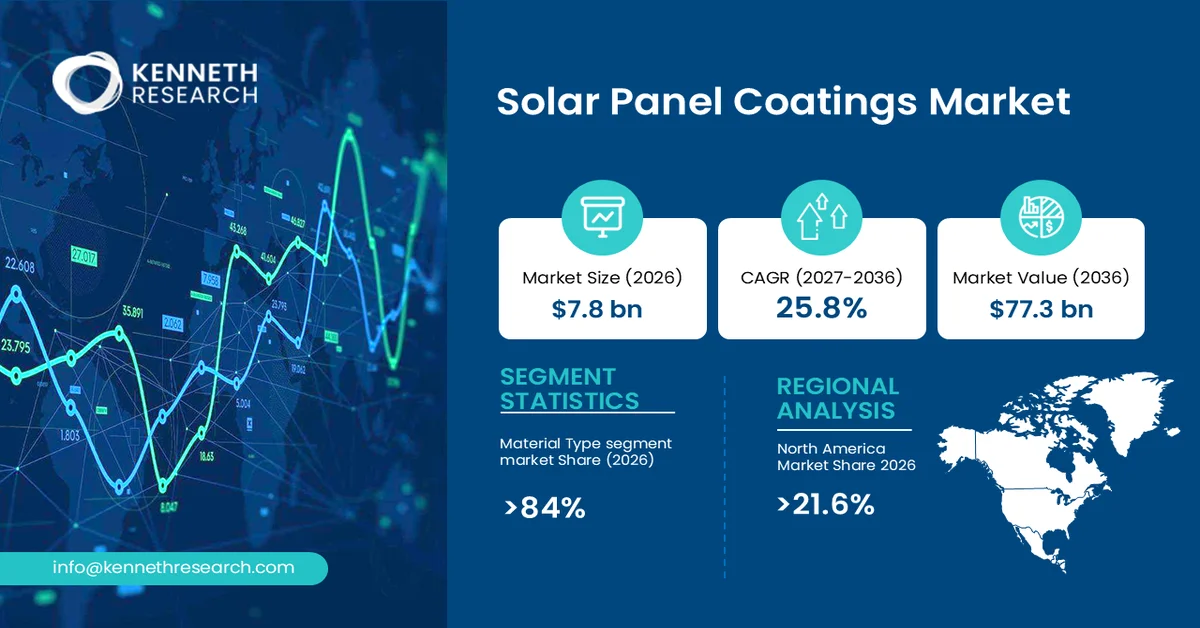
Solar Panel Coatings Market size was valued at USD 7.8 billion in 2026 and is projected to reach USD 77.3 billion by the end of 2036, rising at a CAGR of 25.8% during the forecast period, i.e., 2027–2036. In 2027, the industry size of the Solar Panel Coatings Market is estimated at USD 9.8 billion.
The primary growth driver for the solar panel coatings market is the global expansion of photovoltaic power generation and the need to improve module efficiency, durability, and energy yield.
The solar panel coatings market refers to the industry involved in developing, manufacturing, and supplying specialized surface coatings applied to solar panels and photovoltaic module components to improve their optical, protective, and operational performance. These coatings include anti-reflective, anti-soiling, hydrophobic, anti-corrosion, self-cleaning, and protective formulations designed for use on glass, photovoltaic cells, and other exposed module surfaces.
Key characteristics include enhanced light transmission, reduced surface reflection, resistance to dust and contaminants, improved weatherability, and protection against environmental degradation. Material technologies can include silicon dioxide (SiO₂), titanium dioxide (TiO₂), polymers, nanomaterials, and other advanced coating formulations.
Key Solar Panel Coatings Market Insights Summary:
Key Takeaways: Market Trends & Insights
- • Solar Panel Coatings Market projected to grow from USD 7.8 billion in 2026 to USD 77.3 billion by 2036 at a 25.8% CAGR
- • North America accounted for the largest regional share at 21.6% in 2026, driven by extensive photovoltaic deployment and continued investment in solar infrastructure across the U.S. and Canada
- • Silicon Dioxide (SiO2) is expected to remain the leading Material Type segment with an 84% market share in 2026, supported by its suitability for anti-reflective and protective solar-panel surface applications
- • Utility-Scale Solar Farms will continue to represent a significant Application segment as large-scale solar projects increasingly adopt coatings to improve module performance, durability, and resistance to environmental conditions
Market Drivers
- Expansion of high-efficiency photovoltaic manufacturing
- Growing need to improve solar module durability and energy yield
- Increasing deployment of utility-scale solar projects
- Rising adoption of advanced anti-reflective, anti-soiling, and hydrophobic coating technologies
Challenges
- Long-Term Coating Durability and Performance Consistency
- Integration Costs and Manufacturing Compatibility
Solar Panel Coatings Market Overview & Supply Chain
Global adoption of solar panel coatings is increasing as photovoltaic manufacturers and project operators seek to improve energy yield, module durability, and performance under dust, moisture, temperature, and other environmental stresses. Coatings are increasingly relevant to high-efficiency PV manufacturing because surface treatments can reduce optical losses and protect exposed module surfaces.
The solar panel coatings industry value chain begins with raw materials such as silicon dioxide, titanium dioxide, metal oxides, polymers, solvents, nanoparticles, and other specialty chemicals. Material suppliers process these inputs into coating formulations engineered for optical transmission, hydrophobicity, anti-soiling performance, abrasion resistance, and environmental durability. Coating manufacturers then produce and formulate finished products, while specialized equipment providers supply deposition, spraying, curing, and surface-treatment systems.
Solar Panel Coatings Market: Growth Drivers & Challenges
Growth Drivers
- Expansion of high-efficiency photovoltaic manufacturing: The increasing emphasis on photovoltaic efficiency is driving demand for advanced coatings that improve light transmission and reduce optical losses. Anti-reflective coatings are increasingly incorporated into PV cell and module designs because surface reflection directly limits the amount of sunlight reaching the active photovoltaic material. Manufacturers are therefore investing in coatings that combine high optical transmission with durability, adhesion, and resistance to environmental degradation. In the future, increasingly sophisticated cell structures and tighter performance requirements are expected to accelerate adoption of advanced coating formulations across high-volume PV manufacturing.
- Growing need to improve solar module durability and energy yield: Solar panels operate continuously under exposure to dust, moisture, ultraviolet radiation, temperature fluctuations, abrasion, and other environmental stresses. This creates demand for coatings that can reduce soiling, repel water, limit surface degradation, and maintain optical performance over extended operating periods. Anti-soiling and hydrophobic coatings are particularly relevant to utility-scale solar installations because accumulated contaminants can reduce energy generation while increasing cleaning requirements and operating costs.
Challenges
- Long-term coating durability and performance consistency: A major restraint is the difficulty of maintaining coating performance throughout the long operating life of photovoltaic modules. Coatings must withstand ultraviolet exposure, thermal cycling, humidity, dust abrasion, cleaning chemicals, and mechanical stresses without cracking, delaminating, or losing their optical properties. Variations in formulation, deposition conditions, substrate quality, and curing can also produce inconsistent performance across large production volumes.
- Integration costs and manufacturing compatibility: Advanced coatings must be integrated into highly optimized photovoltaic manufacturing lines without creating significant additional processing time, energy consumption, material waste, or equipment requirements. Coating deposition, curing, and surface preparation can introduce additional production steps and may require specialized equipment or process controls. Compatibility issues can also arise between coating formulations and different glass, cell, encapsulant, or module architectures.
Solar Panel Coatings Market Size and Forecast:
| Report Attribute | Details |
|---|---|
| Base Year |
2026 |
| Forecast Period |
2027-2036 |
| CAGR |
25.8% |
| Base Year Market Size (2026) |
USD 7.8 billion |
| Forecast Year Market Size (2036) |
USD 77.3 billion |
| Regional Scope |
|
Solar Panel Coatings Market Segmentation Analysis:
Material Type Segment Analysis
Silicon Dioxide (SiO₂) is the leading Material Type segment, accounting for 84% of the solar panel coatings market in 2026, supported by its strong suitability for anti-reflective and protective surface applications. SiO₂-based coatings can reduce optical reflection while maintaining high light transmission, making them particularly relevant to crystalline-silicon photovoltaic modules.
Demand is further supported by the continued development of higher-efficiency PV technologies, where minimizing optical losses becomes increasingly important. On the supply side, SiO₂ benefits from established material availability, scalable formulation capabilities, and compatibility with different coating and deposition techniques. Manufacturers are also developing multifunctional formulations that combine anti-reflective properties with hydrophobicity, anti-soiling characteristics, and surface protection.
Application Type Segment Analysis
Utility-Scale Solar Farms are expected to remain a key Application segment for solar panel coatings, supported by the expanding deployment of large-scale photovoltaic installations and the need to maximize energy yield while controlling maintenance requirements. Utility-scale projects operate under prolonged outdoor exposure, making protection against dust, moisture, ultraviolet radiation, and other environmental stresses particularly important. The large surface area of utility-scale installations creates substantial opportunities for anti-reflective, anti-soiling, hydrophobic, and protective coatings. Project developers and asset operators increasingly focus on technologies that can preserve module performance and reduce cleaning and maintenance requirements throughout project lifecycles.
Our in-depth analysis of the global solar panel coatings market includes the following segments:
|
Segment |
Sub-segment |
|
Material Type |
|
|
Coating Type |
|
|
By Application |
|
Solar Panel Coatings Market Regional Insights:
North America Market Trends & Insights:
North America accounted for the largest regional share of the solar panel coatings market at 21.6% in 2026, supported by extensive photovoltaic deployment, established solar manufacturing capabilities, strong investment in renewable-energy infrastructure, and growing emphasis on improving module efficiency and durability. The region benefits from an expanding utility-scale solar base, which creates demand for anti-reflective, anti-soiling, hydrophobic, and protective coatings.
The U.S. represents the region's principal market due to rapid deployment of utility-scale solar projects, federal support for clean-energy investment, and continued technological development across the photovoltaic value chain.
Canada is also expanding solar deployment as provinces pursue greater renewable electricity capacity and grid diversification. The combination of new project development and the need to maintain performance across existing installations creates opportunities for coating suppliers in both countries.
Asia-Pacific Market Trends & Insights:
Asia-Pacific is expected to remain an important regional market for solar panel coatings, supported by large-scale photovoltaic deployment, expanding solar manufacturing capacity, and continued investment in renewable-energy infrastructure. Strong demand from utility-scale and distributed solar projects creates opportunities for anti-reflective, anti-soiling, hydrophobic, and protective coatings that can improve module performance and durability.
Japan represents a technologically advanced solar market, with government initiatives supporting next-generation photovoltaic technologies and domestic industrial competitiveness.
China remains the region's major demand center because of its extensive PV manufacturing ecosystem and rapid deployment of large-scale solar capacity. The country's solar installations increasingly require technologies that improve module efficiency, reduce soiling losses, and maintain performance under demanding environmental conditions.
Leading Companies Operating in the Global Solar Panel Coatings Market:
Here is a list of upstream, downstream, and key players operating in the global solar panel coatings market competitive ecosystem:
- TriNANO Technologies (India)
- Company Overview
- Business Strategy
- Key Product Offerings
- Financial Performance
- Key Performance Indicators
- Risk Analysis
- Recent Development
- Regional Presence
- SWOT Analysis
- Nasiol (Turkey)
- 3M (U.S)
Recent Developments
- December 2025 —TriNANO formalized an MoU with Contendre Greenergy Limited Solar to integrate its 3D Quantum Nano Cladding technology into Contendre Solar's manufacturing processes.
- April 2026 —Nasiol launched its Solar Line, comprising SolarCoat GC, SolarCoat FC, SolarClean, and SolarRinse for solar-panel and PV applications. The launch expands Nasiol's dedicated renewable-energy coating portfolio and targets both solar-farm and rooftop applications.
Frequently Asked Question
In 2026, the solar panel coatings market exceeded USD 7.8 billion.
The Solar Panel Coatings Market market is projected to reach USD 77.3 billion by the end of 2036, expanding at a CAGR of 25.8% over the forecast period (2027-2036).
The major players in the market are 3M, Pellucere Technologies, Nasiol, TriNANO Technologies, and BTcorp Generique Nano (ARMINANO), and others.
In the Material Type segment, the Silicon Dioxide (SiO2) sub-segment is anticipated to capture the largest market share of 84% in the future and exhibit lucrative growth opportunities during 2027-2036.
North America is projected to hold the largest market share of 21.6% by the end of 2036 and provide more business opportunities in the future.
Why Choose Kenneth Research ?
-
Insight with Impact : We don’t just gather data — we uncover stories, trends, and opportunities that fuel business growth.
-
Experts Who Get It : Our team speaks your industry’s language and knows what really matters to your customers and market.
-
Custom-Built for You : Forget one-size-fits-all. We craft research and consulting solutions as unique as your business vision.
-
Partners, Not Just Providers : We work with you, not for you — collaborating closely to turn insights into smart, strategic moves.
-
Results That Speak : Our work powers brands, startups, and industry leaders alike — with a track record of ideas that work in the real world.
Report ID: 1440 |
Published Date: 25 Sep 2026 |
Report Format: |
Delivery Timeline: 48-72 Business Hours

Copyright © 2025 Kenneth Research. All rights reserved. Terms of Use | Privacy Policy
