Report ID: 1395 |
Published Date: 25 Sep 2026 |
Report Format: |
Delivery Timeline: 48-72 Business Hours
Solar Control Glass Market Outlook:
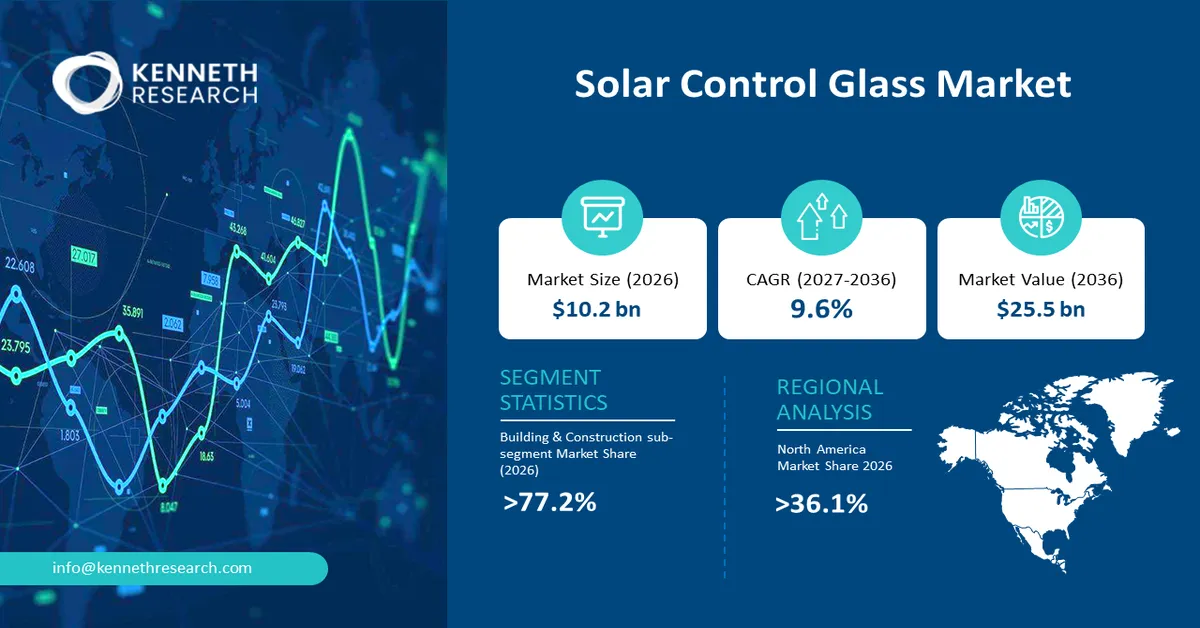
Solar Control Glass Market size was valued at USD 10.2 billion in 2026 and is projected to reach USD 25.5 billion by the end of 2036, rising at a CAGR of 9.6% during the forecast period, i.e., 2027-2036. In 2027, the industry size of the solar control glass is estimated at USD 11.2 billion.
The primary growth driver for the solar control glass market is the increasing emphasis on energy-efficient building envelopes. Demand is rising as commercial and residential projects seek to reduce solar heat gain, improve indoor thermal comfort, lower cooling requirements, and comply with increasingly stringent energy-efficiency standards.
The solar control glass market refers to the industry producing and supplying specialized architectural glass designed to regulate the amount of solar radiation entering buildings. These products typically incorporate coatings, tints, or other surface treatments that selectively control solar heat gain while maintaining desirable levels of daylight and external visibility. Solar control glass is primarily engineered to improve the thermal performance of glazed building envelopes and reduce the cooling burden associated with excessive solar radiation.
Key characteristics include controlled solar heat gain, optimized visible-light transmission, thermal performance, glare management, and compatibility with insulated glazing systems. Depending on building requirements and climate conditions, products can use reflective, absorptive, low-emissivity, or spectrally selective technologies.
Key Solar Control Glass Market Insights Summary:
Key Takeaways: Market Trends & Insights
- Solar control glass market is projected to grow from USD 10.2 billion in 2026 to USD 25.5 billion by 2036, expanding at a 9.6% CAGR during the forecast period.
- North America accounted for the largest regional share at 36.1% in 2026, supported by strong energy-efficiency requirements, advanced building-envelope practices, and increasing adoption of high-performance glazing across the U.S. and Canada.
- Building & Construction is expected to remain the leading End Use segment with a 77.2% market share in 2026, driven by rising demand for energy-efficient façades and solar heat management in modern buildings.
- New Construction is projected to witness strong growth within the Installation segment as developers increasingly integrate solar-control glazing into building designs from the initial planning and specification stages.
Market Drivers
- Rising demand for high-performance building envelopes
- Expansion of sustainable and climate-responsive construction
- Increasing adoption of advanced coated and spectrally selective glazing
- Growing integration of energy-efficient façades with smart-building systems
Challenges
- High initial cost and complex specification requirements
- Supply-chain complexity and performance consistency
Solar Control Glass Market Overview & Supply Chain
Global adoption of solar control glass is increasing as building owners, architects, developers, and governments place greater emphasis on energy efficiency, thermal comfort, and lower operational energy requirements. High-performance glazing has become increasingly relevant to building-envelope strategies because it can limit unwanted solar heat gain while preserving daylight and external visibility. The technology is particularly valuable in commercial and institutional buildings where extensive glazed façades can increase cooling requirements.
The value chain begins with raw-material suppliers providing silica sand, soda ash, limestone, metal oxides, coating materials, and other inputs required for glass production and functional surface treatments. Manufacturers process these materials through glass melting, forming, cutting, tempering, laminating, insulating, and coating operations to produce solar-control products tailored to architectural specifications. Specialized coating and processing capabilities are particularly important because optical transmission, solar heat management, durability, and appearance must meet project requirements.
Solar Control Glass Market: Growth Drivers & Challenges
Growth Drivers:
- Rising demand for high-performance building envelopes: Growing emphasis on energy-efficient building envelopes is accelerating adoption of solar control glazing. Developers and building owners increasingly evaluate façade systems based on their ability to manage solar heat gain, daylight, cooling loads, and occupant comfort rather than relying solely on conventional clear glazing. Solar control glass supports this transition by limiting unwanted solar radiation while maintaining useful daylight transmission, making it particularly relevant for large commercial façades and climate-sensitive buildings.
- Expansion of sustainable and climate-responsive construction: The expansion of sustainable construction is strengthening demand for glazing solutions that contribute to overall building performance. Architects and developers are increasingly integrating façade materials with insulation, shading, efficient HVAC systems, daylighting controls, and building-management technologies to create more responsive buildings. Solar control glass fits this integrated approach because its optical and thermal properties can be selected according to climate, orientation, façade design, and occupancy requirements. In warm or cooling-dominated environments, appropriately specified glazing can reduce excessive solar heat entering occupied spaces, supporting more efficient HVAC operation.
Challenges:
- High initial cost and complex specification requirements: Solar control glass can involve higher procurement and processing costs than conventional glazing because performance depends on specialized coatings, fabrication methods, glass configurations, and project-specific optical and thermal requirements. The specification process can also be technically demanding, as architects, façade consultants, contractors, and building owners must balance solar heat control, daylight transmission, appearance, insulation, orientation, and climate conditions. These requirements can lengthen procurement cycles and increase the need for technical coordination across the construction value chain.
- Supply-chain complexity and performance consistency: The market also faces challenges associated with maintaining consistent product quality across raw-material sourcing, coating, fabrication, transportation, and installation. Solar control glass must meet precise optical and thermal specifications, while large architectural projects frequently require customized dimensions, configurations, and appearance characteristics. Variations in coating quality, fabrication accuracy, handling, or installation can affect façade performance and increase project risk.
Solar Control Glass Market Size and Forecast:
| Report Attribute | Details |
|---|---|
| Base Year |
2026 |
| Forecast Period |
2027-2036 |
| CAGR |
9.6% |
| Base Year Market Size (2026) |
USD 10.2 billion |
| Forecast Year Market Size (2036) |
USD 25.5 billion |
| Regional Scope |
|
Solar Control Glass Market Segmentation Analysis:
End-Use Segment Analysis
In the End-Use segment, the Building & Construction sub-segment is anticipated to capture the largest market share of 77.2% in 2026.
Building & construction represents the leading end-use segment because solar control glass directly addresses the thermal and daylight-management requirements of modern building envelopes. Demand is supported by the continued development of residential properties, commercial offices, institutional facilities, hospitality projects, and high-rise structures featuring extensive glazed façades. New projects increasingly specify high-performance glazing alongside insulation, shading, efficient HVAC equipment, and other envelope technologies to improve whole-building performance.
Installation Type Segment Analysis
New construction is positioned for continued growth within the installation segment as developers increasingly integrate energy-performance requirements into projects during the design and specification stage. Installing solar control glass during initial construction enables architects and façade engineers to select glazing characteristics according to building orientation, climate, façade geometry, daylight requirements, and cooling strategy. This provides greater design flexibility than retrofitting completed structures and allows glazing performance to be coordinated with insulation, shading, HVAC, and building-management systems from the outset. On the supply side, glass manufacturers and fabricators can incorporate solar-control coatings and customized configurations directly into project specifications, supporting efficient procurement and installation.
Our in-depth analysis of the global solar control glass market includes the following segments:
|
Segment |
Sub-segment |
|
Type |
|
|
Coating Type |
|
|
Glazing Type |
|
|
Installation |
|
|
End-Use |
|
Solar Control Glass Market Regional Insights:
North America Market Trends & Insights:
In the regional segment, North America is anticipated to capture the largest market share of 36.1% in 2026.
North America holds the dominant regional position in the solar control glass market, supported by sophisticated construction practices, strong demand for high-performance building envelopes, and increasing emphasis on energy-efficient commercial and residential buildings.
In the U.S., demand is supported by commercial construction, institutional development, high-rise buildings, and renovation activity, while energy-code compliance encourages greater attention to façade performance. The country also benefits from extensive domestic manufacturing, glazing fabrication, and architectural-design capabilities.
Canada complements this regional strength through energy-efficiency initiatives and growing emphasis on high-performance buildings. Natural Resources Canada specifically identifies glazing as a key determinant of window energy efficiency and highlights the importance of selecting glazing according to climate, orientation, and solar performance.
Asia-Pacific Market Trends & Insights:
Asia-Pacific presents significant long-term opportunities for the solar control glass market, supported by rapid urban development, expanding commercial infrastructure, and increasing government emphasis on energy-efficient buildings. Japan and China are particularly important because both markets are strengthening building-performance requirements and promoting lower-carbon construction.
Japan is strengthening the energy-performance framework for buildings through revised regulations administered by the Ministry of Land, Infrastructure, Transport and Tourism. Its building-energy-efficiency framework includes requirements and measures covering new construction, energy-performance labeling, and improvements to building components.
China offers substantial opportunities through large-scale urban construction, building renovation, and the government's transition toward greener building stock. National policy is encouraging improved envelope performance, energy-saving renovations, and advanced low-carbon construction technologies.
Leading Companies Operating in the Solar Control Glass Market:
Here is a list of upstream, downstream, and key players operating in the global solar control glass market competitive ecosystem:
- AGC (Japan)
- Company Overview
- Business Strategy
- Key Product Offerings
- Financial Performance
- Key Performance Indicators
- Risk Analysis
- Recent Development
- Regional Presence
- SWOT Analysis
- Guardian Glass (U.S)
- Saint-Gobain Glass (France)
- NSG Group (Pilkington) (Japan)
- Xinyi Glass Holdings (China)
- Sisecam (Turkey)
Recent Developments
- In June 2026, AGC announced its participation in a Malaysian demonstration project for retrofitting the Sustainable Energy Development Authority headquarters toward Nearly Zero Energy Building performance.
- In January 2026, Guardian Glass announced the launch of Bird1st™ UV glass. The product combines a UV-reflective bird-friendly pattern with Guardian's glazing technologies and is designed to support building requirements while preserving views and façade aesthetics.
Frequently Asked Question
In 2026, the solar control glass market exceeded USD 10.2 billion.
The solar control glass market is projected to reach USD 25.5 billion by the end of 2036, expanding at a CAGR of 9.6% over the forecast period (2027-2036).
The major players in the market are AGC, Saint-Gobain Glass, Guardian Glass, NSG Group (Pilkington), and Vitro Architectural Glass, and others.
In the End Use segment, the Building & Construction sub-segment is anticipated to capture the largest market share of 77.2% in the future and exhibit lucrative growth opportunities during 2027-2036.
North America is projected to hold the largest market share of 36.1% by the end of 2026 and provide more business opportunities in the future.
Why Choose Kenneth Research ?
-
Insight with Impact : We don’t just gather data — we uncover stories, trends, and opportunities that fuel business growth.
-
Experts Who Get It : Our team speaks your industry’s language and knows what really matters to your customers and market.
-
Custom-Built for You : Forget one-size-fits-all. We craft research and consulting solutions as unique as your business vision.
-
Partners, Not Just Providers : We work with you, not for you — collaborating closely to turn insights into smart, strategic moves.
-
Results That Speak : Our work powers brands, startups, and industry leaders alike — with a track record of ideas that work in the real world.
Report ID: 1395 |
Published Date: 25 Sep 2026 |
Report Format: |
Delivery Timeline: 48-72 Business Hours

Copyright © 2025 Kenneth Research. All rights reserved. Terms of Use | Privacy Policy
