Report ID: 1323 |
Published Date: 11 Sep 2026 |
Report Format: |
Delivery Timeline: 48-72 Business Hours
Solar Cell Paste Type Market Outlook:
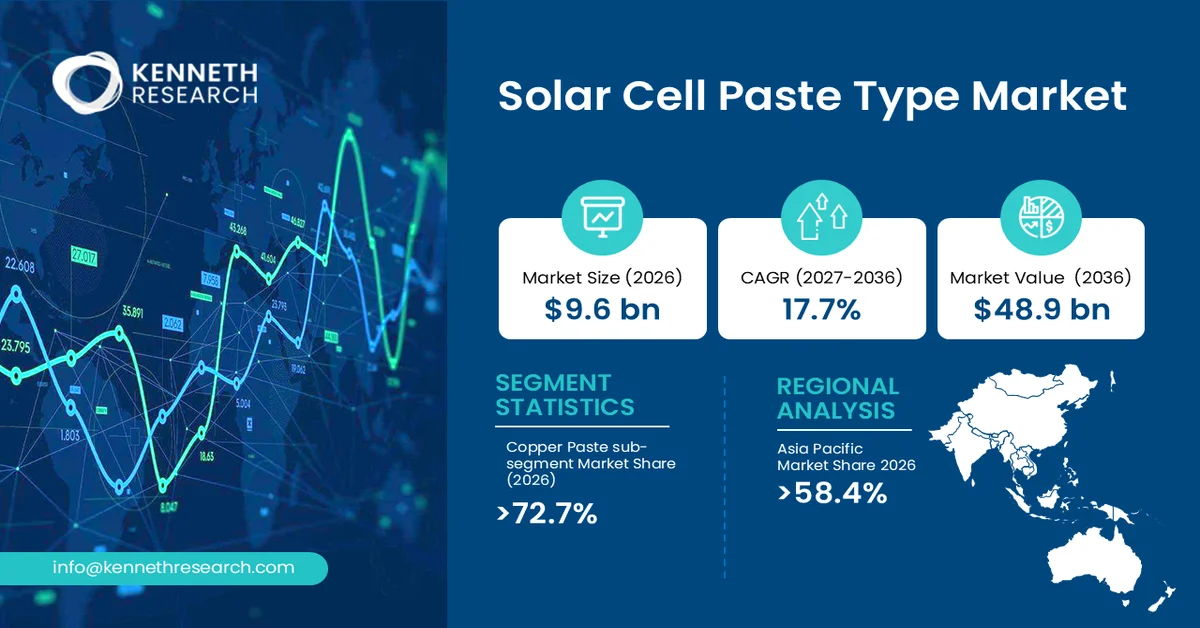
Solar Cell Paste Type Market size was valued at USD 9.6 billion in 2026 and is projected to reach USD 48.9 billion by the end of 2036, rising at a CAGR of 17.7% during the forecast period, i.e., 2027–2036. In 2027, the industry size of the solar cell paste type market is estimated at USD 11.3 billion.
The primary growth driver for the solar cell paste type market is the photovoltaic industry's pursuit of lower-cost, high-efficiency metallization. Government-backed R&D is advancing copper and other metal-based pastes to reduce reliance on costly silver while maintaining scalable screen-printing compatibility, supporting cost optimization across high-volume solar-cell manufacturing.
The solar cell paste type market comprises conductive metallization pastes formulated for application to photovoltaic cells to establish electrical contacts and enable collection and transfer of photogenerated current. These materials are generally engineered around metallic components and supporting formulation constituents, with paste composition selected according to the cell architecture, contact structure, printing method, firing conditions, and required electrical and mechanical characteristics.
A defining characteristic is compatibility with manufacturing processes such as screen printing, where paste is deposited in controlled patterns to form front and rear contacts. Paste formulations must balance conductivity, adhesion, printability, contact formation, and compatibility with semiconductor and passivation layers. Government-backed research is also examining copper-based and metal-complex formulations as alternatives to conventional silver-intensive metallization.
Key Solar Cell Paste Type Market Insights Summary:
Key Takeaways: Market Trends & Insights
- Solar cell paste type market value is projected to rise from USD 9.6 billion in 2026 to USD 48.9 billion by 2036, reflecting a 17.7% CAGR over 2027–2036
- Copper Paste leads the Paste Type segment with a 72.7% market share in 2026, supported by efforts to reduce reliance on costly precious-metal metallization
- Monocrystalline Cells represent the fastest-growing application segment, driven by increasing adoption of high-efficiency photovoltaic cell architectures
- Asia Pacific dominates the regional landscape with a 58.4% market share in 2026, supported by extensive photovoltaic manufacturing capabilities across China and Japan
- Europe remains a key secondary region, with Germany and Spain offering opportunities through photovoltaic deployment, advanced industrial capabilities, and supportive clean-energy initiatives
Market Drivers
- Expansion of Solar PV Manufacturing Capacity
- Shift Toward Silver-Reducing and Advanced Metallization
- Advancement of High-Efficiency Solar Cell Architectures
- Increasing Photovoltaic Manufacturing Localization and Supply-Chain Diversification
Challenges
- Technical Complexity of Copper-Based Metallization
- Increasing Metallization Requirements Across Cell Architectures
Solar Cell Paste Type Market Overview & Supply Chain
Global adoption of solar cell pastes is increasing alongside the expansion and technological upgrading of photovoltaic manufacturing. Metallization pastes are critical to forming conductive contacts on solar cells, directly connecting paste formulation with cell efficiency, manufacturing yield, process compatibility, and material-cost optimization. Technological development is increasingly focused on reducing precious-metal dependence while enabling copper-based and other advanced metallization approaches compatible with industrial production.
The solar cell paste type market value chain begins with sourcing conductive metals and formulation inputs, including silver, copper, glass-forming constituents, solvents, binders, and functional additives. Material suppliers provide controlled-purity inputs to paste manufacturers, which formulate, disperse, mill, and characterize compositions according to cell architecture and printing requirements. Manufacturers then supply finished pastes through direct sales, technical-distribution networks, or qualified industrial distributors. Downstream photovoltaic cell producers integrate these materials into metallization processes, commonly alongside screen-printing and thermal-processing equipment. Cell and module manufacturers represent the principal industrial end users, while equipment suppliers, materials laboratories, photovoltaic technology developers, certification bodies, and research institutions influence qualification and adoption.
Solar Cell Paste Type Market - Growth Drivers & Challenges
Growth Drivers
- Expansion of Solar PV Manufacturing Capacity: The expansion of photovoltaic manufacturing is increasing the addressable demand for metallization pastes because every additional cell-production line requires conductive materials for forming electrical contacts. This creates a direct link between growth in cell manufacturing capacity and consumption of paste formulations. The International Energy Agency reported that global solar PV manufacturing capacity increased by more than 70% in 2022, reaching almost 450 GW, with China accounting for more than 95% of new facilities across the supply chain.
- Shift Toward Silver-Reducing and Advanced Metallization: The transition toward advanced cell architectures is encouraging manufacturers to reconsider conventional metallization strategies, creating opportunities for copper-containing and other lower-silver paste technologies. Metallization must simultaneously deliver electrical conductivity, reliable adhesion, precise pattern formation, and compatibility with increasingly sophisticated cell structures. As cell designs evolve, paste suppliers are therefore under pressure to develop formulations that preserve electrical performance while improving material economics and manufacturing compatibility.
Challenges
- Technical Complexity of Copper-Based Metallization: The transition from conventional silver pastes to copper-based formulations is constrained by material and process-compatibility issues. Copper can oxidize readily and can interact adversely with silicon, creating contamination and degradation risks that require protective barriers, specialized paste chemistry, or modified processing conditions. These requirements complicate qualification because manufacturers must balance electrical conductivity, contact resistance, adhesion, printability, curing behavior, and long-term reliability within existing production environments.
- Increasing Metallization Requirements Across Cell Architectures: Rapid evolution in photovoltaic cell architectures creates a demanding formulation environment because a paste optimized for one technology may not transfer directly to another. Changes in contact structures, passivation layers, firing conditions, and fine-line printing requirements can alter the acceptable electrical and mechanical characteristics of metallization materials. Consequently, suppliers must continually reformulate products and conduct application-specific qualification rather than relying on standardized formulations. This raises development costs and increases technical collaboration requirements between paste producers, screen-printing equipment suppliers, and cell manufacturers.
Solar Cell Paste Type Market Size and Forecast:
| Report Attribute | Details |
|---|---|
| Base Year |
2026 |
| Forecast Year |
2027-2036 |
| CAGR |
17.7% |
| Base Year Market Size (2026) |
USD 9.6 billion |
| Forecast Year Market Size (2036) |
USD 48.9 billion |
| Regional Scope |
|
Solar Cell Paste Type Market - Segment Analysis
Paste Type Segment Analysis
In the paste type segment, Copper Paste sub-segment is anticipated to capture the largest market share of 72.7% the end of 2026.
Copper paste dominates the solar cell paste type market because it addresses the photovoltaic industry's need to reduce dependence on high-cost precious metals while maintaining conductive pathways for cell metallization. Demand is supported by the continued expansion of crystalline-silicon cell production and by manufacturers' efforts to optimize metallization economics without compromising electrical performance. China's Ministry of Industry and Information Technology recorded 310 GW of crystalline-silicon cell production in the first half of 2024, demonstrating substantial downstream manufacturing activity requiring electrode materials. The Chinese industrial statistical framework also explicitly classifies copper paste for crystalline-silicon solar-cell front electrodes as a key electronic-material product, reinforcing its industrial positioning.
Application Segment Analysis
The Monocrystalline Cells is projected to grow as the second-largest segment in the solar cell paste type market due to four converging demand drivers.
Monocrystalline cells are projected to be the fastest-growing application segment because their higher-efficiency architecture aligns with manufacturers’ efforts to increase power output while optimizing module footprint. This supports demand for metallization pastes engineered for fine-line printing, low contact resistance, reliable adhesion, and compatibility with advanced N-type and other high-efficiency structures. Government policy is reinforcing this transition: China’s Ministry of Industry and Information Technology specifically supports industrialization of TOPCon, HJT, and IBC high-efficiency cells while calling for stronger commercialization of electronic pastes and advanced monocrystalline silicon processing. Supply-side specialization should encourage paste developers to tailor formulations to evolving contact structures and printing processes. Going forward, increasing efficiency requirements and commercialization of N-type architectures should sustain demand for application-specific metallization pastes.
Our in-depth analysis of the solar cell paste type market includes the following segments:
|
Segment |
Sub-segment |
|
Paste Type |
|
|
Application |
|
|
Application |
|
Solar Cell Paste Type Market - Regional Analysis
Asia Pacific Market Trends & Insights:
Asia Pacific solar cell paste type market is projected to hold the largest revenue share of 58.4% the end of 2026.
Asia Pacific is the dominant region for the solar cell paste type market, supported by its deeply integrated photovoltaic manufacturing ecosystem, extensive cell and module production infrastructure, established materials supply chains, and continued investment in high-efficiency solar technologies. The region combines strong manufacturing capabilities with substantial domestic solar deployment and supportive industrial policies.
China is the region’s central manufacturing base, supported by vertically integrated polysilicon, wafer, cell, module, equipment, and materials industries. Government manufacturing standards increasingly emphasize efficiency, quality control, technological advancement, and environmentally responsible production, supporting demand for specialized metallization pastes.
Japan represents a technology-oriented market where high-efficiency photovoltaic deployment, domestic manufacturing expertise, and policy-backed energy transition initiatives support demand for advanced cell materials. Together, China’s manufacturing depth and Japan’s technology and deployment base strengthen Asia Pacific’s position as the leading regional ecosystem for solar-cell paste consumption and innovation.
Europe Market Market Trends & Insights:
Europe represents a strategically important secondary region for the solar cell paste type market because its expanding photovoltaic deployment, advanced materials ecosystem, and policy focus on resilient clean-energy supply chains create opportunities for specialized metallization materials. Demand is supported by the continued rollout of rooftop, commercial, utility-scale, and integrated photovoltaic systems, while industrial policy increasingly emphasizes domestic manufacturing and reduced dependence on imported components.
Germany is the principal country opportunity within Europe, combining a mature photovoltaic market with established engineering capabilities and an active policy framework supporting solar deployment and domestic clean-technology manufacturing. Its photovoltaic strategy emphasizes accelerating deployment, innovative applications, workforce development, and simplified project implementation.
Spain offers a complementary opportunity through strong solar-resource advantages, expanding utility-scale and distributed photovoltaic activity, and its participation in EU initiatives aimed at strengthening the European PV industrial ecosystem. For paste suppliers, both markets offer opportunities in advanced metallization, technical qualification, localized supply partnerships, and materials tailored to increasingly efficient cell architectures. The European Solar PV Industry Alliance further supports investment identification, manufacturing scale-up, and diversification of PV supply chains.
Solar Cell Paste Type Market Competitive Landscape
Here is a list of upstream, downstream, and key players operating in the solar cell paste type competitive ecosystem:
- Giga Solar Materials (China)
- Company Overview
- Business Strategy
- Key Product Offerings
- Financial Performance
- Key Performance Indicators
- Risk Analysis
- Recent Development
- Regional Presence
- SWOT Analysis
- Monocrystal (Russia)
- Giga Solar (China)
- Alpha Assembly (MacDermid Alpha) (United States)
Recent Developments
- In 2017, Monocrystal released the MY-655 back-side silver metallization paste for PERC solar cells, targeting the market demand for high-efficiency products. The paste delivers up to 0.05% efficiency gain and features a 7% lower consumption rate than previous MY-series pastes while providing stable adhesion of more than 2N for higher cell reliability.
Frequently Asked Question
In 2026, the solar cell paste type market exceeded USD 9.6 billion.
The solar cell paste type market is projected to reach USD 48.9 billion by the end of 2036, expanding at a CAGR of 17.7% over the forecast period (2027-2036).
The major players in the market are Giga Solar Materials, Monocrystal, Giga Solar, and Alpha Assembly (MacDermid Alpha) and others.
In the Paste Type segment, the Copper Paste sub-segment is anticipated to capture the largest market share of 72.7% in the future and exhibit lucrative growth opportunities during 2027-2036. This growth trajectory is largely attributed to the industry's efforts to reduce dependence on costly precious metals while maintaining conductive performance.
Asia Pacific is projected to hold the largest market share of 58.4% by the end of 2026 and provide more business opportunities in the future. Continuous photovoltaic manufacturing activity and investments across China and Japan are fostering the region's dominance.
Why Choose Kenneth Research ?
-
Insight with Impact : We don’t just gather data — we uncover stories, trends, and opportunities that fuel business growth.
-
Experts Who Get It : Our team speaks your industry’s language and knows what really matters to your customers and market.
-
Custom-Built for You : Forget one-size-fits-all. We craft research and consulting solutions as unique as your business vision.
-
Partners, Not Just Providers : We work with you, not for you — collaborating closely to turn insights into smart, strategic moves.
-
Results That Speak : Our work powers brands, startups, and industry leaders alike — with a track record of ideas that work in the real world.
Report ID: 1323 |
Published Date: 11 Sep 2026 |
Report Format: |
Delivery Timeline: 48-72 Business Hours

Copyright © 2025 Kenneth Research. All rights reserved. Terms of Use | Privacy Policy
