Report ID: 1336 |
Published Date: 09 Sep 2026 |
Report Format: |
Delivery Timeline: 48-72 Business Hours
Solar Cell Market Outlook:
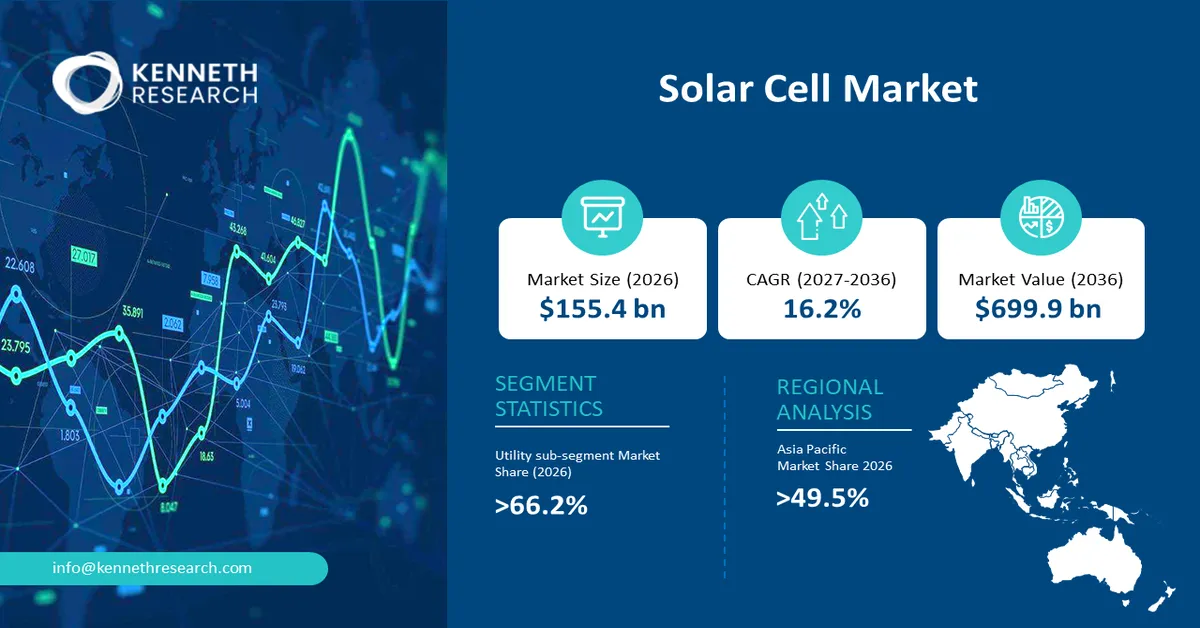
Solar Cell Market size was valued at USD 155.4 billion in 2026 and is projected to reach USD 699.9 billion by the end of 2036, rising at a CAGR of 16.2% during the forecast period, i.e., 2027-2036. In 2027, the industry size of the solar cell is estimated at USD 181.2 billion.
A primary growth driver for the solar cell market is accelerating solar photovoltaic deployment as governments pursue energy-security and decarbonization objectives. IRENA reported that solar photovoltaic capacity additions reached 452.1 GW in 2024, demonstrating sustained expansion in installations and strengthening demand for cells across utility-scale, commercial, and distributed power projects.
The solar cell market comprises the manufacturing and supply of photovoltaic cells that convert sunlight directly into electricity through semiconductor-based photovoltaic effects. Solar cells are fundamental building blocks of photovoltaic modules, with multiple cells interconnected and encapsulated to create power-generating panels. Key characteristics include semiconductor material selection, cell architecture, conversion efficiency, electrical performance, durability, manufacturing process, and compatibility with module designs. Technologies can differ in material composition and structural configuration, influencing energy yield, manufacturing requirements, and deployment suitability.
Industrial relevance extends across the photovoltaic value chain, linking upstream materials and wafer production with cell fabrication, module assembly, system integration, and electricity generation. Cell manufacturers therefore operate within an interconnected ecosystem where technology development, production scalability, quality control, supply-chain resilience, and cost competitiveness affect downstream project economics. The market supports applications ranging from large power-generation installations to commercial and distributed solar systems, making cell performance and manufacturing capability important considerations for project developers, module producers, equipment suppliers, investors, and policymakers.
Key Solar Cell Market Insights Summary:
Key Takeaways: Market Trends & Insights
- Solar cell market reached USD 155.4 billion in 2026, establishing a substantial base for continued photovoltaic industry expansion
- The solar cell market is projected to reach USD 699.9 billion by 2036, reflecting strong long-term expansion across photovoltaic applications
- Utility remains the leading application segment with a 66.2% market share in 2026, supported by accelerating deployment of large-scale solar generation
- Monocrystalline technology is positioned as a key growth segment as manufacturers and developers increasingly prioritize higher-efficiency photovoltaic solutions
- Asia Pacific leads the solar cell market with a 49.5% market share in 2026, supported by manufacturing depth and substantial renewable-energy deployment across China and Japan
Market Drivers
- Expansion of utility-scale solar deployment
- Advancement in high-efficiency photovoltaic technologies
- Growing integration of distributed solar generation
- Increasing investment in photovoltaic manufacturing capacity
Challenges
- Supply-chain concentration and manufacturing overcapacity
- Trade restrictions and fragmented supply chains
Solar Cell Market Overview & Supply Chain
Global adoption of the solar cell market is increasing as countries expand renewable electricity generation, strengthen energy-security strategies, and pursue lower-carbon power systems. Technological progress in photovoltaic efficiency, manufacturing automation, and cell architectures is improving deployment economics, while supportive policy frameworks are encouraging investment across the solar value chain. The technology is increasingly relevant to utility-scale generation, distributed power, industrial decarbonization, and electrification.
The solar cell market value chain begins with upstream extraction and processing of high-grade quartz and other materials required to produce metallurgical-grade silicon, polysilicon, wafers, and cell components. In crystalline-silicon production, polysilicon is refined, formed into ingots, sliced into wafers, and processed through chemical, thermal, and metallization steps to create photovoltaic cells. Cell manufacturers then supply modules and integrated photovoltaic manufacturers, which combine cells with glass, encapsulants, backsheets, frames, junction boxes, and electrical components. Distribution channels include direct manufacturer sales, specialized distributors, module producers, system integrators, and project procurement networks. End users include utilities, commercial and industrial operators, residential consumers, and renewable-energy developers.
Solar Cell Market: Growth Drivers & Challenges
Growth Drivers:
- Expansion of solar power deployment: The accelerating deployment of solar power generation is strengthening demand across the solar cell value chain. As utilities, commercial operators, and distributed-generation developers add photovoltaic capacity, demand rises for cells, wafers, modules, manufacturing equipment, and related components. This creates a direct volume-growth mechanism for cell manufacturers while encouraging suppliers to expand production capabilities and improve manufacturing efficiency.
- Technological advancement and efficiency improvement: Continuous innovation in photovoltaic technology is supporting market development by enabling manufacturers and project developers to obtain greater electricity output from available installation areas. Improvements in cell architecture, materials, manufacturing processes, and energy-conversion performance can increase the commercial attractiveness of solar installations while supporting differentiated product offerings. This mechanism is particularly relevant as manufacturers seek to balance efficiency, reliability, production yield, and lifecycle economics.
Challenges:
- Supply-chain concentration and manufacturing overcapacity: A structural imbalance between manufacturing capacity and end-market absorption can pressure solar cell producers, particularly when capacity expansion outpaces project deployment. The root cause is rapid investment in upstream and downstream production, combined with concentrated manufacturing ecosystems and aggressive competition among producers. This can depress selling prices, compress manufacturer margins, and make it difficult for higher-cost producers to achieve acceptable returns on new facilities. The commercial impact extends beyond cell manufacturers to equipment suppliers, investors, and vertically integrated photovoltaic companies, as weak profitability can delay capacity decisions and increase financial risk.
- Trade restrictions and fragmented supply chains: Solar cell manufacturers face increasing exposure to trade-policy fragmentation as governments seek greater domestic control over strategic clean-energy supply chains. The root cause is the growing use of tariffs, import controls, anti-dumping measures, local-content requirements, and other trade instruments to encourage domestic manufacturing or reduce dependence on concentrated overseas suppliers. Such measures can alter sourcing economics, complicate cross-border procurement, and increase planning uncertainty for manufacturers serving multiple markets.
Solar Cell Market Size and Forecast:
| Report Attribute | Details |
|---|---|
| Base Year |
2026 |
| Forecast Period |
2027-2036 |
| CAGR |
16.2% |
| Base Year Market Size (2026) |
USD 155.4 billion |
| Forecast Year Market Size (2036) |
USD 699.9 billion |
| Regional Scope |
|
Solar Cell Market Segmentation Analysis:
Application Segment Analysis
In the application segment, Utility sub-segment is anticipated to capture the largest market share of 66.2% the end of 2026.
The utility segment dominates the solar cell market because large-scale photovoltaic projects provide a direct pathway for deploying substantial generation capacity while benefiting from centralized procurement, standardized engineering, and economies of scale. Demand is supported by government-backed renewable-energy targets, utility decarbonization programs, competitive project economics, and continued expansion of grid-connected solar generation. Industry adoption is increasingly oriented toward large photovoltaic parks that can integrate with transmission infrastructure and serve substantial electricity loads. China provides a clear indication of this demand pattern: the National Energy Administration reported that centralized photovoltaic installations added 159 million kilowatts during 2024, demonstrating strong deployment activity within utility-oriented projects.
Technology Segment Analysis
The Monocrystalline is projected to grow as the second-largest segment in the solar sell market due to four converging demand drivers.
Monocrystalline technology is projected to grow as developers and manufacturers increasingly prioritize higher-efficiency photovoltaic products that can generate more electricity from constrained installation areas. Demand is supported by utility-scale deployment, rooftop applications, and the ongoing transition toward advanced n-type cell architectures. Industry adoption is shifting toward newer monocrystalline designs, particularly TOPCon and other high-efficiency configurations, as manufacturers seek stronger energy yields and improved project economics. The supply side is also well positioned because established crystalline-silicon production infrastructure can be adapted toward higher-performance cell technologies. The U.S. Department of Energy reports that monocrystalline silicon represented 96% of global solar shipments in 2022, underscoring its established position within photovoltaic manufacturing.
Our in-depth analysis of the solar cell market includes the following segments:
|
Segment |
Sub-segment |
|
Technology |
|
|
Application |
|
Solar Cell Market Regional Insights:
Asia Pacific Market Trends & Insights:
Asia Pacific solar sell market is projected to hold the largest revenue share of 49.5% the end of 2026.
It is supported by its extensive photovoltaic manufacturing base, strong domestic consumption, expanding utility-scale deployment, and sustained investment in renewable-energy infrastructure. The region benefits from integrated supply chains spanning polysilicon, wafers, cells, and modules, allowing manufacturers to achieve production scale and respond rapidly to project demand. Regulatory support through renewable-energy targets, grid expansion, industrial policies, and clean-energy investment further reinforces regional competitiveness.
China remains the region's principal market, combining extensive manufacturing capacity with large utility and distributed-generation pipelines.
Japan represents another strategically important market, where established photovoltaic deployment, energy-security priorities, and continued adoption of distributed solar support demand for advanced cells and modules. For suppliers, Asia Pacific's combination of manufacturing depth and project activity creates opportunities across technology upgrades, capacity expansion, and localized supply. Going forward, continued renewable-power investment and manufacturing modernization should reinforce the region's strategic importance to the solar cell market.
Europe Market Trends & Insights:
Europe presents a strong opportunity for solar-cell suppliers as electricity decarbonization, energy-security priorities, distributed generation, and industrial electrification continue to stimulate photovoltaic deployment. Government initiatives are strengthening the investment environment through streamlined permitting, rooftop-solar measures, renewable-energy targets, and programs designed to expand domestic clean-energy manufacturing.
Germany remains a major European market, supported by strong photovoltaic deployment, regulatory reforms, competitive procurement, and investment in distributed and utility-scale systems. The Bundesnetzagentur highlights continued expansion and substantial participation in solar auctions, indicating an active project-development environment.
Spain offers another attractive opportunity because of its strong solar resource, growing self-consumption activity, and policy support for distributed generation. Spain’s IDAE promotes self-consumption as a mechanism for reducing energy costs and strengthening renewable-energy deployment, creating opportunities for installers, technology providers, and photovoltaic-component suppliers.
Leading Companies Operating in the Global Solar Cell Market:
Here is a list of upstream, downstream, and key players operating in the solar cell market competitive ecosystem:
- Tongwei Co., Ltd. (China)
- Company Overview
- Business Strategy
- Key Product Offerings
- Financial Performance
- Key Performance Indicators
- Risk Analysis
- Recent Development
- Regional Presence
- SWOT Analysis
- SolarSpace (Zhongrun Solar Energy) (China)
- Aiko Solar (China)
- LONGi Green Energy Technology Co., Ltd. (China)
Recent Developments
- In June 2026, Tongwei announced that its THC-G12 heterojunction copper-interconnection module achieved an output power of 802.43W with a full-area conversion efficiency of 25.83%, breaking the heterojunction module power record for the twelfth time. The module uses copper interconnection metallization technology, enabling 100% silver-free heterojunction modules. The result was verified by TÜV Rheinland under standard module size conditions.
- In July 2026, LONGi Green Energy achieved a new world record of 35.5% power conversion efficiency for a crystalline silicon-perovskite tandem solar cell, certified by the European Solar Test Installation (ESTI). This surpasses LONGi's previous record of 35.2% from earlier in the year, and builds on a series of advances since first breaking 33% efficiency in 2023. The theoretical efficiency limit for this tandem technology is estimated at 43%, significantly higher than the 33.7% limit for conventional single-junction silicon cells
Frequently Asked Question
In 2026, the solar cell market exceeded USD 155.4 billion.
The solar cell market is projected to reach USD 699.9 billion by the end of 2036, expanding at a CAGR of 16.2% over the forecast period (2027-2036).
The major players in the solar cell market are Tongwei Co., Ltd., SolarSpace (Zhongrun Solar Energy), Aiko Solar, LONGi Green Energy Technology Co., Ltd., and others.
In the Application segment, the Utility sub-segment is anticipated to capture the largest market share of 66.2% in the future and exhibit lucrative growth opportunities during 2027-2036. This growth trajectory is largely attributed to the accelerating deployment of utility-scale solar power generation.
Asia Pacific is projected to hold the largest market share of 49.5% by the end of 2026 and provide more business opportunities in the future. Continuous investments in photovoltaic manufacturing and renewable-power deployment across China and Japan are fostering the region's dominance.
Why Choose Kenneth Research ?
-
Insight with Impact : We don’t just gather data — we uncover stories, trends, and opportunities that fuel business growth.
-
Experts Who Get It : Our team speaks your industry’s language and knows what really matters to your customers and market.
-
Custom-Built for You : Forget one-size-fits-all. We craft research and consulting solutions as unique as your business vision.
-
Partners, Not Just Providers : We work with you, not for you — collaborating closely to turn insights into smart, strategic moves.
-
Results That Speak : Our work powers brands, startups, and industry leaders alike — with a track record of ideas that work in the real world.
Report ID: 1336 |
Published Date: 09 Sep 2026 |
Report Format: |
Delivery Timeline: 48-72 Business Hours

Copyright © 2025 Kenneth Research. All rights reserved. Terms of Use | Privacy Policy
