Report ID: 1038 |
Published Date: 27 Jul 2026 |
Report Format: |
Delivery Timeline: 48-72 Business Hours
Smart Hospital Wearables Market Outlook:
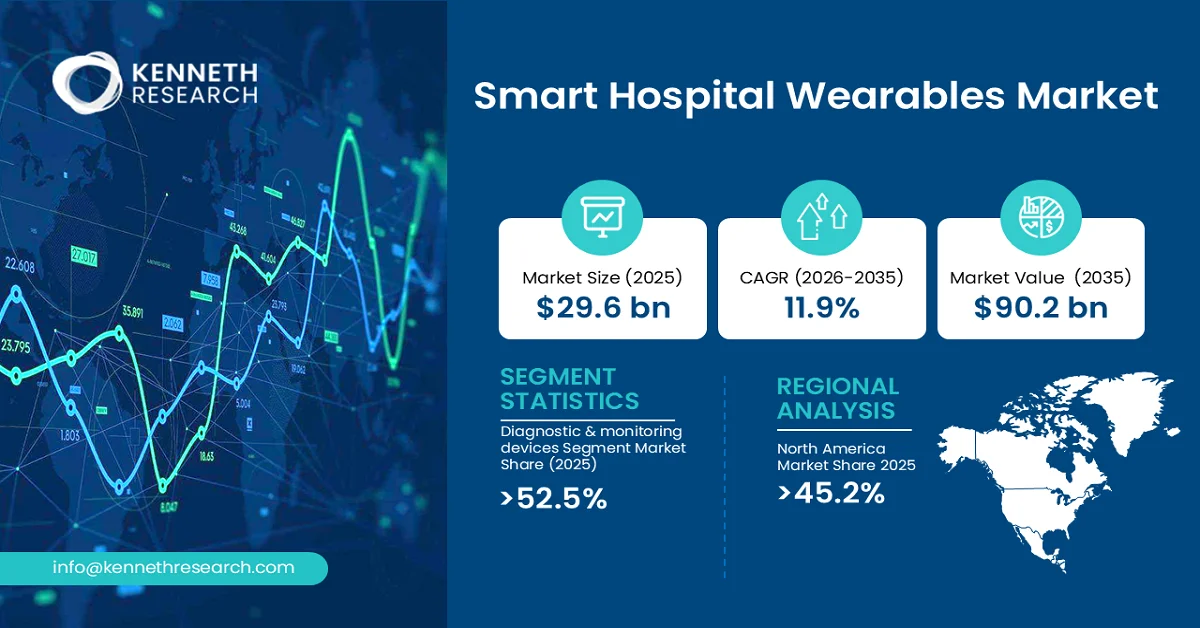
Smart Hospital Wearables Market size was valued at USD 29.6 billion in 2025 and is projected to reach USD 90.2 billion by the end of 2035, rising at a CAGR of 11.9% during the forecast period, i.e., 2026–2035. In 2026, the industry size of the smart hospital wearables market is estimated at USD 33.1 billion.
The primary growth driver for the smart hospital wearables market is the rapid integration of digital health technologies into hospital ecosystems. Governments are strengthening national digital health strategies, interoperability frameworks, and connected care infrastructure, enabling healthcare providers to deploy wearable devices for continuous patient monitoring, clinical decision-making, and workflow optimization.
The smart hospital wearables market comprises wearable medical technologies designed for use within hospital and clinical environments to monitor, diagnose, manage, and support patient care in real time. These devices include diagnostic and monitoring wearables, therapeutic wearables, smart patches, biosensors, wearable ECG monitors, connected infusion support systems, and other body-worn medical devices that continuously capture physiological data and securely transmit it to hospital information systems or electronic health records.
A defining characteristic of the market is its integration with digital health ecosystems, enabling continuous patient monitoring, wireless connectivity, remote clinical supervision, predictive analytics, and data-driven treatment decisions. Smart hospital wearables are engineered to improve patient safety, support early detection of clinical deterioration, reduce manual monitoring workloads, and enhance care coordination across departments. They are increasingly interoperable with cloud platforms, artificial intelligence applications, and hospital digital infrastructure.
The market has become strategically important as healthcare providers accelerate digital transformation initiatives to improve operational efficiency, optimize resource utilization, strengthen patient outcomes, and enable more personalized, connected, and value-based healthcare delivery across acute, ambulatory, and specialized care settings.
Key Smart Hospital Wearables Market Insights Summary:
Key Takeaways: Market Trends & Insights
- The market is projected to expand from USD 29.6 billion in 2025 to USD 90.2 billion by 2035, registering a CAGR of 11.9% during 2026–2035
- Diagnostic & Monitoring Devices led the market with a 52.5% share in 2025, driven by increasing adoption of continuous patient monitoring technologies
- North America accounted for the largest regional share at 45.2% in 2025, supported by advanced healthcare infrastructure and rapid digital health adoption
- Growing integration of artificial intelligence, cloud connectivity, and electronic health records is accelerating the deployment of wearable technologies across hospital environments
- Increasing investments in smart hospitals and connected healthcare infrastructure are creating long-term opportunities for wearable devices that enhance clinical efficiency and patient outcomes
Market Drivers
- Expansion of hospital digital transformation initiatives
- Rising demand for continuous real-time patient monitoring
- Increasing interoperability between wearable devices and hospital information systems
- Growing adoption of remote and hybrid inpatient care models
Challenges
- High integration complexity with legacy hospital infrastructure
- Data privacy, cybersecurity, and regulatory compliance challenges
Smart Hospital Wearables Market Overview & Supply Chain
The adoption of smart hospital wearables is increasing globally as healthcare providers accelerate digital transformation, expand continuous patient monitoring, and integrate connected medical technologies into clinical workflows. Wearable devices enable real-time physiological monitoring, improve care coordination, and support faster clinical interventions by seamlessly connecting with electronic health records (EHRs) and hospital information systems. Regulatory initiatives promoting interoperability and digital health infrastructure are further strengthening deployment across hospitals. According to the OECD Health at a Glance 2023, electronic medical record (EMR) adoption in the hospital sector for inpatient use increased by nearly 45% between 2012 and 2021 across OECD countries, demonstrating the rapid modernization of healthcare infrastructure that supports the integration of smart hospital wearables into routine clinical care.
The smart hospital wearables market value chain begins with the procurement of specialized electronic components, including semiconductor chips, microprocessors, wireless communication modules, biosensors, batteries, medical-grade polymers, adhesives, and advanced packaging materials sourced from global electronics and medical material suppliers. Device manufacturers integrate these inputs through precision engineering, embedded software development, sensor calibration, firmware programming, and regulatory quality testing to produce clinically compliant wearable solutions. Following manufacturing, products are distributed through direct sales teams, medical device distributors, healthcare technology integrators, and hospital procurement networks. System integration partners connect wearable devices with electronic health records, cloud platforms, cybersecurity infrastructure, and hospital information systems to enable seamless data exchange. Primary end users include hospitals, ambulatory surgical centers, specialty clinics, rehabilitation facilities, and long-term care institutions. Major stakeholders across the value chain include component suppliers, original equipment manufacturers, software developers, regulatory authorities, healthcare providers, technology integrators, group purchasing organizations, and after-sales service providers responsible for maintenance, upgrades, and technical support.
Smart Hospital Wearables Market: Growth Drivers & Challenges
Growth Drivers:
- Expansion of Connected Patient Monitoring Platforms: The growing deployment of connected patient monitoring platforms is a major driver for the smart hospital wearables market. Hospitals are increasingly adopting wearable technologies to enable continuous monitoring of patient vital signs beyond intensive care units, allowing clinicians to detect physiological deterioration earlier and respond more efficiently. Integration with electronic health records, cloud-based analytics, and hospital information systems improves workflow efficiency while reducing reliance on periodic manual observations. As healthcare providers focus on improving patient safety, reducing hospital stays, and optimizing staff productivity, wearable monitoring solutions are becoming an essential component of modern hospital infrastructure. The continued introduction of advanced wearable monitoring platforms by leading medical technology companies is further accelerating adoption by offering enhanced mobility, interoperability, and real-time clinical decision support. These innovations are expected to expand wearable deployment across emergency departments, surgical recovery units, and general wards in the coming years. In August 2023, GE HealthCare received U.S. FDA 510(k) clearance for Portrait Mobile, a wireless wearable patient monitoring solution designed to continuously monitor hospitalized patients using wearable sensors while supporting early detection of patient deterioration.
- Growing Integration of Artificial Intelligence and Predictive Clinical Analytics: The integration of artificial intelligence with smart hospital wearables is transforming the delivery of inpatient care by converting continuous physiological data into actionable clinical insights. AI-enabled algorithms can identify subtle changes in patient conditions, prioritize high-risk cases, and support proactive clinical interventions before complications become severe. This capability enhances clinical decision-making while helping healthcare providers optimize resource allocation and reduce alarm fatigue. As hospitals continue investing in digital health ecosystems, wearable devices equipped with predictive analytics are becoming increasingly valuable for improving patient outcomes and operational efficiency. Future advancements in machine learning, edge computing, and interoperable healthcare platforms are expected to strengthen the role of intelligent wearables in personalized medicine, automated clinical workflows, and hospital-wide predictive care strategies, creating long-term opportunities for technology developers and healthcare providers.
Challenges:
- High Integration Complexity and Legacy Hospital Infrastructure: One of the primary restraints affecting the smart hospital wearables market is the complexity of integrating wearable devices with existing hospital infrastructure. Many healthcare facilities continue to operate legacy electronic health record systems, proprietary medical devices, and fragmented IT environments that were not designed for seamless interoperability. As a result, implementing wearable technologies often requires extensive software customization, middleware deployment, cybersecurity enhancements, and workflow redesign. These requirements increase implementation timelines and operational complexity while placing additional demands on hospital IT teams. Commercially, vendors must invest in customized integration services and ongoing technical support, which can lengthen procurement cycles and increase deployment costs. As healthcare systems gradually modernize their digital infrastructure and adopt standardized interoperability frameworks, integration barriers are expected to diminish, enabling broader adoption of smart hospital wearables across diverse clinical settings.
- Data Privacy, Cybersecurity, and Regulatory Compliance Challenges: The continuous collection and transmission of patient health data through smart hospital wearables create significant challenges related to data privacy, cybersecurity, and regulatory compliance. Healthcare organizations must ensure secure data transmission, encrypted storage, identity management, and controlled access across interconnected hospital networks. The increasing sophistication of cyber threats has heightened concerns regarding unauthorized access, data breaches, and potential disruptions to connected medical devices. These risks require manufacturers and healthcare providers to invest substantially in cybersecurity architecture, software validation, regulatory documentation, and post-market monitoring, increasing both development and operational costs. Commercially, stringent compliance requirements can delay product approvals, extend purchasing decisions, and slow implementation within healthcare facilities. Looking ahead, stronger cybersecurity standards, secure-by-design device development, and harmonized regulatory frameworks are expected to improve confidence in connected wearable technologies while supporting sustainable market expansion.
Smart Hospital Wearables Market Size and Forecast:
| Report Attribute | Details |
|---|---|
| Base Year |
2025 |
| Forecast Year |
2026-2035 |
| CAGR |
11.9% |
| Base Year Market Size (2025) |
USD 29.6 billion |
| Forecast Year Market Size (2035) |
USD 90.2 billion |
| Regional Scope |
|
Smart Hospital Wearables Market Segmentation Analysis:
Product Type Segment Analysis
In the product type segment, the diagnostic & monitoring devices sub-segment is anticipated to capture the largest market share of 52.5% by the end of 2025.
Diagnostic & Monitoring Devices dominate the smart hospital wearables market due to the growing emphasis on continuous physiological monitoring, early detection of clinical deterioration, and data-driven patient management within hospital environments. Healthcare providers increasingly rely on wearable devices capable of tracking vital signs, cardiac activity, respiratory parameters, oxygen saturation, and other physiological indicators in real time, enabling clinicians to make faster and more informed treatment decisions. The widespread adoption of digital health platforms and interoperable hospital information systems has further accelerated the integration of wearable monitoring devices into routine clinical workflows. On the supply side, manufacturers continue to advance sensor miniaturization, battery performance, wireless connectivity, and artificial intelligence-enabled analytics, enhancing device reliability and clinical utility while supporting large-scale deployment across inpatient settings. Looking ahead, the segment is expected to maintain its leadership as hospitals increasingly adopt continuous monitoring technologies to improve patient safety, optimize workforce efficiency, and support predictive healthcare models. Supporting this trend, the U.S. Centers for Medicare & Medicaid Services (CMS) states that Medicare covers remote patient monitoring for the collection of physiologic data using internet-connected medical devices for both chronic and acute conditions, reflecting the growing institutional acceptance of connected monitoring technologies that underpin demand for diagnostic and monitoring wearables.
Product Type Segment Analysis
The Therapeutic devices is projected to grow as the second-largest segment in the smart hospital wearables market due to four converging demand drivers.
Therapeutic Devices are projected to witness strong growth in the smart hospital wearables market as healthcare providers increasingly adopt wearable technologies that actively support treatment, rehabilitation, pain management, and chronic disease management alongside patient monitoring. Wearable therapeutic devices, including neuromodulation systems, insulin delivery devices, rehabilitation wearables, and wearable drug delivery technologies, enable continuous therapy while improving patient mobility and treatment adherence within hospital settings. Healthcare organizations are increasingly incorporating these solutions into postoperative recovery, neurological rehabilitation, and chronic care pathways to enhance clinical outcomes and reduce dependence on conventional inpatient therapies. On the supply side, manufacturers are advancing miniaturized electronics, flexible materials, wireless connectivity, and AI-enabled therapeutic algorithms, enabling more personalized and user-friendly treatment solutions. Looking ahead, continued innovation in digital therapeutics, closed-loop therapy systems, and wearable rehabilitation technologies is expected to expand clinical applications and strengthen the role of therapeutic wearables in modern hospital care. Supporting this trend, the U.S. Food and Drug Administration (FDA) maintains a continuously updated database of authorized wearable sensor-based digital health medical devices, including smartwatches, wearable patches, rings, and bands designed for continuous health monitoring and therapeutic applications, reflecting the expanding regulatory acceptance of wearable medical technologies.
Our in-depth analysis of the global smart hospital wearables market includes the following segments:
|
Segment |
Sub-segment |
|
Product Type |
|
|
Type |
|
|
Technology |
|
|
Modality |
|
|
Application |
|
|
End User |
|
|
Distribution Channel |
|
Smart Hospital Wearables Market Regional Insights:
North America Market Trends & Insights
North America smart hospital wearables market is projected to hold the largest revenue share of 45.2% by the end of 2025.
The region's dominance is supported by its advanced healthcare infrastructure, rapid adoption of connected medical technologies, and strong investment in digital health transformation. Hospitals across North America are increasingly integrating wearable devices with electronic health records, cloud-based platforms, and artificial intelligence to enable continuous patient monitoring and improve clinical decision-making. The presence of leading medical device manufacturers, established healthcare technology providers, and a well-developed regulatory framework encourages continuous product innovation and commercialization. In addition, favorable reimbursement pathways, robust hospital capital expenditure, and widespread implementation of interoperability standards continue to strengthen demand for smart hospital wearables across acute care, specialty care, and outpatient settings.
The United States remains the primary contributor to regional growth due to its extensive healthcare technology ecosystem, strong regulatory support, and high adoption of digital health solutions by hospitals and integrated delivery networks.
Canada is also witnessing steady adoption as healthcare providers invest in connected care infrastructure, virtual healthcare services, and hospital modernization initiatives to improve patient outcomes and operational efficiency. Supporting the region's leadership, the Office of the National Coordinator for Health Information Technology (ONC) reported that 96% of non-federal acute care hospitals in the United States had adopted a certified electronic health record system, providing the digital infrastructure necessary for integrating smart hospital wearables into clinical workflows.
Europe Market Trends & Insights
Europe represents a significant market for smart hospital wearables, supported by the region's strong focus on digital healthcare transformation, patient-centered care, and advanced medical technology adoption. Healthcare providers are increasingly deploying wearable devices to enable continuous patient monitoring, improve clinical efficiency, and enhance treatment outcomes across hospital environments. The region benefits from well-established healthcare systems, widespread implementation of electronic health records, and increasing integration of artificial intelligence into clinical workflows. Government initiatives promoting interoperability, secure health data exchange, and digital innovation continue to encourage the adoption of connected medical devices across hospitals and specialty care facilities. In addition, collaborative research programs, public funding for healthcare innovation, and growing investments in smart hospitals are creating favorable conditions for the development and commercialization of advanced wearable technologies. As hospitals continue modernizing their digital infrastructure, Europe is expected to present substantial opportunities for manufacturers offering interoperable, AI-enabled, and clinically validated wearable solutions.
Germany remains a leading contributor due to its technologically advanced healthcare system, strong medical device manufacturing base, and continued investments in hospital digitalization. The country's emphasis on connected healthcare, digital therapeutics, and interoperability is supporting broader adoption of wearable technologies across inpatient and specialized care settings.
The United Kingdom is also emerging as an important market, driven by ongoing digital transformation across the National Health Service (NHS), expanding use of remote patient monitoring, and increasing deployment of connected medical devices to improve clinical efficiency and patient outcomes. Continued collaboration between healthcare providers, technology developers, and research institutions is expected to accelerate innovation and strengthen the adoption of smart hospital wearables across both countries.
Leading Companies Operating in the Global Smart Hospital Wearables Market:
Here is a list of upstream, downstream, and key players operating in the global smart hospital wearables market competitive ecosystem:
- Biotronik (Germany)
- ResMed Inc. (United States)
- GE Healthcare (United States)
- Siemens Healthineers (Germany)
- Abbott Laboratories (United States)
- Huawei Technologies (China)
Recent Developments
- In May 2026, Oura announced the Oura Ring 5, featuring continuous blood pressure signals and nighttime breathing analysis, alongside a confidential IPO filing.
- In December 2025, vTitan launched vCardio, an India-designed wearable point-of-care cardiac monitor featuring edge-AI algorithms capable of detecting and classifying over 20 clinically significant cardiac arrhythmias in real-time.
Frequently Asked Question
In 2025, the smart hospital wearables market exceeded USD 29.6 billion.
The smart hospital wearables market is projected to reach USD 90.2 billion by the end of 2035, expanding at a CAGR of 11.9% over the forecast period (2026–2035).
The major players in the market are Biotronik, ResMed Inc., GE Healthcare, Siemens Healthineers, Abbott Laboratories, Huawei Technologies, and others.
In the Type segment, the diagnostic & monitoring devices sub-segment is anticipated to capture the largest market share of 52.5% in the future and exhibit lucrative growth opportunities during 2026–2035. This growth trajectory is largely attributed to the increasing adoption of continuous patient monitoring solutions integrated with connected hospital infrastructure and digital health platforms.
North America is projected to hold the largest market share of 45.2% by the end of 2035 and provide more business opportunities in the future. Continuous investments in digital healthcare infrastructure, connected medical technologies, and hospital modernization across the United States and Canada are fostering the region's dominance.
Why Choose Kenneth Research ?
-
Insight with Impact : We don’t just gather data — we uncover stories, trends, and opportunities that fuel business growth.
-
Experts Who Get It : Our team speaks your industry’s language and knows what really matters to your customers and market.
-
Custom-Built for You : Forget one-size-fits-all. We craft research and consulting solutions as unique as your business vision.
-
Partners, Not Just Providers : We work with you, not for you — collaborating closely to turn insights into smart, strategic moves.
-
Results That Speak : Our work powers brands, startups, and industry leaders alike — with a track record of ideas that work in the real world.
Report ID: 1038 |
Published Date: 27 Jul 2026 |
Report Format: |
Delivery Timeline: 48-72 Business Hours

Copyright © 2025 Kenneth Research. All rights reserved. Terms of Use | Privacy Policy
