Report ID: 1434 |
Published Date: 29 Sep 2026 |
Report Format: |
Delivery Timeline: 48-72 Business Hours
Smart Grid Technology Market Outlook:
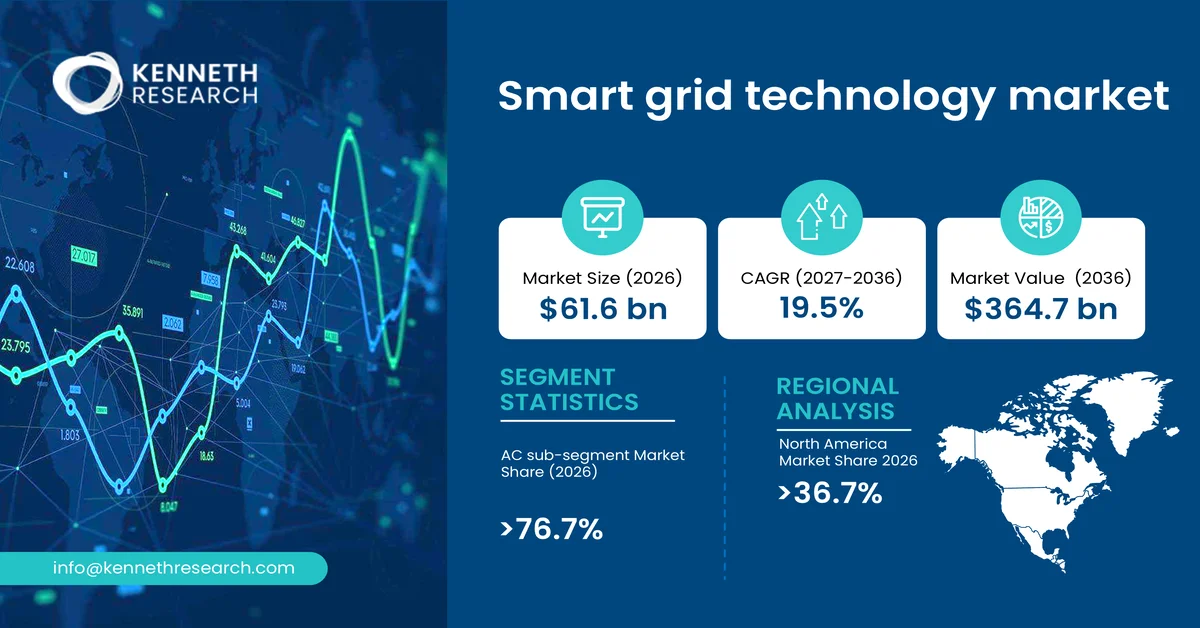
Smart grid technology market size was valued at USD 61.6 billion in 2026 and is projected to reach USD 364.7 billion by the end of 2036, expanding at a CAGR of 19.5% during the forecast period, i.e., 2027–2036. In 2027, the industry size of the smart grid technology market is estimated at USD 73.4 billion.
A primary growth driver for the smart grid technology market is the accelerating need to modernize electricity infrastructure for greater flexibility, reliability, renewable-energy integration, and resilience.
The smart grid technology market comprises digital technologies, equipment, software, and related services used to modernize electricity generation, transmission, distribution, and consumption systems. Smart grids integrate physical power infrastructure with digital capabilities such as sensing, two-way communications, automated controls, computing, data management, advanced metering, grid monitoring, and analytics. These capabilities allow utilities and grid operators to monitor system conditions, identify faults, coordinate distributed energy resources, manage electricity flows, and respond more effectively to changing demand and supply conditions.
A key characteristic of smart grid technology is the integration of digital and physical infrastructure to create a more responsive and interconnected electricity network. The technology supports improved reliability, operational efficiency, resilience, security, renewable-energy integration, and customer participation in energy management. The U.S. Department of Energy identifies sensing, communications, control, computing, and data and information management as core elements of smart-grid functionality.
Key Smart Grid Technology Market Insights Summary:
Key Takeaways: Market Trends & Insights
- The smart grid technology market is projected to expand from USD 73.4 billion in 2027 to USD 364.7 billion by 2036 at a CAGR of 19.5%
- The AC segment leads the Grid Type category with a 76.7% market share in 2026, supported by grid modernization and renewable-energy integration
- North America dominates the market with a 36.7% market share in 2026, supported by grid modernization, digital monitoring, automation, and resilience investments
- Implementation and Deployment is identified as the second and fastest analysis segment within the Service Type category, driven by increasing grid modernization and technology integration requirements
- The market is supported by major players including Smart Wires Technology Ltd., Uplight, EnergyHub, Belden Inc., Xylem Inc., and Fujitsu Limited
Market Drivers
- Expansion of distributed energy resources
- Rising electrification and grid modernization requirements
- Integration of renewable energy and energy storage
- Increasing emphasis on grid resilience, reliability, and cybersecurity
Challenges
- High integration complexity with legacy grid infrastructure
- Cybersecurity and data-management risks
Smart Grid Technology Market Overview & Supply Chain
Adoption of the smart grid technology market is increasing globally as electricity systems transition toward greater electrification, renewable-energy integration, distributed generation, energy storage, and digitally managed demand. Utilities and grid operators are deploying digital monitoring, automation, advanced metering, communications, and control technologies to improve reliability, resilience, flexibility, and operational visibility.
The value chain of the smart grid technology market begins with sourcing electronic components, electrical equipment, semiconductors, sensors, communication hardware, computing components, power-system equipment, software, and other specialized inputs. Manufacturers and technology providers integrate these inputs into smart meters, sensors, automation equipment, digital substations, grid-management platforms, communication systems, control technologies, and related solutions. System integrators then configure and connect hardware and software with existing utility infrastructure, while engineering and consulting providers support planning, installation, testing, cybersecurity, and interoperability. Distribution occurs through direct utility procurement, technology vendors, engineering contractors, system integrators, and specialized channel partners. End users primarily include electricity utilities, transmission and distribution operators, industrial facilities, commercial organizations, municipalities, and other energy-system operators.
Smart Grid Technology Market - Growth Drivers & Challenges
Growth Drivers
- Expansion of Distributed Energy Resources: The growing deployment of distributed energy resources is strengthening demand for smart grid technologies because utilities need greater visibility, coordination, and control across increasingly decentralized electricity systems. Distributed solar, storage, electric-vehicle infrastructure, flexible loads, and other grid-edge assets require digital platforms capable of monitoring operating conditions and balancing variable generation with demand.
- Rising Electrification and Grid Modernization Requirements: Electrification across transportation, buildings, industry, and digital infrastructure is increasing the complexity of electricity-system planning and operation. As new loads connect to existing networks, utilities require improved forecasting, automated controls, digital monitoring, and flexible demand-management capabilities to maintain reliable service. Renewable generation adds another layer of complexity because its output can vary according to weather conditions, increasing the value of responsive grid technologies.
Challenges
- High Integration Complexity with Legacy Grid Infrastructure: A major restraint is the technical complexity of integrating smart grid technologies with aging and heterogeneous electricity infrastructure. Utilities often operate networks containing equipment, communication protocols, control systems, and software platforms from different generations and vendors. Connecting new digital technologies to these legacy environments can require extensive system engineering, interoperability testing, cybersecurity upgrades, and operational redesign.
- Cybersecurity and Data-Management Risks: Increasing digitalization creates a second major restraint through the expansion of the grid's cyberattack surface and the volume of operational data that utilities must manage. Smart meters, connected sensors, automated controls, communications networks, distributed energy resources, and cloud-based platforms introduce additional digital interfaces that require continuous protection. A security incident can disrupt operations, compromise sensitive information, or undermine confidence in connected grid infrastructure.
Smart Grid Technology Market Size and Forecast:
| Report Attribute | Details |
|---|---|
| Base Year |
2026 |
| Forecast Year |
2027-2036 |
| CAGR |
19.5% |
| Base Year Market Size (2026) |
USD 61.6 billion |
| Forecast Year Market Size (2036) |
USD 364.7 billion |
| Regional Scope |
|
Smart Grid Technology Market - Segment Analysis
Grid Type Segment Analysis
In the grid type segment, AC sub-segment is anticipated to capture the largest market share of 76.7% by the end of 2026.
The AC segment dominates the grid-type category because existing electricity networks are predominantly built around alternating-current transmission and distribution architectures, creating a broad installed base and strong compatibility requirements for smart-grid modernization. Demand is being reinforced by rising electricity consumption, renewable generation integration, distributed energy resources, and the need for automated monitoring and control across transmission and distribution networks. The U.S. Energy Information Administration reported that U.S. electricity demand increased 2% in the second half of 2024 compared with the same period in 2023, strengthening the operational requirement for grid capacity, visibility, and responsive management. This demand environment supports continued deployment of AC-compatible smart meters, sensors, protection systems, automation equipment, communications infrastructure, and digital control platforms.
Service Type Segment Insights
The implementation and deployment is projected to grow as the second-largest segment in the smart grid technology market due to four converging demand drivers.
Implementation and deployment is projected to grow strongly within the service-type category as utilities increasingly require specialized support to integrate digital grid technologies with existing electricity infrastructure. Demand is being driven by renewable-energy integration, distributed energy resources, network modernization, and the need to translate hardware and software investments into operational grid capabilities. The International Energy Agency reported that annual global grid investment is expected to reach USD 400 billion in 2024, with spending driven by new policies and funding across major electricity markets. This investment environment creates opportunities for engineering, system integration, installation, commissioning, interoperability testing, and deployment-management services.
Our in-depth analysis of the smart grid technology market includes the following segments:
|
Segment |
Sub-segment |
|
Grid Type |
|
|
Service Type |
|
|
Technology |
|
|
Vertical |
|
Smart Grid Technology Market - Regional Analysis
North America Market Trends & Insights:
North America smart grid technology market is projected to hold the largest revenue share of 36.7% by the end of 2026.
Regional leadership is supported by a mature electricity infrastructure, substantial utility investment, advanced digital-grid capabilities, and strong demand for system modernization.
The United States is expected to remain the principal country-level contributor because of its large and technologically diverse power system, extensive utility base, and continuing grid-modernization requirements. Investment is increasingly focused on digital monitoring, automation, cybersecurity, distributed-energy integration, and improved network resilience.
Canada provides a complementary growth market, particularly through its large-scale electricity infrastructure, clean-power resources, and cross-border electricity relationships. The two markets also benefit from established equipment suppliers, engineering capabilities, utilities, and regulatory institutions, creating a comparatively developed ecosystem for smart-grid deployment. Future regional growth should remain closely linked to grid modernization, electrification, renewable-energy integration, and the need to improve operational flexibility across increasingly complex electricity networks.
Asia Pacific Market Trends & Insights:
Asia Pacific is emerging as a strategically important market for smart grid technology, supported by expanding electricity demand, rapid urbanization, industrial development, renewable-energy deployment, and modernization of transmission and distribution infrastructure. Governments are increasingly prioritizing intelligent, flexible, and digitally enabled power networks to accommodate distributed generation, energy storage, electric-vehicle charging, and changing industrial loads.
China is a key regional market, with government policy emphasizing intelligent and digital distribution networks capable of accommodating renewable generation and new electricity-system technologies.
India represents another significant opportunity as grid modernization, renewable integration, electrification, and distribution-system improvements increase demand for digital grid infrastructure. Together, both countries offer substantial opportunities for equipment suppliers, technology developers, engineering companies, utilities, and system integrators.
Smart Grid Technology Market Competitive Landscape
Here is a list of upstream, downstream, and key players operating in smart grid technology market competitive ecosystem:
- Smart Wires Technology Ltd. (United States)
- Company Overview
- Business Strategy
- Key Product Offerings
- Financial Performance
- Key Performance Indicators
- Risk Analysis
- Recent Development
- Regional Presence
- SWOT Analysis
- Uplight (United States)
- EnergyHub (United States)
- Belden Inc. (United States)
- Xylem Inc. (United States)
- Fujitsu Limited (Japan)
Recent Developments
- In March 2026, EnergyHub announced a partnership with Austin Energy to launch the Power Partner Battery pilot program, expanding the utility's multi-DER virtual power plant (VPP) capabilities.
The new residential "Bring Your Own Battery" (BYOB) program allows customers to enroll their home batteries (from Tesla, FranklinWH, and SolarEdge) to earn rewards for supporting grid reliability. Austin Energy's existing programs already deliver more than 57 MW of flexible capacity, and the battery program accelerates the utility's goal of achieving 78 MW of summer peak reduction capacity by 2027. - In December 2025, Fujitsu Limited and The University of Tokyo launched a trial for Japan's first cloud-connected inter-regional workload shift based on power grid conditions.
The trial, part of the Watt-Bit Collaboration Project, ran from January 5 to March 31, 2026, and aimed to optimize electricity supply and demand by shifting data center workloads between regions based on grid load status and electricity market prices. The initiative supports the decentralization of data centers near renewable energy sources and contributes to Japan's carbon neutrality goals.
Frequently Asked Question
In 2026, the smart grid technology market exceeded USD 61.6 billion.
The smart grid technology market is projected to reach USD 364.7 billion by the end of 2036, expanding at a CAGR of 19.5% over the forecast period (2027-2036).
The major players in the market are Smart Wires Technology Ltd. (United States), Uplight (United States), EnergyHub (United States), Belden Inc. (United States), Xylem Inc. (United States), Fujitsu Limited (Japan), and others.
In the Grid Type segment, the AC sub-segment is anticipated to capture the largest market share of 76.7% in the future and exhibit lucrative growth opportunities during 2027-2036. This growth trajectory is largely attributed to increasing grid modernization and the integration of renewable energy and distributed energy resources.
North America is projected to hold the largest market share of 36.7% by the end of 206 and provide more business opportunities in the future. Continuous investments in grid modernization, digital monitoring, automation, renewable-energy integration, and grid resilience across the United States and Canada are fostering the region's dominance.
Why Choose Kenneth Research ?
-
Insight with Impact : We don’t just gather data — we uncover stories, trends, and opportunities that fuel business growth.
-
Experts Who Get It : Our team speaks your industry’s language and knows what really matters to your customers and market.
-
Custom-Built for You : Forget one-size-fits-all. We craft research and consulting solutions as unique as your business vision.
-
Partners, Not Just Providers : We work with you, not for you — collaborating closely to turn insights into smart, strategic moves.
-
Results That Speak : Our work powers brands, startups, and industry leaders alike — with a track record of ideas that work in the real world.
Report ID: 1434 |
Published Date: 29 Sep 2026 |
Report Format: |
Delivery Timeline: 48-72 Business Hours

Copyright © 2025 Kenneth Research. All rights reserved. Terms of Use | Privacy Policy
