Report ID: 1160 |
Published Date: 25 Aug 2026 |
Report Format: |
Delivery Timeline: 48-72 Business Hours
Silicone Surfactant Market Outlook:
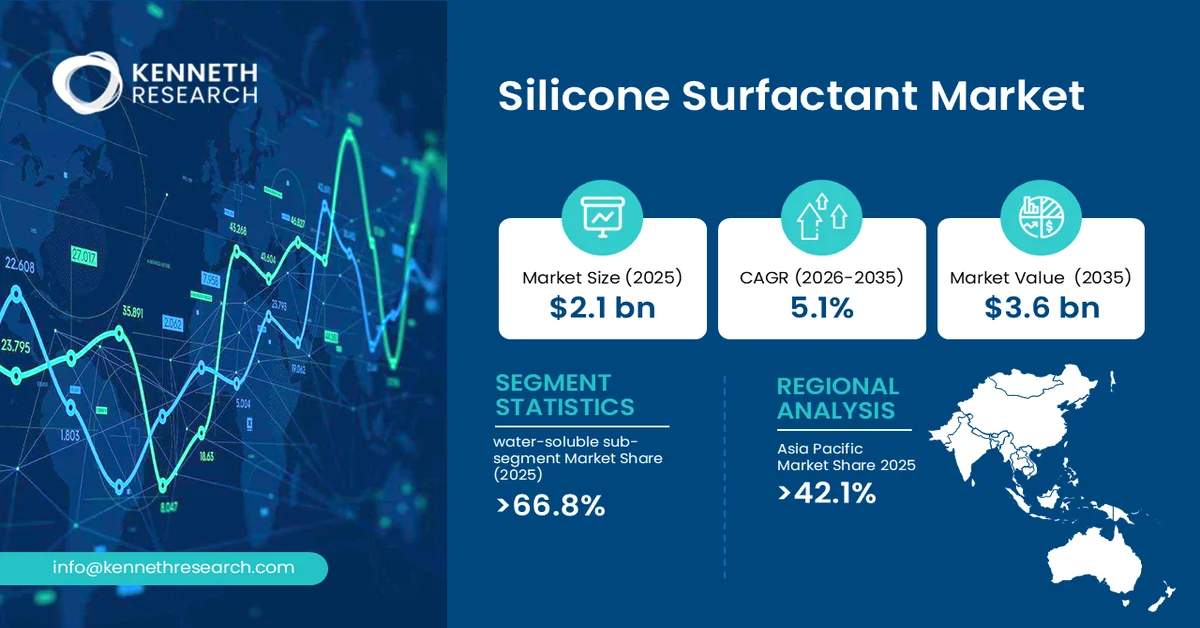
Silicone Surfactant Market size was valued at USD 2.1 billion in 2025 and is projected to reach USD 3.6 billion by the end of 2035, rising at a CAGR of 5.1% during the forecast period, i.e., 2026-2035. In 2026, the industry size of the silicone surfactant is estimated at USD 2.3 billion.
The primary growth driver for the silicone surfactant market is rising demand for high-performance formulation additives across personal care, construction, agriculture, and polyurethane foam applications. Silicone surfactants improve wetting, emulsification, spreading, and foam stabilization, making them indispensable in industrial formulations where performance, process efficiency, and product consistency are critical. The construction sector, a major end-use industry for silicone-based materials, accounts for 13% of global GDP, underscoring the scale of downstream demand.
The silicone surfactant market comprises specialty surface-active agents based on organosilicone chemistry that combine silicone backbones with hydrophilic functional groups to reduce surface tension and enhance interfacial performance. These materials are formulated to deliver superior wetting, spreading, emulsification, defoaming, and foam stabilization compared with many conventional organic surfactants, enabling improved processing efficiency and end-product performance across multiple industries.
Silicone surfactants are available in various formulations to meet application-specific requirements, including compatibility with water-based and solvent-based systems, controlled foaming characteristics, and enhanced substrate coverage. Their unique molecular structure provides excellent thermal stability, chemical resistance, and surface modification properties, making them suitable for demanding industrial environments.
Industrially, silicone surfactants are integral to personal care products, polyurethane foam manufacturing, coatings, textiles, agriculture, and specialty chemical formulations. They support product quality, manufacturing consistency, and functional performance by improving ingredient dispersion, coating uniformity, and formulation stability. Their versatility and compatibility with advanced material systems make silicone surfactants an important class of specialty chemicals supporting innovation across consumer and industrial value chains.
Key Silicone Surfactant Market Insights Summary:
Key Takeaways: Market Trends & Insights
- Silicone Surfactant Market is projected to expand from USD 2.3 billion in 2026 to USD 3.6 billion by 2035, registering a 5.1% CAGR during the forecast period
- Water-Soluble products accounted for the largest 66.8% market share in 2025, supported by increasing adoption in water-based formulations across personal care, agriculture, coatings, and industrial applications
- Asia Pacific held the leading 42.1% market share in 2025, driven by strong specialty chemical manufacturing capabilities and expanding industrial demand in China and India
- The cosmetics end-user industry is expected to witness robust growth as manufacturers increasingly utilize silicone surfactants to improve emulsification, spreadability, formulation stability, and sensory performance in premium personal care products
- Increasing demand from polyurethane foam, construction, coatings, and specialty chemical applications continues to strengthen the long-term growth outlook for the silicone surfactant market through ongoing product innovation and industrial investments
Market Drivers
- Increasing adoption of silicone surfactants in agricultural adjuvant formulations.
- Growing demand for high-performance additives in industrial coatings and paints.
- Expansion of advanced polyurethane foam manufacturing across emerging economies.
- Rising investment in specialty chemicals focused on sustainable and multifunctional formulations.
Challenges
- Raw material supply volatility and fluctuating specialty chemical feedstock costs.
- Increasing regulatory and sustainability compliance requirements for specialty chemical formulations.
Silicone Surfactant Market Overview & Supply Chain
Global adoption of silicone surfactants is increasing as manufacturers seek advanced additives that improve formulation efficiency, surface performance, and process reliability across construction, personal care, agriculture, coatings, and polyurethane foam production. Their ability to enhance wetting, emulsification, foam control, and substrate coverage aligns with growing industrial demand for high-performance and sustainable formulations. The market is also benefiting from regulatory emphasis on energy-efficient buildings and lower-emission manufacturing, where high-performance materials contribute to improved product durability and resource efficiency.
The silicone surfactant value chain begins with the procurement of silicon metal, siloxanes, polyethers, specialty alcohols, catalysts, and other functional intermediates supplied by upstream chemical producers. These raw materials undergo controlled synthesis through silicone modification, polymerization, and blending processes to produce surfactants with application-specific characteristics such as enhanced wetting, foam stabilization, emulsification, or defoaming performance. Manufacturers implement stringent quality assurance and formulation testing to ensure consistency across industrial and consumer applications. Finished products are distributed through direct sales networks, specialty chemical distributors, and regional channel partners serving global markets. Downstream customers include producers of polyurethane foams, personal care formulations, coatings, agricultural adjuvants, textiles, and industrial cleaning products. Key stakeholders across the value chain comprise raw material suppliers, silicone chemistry manufacturers, formulation specialists, contract manufacturers, distributors, regulatory agencies, research institutions, and end-use industries focused on performance optimization and product innovation.
Silicone Surfactant Market - Growth Drivers & Challenges
Growth Drivers:
- Expanding demand for high-performance polyurethane foam applications: The increasing use of polyurethane foams across construction, furniture, automotive, and insulation applications is a major catalyst for the silicone surfactant market. Silicone surfactants play a critical role in regulating cell structure, foam stability, air flow, and dimensional consistency during foam production, directly influencing product quality and manufacturing efficiency. As industries prioritize lightweight materials, thermal insulation, and durable cushioning solutions, manufacturers are adopting advanced silicone surfactants to achieve tighter process control and consistent product performance. The long-term transition toward energy-efficient buildings and lightweight transportation further strengthens demand for specialty additives that enhance foam characteristics without compromising productivity.
- Rising innovation in personal care and specialty formulations: Growing innovation in cosmetics, skin care, hair care, and specialty chemical formulations is accelerating demand for silicone surfactants that deliver enhanced sensory properties and formulation stability. These materials improve spreading behavior, emulsification efficiency, ingredient compatibility, and product aesthetics, enabling manufacturers to develop premium formulations with improved consumer performance. Increasing research into multifunctional ingredients is encouraging formulators to replace conventional additives with advanced silicone-based alternatives capable of meeting evolving regulatory and consumer expectations. In addition, demand for products with improved durability, texture, and application performance is prompting continuous investment in silicone chemistry innovation. Future opportunities are expected to emerge from multifunctional formulations, bio-based silicone technologies, and customized surfactant systems designed for specific industrial processes, allowing manufacturers to differentiate products while improving production efficiency and supporting higher-value specialty applications.
Challenges:
- Volatility in silicone-based raw material supply and feedstock costs: The silicone surfactant market is significantly affected by fluctuations in the availability and pricing of silicone intermediates, siloxanes, polyethers, and other specialty chemical feedstocks. Production depends on complex upstream supply chains that are vulnerable to changes in energy costs, environmental compliance requirements, plant maintenance shutdowns, and geopolitical trade disruptions. Such volatility complicates procurement planning and increases production costs for manufacturers, particularly those operating under long-term customer contracts with limited pricing flexibility. Commercially, unpredictable raw material expenses can compress profit margins, delay product launches, and reduce investment in formulation innovation. End users may also face longer lead times and higher procurement costs, encouraging the evaluation of alternative additives for cost-sensitive applications. Looking ahead, companies are expected to strengthen supplier diversification, regional sourcing strategies, and inventory management practices to improve supply resilience while maintaining consistent product quality.
- Balancing performance requirements with evolving sustainability and regulatory expectations: Manufacturers of silicone surfactants face increasing pressure to deliver high-performance products while complying with evolving environmental, chemical safety, and product stewardship requirements across multiple jurisdictions. Many end-use industries now require formulations with enhanced sustainability profiles, lower environmental impact, and greater transparency regarding chemical composition and lifecycle performance. Meeting these expectations often requires substantial investment in research, reformulation, regulatory testing, and validation without compromising the functional advantages that silicone surfactants provide. Commercially, longer product development cycles and higher compliance costs can slow market entry and increase barriers for smaller manufacturers. Differences in regional regulatory frameworks further complicate global product commercialization and portfolio standardization. Over the long term, companies that successfully integrate sustainable chemistry, regulatory readiness, and application-specific innovation into product development are likely to strengthen their competitive positioning while adapting more effectively to changing customer requirements.
Silicone Surfactant Market Size and Forecast:
| Report Attribute | Details |
|---|---|
| Base Year |
2025 |
| Forecast Year |
2026-2035 |
| CAGR |
5.1% |
| Base Year Market Size (2025) |
USD 2.1 billion |
| Forecast Year Market Size (2035) |
USD 3.6 billion |
| Regional Scope |
|
Silicone Surfactant Market Segmentation Analysis:
Product Type Segment Analysis
In the product type segment, the water-soluble sub-segment is anticipated to capture the largest market share of 66.8% by the end of 2025.
The water-soluble segment leads the silicone surfactant market due to its broad compatibility with water-based formulations used across personal care, agriculture, coatings, textiles, and industrial cleaning applications. These surfactants provide excellent wetting, spreading, emulsification, and foam stabilization, making them well suited for industries that increasingly favor water-based processing to improve operational efficiency and meet evolving environmental requirements. Demand is particularly strong from manufacturers seeking formulation flexibility, improved ingredient dispersion, and consistent product performance across diverse applications. On the supply side, established production technologies, scalable manufacturing capabilities, and the availability of tailored silicone-polyether chemistries have enabled suppliers to offer customized products for different industrial needs. Continued innovation in multifunctional formulations is also expanding their use in high-value specialty applications. Supporting this demand trend, the Organisation for Economic Co-operation and Development (OECD) notes that technically and economically feasible alternatives in cosmetic formulations include silicone polyethers serving functions such as emulsion stabilisation, demonstrating the established industrial role of water-compatible silicone chemistries in modern formulations.
End-User Industry Segment Analysis
The cosmetics is projected to grow as the second-largest segment in the silicone surfactant market due to four converging demand drivers.
The cosmetics segment is projected to witness strong growth in the silicone surfactant market as manufacturers increasingly incorporate silicone surfactants into skin care, hair care, color cosmetics, and hybrid beauty formulations to improve spreadability, emulsification, sensory feel, and formulation stability. Consumer demand for premium products with enhanced texture and long-lasting performance is encouraging formulators to adopt advanced silicone-based ingredients that deliver multifunctional benefits while maintaining compatibility with diverse active ingredients. On the supply side, continuous investment in specialty silicone chemistry, customized formulation technologies, and regulatory-compliant ingredient development is enabling suppliers to address evolving performance and sustainability requirements. Future growth is expected to be supported by innovations in multifunctional personal care products, water-based formulations, and high-value specialty cosmetics.
Our in-depth analysis of the global silicone surfactant market includes the following segments:
|
Segment |
Sub-segment |
|
Product Type |
|
|
Application |
|
|
End-User Industry |
|
Silicone Surfactant Market Regional Insights:
Asia Pacific Market Trends & Insights
Asia Pacific silicone surfactant market is projected to hold the largest revenue share of 42.1% by the end of 2025.
The region benefits from integrated supply chains for silicone intermediates, cost-competitive manufacturing, and sustained investments in advanced chemical processing capabilities. Favorable industrial policies, growing domestic consumption, and continuous expansion of manufacturing infrastructure have further reinforced regional leadership. In addition, the presence of major chemical producers and increasing investments in high-performance materials support the development of application-specific silicone surfactants for both domestic and export markets. Demonstrating the strength of the regional manufacturing ecosystem, China's National Bureau of Statistics reported that the manufacture of raw chemical materials and chemical products increased by 9.6% in 2023 compared with the previous year, highlighting the robust industrial foundation supporting specialty chemical markets.
China serves as the region's principal production hub, supported by a comprehensive chemical manufacturing ecosystem, integrated raw material availability, and significant investments in specialty materials used across construction, automotive, consumer goods, and personal care industries. Its strong export capabilities and continuous technological advancements enable manufacturers to develop high-performance silicone surfactants tailored to diverse industrial applications.
India is emerging as a high-growth market, driven by rapid expansion in specialty chemicals, increasing domestic manufacturing, and rising demand from personal care, agriculture, and infrastructure sectors. Government initiatives promoting industrial development, coupled with growing investments in value-added chemical production and expanding downstream manufacturing, are encouraging both domestic and international suppliers to strengthen their presence. Together, China and India provide a balanced combination of production capacity, expanding consumption, and innovation, reinforcing Asia Pacific's leadership in the global silicone surfactant industry.
Europe Market Trends & Insights
Europe represents a strategically important region for the silicone surfactant market, supported by its advanced specialty chemicals industry, mature manufacturing ecosystem, and strong demand from personal care, construction, automotive, coatings, and industrial processing sectors. The region continues to emphasize sustainable manufacturing, high-performance materials, and regulatory compliance, encouraging the adoption of silicone surfactants in applications requiring enhanced formulation efficiency and product performance. Ongoing investments in research and development, circular economy initiatives, and advanced material technologies are fostering innovation in specialty silicone chemistries. In addition, Europe's focus on resource-efficient production and environmentally responsible industrial processes is creating opportunities for manufacturers to develop next-generation silicone surfactants that meet evolving customer and regulatory requirements. As industries increasingly prioritize multifunctional additives and premium formulations, the region is expected to remain an important center for product innovation, application development, and value-added specialty chemical production.
Germany serves as Europe's leading market due to its well-established chemical manufacturing sector, extensive industrial base, and strong presence of global producers specializing in advanced materials and formulation technologies. Demand is supported by applications in polyurethane systems, industrial coatings, automotive components, and personal care products, while continuous investment in specialty chemical innovation strengthens domestic production capabilities.
France complements regional growth through its internationally recognized cosmetics and personal care industry, where manufacturers increasingly utilize high-performance silicone surfactants to improve formulation stability, sensory characteristics, and product functionality. The country's emphasis on sustainable ingredient development, premium consumer products, and research-driven innovation further supports the adoption of advanced silicone technologies, reinforcing Europe's position as a key market for specialty surfactant applications.
Leading Companies Operating in the Global Silicone Surfactant Market:
Here is a list of upstream, downstream, and key players operating in the global silicone surfactant market competitive ecosystem:
- Momentive Performance Materials Inc. (United States)
- Company Overview
- Business Strategy
- Key Product Offerings
- Financial Performance
- Key Performance Indicators
- Risk Analysis
- Recent Development
- Regional Presence
- SWOT Analysis
- Wacker Chemie AG (Germany)
- Elkem Silicones (Norway)
- Siltech Corporation (Canada)
Recent Developments
- In January 2025, the European Chemicals Agency (ECHA) added octamethyltrisiloxane (trisiloxane) to its Candidate List of substances of very high concern, labeling it "very persistent and very bioaccumulative" . This silicone compound is widely used as a conditioning agent, emollient, and solvent in personal care products. Under REACH regulations, suppliers in the EU using this chemical in concentrations above 0.1% must now inform consumers about its safety risks . This regulatory development has significant implications for silicone surfactant manufacturers serving the personal care industry.
- In 2025, the European Commission closed its proposal to nominate D4, D5, and D6 cyclosiloxanes under the Stockholm Convention on Persistent Organic Pollutants (POPs) . This decision followed extensive industry consultation and provides regulatory clarity for silicone manufacturers. However, REACH restrictions remain in place, with D4, D5, and D6 use already restricted in wash-off personal care products since 2020, with restrictions extended to leave-on cosmetic products in 2024.
Frequently Asked Question
In 2025, the silicone surfactant market exceeded USD 2.1 billion.
The silicone surfactant market is projected to reach USD 3.6 billion by the end of 2035, expanding at a CAGR of 5.1% over the forecast period (2026-2035).
The major players in the market are Momentive Performance Materials Inc. (United States), Wacker Chemie AG (Germany), Elkem Silicones (Norway), Siltech Corporation (Canada), and others.
In the product type segment, the Water-Soluble sub-segment is anticipated to capture the largest market share of 66.8% in the future and exhibit lucrative growth opportunities during 2026–2035. This growth trajectory is largely attributed to increasing demand for high-performance water-based formulations across personal care, agriculture, coatings, textiles, and industrial applications.
Asia Pacific is projected to hold the largest market share of 42.1% by the end of 2025 and provide more business opportunities in the future. Continuous investments in specialty chemical manufacturing and expanding downstream industries in China and India are fostering the region's dominance.
Why Choose Kenneth Research ?
-
Insight with Impact : We don’t just gather data — we uncover stories, trends, and opportunities that fuel business growth.
-
Experts Who Get It : Our team speaks your industry’s language and knows what really matters to your customers and market.
-
Custom-Built for You : Forget one-size-fits-all. We craft research and consulting solutions as unique as your business vision.
-
Partners, Not Just Providers : We work with you, not for you — collaborating closely to turn insights into smart, strategic moves.
-
Results That Speak : Our work powers brands, startups, and industry leaders alike — with a track record of ideas that work in the real world.
Report ID: 1160 |
Published Date: 25 Aug 2026 |
Report Format: |
Delivery Timeline: 48-72 Business Hours

Copyright © 2025 Kenneth Research. All rights reserved. Terms of Use | Privacy Policy
