Report ID: 1144 |
Published Date: 24 Aug 2026 |
Report Format: |
Delivery Timeline: 48-72 Business Hours
Silicone Roof Coating Market Outlook:
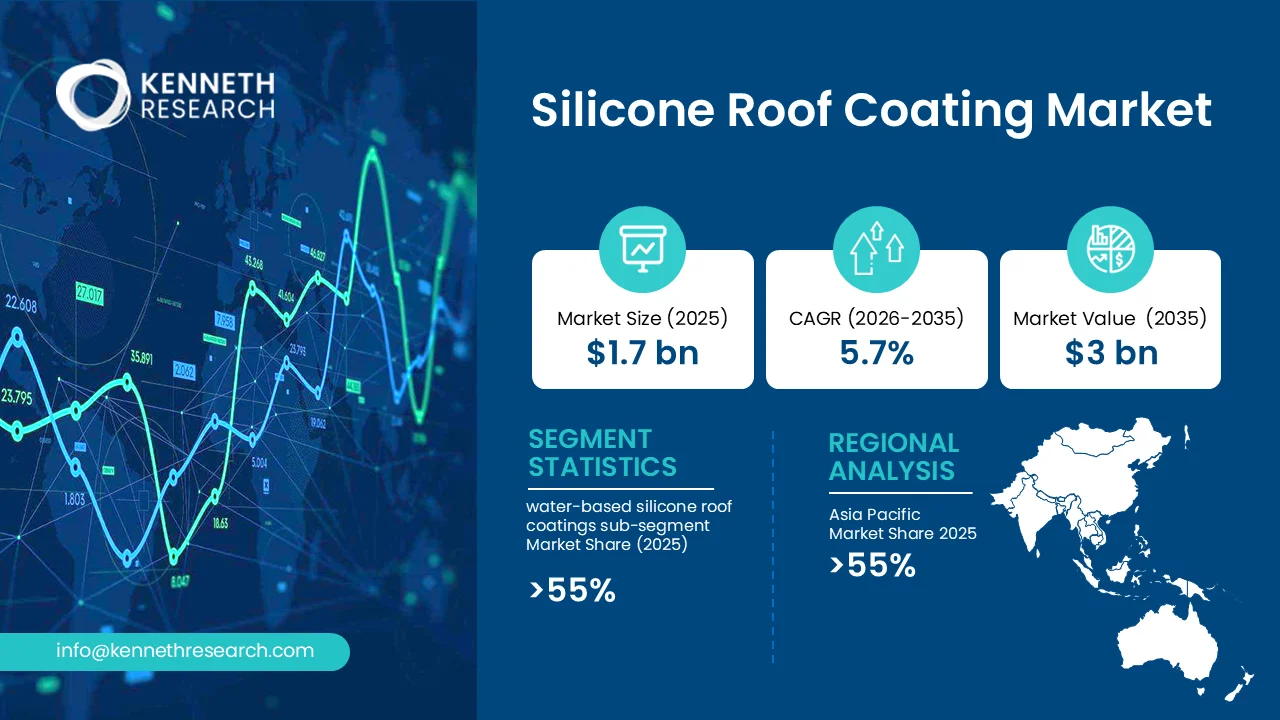
Silicone Roof Coating Market size was valued at USD 1.7 billion in 2025 and is projected to reach USD 3 billion by the end of 2035, expanding at a CAGR of 5.7% during the forecast period, i.e., 2026–2035. In 2026, the industry size of the silicone roof coating is estimated at USD 1.8 billion.
The primary growth driver of the silicone roof coating market is the increasing demand for durable, energy-efficient, and weather-resistant roofing solutions. Growing investments in commercial roof restoration, rising emphasis on extending roof lifespan instead of replacement, and stricter building sustainability requirements are accelerating the adoption of silicone roof coatings across new construction and renovation projects.
The silicone roof coating market comprises silicone-based liquid-applied protective coatings designed to restore, waterproof, and enhance the performance of existing and new roofing systems. These coatings form a seamless, flexible membrane after curing, providing long-term protection against moisture intrusion, ultraviolet radiation, thermal stress, ponding water, and environmental degradation. They are widely compatible with various roof substrates, including metal, concrete, modified bitumen, single-ply membranes, and spray polyurethane foam, making them a preferred solution for roof maintenance and refurbishment.
Silicone roof coatings are recognized for their excellent weatherability, high elasticity, superior adhesion, and ability to maintain performance under prolonged exposure to harsh climatic conditions. Their reflective properties also contribute to reducing rooftop heat absorption, supporting energy-efficient building operations and improved indoor thermal comfort. The market plays an important role in the construction, infrastructure, industrial, commercial, and institutional sectors by enabling cost-effective roof restoration while minimizing material waste associated with complete roof replacement. Increasing focus on sustainable building practices, lifecycle cost optimization, and resilient infrastructure continues to strengthen the industrial relevance of silicone roof coating technologies.
Key Silicone Roof Coating Market Insights Summary:
Key Takeaways: Market Trends & Insights
- Silicone Roof Coating Market is projected to grow from USD 1.7 billion in 2025 to USD 3 billion by 2035, registering a 5.7% CAGR during the forecast period.
- Asia Pacific accounted for the largest regional share at 55% in 2025, supported by rapid commercial construction, infrastructure modernization, and increasing adoption of sustainable roofing solutions across Japan and China.
- Water-based silicone roof coatings are expected to remain the leading Type segment with a 55% market share, driven by rising preference for environmentally compliant, low-VOC, and high-performance roof restoration systems.
- Commercial Buildings will continue to witness robust growth owing to increasing investments in roof rehabilitation, energy-efficient building upgrades, and lifecycle asset management across offices, warehouses, retail facilities, healthcare institutions, and educational campuses.
- The market is benefiting from growing demand for durable roof restoration solutions, expanding implementation of reflective roofing systems, continuous product innovation in silicone coating technologies, and increasing emphasis on extending roof service life through sustainable maintenance practices.
Market Drivers
- Expansion of energy-efficient and sustainable building initiatives.
- Rising preference for roof restoration over full roof replacement.
- Increasing construction of commercial and industrial infrastructure.
- Advancements in high-performance, weather-resistant silicone coating technologies.
Challenges
- Performance variability due to roof surface preparation requirements.
- Volatility in specialty raw material supply chains.
Silicone Roof Coating Market Overview & Supply Chain
The adoption of silicone roof coatings is increasing globally as building owners prioritize long-lasting roof protection, energy-efficient building envelopes, and cost-effective restoration over complete roof replacement. Silicone formulations offer excellent resistance to ultraviolet exposure, standing water, and extreme weather, making them particularly suitable for commercial, industrial, and institutional buildings operating under demanding climatic conditions. Governments are also strengthening energy-efficiency frameworks that encourage reflective roofing materials to reduce cooling loads and improve building performance. According to the U.S. Environmental Protection Agency's ENERGY STAR program, cool roofs utilize highly reflective materials or coatings that reduce roof surface temperatures and decrease heat transfer into buildings, supporting lower cooling demand and improved energy efficiency. This growing policy emphasis on sustainable building practices continues to reinforce the adoption of advanced silicone roof coating systems across both developed and emerging economies.
The silicone roof coating industry begins with the procurement of silicone polymers, specialty resins, pigments, reinforcing fillers, catalysts, additives, and performance-enhancing chemicals supplied by global chemical manufacturers. These raw materials undergo formulation, mixing, dispersion, quality testing, and packaging at specialized coating production facilities to achieve the required durability, adhesion, and weather resistance. Finished products are distributed through manufacturer-owned sales networks, industrial coating distributors, construction material wholesalers, and specialized roofing solution providers. Contractors, roofing installers, facility maintenance companies, and engineering firms play a critical role in product specification and on-site application during new construction and roof restoration projects. The primary end users include commercial buildings, industrial facilities, warehouses, educational institutions, healthcare facilities, government buildings, and residential property owners. Key stakeholders across the value chain include raw material suppliers, coating manufacturers, certification organizations, distributors, roofing contractors, architects, engineering consultants, construction companies, building owners, and facility management service providers.
Silicone Roof Coating Market: Growth Drivers & Challenges
Growth Drivers:
- Expansion of energy-efficient and sustainable building initiatives: The growing emphasis on energy-efficient buildings is a major catalyst for the silicone roof coating market. Building owners are increasingly selecting silicone roof coatings to improve roof durability, reduce solar heat gain, and extend roofing system service life while avoiding costly roof replacements. Silicone coatings complement green building objectives by enhancing roof reflectivity and minimizing maintenance requirements under challenging environmental conditions. As governments continue promoting building energy optimization and decarbonization, demand for high-performance roofing materials is expected to strengthen across commercial, industrial, and institutional facilities. According to the U.S. Department of Energy's 2023 Better Buildings Progress Report, more than 900 public and private partners have collectively saved over 3.1 quadrillion British thermal units (QBtu) of energy through efficiency improvements, demonstrating the growing priority placed on energy-efficient building technologies that indirectly support advanced roofing solutions. This trend is expected to encourage continued innovation in high-performance silicone coating formulations and broader adoption in retrofit projects.
- Rising preference for roof restoration over full roof replacement: Organizations are increasingly adopting roof restoration strategies to maximize asset life, minimize operational disruptions, and reduce lifecycle maintenance costs. Silicone roof coatings enable restoration without extensive demolition, making them an attractive solution for aging commercial and industrial roofing systems. Their superior resistance to ultraviolet exposure, weathering, moisture ingress, and ponding water enhances long-term roof performance while reducing maintenance frequency. The growing availability of specialized application technologies and customized coating systems for diverse roof substrates further supports market expansion. Looking ahead, increasing investments in industrial facilities, logistics infrastructure, educational campuses, healthcare institutions, and commercial real estate are expected to reinforce demand for restoration-focused roofing solutions. Manufacturers are also expected to prioritize advanced formulations with improved adhesion, durability, and environmental performance, further strengthening the competitive position of silicone roof coatings within the global roofing industry.
Challenges:
- Performance variability due to roof surface preparation requirements: The effectiveness of silicone roof coatings depends heavily on proper roof inspection, cleaning, substrate repair, and surface preparation before application. Contaminants such as dust, oils, moisture, loose materials, or deteriorated roofing layers can significantly reduce coating adhesion and long-term performance. This increases project complexity and requires skilled contractors capable of evaluating diverse roof conditions. Commercially, inadequate preparation can lead to premature coating failure, warranty disputes, and additional maintenance expenses, reducing customer confidence in restoration projects. Contractors must therefore invest more time and resources during project planning and execution, affecting installation schedules and profitability. Looking ahead, manufacturers are expected to develop formulations with improved substrate compatibility and application tolerance, while contractor training and standardized installation practices will become increasingly important for maintaining consistent coating performance across varied roofing systems.
- Volatility in specialty raw material supply chains: Silicone roof coating manufacturers rely on specialty silicone polymers, additives, pigments, catalysts, and performance-enhancing ingredients sourced through global chemical supply networks. Fluctuations in raw material availability, transportation disruptions, geopolitical uncertainties, and manufacturing constraints can affect production planning and procurement costs. Such volatility makes long-term pricing strategies more difficult for coating manufacturers and distributors, particularly on large commercial projects where contract pricing is established well before installation. Commercial customers may delay purchasing decisions when product prices become unpredictable, creating uncertainty throughout the construction value chain. Over the coming years, manufacturers are expected to diversify supplier networks, strengthen regional sourcing strategies, and optimize inventory management to improve supply resilience while maintaining product quality and delivery reliability.
Silicone Roof Coating Market Size and Forecast:
| Report Attribute | Details |
|---|---|
| Base Year |
2025 |
| Forecast Year |
2026-2035 |
| CAGR |
5.7% |
| Base Year Market Size (2025) |
USD 1.7 billion |
| Forecast Year Market Size (2035) |
USD 3 billion |
| Regional Scope |
|
Silicone Roof Coating Market Segmentation Analysis:
Type Segment Analysis
In the type segment, the water-based silicone roof coatings sub-segment is anticipated to capture the largest market share of 55% by the end of 2025.
Water-based silicone roof coatings dominate the silicone roof coating market due to their combination of high weather resistance, low environmental impact, and suitability for large-scale roof restoration projects. The segment is witnessing sustained demand from commercial, industrial, institutional, and public infrastructure projects where long-term waterproofing, ultraviolet stability, and ease of application are essential. Compared with solvent-based alternatives, water-based formulations are increasingly preferred because they align with evolving environmental regulations and workplace safety requirements while maintaining excellent adhesion and durability. On the supply side, manufacturers continue expanding portfolios with improved low-VOC formulations, enhanced curing characteristics, and compatibility across multiple roofing substrates, enabling broader adoption by roofing contractors. Demand is further supported by the increasing emphasis on energy-efficient roofing systems. According to the U.S. General Services Administration's 2024 Facilities Standards (P100), federal buildings are required to incorporate cool roofs in Climate Zones 4A and 4B in accordance with ASHRAE 189.1, reinforcing institutional demand for reflective roofing solutions compatible with water-based silicone coating technologies. Looking ahead, continued investments in sustainable construction, roof rehabilitation, and resilient infrastructure are expected to strengthen the segment's leadership.
End user Segment Analysis
The commercial buildings segment is projected to witness strong growth as facility owners increasingly prioritize roof restoration solutions that improve asset longevity, operational efficiency, and building resilience. Office complexes, warehouses, retail centers, educational institutions, healthcare facilities, and hospitality properties require roofing systems capable of withstanding prolonged exposure to ultraviolet radiation, heavy rainfall, and temperature fluctuations while minimizing maintenance interruptions. Silicone roof coatings are gaining wider acceptance because they provide seamless waterproofing, excellent weather resistance, and compatibility with a broad range of existing roof substrates, making them well suited for refurbishment projects. On the supply side, manufacturers are expanding product portfolios with application-specific formulations and contractor support programs to meet the diverse needs of commercial infrastructure. Demand is also supported by the extensive commercial building stock requiring periodic renovation. According to the U.S. Energy Information Administration (EIA) Commercial Buildings Energy Consumption Survey, the United States has an estimated 5.918 million commercial buildings comprising approximately 96.4 billion square feet of commercial floorspace, highlighting the substantial addressable market for roof maintenance and restoration solutions. Continued investments in commercial infrastructure modernization and lifecycle asset management are expected to sustain the segment's long-term growth.
Our in-depth analysis of the global silicone roof coating market includes the following segments:
|
Segment |
Sub-segment |
|
Type |
|
|
End User |
|
|
Application |
|
|
Roof Type |
|
|
Distribution Channel |
|
Silicone Roof Coating Market Regional Insights:
Asia Pacific Market Trends & Insights:
Asia Pacific accounted for 55% of the silicone roof coating market in 2025, making it the leading regional market.
The region's dominance is driven by rapid urbanization, expanding commercial and industrial construction, large-scale infrastructure modernization, and increasing investments in energy-efficient building envelopes. Governments across the region continue to strengthen building performance standards and encourage sustainable construction practices that support the use of durable, reflective, and weather-resistant roofing materials. Strong domestic manufacturing capabilities for construction chemicals and roofing products further enhance regional supply security and product availability. In addition, the growing stock of commercial buildings requiring roof rehabilitation rather than replacement has accelerated the adoption of silicone roof coating systems. Supporting this construction momentum, Japan's Ministry of Land, Infrastructure, Transport and Tourism (MLIT) reported that non-dwelling building starts were published for 2023, reflecting continued investment across office, industrial, commercial, and institutional facilities that create sustained demand for advanced roofing solutions.
Japan remains a key contributor to regional leadership through its emphasis on high-quality building construction, stringent durability standards, and extensive renovation of commercial and industrial facilities. The country's focus on resilient infrastructure and lifecycle asset management continues to encourage the use of premium roof restoration technologies.
China complements this leadership with its vast commercial and industrial construction base, ongoing urban redevelopment initiatives, and significant investment in modern building infrastructure. Large-scale logistics facilities, manufacturing complexes, warehouses, and commercial developments continue to create substantial demand for high-performance roofing systems capable of delivering long-term weather protection and operational efficiency. Together, Japan's advanced construction standards and China's expansive building activity position Asia Pacific as the leading regional market for silicone roof coatings.
North America Market Trends & Insights:
North America represents a significant market for silicone roof coatings, supported by a mature construction industry, a substantial inventory of aging commercial and industrial buildings, and a strong focus on preventative building maintenance. Property owners across the region are increasingly investing in roof restoration solutions that extend roof service life, improve weather resistance, and reduce lifecycle maintenance costs without requiring complete roof replacement. Growing adoption of sustainable construction practices, stricter building energy codes, and increasing awareness of resilient building materials continue to support demand for high-performance silicone roof coatings. The presence of established coating manufacturers, advanced roofing contractors, and well-developed distribution networks further strengthens market penetration. Future opportunities are expected to emerge from ongoing commercial renovation projects, industrial facility upgrades, warehouse expansion, institutional infrastructure modernization, and the increasing integration of reflective roofing systems into energy-efficient building strategies.
The United States remains the primary contributor to regional demand owing to its extensive commercial real estate portfolio, continuous investment in industrial and logistics infrastructure, and widespread adoption of roof restoration as a cost-effective asset management strategy. The country's mature roofing services industry and emphasis on sustainable building performance continue to encourage the use of advanced silicone coating technologies.
Canada is also experiencing growing adoption, supported by investments in commercial construction, public infrastructure renewal, and environmentally responsible building practices. Increasing attention to durable roofing solutions capable of withstanding diverse climatic conditions is encouraging greater use of silicone roof coatings across institutional, industrial, and commercial facilities, positioning Canada as an important growth market within the region.
Leading Companies Operating in the Global Silicone Roof Coating Market:
Here is a list of upstream, downstream, and key players operating in the global silicone roof coating market competitive ecosystem:
- GAF (United States)
- Company Overview
- Business Strategy
- Key Product Offerings
- Financial Performance
- Key Performance Indicators
- Risk Analysis
- Recent Development
- Regional Presence
- SWOT Analysis
- Carlisle SynTec Systems (United States)
- Henry Company (United States)
- APOC Roofing Systems (United States)
- Gaco (United States)
Recent Developments
- March 2025: Carlisle published its 2024 Annual Report highlighting its transformation into a pure-play building products company, emphasizing innovation and growth across its roofing and building envelope businesses.
- January 2025: GAF released technical guidance highlighting the growing adoption of silicone roof coatings for commercial roof restoration due to their durability, waterproofing capability, and compatibility with multiple roof systems.
Frequently Asked Question
In 2025, the silicone roof coating market exceeded USD 1.7 billion.
The silicone roof coating market is projected to reach USD 3 billion by the end of 2035, expanding at a CAGR of 5.7% over the forecast period (2026-2035).
The major players in the market are GAF, Carlisle SynTec Systems, Henry Company, Progressive Materials, APOC Roofing Systems, Karnak Corporation, Gaco, Everest Systems, and others.
In the type segment, the water-based silicone roof coatings sub-segment is anticipated to capture the largest market share of 55% in the future and exhibit lucrative growth opportunities during 2026-2035. This growth trajectory is largely attributed to increasing demand for energy-efficient, environmentally compliant, and durable roof restoration solutions across commercial and industrial buildings.
Asia Pacific is projected to hold the largest market share of 55% by the end of 2025 and provide more business opportunities in the future. Continuous investments in commercial infrastructure, sustainable construction, and building modernization across Japan and China are fostering the region's dominance.
Why Choose Kenneth Research ?
-
Insight with Impact : We don’t just gather data — we uncover stories, trends, and opportunities that fuel business growth.
-
Experts Who Get It : Our team speaks your industry’s language and knows what really matters to your customers and market.
-
Custom-Built for You : Forget one-size-fits-all. We craft research and consulting solutions as unique as your business vision.
-
Partners, Not Just Providers : We work with you, not for you — collaborating closely to turn insights into smart, strategic moves.
-
Results That Speak : Our work powers brands, startups, and industry leaders alike — with a track record of ideas that work in the real world.
Report ID: 1144 |
Published Date: 24 Aug 2026 |
Report Format: |
Delivery Timeline: 48-72 Business Hours

Copyright © 2025 Kenneth Research. All rights reserved. Terms of Use | Privacy Policy
