Report ID: 1158 |
Published Date: 24 Aug 2026 |
Report Format: |
Delivery Timeline: 48-72 Business Hours
Silicone Elastomers Market Outlook:
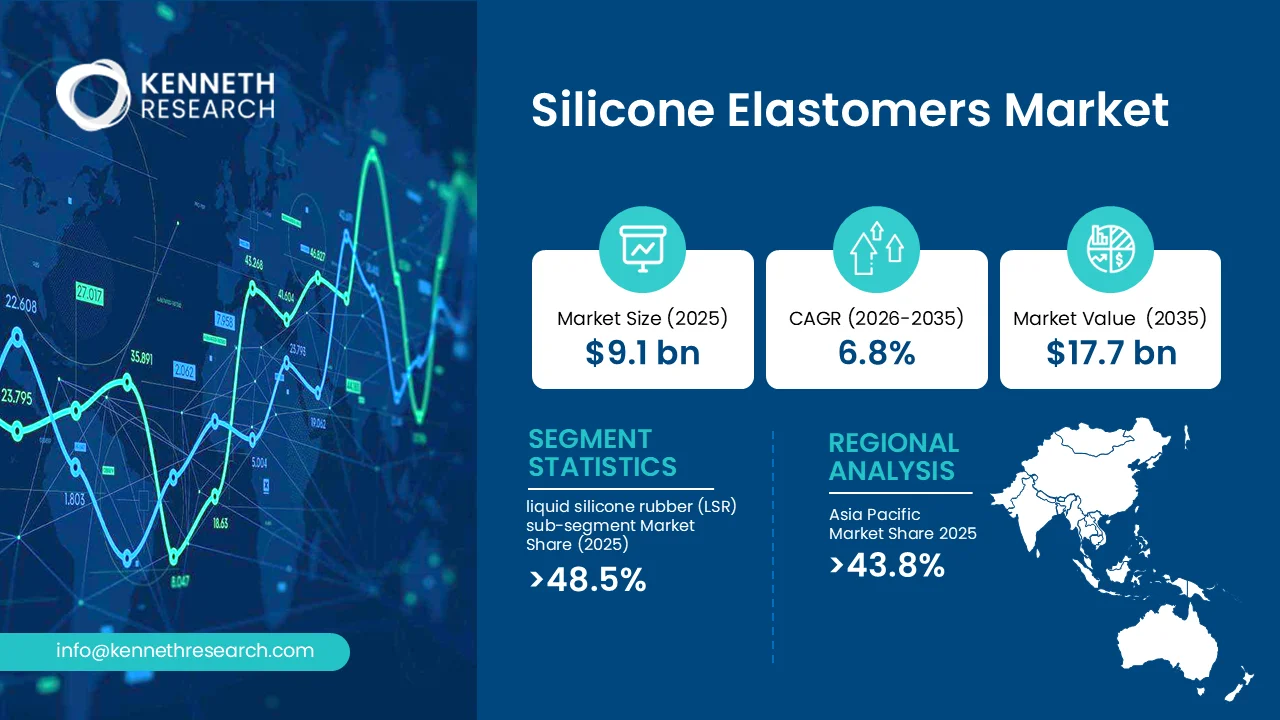
Silicone Elastomers Market size was valued at USD 9.1 billion in 2025 and is projected to reach USD 17.7 billion by the end of 2035, rising at a CAGR of 6.8% during the forecast period, i.e., 2026–2035. In 2026, the industry size of silicone elastomers is estimated at USD 9.8 billion.
Rising electrification in transportation and increasing demand for lightweight, durable, and thermally stable materials are accelerating silicone elastomer adoption. Expanding electric vehicle production, advanced automotive electronics, and stringent performance requirements are driving manufacturers toward high-performance silicone components capable of delivering long-term reliability under demanding operating and environmental conditions.
The silicone elastomers market comprises materials manufactured from silicone polymers that combine the elasticity of conventional rubber with superior resistance to heat, chemicals, ultraviolet radiation, moisture, and extreme weather conditions. These elastomers are available in multiple product forms, including liquid silicone rubber (LSR), high-consistency rubber (HCR), and room-temperature vulcanizing (RTV) silicone, enabling manufacturers to address diverse processing and performance requirements. Their excellent biocompatibility, electrical insulation, flexibility across wide temperature ranges, and long service life make them suitable for precision molding, sealing, insulation, gasketing, vibration damping, and protective applications.
Silicone elastomers play a critical role across automotive, healthcare, electronics, construction, industrial manufacturing, aerospace, and consumer goods industries where product durability, operational safety, and regulatory compliance are essential. Their ability to maintain mechanical integrity under harsh operating environments supports the production of high-performance components used in electric mobility systems, medical devices, electrical connectors, cable insulation, and advanced sealing technologies. Continuous innovation in manufacturing processes and increasing adoption of high-performance materials across industrial sectors are reinforcing the strategic importance of silicone elastomers within global advanced materials and specialty chemicals value chains.
Key Silicone Elastomers Market Insights Summary:
Key Takeaways: Market Trends & Insights
- Silicone Elastomers Market is projected to grow from USD 9.8 billion in 2026 to USD 17.7 billion by 2035, registering a 6.8% CAGR during the forecast period (2026-2035)
- Liquid Silicone Rubber (LSR) is the leading product type, accounting for 48.5% of the market in 2025, driven by its widespread adoption in automotive, healthcare, electronics, and precision molding applications
- Asia Pacific held the dominant regional position with a 43.8% market share in 2025, supported by strong manufacturing capabilities and expanding industrial activity across China and India
- Automotive and Transportation is projected to be the fastest-growing application segment due to increasing electric vehicle production and rising demand for advanced sealing, insulation, and thermal management components
- The market is witnessing sustained growth from increasing adoption of high-performance silicone elastomers across electric mobility, renewable energy, industrial automation, and advanced manufacturing industries
Market Drivers
- Increasing adoption in medical devices and healthcare equipment
- Growing use in high-performance electronics and electrical insulation
- Expansion of construction applications requiring durable weather-resistant sealing materials
- Increasing investments in industrial automation and precision manufacturing
Challenges
- Volatility in silicone feedstock supply and specialty raw material costs.
- Complex processing requirements and stringent regulatory qualification.
Silicone Elastomers Market Overview & Supply Chain
The global adoption of silicone elastomers is increasing as manufacturers seek materials that combine thermal stability, chemical resistance, electrical insulation, and long-term durability across demanding applications. The transition toward electric mobility, advanced electronics, medical technologies, and renewable energy systems has intensified demand for high-performance elastomeric materials capable of operating reliably under extreme environmental and mechanical conditions. Silicone elastomers are particularly valued for maintaining performance across wide temperature ranges while supporting lightweight product designs and extended service life. Their compatibility with automated manufacturing processes and compliance with stringent quality and safety standards further strengthen their adoption across industrial sectors. Industry momentum is reinforced by accelerating electrification worldwide. According to the International Energy Agency (IEA), the global electric vehicle fleet consumed approximately 130 TWh of electricity in 2023, highlighting the rapid expansion of electrified transport systems that increasingly rely on advanced silicone-based insulation, sealing, and thermal management components.
The silicone elastomers value chain begins with the procurement of silicon metal, methyl chloride, catalysts, fillers, reinforcing agents, and specialty additives supplied by chemical and mineral processing companies. These raw materials undergo polymerization and compounding to produce silicone base polymers, followed by formulation into liquid silicone rubber (LSR), high-consistency rubber (HCR), or room-temperature vulcanizing (RTV) silicone products. Manufacturers employ extrusion, injection molding, compression molding, and curing technologies to produce customized components such as seals, gaskets, tubing, keypads, connectors, and insulating parts. Distribution occurs through specialty chemical suppliers, industrial distributors, direct OEM contracts, and regional channel partners, ensuring consistent supply to global manufacturing hubs. End users include automotive, healthcare, electronics, construction, aerospace, industrial equipment, consumer goods, and energy industries. Major stakeholders comprise raw material producers, silicone formulators, component manufacturers, equipment suppliers, regulatory bodies, certification organizations, OEMs, and aftermarket service providers collaborating across the advanced materials ecosystem.
Silicone Elastomers Market: Growth Drivers & Challenges
Growth Drivers:
- Expanding electrification and renewable energy infrastructure: The accelerating deployment of electric mobility and renewable energy infrastructure is creating sustained demand for silicone elastomers because these materials offer exceptional dielectric strength, thermal stability, weather resistance, and long operational life. They are extensively used in battery packs, charging systems, cable insulation, power connectors, seals, and environmental protection components that require consistent performance under demanding operating conditions. As energy systems become more electrified, manufacturers increasingly specify silicone elastomers to improve reliability, safety, and maintenance intervals. This trend is also encouraging material innovation tailored to high-voltage and high-temperature applications. Over the long term, expanding investments in clean energy, smart grids, and energy storage are expected to strengthen demand for advanced silicone elastomer formulations that enable higher equipment efficiency and durability. The International Energy Agency reported that global renewable capacity additions increased by almost 50% to nearly 510 GW in 2023, highlighting the rapid expansion of infrastructure that depends on advanced sealing and insulation materials.
- Rising demand for high-performance materials across advanced manufacturing: Manufacturers across automotive, electronics, healthcare, aerospace, and industrial equipment sectors are increasingly adopting silicone elastomers to meet demanding performance and regulatory requirements. Their resistance to extreme temperatures, chemicals, ultraviolet exposure, moisture, and mechanical fatigue makes them suitable for applications where conventional elastomers may experience premature degradation. Growing automation and precision manufacturing have also increased demand for materials compatible with complex molding processes, including liquid silicone rubber technologies that enable high-volume, high-quality production. At the same time, evolving product designs emphasize lightweight construction, miniaturization, and extended service life, all of which favor silicone-based materials. Looking ahead, continued investment in advanced manufacturing technologies, medical innovation, industrial automation, and next-generation electronic devices is expected to expand application opportunities and encourage development of specialized silicone elastomer grades with enhanced functional performance.
Challenges:
- Volatility in Silicone Feedstock Supply and Specialty Raw Material Costs: Silicone elastomer manufacturing depends on a specialized supply chain that includes silicon metal, chlorosilanes, catalysts, reinforcing fillers, and performance additives, many of which are produced by a relatively limited number of global suppliers. Disruptions arising from energy price fluctuations, raw material availability, transportation constraints, or regional production concentration can significantly affect manufacturing economics and procurement planning. For producers, inconsistent input costs reduce pricing stability and complicate long-term supply agreements with downstream customers. Original equipment manufacturers that rely on silicone elastomer components may also experience increased procurement risks and extended lead times, particularly for application-specific formulations. Commercially, sustained cost volatility places pressure on profit margins and encourages customers to evaluate alternative materials where performance requirements allow. Going forward, manufacturers are expected to strengthen supplier diversification, regional sourcing strategies, and inventory planning while investing in process optimization to reduce exposure to supply-side uncertainties.
- Complex processing requirements and stringent regulatory qualification: Silicone elastomers often require specialized processing equipment, controlled curing conditions, and rigorous formulation expertise to achieve consistent mechanical, thermal, and chemical performance. Applications in medical devices, automotive systems, electronics, and aerospace frequently involve extensive product validation, certification, and customer-specific qualification procedures before commercial adoption. These technical and regulatory requirements increase development timelines and elevate production costs, particularly for manufacturers entering high-value application segments. In addition, maintaining uniform product quality across global manufacturing sites requires continuous investment in process control, testing, and compliance management. Commercially, these factors can slow new product introductions and create barriers for smaller manufacturers lacking advanced production capabilities. Over the longer term, companies that invest in automated processing technologies, quality assurance systems, and regulatory expertise are likely to improve competitiveness while meeting increasingly demanding customer and industry standards.
Silicone Elastomers Market Size and Forecast:
| Report Attribute | Details |
|---|---|
| Base Year |
2025 |
| Forecast Year |
2026-2035 |
| CAGR |
6.8% |
| Base Year Market Size (2025) |
USD 9.1 billion |
| Forecast Year Market Size (2035) |
USD 17.7 billion |
| Regional Scope |
|
Silicone Elastomers Market Segmentation Analysis:
Product Type Segment Analysis
In the product type segment, the liquid silicone rubber (LSR) sub-segment is anticipated to capture the largest market share of 48.5% by the end of 2025.
Liquid Silicone Rubber (LSR) dominates the silicone elastomers market because it combines exceptional processing efficiency with superior mechanical, thermal, and chemical performance, making it the preferred material for high-volume precision manufacturing. Demand is particularly strong from automotive, medical device, electronics, and consumer product manufacturers that require components with consistent dimensional accuracy, biocompatibility, and long-term durability. LSR is highly compatible with automated injection molding processes, enabling shorter production cycles, reduced material waste, and scalable manufacturing for complex component geometries. On the supply side, continuous investments by silicone material producers in advanced formulations and production technologies have improved product consistency while supporting increasingly stringent quality and regulatory requirements. The growing automotive manufacturing base further reinforces demand for LSR-based seals, connectors, gaskets, and electrical insulation components.
Application Segment Analysis
The automotive and transportation is projected to grow as the second-largest segment in the silicone elastomers market due to four converging demand drivers.
The automotive and transportation segment is projected to experience strong growth as vehicle manufacturers increasingly require high-performance materials capable of withstanding demanding thermal, electrical, and mechanical operating conditions. Silicone elastomers are widely used in battery sealing systems, electrical connectors, gaskets, cable insulation, vibration dampers, and under-the-hood components because they retain flexibility and performance under extreme temperatures while supporting lightweight vehicle designs. Growing electrification, vehicle digitalization, and stricter safety requirements are encouraging original equipment manufacturers to specify advanced silicone materials for next-generation mobility platforms. Supply-side growth is supported by ongoing investments in specialized silicone formulations, automated molding technologies, and expanded production capabilities that enable consistent quality for high-volume automotive manufacturing.
Our in-depth analysis of the global silicone elastomers market includes the following segments:
|
Segment |
Sub-segment |
|
Product Type |
|
|
Application |
|
Silicone Elastomers Market Regional Insights:
Asia Pacific Market Trends & Insights:
Asia Pacific silicone elastomers market is projected to hold the largest revenue share of 43.8% by the end of 2025.
The region's leadership is supported by its extensive manufacturing ecosystem, expanding automotive and electronics industries, robust healthcare production capabilities, and continued investments in industrial modernization. Strong domestic demand, integrated supply chains, and significant production capacity for specialty chemicals enable large-scale consumption of silicone elastomers across multiple end-use sectors. Government initiatives promoting advanced manufacturing, electric mobility, renewable energy, and high-value industrial production further strengthen regional competitiveness. In addition, the presence of major silicone material producers and component manufacturers enables efficient procurement, processing, and distribution across domestic and export markets. Supporting this industrial foundation, China's Ministry of Industry and Information Technology reported that the country's electronic information manufacturing industry fixed-asset investment increased by 12% in 2024, reflecting sustained investment in sectors that extensively utilize silicone elastomers for insulation, sealing, and precision components.
China serves as the region's primary manufacturing hub, supported by a comprehensive industrial base spanning automotive, electronics, medical devices, renewable energy equipment, and specialty chemicals. Its vertically integrated supply chains, advanced processing capabilities, and continuous investments in high-value manufacturing reinforce demand for silicone elastomers across domestic production and export-oriented industries.
Meanwhile, India is emerging as an important growth market, driven by expanding automotive manufacturing, electronics production, healthcare infrastructure, and industrial development initiatives. Government policies encouraging domestic manufacturing, coupled with increasing investments in advanced materials and value-added production, are strengthening the country's position within regional supply chains. Together, China and India provide a balanced combination of large-scale manufacturing capacity, growing industrial consumption, and expanding downstream industries, reinforcing Asia Pacific's long-term leadership in the silicone elastomers market.
North America Market Trends & Insights:
North America represents a strategically important market for silicone elastomers, supported by strong demand from the automotive, aerospace, healthcare, electronics, industrial equipment, and energy sectors. The region places significant emphasis on high-performance materials that meet stringent quality, safety, and environmental standards, encouraging widespread adoption of silicone elastomers in mission-critical applications. Continuous investment in electric vehicle production, medical technologies, advanced electronics, and grid modernization is expanding opportunities for specialized silicone formulations with enhanced thermal stability, electrical insulation, and long-term durability. Government policies promoting advanced manufacturing, clean energy deployment, domestic supply chain resilience, and industrial innovation further support the development and commercialization of high-value silicone-based products. Looking ahead, increasing automation, digital manufacturing, and next-generation mobility solutions are expected to create sustained demand for silicone elastomers across diverse industrial applications while encouraging continued investment in research, product development, and production capabilities.
The United States serves as the region's primary market owing to its advanced manufacturing infrastructure, extensive research and development ecosystem, and strong presence of automotive, aerospace, healthcare, and electronics manufacturers. Demand is reinforced by continuous innovation in electric mobility, medical devices, semiconductor technologies, and industrial automation, all of which require high-performance elastomeric materials.
Canada complements regional growth through its expanding clean energy sector, automotive supply chain, industrial manufacturing capabilities, and increasing focus on advanced materials. Investments in sustainable manufacturing, infrastructure modernization, and technology-driven industrial development are supporting broader adoption of silicone elastomers across transportation, electrical equipment, construction, and specialized industrial applications, strengthening North America's position as a key innovation and production hub within the global silicone elastomers market.
Leading Companies Operating in the Global Silicone Elastomers Market:
Here is a list of upstream, downstream, and key players operating in the global silicone elastomers market competitive ecosystem:
- Wacker Chemie AG (Germany)
- Company Overview
- Business Strategy
- Key Product Offerings
- Financial Performance
- Key Performance Indicators
- Risk Analysis
- Recent Development
- Regional Presence
- SWOT Analysis
- Momentive Performance Materials Inc. (United States)
- Elkem ASA (Norway)
- Primasil Silicones Limited (United Kingdom)
- Stockwell Elastomerics, Inc. (United States)
- Reiss Manufacturing, Inc. (United States)
Recent Developments
- In October 2025, Elkem launched SILBIONE™ LSR Select EC 70, a next-generation medical-grade liquid silicone rubber engineered for advanced healthcare devices. The material combines high electrical conductivity (resistivity below 10 ohm-centimeters) with certified biocompatibility, having passed ISO 10993-5 cytotoxicity and ISO 10993-10 skin sensitization tests. The product is specifically designed for wearable health monitors, flexible sensors, prosthetics, and diagnostic devices, and is compatible with Elkem's patented LSR Select™ platform for precision liquid injection molding with faster cycle times and reduced waste.
- In April 2025, Nordmann entered a strategic partnership with WACKER, taking over distribution of WACKER's silicone elastomers across Europe, including ELASTOSIL®, POWERSIL®, and SILPURAN® brands. The partnership covers high-consistency rubber, liquid silicone rubber, and related additives.
Frequently Asked Question
In 2025, the silicone elastomers market exceeded USD 9.1 billion.
The silicone elastomers market is projected to reach USD 17.7 billion by the end of 2035, expanding at a CAGR of 6.8% over the forecast period (2026-2035).
The major players in the market are Wacker Chemie AG (Germany), Momentive Performance Materials Inc. (United States), Elkem ASA (Norway), Primasil Silicones Limited (United Kingdom), Stockwell Elastomerics, Inc. (United States), Reiss Manufacturing, Inc. (United States), and others.
In the Product Type segment, the Liquid Silicone Rubber (LSR) sub-segment is anticipated to capture the largest market share of 48.5% in the future and exhibit lucrative growth opportunities during 2026–2035. This growth trajectory is largely attributed to increasing demand for high-performance materials in automotive, medical devices, electronics, and precision manufacturing applications.
Asia Pacific is projected to hold the largest market share of 43.8% by the end of 2035 and provide more business opportunities in the future. Continuous investments in advanced manufacturing, electric mobility, and industrial expansion across China and India are fostering the region's dominance.
Why Choose Kenneth Research ?
-
Insight with Impact : We don’t just gather data — we uncover stories, trends, and opportunities that fuel business growth.
-
Experts Who Get It : Our team speaks your industry’s language and knows what really matters to your customers and market.
-
Custom-Built for You : Forget one-size-fits-all. We craft research and consulting solutions as unique as your business vision.
-
Partners, Not Just Providers : We work with you, not for you — collaborating closely to turn insights into smart, strategic moves.
-
Results That Speak : Our work powers brands, startups, and industry leaders alike — with a track record of ideas that work in the real world.
Report ID: 1158 |
Published Date: 24 Aug 2026 |
Report Format: |
Delivery Timeline: 48-72 Business Hours

Copyright © 2025 Kenneth Research. All rights reserved. Terms of Use | Privacy Policy
