Report ID: 1057 |
Published Date: 06 Aug 2026 |
Report Format: |
Delivery Timeline: 48-72 Business Hours
Silicone Defoamer Market Outlook:
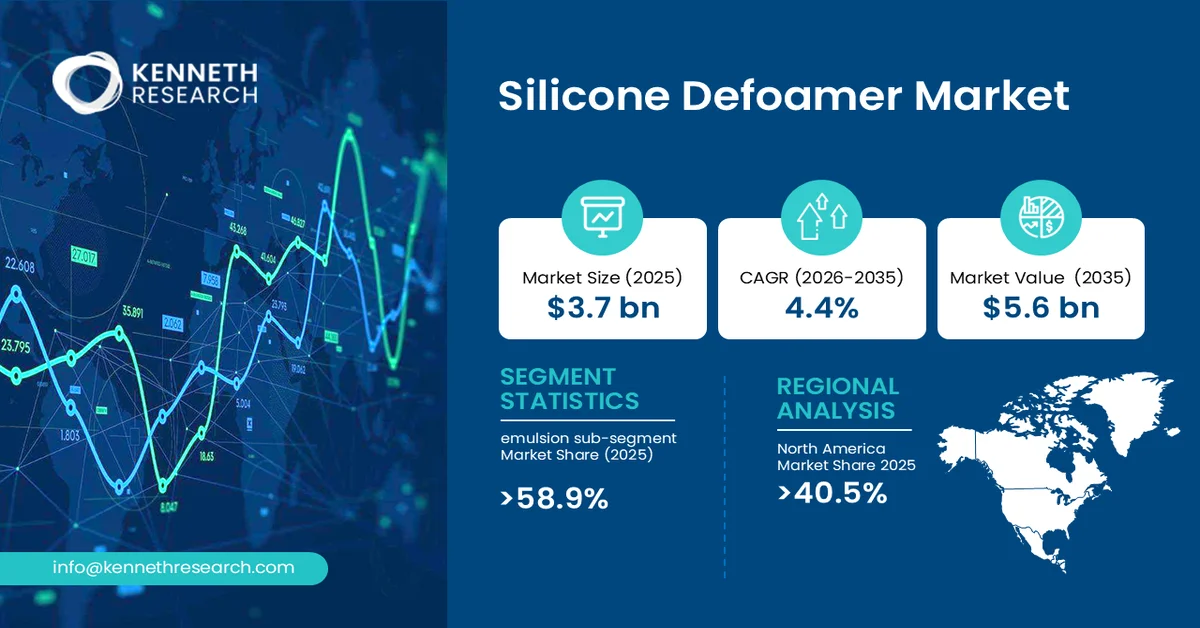
Silicone Defoamer Market size was valued at USD 3.7 billion in 2025 and is projected to reach USD 5.6 billion by the end of 2035, rising at a CAGR of 4.4% during the forecast period, i.e., 2026-2035. In 2026, the industry size of the silicone defoamer is estimated at USD 3.8 billion.
Growing industrial emphasis on efficient process control and wastewater management is driving demand for silicone defoamers across chemical manufacturing, pulp and paper, food processing, and water treatment. Their superior foam suppression, thermal stability, and compatibility with diverse formulations improve operational efficiency while supporting compliance with increasingly stringent environmental and process-quality requirements.
The silicone defoamer market comprises silicone-based antifoaming agents formulated to prevent, suppress, or eliminate foam generated during industrial manufacturing and liquid-processing operations. These products are primarily based on silicone polymers and are available in multiple formulation types, including emulsions, compounds, dispersions, and fluids, enabling their use across varied process conditions. Silicone defoamers are valued for their rapid foam knockdown, long-lasting effectiveness, chemical inertness, thermal stability, low surface tension, and compatibility with aqueous and non-aqueous systems. They help maintain process continuity, improve equipment efficiency, reduce product losses, and enhance product quality by minimizing foam-related operational disruptions.
The market serves a broad industrial base including chemical processing, pulp and paper, water and wastewater treatment, food and beverage manufacturing, pharmaceuticals, textiles, paints and coatings, and oil and gas operations. Silicone defoamers play an important role in optimizing production efficiency, supporting consistent process performance, and reducing downtime caused by excessive foaming. Their industrial relevance continues to increase as manufacturers seek reliable process additives that improve productivity while aligning with evolving environmental, quality, and regulatory expectations for industrial formulations.
Key Silicone Defoamer Market Insights Summary:
Key Takeaways: Market Trends & Insights
- Silicone defoamer market is projected to grow from USD 3.8 billion in 2026 to USD 5.6 billion by 2035 at a CAGR of 4.4%
- Emulsion accounted for the largest formulation type segment with a 58.9% market share in 2025 owing to its superior compatibility with water-based industrial processes and efficient foam suppression
- North America dominated the global silicone defoamer market with a 40.5% market share in 2025 supported by strong chemical manufacturing capabilities and advanced industrial processing infrastructure across the United States and Canada
- Chemical Processing is expected to emerge as the fastest-growing application segment driven by increasing investments in specialty chemicals continuous manufacturing and demand for high-performance process efficiency
- Europe is expected to witness sustained growth led by Germany and France as industrial modernization sustainability initiatives and specialty chemical manufacturing continue to increase demand for advanced silicone defoamer formulations
Market Drivers
- Increasing wastewater treatment infrastructure investments
- Expansion of food and beverage processing industries
- Growing pharmaceutical and biotechnology manufacturing activities
- Rising demand from paints, coatings, and construction chemicals
Challenges
- Raw material supply volatility and silicone feedstock cost fluctuations
- Increasing regulatory scrutiny of industrial chemical formulations
Silicone Defoamer Market Overview & Supply Chain
The adoption of silicone defoamers is increasing globally as manufacturers prioritize higher process efficiency, lower operational downtime, and improved product quality across chemical processing, pulp and paper, water treatment, food and beverage, and pharmaceutical industries. Their ability to provide rapid foam suppression under demanding temperature and chemical conditions makes them indispensable in continuous manufacturing environments. Growing regulatory attention toward sustainable industrial operations and resource-efficient production is also encouraging the use of high-performance process additives. This trend is reinforced by expanding industrial decarbonization initiatives. According to the International Energy Agency (IEA), the share of near-zero-emission primary chemical production is projected to increase from 2% in 2022 to 17% by 2030, highlighting the ongoing transformation of chemical manufacturing processes where advanced specialty additives such as silicone defoamers contribute to process optimization and operational reliability.
The silicone defoamer value chain begins with the procurement of silicone intermediates, including polydimethylsiloxane (PDMS), silica derivatives, emulsifiers, specialty surfactants, carrier fluids, and formulation additives sourced from global chemical suppliers. These raw materials undergo formulation, blending, emulsification, quality testing, and performance validation to produce application-specific defoamers tailored for diverse industrial environments. Manufacturers then package the products in bulk industrial containers or customized formats for regional distribution through specialty chemical distributors, direct industrial supply contracts, and technical sales networks. End users include chemical manufacturers, pulp and paper mills, water and wastewater treatment facilities, food and beverage processors, pharmaceutical companies, textile manufacturers, paint and coating producers, and oil and gas operators. Key stakeholders across the value chain comprise raw material suppliers, silicone technology developers, formulation specialists, contract manufacturers, logistics providers, regulatory authorities, industrial distributors, original equipment manufacturers, and end-use industries that integrate silicone defoamers into critical production processes to enhance operational efficiency and product consistency.
Silicone Defoamer Market: Growth Drivers & Challenges
Growth Drivers:
- Expanding industrial process efficiency and sustainable manufacturing requirements: Industrial manufacturers are increasingly adopting silicone defoamers to improve process efficiency, reduce production interruptions, and enhance product consistency across chemical processing, pulp and paper, water treatment, food manufacturing, and coatings industries. Excessive foam can lower equipment productivity, reduce throughput, increase maintenance requirements, and compromise product quality, making high-performance defoaming solutions an essential process additive. Silicone-based formulations provide rapid foam suppression while maintaining effectiveness under demanding chemical and thermal conditions, supporting continuous manufacturing environments. Sustainability initiatives are further accelerating adoption as industries seek technologies that optimize water usage, energy consumption, and operational efficiency. According to the International Energy Agency (IEA), global hydrogen demand reached 97 Mt in 2023, with demand remaining concentrated in refining and the chemical sector, highlighting the continued importance of process optimization technologies within industrial chemical operations where silicone defoamers contribute to reliable production performance.
- Increasing adoption of advanced silicone formulations across high-performance industrial applications: Manufacturers are investing in advanced silicone defoamer formulations that deliver greater compatibility with complex production systems, stricter quality requirements, and evolving environmental standards. Modern industrial processes require additives capable of performing consistently across diverse pH ranges, elevated temperatures, and high-shear environments without negatively affecting downstream operations or finished product quality. This requirement is encouraging innovation in emulsion technologies, multifunctional formulations, and application-specific products tailored to industries such as pharmaceuticals, food processing, coatings, textiles, and wastewater treatment. The growing transition toward automated and continuous manufacturing further strengthens demand for reliable foam-control technologies capable of minimizing production disruptions. As industrial facilities continue modernizing operations and implementing more sophisticated processing technologies, silicone defoamers are expected to become increasingly integrated into manufacturing workflows, supporting higher productivity, improved operational consistency, enhanced regulatory compliance, and lower lifecycle operating costs across multiple end-use industries.
Challenges:
- Volatility in silicone-based raw material supply and production costs: The silicone defoamer market faces a significant restraint from fluctuations in the availability and pricing of silicone-based raw materials, including silicone polymers, specialty silica, emulsifiers, and formulation additives. Supply disruptions caused by feedstock imbalances, production outages, logistics constraints, and evolving environmental compliance requirements can increase manufacturing costs and complicate procurement strategies. Since silicone defoamers are often formulated for precise industrial applications, substituting raw materials without affecting performance is technically challenging and requires extensive validation. These cost pressures reduce pricing flexibility for manufacturers and may compress profit margins, particularly in highly competitive end-use industries. Commercially, prolonged raw material uncertainty can delay supply agreements, influence purchasing decisions, and encourage customers to evaluate lower-cost alternatives. Looking ahead, companies are expected to strengthen supplier diversification, regional sourcing strategies, and formulation optimization to improve supply resilience while maintaining consistent product quality.
- Increasing regulatory scrutiny of industrial chemical formulations: The evolving regulatory landscape governing industrial chemicals presents another major challenge for silicone defoamer manufacturers. Environmental, occupational safety, and product stewardship requirements continue to become more comprehensive across multiple jurisdictions, requiring manufacturers to assess formulation components, manufacturing practices, product labeling, and downstream environmental impacts. Compliance often demands extensive testing, documentation, reformulation efforts, and regulatory approvals before products can be introduced or expanded into new markets. These requirements increase development timelines and compliance expenditures while creating additional complexity for multinational suppliers operating across different regulatory frameworks. From a commercial perspective, frequent regulatory changes may slow product commercialization, limit the use of certain formulation ingredients, and raise barriers for smaller manufacturers with limited compliance resources. Over the longer term, the industry is expected to accelerate investment in environmentally responsible formulations, regulatory expertise, and sustainable product innovation to maintain market competitiveness.
Silicone Defoamer Market Size and Forecast:
| Report Attribute | Details |
|---|---|
| Base Year |
2025 |
| Forecast Year |
2026-2035 |
| CAGR |
4.4% |
| Base Year Market Size (2025) |
USD 3.7 billion |
| Forecast Year Market Size (2035) |
USD 5.6 billion |
| Regional Scope |
|
Silicone Defoamer Market Segmentation Analysis:
Formulation Type Segment Analysis
In the formulation type segment, the emulsion sub-segment is anticipated to capture the largest market share of 58.9% by the end of 2025.
The emulsion sub-segment leads the silicone defoamer market because it offers an optimal balance of performance, ease of handling, and compatibility with water-based industrial systems. Emulsion-based silicone defoamers are extensively used in chemical processing, pulp and paper, wastewater treatment, food and beverage production, and coatings, where rapid foam control and uniform dispersion are essential for maintaining process efficiency. From the supply side, emulsion formulations benefit from established manufacturing technologies, scalable production, and broad commercial availability, allowing suppliers to serve diverse industrial customers with application-specific products. Demand is also supported by increasing investments in wastewater treatment infrastructure. According to the World Health Organization (WHO), among the 22 countries reporting industrial wastewater data for 2022, only 27% of industrial wastewater was safely treated, underscoring the continued need for advanced treatment technologies where foam-control solutions play a critical operational role. As industries continue to modernize production facilities and expand water treatment capabilities, emulsion silicone defoamers are expected to retain their leading position through continued formulation innovation, improved environmental compatibility, and broader adoption across high-volume industrial applications.
Application Segment Analysis
The chemical processing is projected to grow as the second-largest segment in the silicone defoamer market due to four converging demand drivers.
The chemical processing application segment is projected to experience strong growth as manufacturers increasingly prioritize uninterrupted production, higher process efficiency, and improved product quality across complex chemical operations. Foam generation during mixing, reaction, distillation, and wastewater handling can reduce equipment efficiency, affect product consistency, and increase operational costs, making silicone defoamers a critical processing aid. On the supply side, manufacturers are expanding application-specific silicone defoamer portfolios designed for high-temperature, high-shear, and chemically demanding environments, enabling broader adoption across diverse processing facilities. According to Eurostat, the European Union produced 218 million tonnes of industrial chemicals in 2023, demonstrating the scale of industrial chemical manufacturing that depends on efficient process-control technologies, including defoaming solutions. As chemical producers continue modernizing facilities, automating operations, and adopting more resource-efficient manufacturing practices, demand for high-performance silicone defoamers in chemical processing is expected to strengthen steadily.
Our in-depth analysis of the silicone defoamer market includes the following segments:
|
Segment |
Sub-segment |
|
Application |
|
|
Formulation Type |
|
|
Concentration |
|
Silicone Defoamer Market Regional Insights:
North America Market Trends & Insights:
North America silicone defoamer market is projected to hold the largest revenue share of 40.5% by the end of 2025.
The region also benefits from sustained investments in industrial modernization, process automation, and environmentally responsible manufacturing practices that require reliable foam-control technologies. Well-established regulatory frameworks governing industrial operations and product quality further encourage the adoption of technically advanced silicone defoamers. Additionally, the presence of global specialty chemical manufacturers, extensive distribution networks, and ongoing product innovation supports stable supply and rapid commercialization across diverse end-use industries. According to the U.S. environmental protection agency (EPA), the 2024 chemical data reporting (CDR) database includes information on 8,650 chemicals reported by manufacturers and importers for the 2020–2023 reporting period, demonstrating the breadth and sophistication of North America's industrial chemical ecosystem that underpins demand for specialty process additives.
The United States represents the largest contributor within the region, supported by its extensive chemical manufacturing capacity, advanced industrial processing infrastructure, and continuous investment in production efficiency across multiple end-use sectors. Demand for silicone defoamers remains strong in chemical manufacturing, wastewater treatment, food processing, coatings, and pharmaceutical applications, where process reliability and product consistency are essential.
Canada complements regional growth through its well-developed pulp and paper industry, mining operations, water treatment infrastructure, and expanding chemical processing activities. Increasing emphasis on sustainable manufacturing, environmental compliance, and efficient resource utilization is encouraging broader adoption of high-performance silicone defoamers across Canadian industrial facilities. Together, the United States and Canada provide a technologically advanced manufacturing environment, resilient supply chains, and a stable regulatory landscape that collectively reinforce North America's leadership in the silicone defoamer market.
Europe Market Trends & Insights:
Europe represents a strategically important region for the silicone defoamer market, supported by its advanced manufacturing base, well-established specialty chemicals industry, and strong emphasis on sustainable industrial production. Demand for silicone defoamers is expanding across chemical processing, pulp and paper, food and beverage manufacturing, water treatment, pharmaceuticals, and coatings, where effective foam management is essential for maintaining operational efficiency and product quality. Regional industrial activity is further supported by investments in process modernization, digital manufacturing, and circular economy initiatives that encourage the adoption of high-performance specialty additives. Government policies promoting resource efficiency, cleaner production technologies, and stricter environmental compliance are accelerating the development and use of advanced process chemicals with improved performance characteristics. Looking ahead, opportunities are expected to emerge from continued industrial decarbonization, expansion of wastewater treatment infrastructure, and growing investment in specialty chemical manufacturing, creating favorable conditions for innovation in silicone defoamer formulations tailored to evolving industrial requirements.
Germany serves as the region’s primary growth engine due to its robust chemical manufacturing sector, highly automated industrial facilities, and strong focus on process optimization across production-intensive industries. Demand for silicone defoamers remains high in specialty chemicals, coatings, pharmaceuticals, and industrial water treatment, where operational consistency and manufacturing efficiency are critical.
France contributes through its diversified industrial economy, including chemical production, food processing, cosmetics, and environmental infrastructure projects. Increasing investments in sustainable manufacturing, industrial modernization, and advanced processing technologies are supporting broader adoption of silicone defoamers across French production facilities. Together, Germany and France strengthen Europe’s position by driving technological innovation, promoting environmentally responsible manufacturing practices, and expanding demand for high-performance process additives across multiple industrial value chains.
Leading Companies Operating in the Global Silicone Defoamer Market:
Here is a list of upstream, downstream, and key players operating in the global silicone defoamer market competitive ecosystem:
- Momentive Performance Materials Inc. (United States)
- Company Overview
- Business Strategy
- Key Product Offerings
- Financial Performance
- Key Performance Indicators
- Risk Analysis
- Recent Development
- Regional Presence
- SWOT Analysis
- Elkem Silicones (Norway)
- BRB International B.V. (Netherlands)
- Siltech Corporation (Canada)
- BYK-Chemie GmbH (Germany)
- CHT Group (Germany)
Recent Developments
- In June 2025, Evonik coating additives launched TEGO® Foamex 8051, a new highly efficient siloxane defoamer for waterborne decorative coatings . The additive is a 100% active concentrate based on polyethersiloxane technology with very low VOC (0.08%) and SVOC (0.19%) levels, complying with Ecolabel 2014/312/EU standards . The product holds broad international registrations in the US, EU, China, and Japan, and offers strong defoaming persistence under high shear conditions.
- In 2025, regulatory pressure on cyclosiloxanes intensified globally, reshaping the competitive landscape for silicone defoamers. The EU Regulation 2024/1328 severely restricts the use of D4, D5, and D6 cyclosiloxanes in products containing 0.1% or more of these substances, effective June 6, 2026 . Borchers (a Milliken brand) introduced low-cyclosiloxane (<0.1%) defoaming additives, including Borchers® AF 1171 and Borchi® Gol series, to help formulators comply with the new regulations.
Frequently Asked Question
In 2025, the silicone defoamer market exceeded USD 3.7 billion.
The silicone defoamer market is projected to reach USD 5.6 billion by the end of 2035, expanding at a CAGR of 4.4% over the forecast period (2026-2035).
The major players in the market are Momentive Performance Materials Inc. (United States), Elkem Silicones (Norway), BRB International B.V. (Netherlands), Siltech Corporation (Canada), BYK-Chemie GmbH (Germany), CHT Group (Germany), and others.
In the formulation type segment, the emulsion sub-segment is anticipated to capture the largest market share of 58.9% in the future and exhibit lucrative growth opportunities during 2026-2035. This growth trajectory is largely attributed to its superior compatibility with water-based industrial systems, rapid foam suppression performance, and broad adoption across chemical processing, water treatment, pulp and paper, and food manufacturing applications.
North America is projected to hold the largest market share of 40.5% by the end of 2035 and provide more business opportunities in the future. Continuous investments in advanced chemical manufacturing, industrial process optimization, and sustainable production across the United States and Canada are fostering the region's dominance.
Why Choose Kenneth Research ?
-
Insight with Impact : We don’t just gather data — we uncover stories, trends, and opportunities that fuel business growth.
-
Experts Who Get It : Our team speaks your industry’s language and knows what really matters to your customers and market.
-
Custom-Built for You : Forget one-size-fits-all. We craft research and consulting solutions as unique as your business vision.
-
Partners, Not Just Providers : We work with you, not for you — collaborating closely to turn insights into smart, strategic moves.
-
Results That Speak : Our work powers brands, startups, and industry leaders alike — with a track record of ideas that work in the real world.
Report ID: 1057 |
Published Date: 06 Aug 2026 |
Report Format: |
Delivery Timeline: 48-72 Business Hours

Copyright © 2025 Kenneth Research. All rights reserved. Terms of Use | Privacy Policy
