Report ID: 1157 |
Published Date: 24 Aug 2026 |
Report Format: |
Delivery Timeline: 48-72 Business Hours
Silicone Coating Market Outlook:
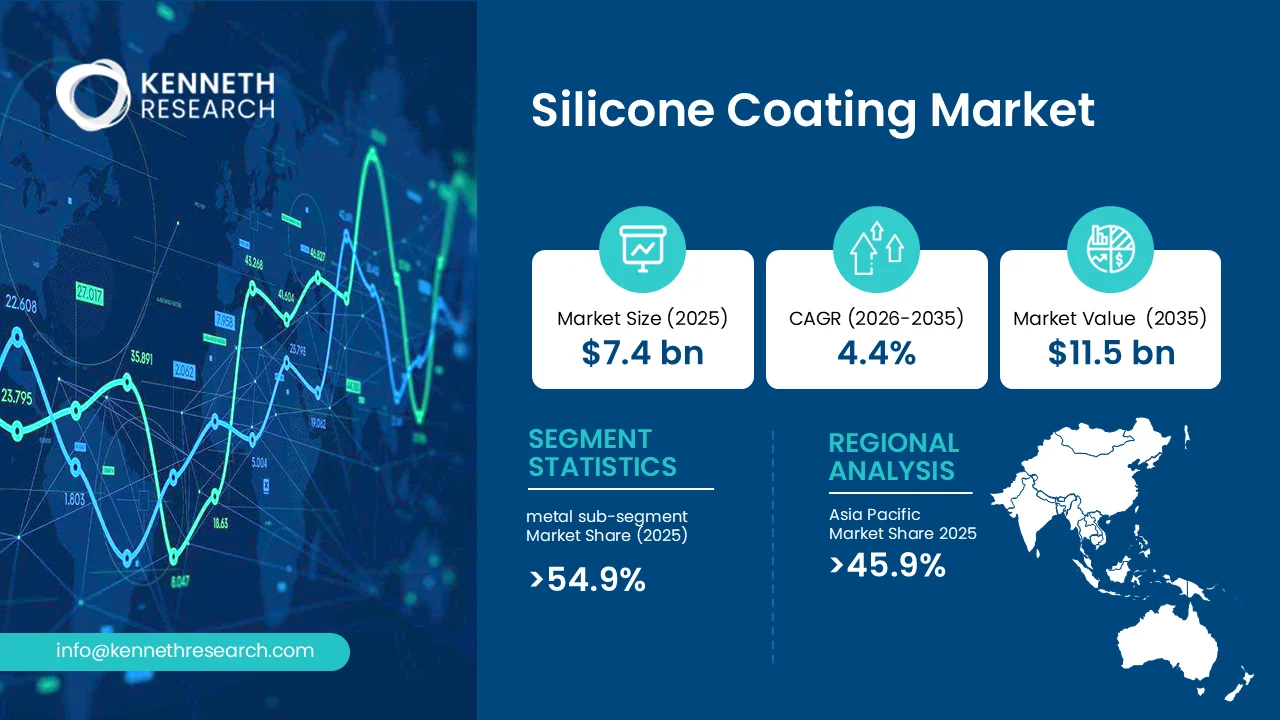
Silicone Coating Market size was valued at USD 7.4 billion in 2025 and is projected to reach USD 11.5 billion by the end of 2035, rising at a CAGR of 4.4% during the forecast period, i.e., 2026-2035. In 2026, the industry size of silicone coating is estimated at USD 7.8 billion.
Growing investment in construction, industrial infrastructure, and asset protection is the primary growth driver for the silicone coating market. Silicone coatings are increasingly selected for their long-term weather resistance, UV stability, moisture protection, thermal endurance, and corrosion resistance, enabling longer maintenance cycles and improved durability across commercial, industrial, and infrastructure applications.
The silicone coating market comprises protective coating formulations based on silicone polymers that are engineered to enhance the durability, functionality, and service life of substrates exposed to demanding environmental and operating conditions. These coatings form resilient barriers against ultraviolet radiation, moisture, chemicals, corrosion, oxidation, and extreme temperatures while maintaining flexibility and adhesion over prolonged periods. Their low surface energy also provides water repellency, reduced contamination, and easier surface maintenance, making them suitable for both interior and exterior applications.
Silicone coatings are widely applied on metal, concrete, masonry, glass, roofing systems, industrial equipment, transportation components, and electrical infrastructure where long-term performance is essential. Their ability to retain protective properties under thermal cycling and harsh weather conditions differentiates them from many conventional organic coating technologies. Industrially, the market plays an important role in extending asset life, reducing maintenance frequency, improving operational reliability, and supporting lifecycle cost optimization. Demand spans construction, manufacturing, marine, automotive, energy, and general industrial sectors, where durable protective coatings contribute to infrastructure resilience, equipment longevity, and sustainable asset management practices.
Key Silicone Coating Market Insights Summary:
Key Takeaways: Market Trends & Insights
- Silicone Coating Market is projected to grow from USD 7.8 billion in 2026 to USD 11.5 billion by 2035, registering a CAGR of 4.4% during the forecast period
- Metal emerged as the leading substrate segment, accounting for 54.9% of the market share in 2025, supported by strong demand for corrosion protection and long-term durability across industrial and infrastructure applications
- Asia Pacific held the dominant regional position with 45.9% of the global market share in 2025, driven by expanding manufacturing capacity, infrastructure investments, and construction activities in China and Japan
- The Building and Construction end-user industry is projected to witness significant growth through 2035, fueled by increasing adoption of weather-resistant and energy-efficient coating solutions for commercial and infrastructure projects
- Industry growth is being supported by rising investments in resilient infrastructure, industrial asset protection, and sustainable construction, creating long-term opportunities for advanced silicone coating technologies across global end-use industries
Market Drivers
- Growing adoption of energy-efficient and resilient building infrastructure
- Increasing demand for high-performance industrial asset protection
- Advancements in low-VOC and environmentally compliant silicone coating technologies
- Rising investments in renewable energy, transportation, and industrial infrastructure requiring durable protective coatings
Challenges
- Volatility in specialty silicone raw material supply and pricing
- Stringent performance qualification and application-specific certification requirements
Silicone Coating Market Overview & Supply Chain
The adoption of silicone coatings is increasing globally as industries prioritize longer asset life, lower maintenance requirements, and improved protection against harsh environmental conditions. Their resistance to ultraviolet radiation, moisture, chemicals, and extreme temperatures makes them a preferred solution across construction, transportation, industrial manufacturing, energy infrastructure, and marine applications. Growing sustainability initiatives are also encouraging the use of durable coating systems that extend infrastructure service life and reduce lifecycle maintenance. This trend is reinforced by the increasing focus on energy-efficient and resilient buildings. According to the United Nations Environment Programme (UNEP), buildings accounted for 34% of global energy demand and 37% of energy- and process-related CO₂ emissions in 2022, highlighting the importance of advanced protective materials that improve building durability and operational performance.
The silicone coating market value chain begins with the procurement of silicone polymers, siloxanes, specialty resins, pigments, fillers, solvents, curing agents, and performance additives supplied by chemical manufacturers and raw material producers. These inputs are processed by coating formulators through blending, dispersion, quality testing, and product customization to develop coatings tailored for specific substrates and environmental conditions. Finished products are distributed through direct sales networks, industrial coating suppliers, specialty chemical distributors, and authorized regional dealers serving both domestic and international markets. Application is performed by industrial contractors, OEMs, construction companies, maintenance service providers, and specialized coating applicators depending on the end-use requirements. Major stakeholders across the value chain include raw material suppliers, coating manufacturers, equipment providers, logistics companies, regulatory agencies, certification organizations, distributors, engineering firms, contractors, and end users in construction, manufacturing, transportation, marine, energy, and infrastructure sectors.
Silicone Coating Market: Growth Drivers & Challenges
Growth Drivers:
- Expanding investments in energy-efficient and resilient buildings: The growing emphasis on energy-efficient, climate-resilient, and low-maintenance buildings is accelerating demand for silicone coatings worldwide. Building owners and infrastructure developers are increasingly adopting advanced protective coatings that enhance weatherability, waterproofing, thermal stability, and ultraviolet resistance while reducing maintenance requirements over the asset lifecycle. Silicone coatings support modern building envelope strategies by protecting roofs, facades, and structural metal components from environmental degradation, thereby improving operational efficiency and extending service life. As governments strengthen energy efficiency initiatives and encourage sustainable construction, manufacturers are introducing higher-performance coating systems tailored to evolving regulatory and performance requirements. Over the long term, the integration of silicone coatings into commercial, industrial, and public infrastructure projects is expected to increase as lifecycle cost optimization and infrastructure resilience become key investment priorities. Supporting this trend, the U.S. Department of Energy states that buildings use 74% of electricity in the United States, reinforcing the importance of durable building envelope technologies that contribute to energy-efficient infrastructure.
- Rising demand for high-performance industrial asset protection: Industrial facilities are increasingly prioritizing predictive maintenance and asset reliability to improve operational efficiency and reduce unplanned downtime. Silicone coatings are gaining wider acceptance because they provide exceptional resistance to corrosion, chemicals, moisture, and extreme temperatures across manufacturing equipment, processing facilities, pipelines, storage tanks, and transportation assets. Their ability to maintain performance under demanding operating conditions supports longer maintenance intervals and lower lifecycle costs compared with conventional protective coatings. In addition, the expansion of renewable energy installations, industrial automation, and advanced manufacturing is creating new opportunities for specialized coating solutions that can withstand challenging service environments. Continued innovation in silicone chemistry, including improved adhesion, low-VOC formulations, and multifunctional protective properties, is expected to broaden application areas and strengthen long-term demand across industrial, energy, marine, and transportation sectors.
Challenges:
- Volatility in specialty silicone raw material supply and pricing: The silicone coating market remains vulnerable to fluctuations in the availability and pricing of specialty silicone intermediates, resins, curing agents, and performance additives. Production of these materials depends on complex chemical manufacturing processes that are sensitive to feedstock availability, energy costs, environmental compliance requirements, and global supply chain disruptions. As input costs fluctuate, coating manufacturers face pressure to balance profitability with competitive pricing, particularly in long-term supply contracts where rapid cost adjustments are difficult. The resulting uncertainty affects procurement strategies, inventory planning, and product pricing across the value chain. Smaller manufacturers are especially exposed because they often have limited purchasing power and fewer opportunities to diversify suppliers. Looking ahead, companies are expected to strengthen supply resilience through supplier diversification, regional sourcing strategies, strategic inventory management, and greater collaboration with upstream chemical producers to improve continuity and reduce commercial risk.
- Stringent performance qualification and application-specific certification requirements: Silicone coatings intended for infrastructure, industrial facilities, transportation, and energy assets must comply with rigorous performance specifications, application standards, and customer qualification procedures before commercial deployment. End users frequently require extensive laboratory testing, field validation, and long-term durability assessments to demonstrate resistance to corrosion, weathering, chemical exposure, and thermal cycling under operating conditions. These qualification processes increase product development timelines and raise commercialization costs, particularly for innovative formulations entering regulated or highly specialized applications. Manufacturers must also continually adapt products to evolving environmental regulations and customer-specific technical specifications across multiple geographic markets. As performance expectations continue to rise, investment in research, technical service capabilities, certification expertise, and collaborative product validation will become increasingly important for maintaining competitiveness and securing long-term supply agreements.
Silicone Coating Market Size and Forecast:
| Report Attribute | Details |
|---|---|
| Base Year |
2025 |
| Forecast Year |
2026-2035 |
| CAGR |
4.4% |
| Base Year Market Size (2025) |
USD 7.4 billion |
| Forecast Year Market Size (2035) |
USD 11.5 billion |
| Regional Scope |
|
Silicone Coating Market Segmentation Analysis:
Substrate Segment Analysis
In the substrate segment, the metal sub-segment is anticipated to capture the largest market share of 54.9% by the end of 2025.
Metal is the leading substrate segment in the silicone coating market because metallic assets require durable protection against corrosion, ultraviolet exposure, moisture ingress, chemical attack, and temperature fluctuations throughout their operational life. Demand is particularly strong across construction, transportation, industrial manufacturing, marine, energy, and infrastructure sectors, where steel and aluminum components are continuously exposed to aggressive operating environments. Silicone coatings are preferred due to their long-term adhesion, weather resistance, thermal stability, and ability to reduce maintenance frequency while extending asset service life. On the supply side, manufacturers have expanded high-performance silicone formulations that are compatible with a broad range of metal substrates and application methods, enabling widespread adoption by OEMs and maintenance contractors. Continued investment in industrial facilities and infrastructure modernization is expected to reinforce demand for advanced protective coatings on metal surfaces. Supporting this trend, the U.S. Geological Survey (USGS) reported that construction accounted for an estimated 46% of total domestic steel shipments by market classification in 2022, reflecting the substantial use of metal in infrastructure and building applications where protective coatings are essential.
End-User Industry Segment Analysis
The building and construction is projected to grow as the second-largest segment in the silicone coating market due to four converging demand drivers.
The building and construction segment is projected to experience robust growth in the silicone coating market as governments and private developers continue to prioritize resilient, energy-efficient, and low-maintenance infrastructure. Silicone coatings are increasingly specified for roofing systems, exterior walls, bridges, tunnels, and commercial buildings because they provide excellent resistance to ultraviolet radiation, moisture penetration, thermal cycling, and environmental degradation. On the supply side, manufacturers are expanding product portfolios with low-VOC, weather-resistant, and substrate-compatible formulations that align with evolving building standards and environmental regulations. Future demand is expected to be supported by continued investments in infrastructure modernization, urban development, and green building initiatives across developed and emerging economies. Reflecting sustained construction activity, Eurostat reported that production in construction increased by 2.4% in the European Union in December 2023 compared with December 2022, indicating continued demand for construction materials and protective coating solutions.
Our in-depth analysis of the global silicone coating market includes the following segments:
|
Segment |
Sub-segment |
|
Composition Type |
|
|
Technology |
|
|
Substrate |
|
|
End-User Industry |
|
Silicone Coating Market Regional Insights:
Asia Pacific Market Trends & Insights:
Asia Pacific silicone coating market is projected to hold the largest revenue share of 45.9% by the end of 2025.
The region's leadership is supported by its extensive manufacturing base, large-scale infrastructure development, expanding construction sector, and strong production of chemicals and industrial materials. Rapid urbanization, industrial modernization, and continuous investment in transportation, energy, and commercial infrastructure have accelerated demand for high-performance protective coatings across diverse end-use industries. Regional governments are also promoting durable, energy-efficient, and sustainable infrastructure, encouraging wider adoption of advanced coating technologies capable of extending asset life and reducing maintenance costs.
China remains the largest contributor to regional demand owing to its extensive industrial manufacturing capacity, large construction sector, and significant investments in transportation, renewable energy, and industrial infrastructure. The country's integrated chemical production network supports the availability of silicone-based raw materials and advanced coating formulations for both domestic consumption and export markets.
Japan complements the regional market through its focus on high-performance specialty coatings, advanced materials engineering, and technologically sophisticated manufacturing industries. Demand in Japan is driven by automotive, electronics, infrastructure maintenance, and precision industrial applications, where stringent quality standards and long service-life requirements favor premium silicone coating technologies. Together, China and Japan reinforce Asia Pacific's leadership through a combination of manufacturing scale, technological innovation, and sustained industrial investment.
North America Market Trends & Insights:
North America represents a significant market for silicone coatings due to sustained demand from construction, industrial manufacturing, transportation, energy, and infrastructure maintenance sectors. Organizations across the region increasingly prioritize protective coating systems that enhance asset reliability, improve corrosion resistance, and reduce long-term maintenance costs. The adoption of silicone coatings is further supported by stringent performance standards, environmental compliance requirements, and growing investment in resilient infrastructure. Manufacturers are also focusing on low-emission formulations and advanced coating technologies that align with evolving sustainability objectives and industrial performance expectations. Continued modernization of commercial buildings, utilities, transportation networks, and renewable energy assets is expected to create long-term opportunities for high-performance silicone coatings. In addition, ongoing investments in research, product innovation, and advanced manufacturing capabilities are strengthening the region's competitive position within the global specialty coatings industry.
The United States leads the regional market through its extensive industrial base, mature construction sector, and strong demand for protective coatings across commercial, infrastructure, aerospace, automotive, marine, and energy applications. Continuous investment in infrastructure rehabilitation and industrial asset management supports consistent adoption of premium silicone coating technologies.
Canada complements regional growth through increasing infrastructure development, commercial construction, mining, oil and gas, and renewable energy projects that require durable protective coatings capable of withstanding harsh climatic conditions. The country's emphasis on sustainable construction practices, long-life infrastructure, and industrial modernization is encouraging broader use of advanced silicone coating systems, while collaboration between coating manufacturers, engineering firms, and industrial contractors continues to support technology adoption across diverse end-use industries.
Silicone Coating Market Competitive Landscape
Here is a list of upstream, downstream, and key players operating in the global silicone coating market competitive ecosystem:
- Wacker Chemie AG (Germany)
- Company Overview
- Business Strategy
- Key Product Offerings
- Financial Performance
- Key Performance Indicators
- Risk Analysis
- Recent Development
- Regional Presence
- SWOT Analysis
- Dow Inc. (Dow Silicones) (United States)
- Momentive Performance Materials Inc. (United States)
- Elkem Silicones (Norway)
- Carboline Company (United States)
- CSL Silicones Inc. (Canada)
Recent Developments
- In September 2025, Hempel A/S launched Hempaguard NB, the industry's first high-performance silicone hull coating designed specifically for newbuild vessels . The breakthrough formulation allows shipowners and shipyards to access Hempaguard's fuel-saving and fouling protection technology during the construction phase for the first time. The coating delivers up to 20% fuel savings, only 1.2% average speed loss, and 120 fouling-free idle days, with nearly 5,000 previous applications.
- In October 2025, Binder Magnetic introduced SI30 and SI50 silicone coatings for synchronous belts . These FDA-compliant coatings offer resistance to dirt, adhesives, and chemicals, high friction coefficient, and electrical insulation capacity. The SI30 (30 Shore A) is suited for weighing, bagging, and suction applications in paper, cardboard, hygiene, and cosmetics industries, while the SI50 (50 Shore A) targets bagging, pressing, and labeling belts for postal and printing applications. Both are resistant to temperatures from -40°C to +180°C.
Frequently Asked Question
In 2025, the silicone coating market exceeded USD 7.4 billion.
The Silicone Coating Market is projected to reach USD 11.5 billion by the end of 2035, expanding at a CAGR of 4.4% over the forecast period (2026-2035).
The major players in the market are Wacker Chemie AG (Germany), Dow Inc. (Dow Silicones) (United States), Momentive Performance Materials Inc. (United States), Elkem Silicones (Norway), Carboline Company (United States), CSL Silicones Inc. (Canada), and others.
In the Substrate segment, the Metal sub-segment is anticipated to capture the largest market share of 54.9% in the future and exhibit lucrative growth opportunities during 2026–2035. This growth trajectory is largely attributed to increasing demand for corrosion-resistant and long-lasting protective coatings across construction, industrial manufacturing, transportation, and infrastructure applications.
Asia Pacific is projected to hold the largest market share of 45.9% by the end of 2035 and provide more business opportunities in the future. Continuous investments in industrial manufacturing, infrastructure development, and construction activities across China and Japan are fostering the region's dominance.
Why Choose Kenneth Research ?
-
Insight with Impact : We don’t just gather data — we uncover stories, trends, and opportunities that fuel business growth.
-
Experts Who Get It : Our team speaks your industry’s language and knows what really matters to your customers and market.
-
Custom-Built for You : Forget one-size-fits-all. We craft research and consulting solutions as unique as your business vision.
-
Partners, Not Just Providers : We work with you, not for you — collaborating closely to turn insights into smart, strategic moves.
-
Results That Speak : Our work powers brands, startups, and industry leaders alike — with a track record of ideas that work in the real world.
Report ID: 1157 |
Published Date: 24 Aug 2026 |
Report Format: |
Delivery Timeline: 48-72 Business Hours

Copyright © 2025 Kenneth Research. All rights reserved. Terms of Use | Privacy Policy
