Report ID: 1156 |
Published Date: 24 Aug 2026 |
Report Format: |
Delivery Timeline: 48-72 Business Hours
Silicone Antifoam Market Outlook:
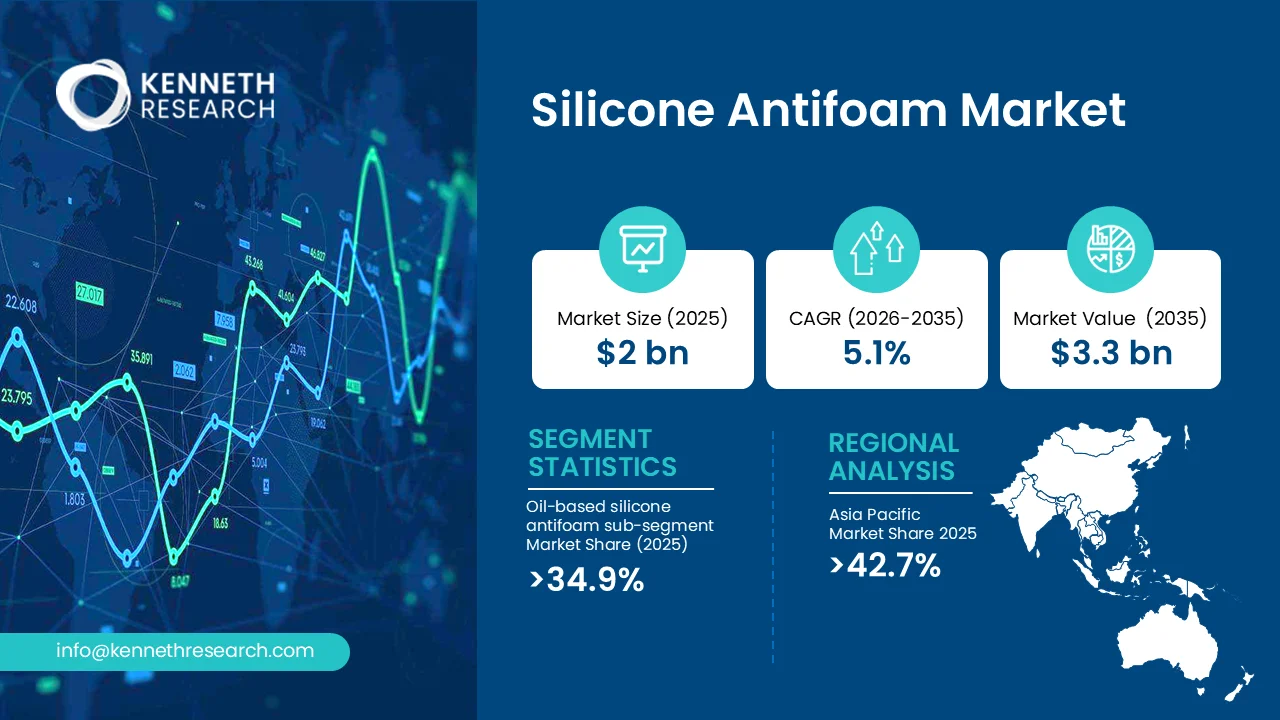
Silicone Antifoam Market size was valued at USD 2 billion in 2025 and is projected to reach USD 3.3 billion by the end of 2035, rising at a CAGR of 5.1% during the forecast period, i.e., 2026-2035. In 2026, the industry size of silicone antifoam is estimated at USD 2.1 billion.
Rising demand for efficient foam control across industrial processes is driving the a, supported by expanding applications in water treatment, chemical processing, food manufacturing, and energy industries where improved process stability, reduced operational disruptions, and enhanced product quality are increasingly prioritized by manufacturers seeking cost-effective and sustainable solutions.
The silicone antifoam market comprises products based on silicone compounds that are formulated to suppress and prevent unwanted foam formation during industrial and commercial processes. These antifoam agents are valued for their high efficiency, low dosage requirements, thermal stability, chemical compatibility, and performance under challenging operating conditions. The market includes different product formulations, including oil-based silicone antifoams and other silicone dispersion types designed for specific application needs.
Silicone antifoams play an important role in industries such as water treatment, manufacturing, chemicals, food processing, and energy by improving process efficiency and maintaining consistent production outcomes. Their industrial relevance is linked to the need for reliable foam management in systems where excessive foam can affect equipment performance, productivity, and operational quality. As industries continue adopting advanced process technologies, silicone antifoam solutions remain essential for optimizing operations, reducing process interruptions, and supporting efficient industrial workflows across diverse end-user sectors while supporting sustainable and resource-efficient manufacturing practices globally.
Key Silicone Antifoam Market Insights Summary:
Key Takeaways: Market Trends & Insights
- Silicone Antifoam Market valued at USD 2 billion in 2025 and projected to reach USD 3.3 billion by 2035 at a CAGR of 5.1% during 2026-2035
- Oil-based silicone antifoam remained the leading product type with a 34.9% market share in 2025 driven by strong adoption across industrial processing applications
- Water Treatment is projected to emerge as the fastest-growing end-user segment supported by increasing investments in wastewater treatment infrastructure and process efficiency
- Asia Pacific accounted for the largest regional share at 42.7% in 2025 led by expanding industrial manufacturing and chemical processing activities in China and India
- Europe continues to represent a strategically important regional market with Germany and France driving demand through advanced manufacturing, chemical production, and sustainable industrial operations
Market Drivers
- Increasing adoption of advanced water and wastewater treatment processes
- Rising demand for process efficiency across industrial manufacturing
- Expansion of chemical and specialty manufacturing activities requiring foam-control solutions
- Growing preference for high-performance additives that improve operational reliability and resource efficiency
Challenges
- Regulatory pressure on chemical composition and environmental compatibility
- High dependence on industrial activity and end-user process demand
Silicone Antifoam Market Overview & Supply Chain
Global adoption of silicone antifoam solutions is increasing as industries focus on improving operational efficiency, controlling process instability, and maintaining consistent product quality across manufacturing environments. Silicone antifoams are gaining relevance in water treatment, chemical processing, food production, energy operations, and industrial manufacturing due to their ability to manage foam-related challenges in complex processing systems. Regulatory emphasis on wastewater management and resource efficiency is further supporting demand, particularly as industries upgrade treatment infrastructure and adopt more controlled production practices. The United Nations system has highlighted the growing importance of wastewater treatment and reuse, with the 2024 UN-Water update reporting that among countries providing relevant data for 2022, wastewater treatment monitoring remains a critical area for achieving sustainable water management goals. This increased focus on efficient water and industrial process management supports the broader relevance of foam-control technologies such as silicone antifoams.
The value chain of the silicone antifoam market begins with the sourcing of essential raw materials, including silicone polymers, siloxane-based compounds, emulsifiers, carriers, and performance-enhancing additives obtained from chemical suppliers. Manufacturers then formulate, blend, and process these inputs into application-specific antifoam products, including oil-based and water-based formulations designed for different industrial requirements. Distribution occurs through direct industrial supply channels, specialty chemical distributors, and regional suppliers that provide technical support and product customization. End users include water treatment operators, chemical manufacturers, food processors, energy companies, and other industrial facilities requiring foam-control solutions. Key stakeholders across the chain include raw material producers, formulation companies, distributors, regulatory bodies, industrial operators, and technology providers involved in process optimization and environmental compliance.
Silicone Antifoam Market: Growth Drivers & Challenges
Growth Drivers:
- Increasing adoption of advanced water and wastewater treatment processes: Growing investment in water management infrastructure is accelerating demand for silicone antifoam solutions because foam formation is a recurring operational challenge in wastewater treatment, chemical treatment, and industrial process systems. Silicone antifoams help improve process reliability by reducing foam-related interruptions, enhancing equipment efficiency, and supporting consistent treatment performance. The United Nations’ 2024 wastewater treatment update reported that, based on 2022 data, only 27% of industrial wastewater was safely treated among reporting countries with available industrial wastewater treatment data, highlighting the continued need for improved treatment practices and technologies. This requirement is expected to encourage greater adoption of process-control additives, including silicone-based foam-control agents. As governments and industries strengthen environmental compliance frameworks and upgrade treatment capabilities, silicone antifoam demand is likely to expand through applications supporting efficient, reliable, and controlled industrial operations.
- Rising demand for process efficiency across industrial manufacturing: Increasing focus on manufacturing productivity and operational optimization is driving the adoption of silicone antifoams across industries such as chemicals, food processing, energy, and specialty manufacturing. Excessive foam can reduce production efficiency, interfere with equipment operation, and affect product consistency, creating a need for effective foam-management solutions. Silicone-based formulations are preferred in many applications due to their high performance at low concentrations, compatibility with diverse process environments, and ability to function under demanding temperature and chemical conditions. Future industrial expansion, automation of production systems, and the growing emphasis on minimizing process losses are expected to support wider deployment of silicone antifoam technologies. Manufacturers are also increasingly seeking customized formulations that address specific operating requirements, encouraging innovation among specialty chemical producers and improving the long-term relevance of silicone antifoam solutions.
Challenges:
- Regulatory pressure on chemical composition and environmental compatibility: Increasing regulatory scrutiny on chemical formulations is creating challenges for silicone antifoam manufacturers, particularly regarding ingredient transparency, environmental persistence, and compliance with evolving industrial standards. The root cause is the growing emphasis from regulatory bodies and industrial buyers on safer chemical usage, sustainable production practices, and reduced environmental impact. These requirements can increase formulation complexity, testing obligations, and compliance costs for producers. Commercially, manufacturers may face longer product development cycles and higher investment needs to redesign formulations while maintaining performance characteristics. In the future, companies with strong research capabilities and sustainable formulation strategies are expected to gain competitive advantages, while suppliers unable to adapt to changing regulatory expectations may experience limitations in market access.
- High dependence on industrial activity and end-user process demand: The silicone antifoam market is closely linked to the operational requirements of industries such as chemicals, manufacturing, water treatment, food processing, and energy, making it vulnerable to fluctuations in industrial investment and production activity. The root cause is that demand for foam-control additives is primarily generated by active processing operations rather than direct consumer consumption. Any slowdown in industrial expansion, production optimization initiatives, or capital expenditure cycles can affect procurement decisions and delay adoption of advanced antifoam solutions. Commercial implications include increased competition among suppliers, pricing pressure, and the need for customized solutions to maintain customer relationships. Going forward, manufacturers that diversify application areas and develop specialized products for resilient industries are likely to reduce exposure to sector-specific demand fluctuations.
Silicone Antifoam Market Size and Forecast:
| Report Attribute | Details |
|---|---|
| Base Year |
2025 |
| Forecast Year |
2026-2035 |
| CAGR |
5.1% |
| Base Year Market Size (2025) |
USD 2 billion |
| Forecast Year Market Size (2035) |
USD 3.3 billion |
| Regional Scope |
|
Silicone Antifoam Market Segmentation Analysis:
Product Type Segment Analysis
In the product type segment, the Oil-based silicone antifoam sub-segment is anticipated to capture the largest market share of 34.9% by the end of 2025.
Oil-based silicone antifoam is the leading product type segment due to its strong performance across demanding industrial applications that require rapid and long-lasting foam suppression. Its dominance is supported by high compatibility with petroleum-based systems, chemical processing operations, coatings, manufacturing processes, and other environments where stable foam control is essential. The segment benefits from widespread industrial adoption because oil-based formulations provide effective dispersion, thermal stability, and reliable performance under challenging process conditions. Demand is further supported by industries seeking cost-efficient additives that improve production continuity and reduce operational disruptions. Government-supported industrial activity data highlights the importance of sectors requiring advanced process solutions; the U.S. Environmental Protection Agency notes that industrial users include major sectors such as chemicals, food and beverage, paper, steel, electronics, and petroleum refining, where industrial water and process management requirements create demand for specialized treatment technologies.
End-User Segment Analysis
The Water Treatment is projected to grow as the second-largest segment in the silicone antifoam market due to four converging demand drivers.
The water treatment segment is projected to experience strong growth as industries and municipalities increasingly prioritize efficient wastewater management, resource conservation, and compliance with environmental standards. Silicone antifoams are gaining adoption in water treatment applications because foam formation can disrupt aeration systems, biological treatment processes, and overall plant efficiency. The rising implementation of advanced wastewater treatment technologies is encouraging operators to adopt specialized process additives that improve reliability and operational control. According to the World Health Organization and United Nations Human Settlements Programme, reporting from countries providing wastewater data for 2022 showed that only 27% of industrial wastewater was safely treated, highlighting the continuing requirement for improved wastewater management infrastructure. Supply-side growth is supported by increasing availability of customized antifoam formulations designed for different treatment conditions and process requirements.
Our in-depth analysis of the global silicone antifoam market includes the following segments:
|
Segment |
Sub-segment |
|
Product Type |
|
|
Application |
|
|
End-User |
|
Silicone Antifoam Market Regional Insights:
Asia Pacific Market Trends & Insights:
Asia Pacific silicone antifoam market is projected to hold the largest revenue share of 42.7% by the end of 2025.
The region’s leadership is supported by its large industrial manufacturing base, expanding chemical processing activities, increasing wastewater treatment requirements, and continued investment in production infrastructure. Strong demand from industries such as chemicals, food processing, energy, and manufacturing has increased the need for efficient foam-control solutions. Government initiatives supporting industrial modernization, environmental management, and manufacturing competitiveness are further strengthening regional adoption. China remains a major contributor due to its extensive chemical and industrial production ecosystem. India is also emerging as an important market through industrial expansion, infrastructure development, and increasing focus on sustainable process management.
China’s silicone antifoam demand is supported by its position as a global manufacturing hub with significant chemical, refining, and processing industries requiring reliable foam-control technologies. The country’s industrial ecosystem provides strong opportunities for domestic production, supply-chain integration, and application development.
India’s market growth is influenced by expanding manufacturing capacity, investments in water infrastructure, and rising adoption of advanced industrial processing technologies. Together, China and India strengthen Asia Pacific’s position through large-scale industrial consumption, improving regulatory focus, and increasing demand for performance-driven specialty chemicals.
Europe Market Trends & Insights:
Europe represents a significant market for silicone antifoam solutions due to strong demand from advanced manufacturing industries, chemical processing, food production, wastewater treatment, and energy-related applications. The region’s industrial landscape emphasizes process efficiency, environmental responsibility, and compliance-driven production practices, increasing the need for reliable foam-control technologies. Government initiatives focused on sustainable industrial operations, circular economy practices, wastewater management, and chemical safety are encouraging industries to adopt improved process technologies. Future opportunities are expected from the modernization of industrial facilities, expansion of sustainable manufacturing systems, and increasing demand for specialty chemical solutions that support efficient resource utilization. Manufacturers that provide application-specific silicone antifoam formulations aligned with environmental requirements and operational performance expectations are positioned to benefit from evolving industrial priorities across Europe.
Germany remains a key contributor to the European silicone antifoam market due to its strong chemical, automotive, machinery, and industrial manufacturing sectors. The country’s focus on advanced production technologies and efficient industrial processes supports demand for specialty additives that enhance operational performance.
France also presents important opportunities through its diversified industrial base, including chemicals, food processing, pharmaceuticals, and water management activities. Increasing emphasis on sustainable industrial practices and modernization of processing infrastructure is expected to support continued adoption of silicone antifoam solutions across both countries.
Leading Companies Operating in the Global Silicone Antifoam Market:
Here is a list of upstream, downstream, and key players operating in the global silicone antifoam market competitive ecosystem:
- Wacker Chemie AG (Germany)
- Company Overview
- Business Strategy
- Key Product Offerings
- Financial Performance
- Key Performance Indicators
- Risk Analysis
- Recent Development
- Regional Presence
- SWOT Analysis
- Momentive Performance Materials Inc. (United States)
- BRB International B.V. (Netherlands)
- CHT Group (Germany)
- Bluestar Silicones (France)
- BYK-Chemie GmbH (Germany)
Recent Developments
- In June 2025, Evonik Coating Additives launched TEGO® Foamex 8051, a new highly efficient siloxane defoamer specifically designed for waterborne decorative coatings . The additive is a 100% active defoamer concentrate based on polyethersiloxane technology with nearly zero VOC (0.08%) and SVOC (0.19%) levels, complying with Ecolabel 2014/312/EU standards . The product holds broad global registrations in the US, EU, China, and Japan, and maintains strong defoaming persistence under high shear conditions and after storage.
- In June 2026, EU Regulation 2024/1328 severely restricts the use of D4, D5, and D6 cyclosiloxanes in products containing 0.1% or more of these substances, with the requirement taking full effect by June 6, 2026 . These cyclosiloxanes, commonly found as impurities in polydimethylsiloxane-based additives, have been identified as very persistent and very bioaccumulative by ECHA . Borchers (a Milliken brand) introduced low-cyclosiloxane (<0.1%) defoaming additives, including Borchers® AF 1171 and Borchi® Gol series, to help formulators comply with the new regulations.
Frequently Asked Question
In 2025, the silicone antifoam market exceeded USD 2 billion.
The silicone antifoam market is projected to reach USD 3.3 billion by the end of 2035, expanding at a CAGR of 5.1% over the forecast period (2026-2035).
The major players in the market are Wacker Chemie AG (Germany), Momentive Performance Materials Inc. (United States), BRB International B.V. (Netherlands), CHT Group (Germany), Bluestar Silicones (France), BYK-Chemie GmbH (Germany), and others.
In the product type segment, the oil-based silicone antifoam sub-segment is anticipated to capture the largest market share of 34.9% in the future and exhibit lucrative growth opportunities during 2026-2035. This growth trajectory is largely attributed to increasing demand for efficient foam control across industrial manufacturing and water treatment operations.
Asia Pacific is projected to hold the largest market share of 42.7% by the end of 2025 and provide more business opportunities in the future. Continuous industrial expansion, manufacturing investments, and growing chemical processing activities in China and India are fostering the region's dominance.
Why Choose Kenneth Research ?
-
Insight with Impact : We don’t just gather data — we uncover stories, trends, and opportunities that fuel business growth.
-
Experts Who Get It : Our team speaks your industry’s language and knows what really matters to your customers and market.
-
Custom-Built for You : Forget one-size-fits-all. We craft research and consulting solutions as unique as your business vision.
-
Partners, Not Just Providers : We work with you, not for you — collaborating closely to turn insights into smart, strategic moves.
-
Results That Speak : Our work powers brands, startups, and industry leaders alike — with a track record of ideas that work in the real world.
Report ID: 1156 |
Published Date: 24 Aug 2026 |
Report Format: |
Delivery Timeline: 48-72 Business Hours

Copyright © 2025 Kenneth Research. All rights reserved. Terms of Use | Privacy Policy
