Report ID: 1155 |
Published Date: 24 Aug 2026 |
Report Format: |
Delivery Timeline: 48-72 Business Hours
Silicone Adhesive Market Outlook:
Silicone Adhesive Market size was valued at USD 9.1 billion in 2025 and is projected to reach USD 19.4 billion by the end of 2035, rising at a CAGR of 7.9% during the forecast period, i.e., 2026-2035. In 2026, the industry size of the silicone adhesive is estimated at USD 9.8 billion.
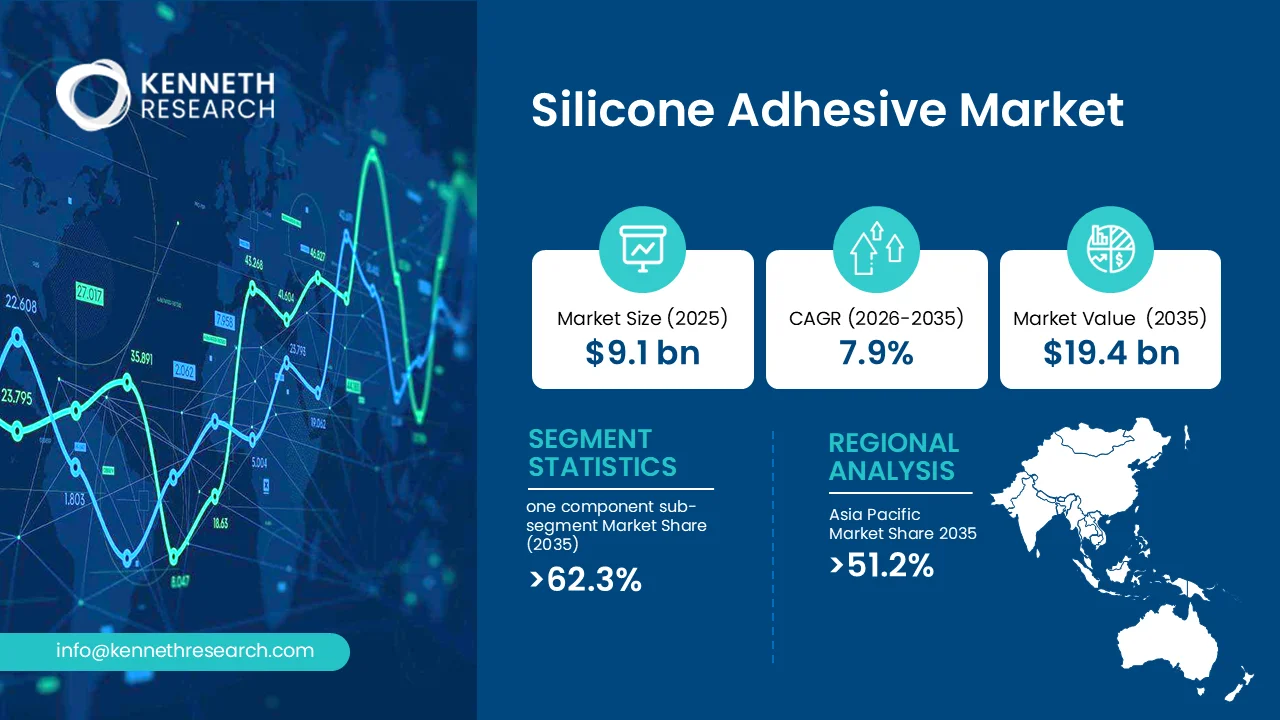
The primary growth driver of the silicone adhesive market is the expanding demand for durable, high-performance bonding materials across electronics, automotive, construction, healthcare, and renewable energy industries. Silicone adhesives provide exceptional thermal stability, weather resistance, flexibility, and long-term durability, enabling reliable bonding and sealing under demanding operating and environmental conditions.
The silicone adhesive market comprises the global production, commercialization, and application of silicone-based adhesive materials formulated to create durable bonds and effective seals across a wide range of substrates. These adhesives are manufactured using silicone polymers that retain elasticity while offering outstanding resistance to temperature extremes, ultraviolet radiation, moisture, chemicals, and environmental aging. Available in one-component and multi-component formulations, silicone adhesives are designed to meet diverse industrial processing requirements, including room-temperature curing, heat curing, and specialized manufacturing applications.
Silicone adhesives play a critical role in industries requiring long-term reliability and performance, including electronics, automotive manufacturing, construction, aerospace, healthcare, renewable energy, and industrial equipment production. They are widely used for component assembly, structural bonding, sealing, encapsulation, insulation, and vibration damping where conventional adhesives may fail under harsh operating conditions. Their compatibility with metals, glass, ceramics, plastics, and composite materials makes them indispensable in modern manufacturing. As industries increasingly prioritize product durability, lightweight designs, energy efficiency, and high-performance materials, silicone adhesives continue to gain strategic importance within advanced manufacturing and infrastructure development.
Key Silicone Adhesive Market Insights Summary:
Key Takeaways: Market Trends & Insights
- Silicone Adhesive Market projected to grow from USD 9.1 billion in 2025 to USD 19.4 billion by 2035 at a 7.9% CAGR.
- Asia Pacific is projected to hold the largest regional share of 51.2% by 2035, supported by its strong electronics, automotive, construction, and renewable energy manufacturing base across China and Japan.
- One Component is anticipated to remain the leading Type segment with a 62.3% market share, driven by its ease of application, ready-to-use formulation, and increasing adoption in automated manufacturing processes.
- Non-Pressure Sensitive Adhesives are expected to witness strong growth owing to rising demand for permanent, high-strength bonding solutions across automotive, electronics, industrial equipment, and infrastructure applications.
- The market is benefiting from expanding adoption of electric vehicles, advanced electronics, renewable energy systems, and sustainable construction, alongside continuous innovation in high-performance, low-emission silicone adhesive technologies.
Market Drivers
- Growing deployment of solar photovoltaic modules and renewable energy infrastructure requiring durable encapsulation and sealing materials.
- Increasing use of silicone adhesives in medical devices, wearable healthcare technologies, and diagnostic equipment owing to their biocompatibility and long-term performance.
- Rising demand for lightweight bonding solutions in aerospace and industrial manufacturing applications.
- Continuous advancements in low-VOC, high-performance silicone adhesive formulations supporting sustainability and regulatory compliance.
Challenges
- Volatility in silicone raw material supply and pricing
- Complex qualification requirements across high-performance applications
Silicone Adhesive Market Overview & Supply Chain
The adoption of silicone adhesives is accelerating globally as manufacturers seek bonding materials capable of withstanding harsh operating environments while supporting lightweight product designs, miniaturized electronics, energy-efficient buildings, and renewable energy systems. Their excellent resistance to temperature fluctuations, moisture, ultraviolet radiation, and chemicals makes them indispensable in applications where long-term reliability is essential. Growing investments in clean energy manufacturing, advanced electronics, electric vehicles, and infrastructure modernization are further strengthening demand for high-performance silicone adhesive solutions. The strategic importance of these applications is reflected in government-backed energy transition initiatives. According to the International Energy Agency (IEA), China's share in all manufacturing stages of solar panels exceeds 80%, underscoring the expanding industrial ecosystem where silicone adhesives are extensively used for module assembly, sealing, and environmental protection. This continued expansion of advanced manufacturing reinforces the long-term industrial relevance of silicone adhesive technologies.
The silicone adhesive value chain begins with the procurement of silicone polymers, siloxane intermediates, fillers, curing agents, pigments, catalysts, and performance-enhancing additives sourced from global chemical and specialty materials suppliers. Raw materials undergo formulation, compounding, mixing, and quality validation before being processed into one-component or multi-component adhesive systems tailored for specific industrial applications. Manufacturers then package products in cartridges, tubes, drums, or bulk containers for distribution through direct industrial sales channels, authorized distributors, specialty chemical suppliers, and regional logistics networks. End users include automotive manufacturers, electronics producers, construction companies, aerospace firms, medical device manufacturers, renewable energy equipment suppliers, and industrial assembly operations. Major stakeholders across the ecosystem include raw material producers, adhesive formulators, contract manufacturers, testing and certification organizations, equipment suppliers, logistics providers, distributors, original equipment manufacturers (OEMs), engineering contractors, and regulatory compliance agencies that collectively ensure product quality, performance, and supply continuity.
Silicone Adhesive Market: Growth Drivers & Challenges
Growth Drivers:
- Expanding electric vehicle and advanced electronics manufacturing: The rapid expansion of electric vehicle production and advanced electronics manufacturing is significantly increasing the demand for silicone adhesives. These materials provide reliable bonding, thermal management, electrical insulation, and vibration resistance for battery systems, sensors, power electronics, displays, and electronic control units. Their ability to maintain performance under high temperatures, humidity, and mechanical stress makes them well suited for next-generation mobility and electronic devices. As manufacturers continue to integrate lightweight materials and compact electronic assemblies, silicone adhesives are becoming increasingly important for improving product durability and operational reliability. According to the International Energy Agency (IEA), global electric car sales exceeded 17 million in 2024, demonstrating the continued expansion of industries that extensively utilize silicone adhesive technologies for battery pack assembly and electronic component protection. Sustained investments in electrification and digitalization are expected to reinforce long-term demand for high-performance adhesive solution
- Rising adoption of high-performance materials in sustainable construction: The increasing emphasis on energy-efficient buildings and resilient infrastructure is driving the adoption of silicone adhesives across the construction sector. Modern commercial and residential projects require materials capable of delivering durable sealing, weather resistance, structural flexibility, and long service life under varying climatic conditions. Silicone adhesives support curtain wall glazing, façade systems, insulated glass units, roofing assemblies, and expansion joints while reducing maintenance requirements and improving building performance. Their compatibility with diverse construction materials enables architects and engineers to implement innovative building designs without compromising structural integrity. Growing investments in green buildings, smart infrastructure, and sustainable urban development are expected to accelerate the use of silicone-based bonding technologies. As environmental performance standards become more stringent, manufacturers are also developing lower-emission and application-specific silicone adhesive formulations, further strengthening their role in future construction and infrastructure projects.
Challenges:
- Volatility in silicone raw material supply and pricing : The silicone adhesive industry remains vulnerable to fluctuations in the availability and pricing of key raw materials such as siloxane intermediates, specialty fillers, catalysts, and curing agents. Supply disruptions can arise from capacity constraints at upstream chemical manufacturing facilities, environmental compliance requirements, transportation bottlenecks, or geopolitical developments affecting global trade. Since silicone adhesive formulations rely on consistent raw material quality, unexpected supply interruptions can delay production schedules and increase manufacturing costs. Commercially, producers may face shrinking profit margins when higher input costs cannot be fully transferred to customers under long-term supply agreements. End users may also postpone procurement or seek alternative bonding technologies where performance requirements permit. Looking ahead, manufacturers are expected to strengthen supply chain resilience through supplier diversification, regional sourcing strategies, long-term procurement contracts, and greater investment in process optimization to reduce dependence on volatile input markets.
- Complex qualification requirements across high-performance applications: Silicone adhesives intended for aerospace, medical devices, automotive electronics, renewable energy equipment, and other critical applications must undergo extensive validation before commercial adoption. Each industry often requires compliance with unique performance specifications, environmental testing protocols, safety standards, and customer-specific qualification procedures. These lengthy approval cycles increase product development costs and delay commercialization of new adhesive formulations. Manufacturers must also invest significantly in laboratory testing, regulatory documentation, application engineering, and technical support to satisfy customer requirements. For smaller suppliers, these barriers can restrict market entry and limit participation in high-value application segments. From a commercial perspective, prolonged qualification timelines may slow revenue generation and reduce flexibility in responding to evolving customer demands. Over the long term, continued collaboration between adhesive manufacturers, original equipment manufacturers, certification bodies, and research organizations will be essential to streamline product validation while maintaining stringent quality and reliability standards.
Silicone Adhesive Market Size and Forecast:
| Report Attribute | Details |
|---|---|
| Base Year |
2025 |
| Forecast Year |
2026-2035 |
| CAGR |
7.9% |
| Base Year Market Size (2025) |
USD 9.1 billion |
| Forecast Year Market Size (2035) |
USD 19.4 billion |
| Regional Scope |
|
Silicone Adhesive Market Segmentation Analysis:
Type Segment Analysis
In the type segment, the one component sub-segment is anticipated to capture the largest market share of 62.3% by the end of 2035.
The one component sub-segment dominates the silicone adhesive market due to its ease of application, reduced processing time, and compatibility with automated manufacturing environments. These adhesives are supplied in ready-to-use formulations, eliminating the need for on-site mixing while minimizing material waste and application errors. Their consistent curing performance and strong adhesion across metals, glass, ceramics, plastics, and composite materials have made them the preferred choice in electronics, automotive, construction, and industrial assembly. Manufacturers increasingly favor one-component silicone adhesives because they improve production efficiency, reduce labor requirements, and simplify quality control in high-volume manufacturing operations. On the supply side, continuous investments in formulation technologies have enhanced shelf life, curing characteristics, and environmental resistance, allowing producers to address increasingly demanding industrial applications. Supporting this trend, the Japan Electronics and Information Technology Industries Association (JEITA), based on Japan's Ministry of Economy, Trade and Industry (METI) statistics, reported that Japan's industrial electronic equipment production reached 3,376,387 million yen in 2024, highlighting sustained manufacturing activity that drives demand for reliable one-component silicone adhesive solutions in electronic equipment assembly and component protection. Looking ahead, the continued expansion of advanced manufacturing, automation, and high-reliability electronic systems is expected to further strengthen the leadership of this segment.
Technology Segment Analysis
The non-pressure sensitive adhesives sub-segment is projected to experience robust growth as industries increasingly require permanent, high-strength bonding solutions capable of performing under demanding mechanical and environmental conditions. Unlike pressure-sensitive technologies, these adhesives develop durable structural bonds through curing mechanisms, making them well suited for automotive assemblies, electronics, construction components, industrial machinery, and renewable energy equipment. Their growing adoption is supported by the shift toward lightweight materials, automated manufacturing processes, and products requiring extended service life with minimal maintenance. On the supply side, manufacturers are investing in advanced formulations with improved curing efficiency, enhanced thermal stability, lower volatile emissions, and compatibility with automated dispensing systems, enabling broader use across precision manufacturing environments. Demand is also reinforced by sustained infrastructure development. According to the U.S. Census Bureau, construction spending during December 2024 was estimated at a seasonally adjusted annual rate of USD 2,192.2 billion, reflecting continued activity in sectors where durable non-pressure sensitive silicone adhesives are widely used for structural bonding and sealing applications. Looking ahead, expanding industrial automation, infrastructure modernization, and high-performance manufacturing are expected to accelerate the adoption of this technology segment.
Our in-depth analysis of the global silicone adhesive market includes the following segments:
|
Segment |
Sub-segment |
|
Type |
|
|
Technology |
|
|
Curing Mechanism |
|
|
Application |
|
|
End User |
|
Silicone Adhesive Market Regional Insights:
Asia Pacific Market Trends & Insights:
Asia Pacific is projected to account for 51.2% of the silicone adhesive market by 2035, maintaining its position as the dominant regional market.
The region's leadership is supported by its extensive manufacturing ecosystem spanning electronics, automotive, construction materials, industrial machinery, and renewable energy equipment. A well-established chemical production base, integrated supply chains, competitive manufacturing costs, and sustained industrial investments enable large-scale production and consumption of silicone adhesive products. Regional governments continue to promote advanced manufacturing, energy transition initiatives, infrastructure modernization, and high-value industrial production, creating favorable conditions for adhesive manufacturers. In addition, the presence of major original equipment manufacturers (OEMs), contract manufacturers, and specialty chemical producers strengthens innovation, product commercialization, and supply reliability. These factors collectively reinforce Asia Pacific's strategic role in the global silicone adhesive value chain.
Among the leading countries, Japan remains a major contributor through its advanced electronics, automotive, and precision manufacturing industries, where high-performance silicone adhesives are widely used for bonding, sealing, and insulation applications.
China continues to lead regional demand owing to its large-scale industrial production, expanding electric vehicle manufacturing, renewable energy deployment, and construction activities. Supporting the region's industrial leadership, China's National Bureau of Statistics reported that the country's value added of industrial enterprises above the designated size increased by 5.8% year-on-year in 2024, reflecting continued growth in manufacturing sectors that are significant consumers of silicone adhesive technologies. The combination of technological capability, industrial expansion, and strong domestic demand positions both countries as key growth engines for the regional market.
North America Market Trends & Insights:
North America represents a strategically important market for silicone adhesives, supported by strong demand from automotive, aerospace, electronics, medical technology, construction, and renewable energy industries. The region continues to emphasize advanced manufacturing, product innovation, and high-performance materials that enhance durability, operational efficiency, and regulatory compliance. Manufacturers increasingly adopt silicone adhesives for applications requiring thermal stability, weather resistance, electrical insulation, and long-term bonding performance in demanding operating environments. Government initiatives promoting domestic manufacturing, clean energy deployment, infrastructure modernization, and resilient supply chains are creating favorable conditions for the broader specialty materials industry. In parallel, investments in automation, semiconductor manufacturing, electric mobility, and next-generation healthcare technologies are expanding opportunities for specialized silicone adhesive formulations. As sustainability objectives and product performance requirements continue to evolve, the region is expected to witness greater adoption of low-emission, application-specific adhesive technologies across multiple industrial sectors.
The United States remains the principal contributor to regional demand owing to its diversified industrial base, leadership in aerospace and defense manufacturing, advanced electronics production, medical device development, and large-scale infrastructure projects. Continuous innovation, strong research capabilities, and close collaboration between manufacturers and original equipment manufacturers (OEMs) support the commercialization of high-value silicone adhesive solutions.
Canada complements regional growth through expanding investments in advanced manufacturing, clean energy technologies, transportation equipment, and commercial construction. The country's focus on sustainable industrial development, modern infrastructure, and innovation-driven manufacturing is encouraging broader use of high-performance bonding and sealing materials. Together, the United States and Canada provide a resilient industrial ecosystem that supports continued innovation, application development, and long-term demand for silicone adhesives across diverse end-use industries.
Leading Companies Operating in the Global Silicone Adhesive Market:
Here is a list of upstream, downstream, and key players operating in the global silicone adhesive market competitive ecosystem:
- Dow(United States)
- Company Overview
- Business Strategy
- Key Product Offerings
- Financial Performance
- Key Performance Indicators
- Risk Analysis
- Recent Development
- Regional Presence
- SWOT Analysis
- Shin-Etsu Chemical Co., Ltd(Japan)
- Momentive Performance Materials(United States)
- Wacker Chemie AG(Germany)
- Sika AG(Switzerland)
Recent Developments
- February 2025: Momentive and Jiangxi Hungpai New Material Co., Ltd. signed a definitive agreement to establish a joint venture for the manufacturing, promotion, and sale of silanes in Asia Pacific.
- January 2025: WACKER started operations at two new specialty silicone production facilities in Tsukuba (Japan) and Jincheon (South Korea) to serve growing regional demand.
- June 2024: WACKER expanded its ELASTOSIL® eco portfolio with new biomethanol-based liquid silicone rubber grades developed for sustainable, high-performance applications.
Frequently Asked Question
In 2025, the silicone adhesive market exceeded USD 9.1 billion.
The silicone adhesive market is projected to reach USD 19.4 billion by the end of 2035, expanding at a CAGR of 7.9% over the forecast period (2026-2035).
The major players in the market are Dow, Shin-Etsu Chemical Co., Ltd., Momentive Performance Materials, Wacker Chemie AG, Elkem Silicones, Sika AG, HB Fuller, ACC Silicones Ltd., and others.
In the type segment, the one component sub-segment is anticipated to capture the largest market share of 62.3% in the future and exhibit lucrative growth opportunities during 2026-2035. This growth trajectory is largely attributed to its ready-to-use formulation, ease of application, and increasing adoption in automated manufacturing across electronics, automotive, and construction industries.
Asia Pacific is projected to hold the largest market share of 51.2% by the end of 2035 and provide more business opportunities in the future. Continuous investments in advanced manufacturing, electronics, electric vehicles, and renewable energy across Japan and China are fostering the region's dominance.
Why Choose Kenneth Research ?
-
Insight with Impact : We don’t just gather data — we uncover stories, trends, and opportunities that fuel business growth.
-
Experts Who Get It : Our team speaks your industry’s language and knows what really matters to your customers and market.
-
Custom-Built for You : Forget one-size-fits-all. We craft research and consulting solutions as unique as your business vision.
-
Partners, Not Just Providers : We work with you, not for you — collaborating closely to turn insights into smart, strategic moves.
-
Results That Speak : Our work powers brands, startups, and industry leaders alike — with a track record of ideas that work in the real world.
Report ID: 1155 |
Published Date: 24 Aug 2026 |
Report Format: |
Delivery Timeline: 48-72 Business Hours

Copyright © 2025 Kenneth Research. All rights reserved. Terms of Use | Privacy Policy
